What Is DeepSeek V4-Pro-0813? API Pricing, Setup, and DeepSeek Harness Guide
DeepSeek V4-Pro-0813 explained: API pricing, 1M context, 384K output, concurrency, OpenAI/Anthropic setup, and DeepSeek Harness installation.
Evidence 8 cited sources
On this page
What Is DeepSeek V4-Pro-0813? API Pricing, Setup, and DeepSeek Harness Guide
DeepSeek V4-Pro-0813 is the current official backend version mapped to deepseek-v4-pro, and the API model identifier remains deepseek-v4-pro. DeepSeek’s documentation lists a 1M context window, up to 384K output, Tool Calls, the Responses API, OpenAI/Anthropic-compatible endpoints, and account-level concurrency limits. DeepSeek Harness (dsh) is also now an official open-source agent harness in developer preview and can be started with npx @deepseek-ai/dsh web.
If you are searching for what DeepSeek V4-Pro-0813 is, how to call the API, current pricing, what DeepSeek Harness is, or how to install it, this guide answers those questions in one developer workflow: verify the official model limits, pricing, and API setup first, then evaluate the harness capabilities, preview maturity, production tradeoffs, and why the harness layer may matter more than another standalone benchmark score.
Start with the boundary: V4-Pro-0813 is current, but Harness is still developer preview
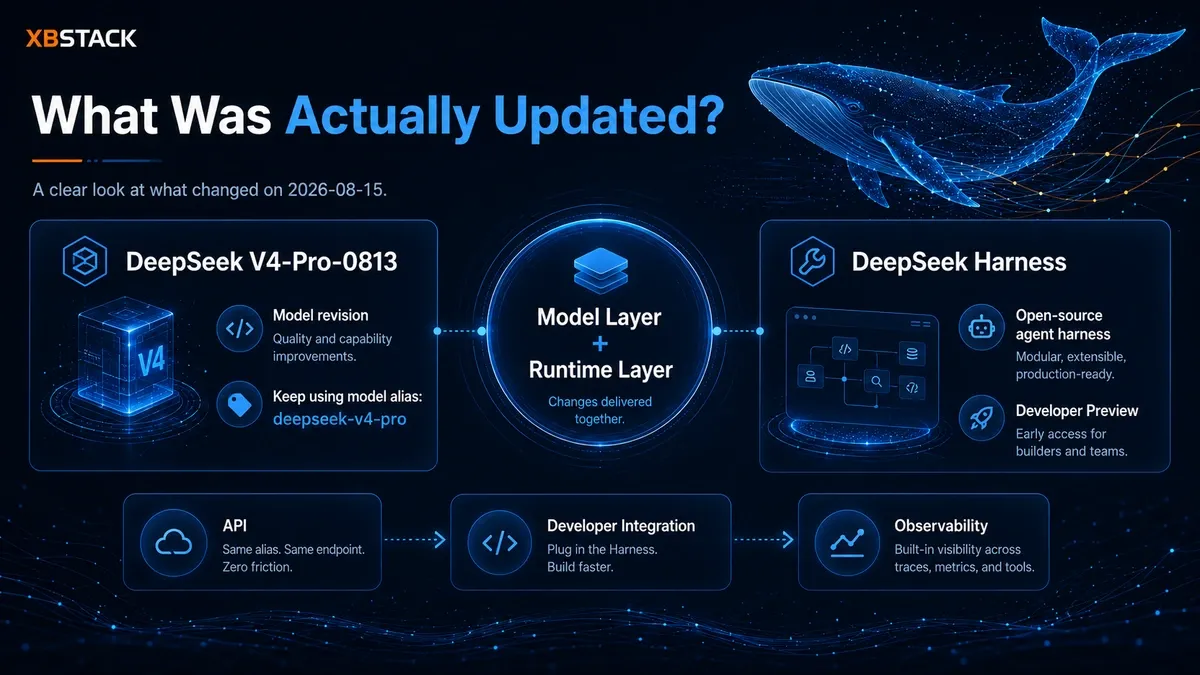
DeepSeek’s official API homepage states that deepseek-v4-flash currently maps to DeepSeek-V4-Flash-0731 and deepseek-v4-pro maps to DeepSeek-V4-Pro-0813. The API call does not change. You still pass deepseek-v4-pro as the model identifier, and the backend points to the current revision.
Harness has a different maturity status. The official deepseek-ai/deepseek-harness README says that DeepSeek Harness (dsh) is an open-source agent harness developed by DeepSeek AI. The same README labels it developer preview and explicitly warns that there will be compatibility-breaking changes.
That distinction matters. A model alias update can be introduced behind an API compatibility layer and evaluated through controlled regression. A harness is closer to an evolving agent runtime: it touches plugins, workspace boundaries, file access, command execution, permissions, approvals, and upgrade behavior. Writing “DeepSeek launched V4 Pro and Harness as finished products” would blur two very different maturity levels and mislead developers looking for production guidance.
What V4-Pro-0813 actually exposes: 1M context, 384K output, and an agent-ready API surface
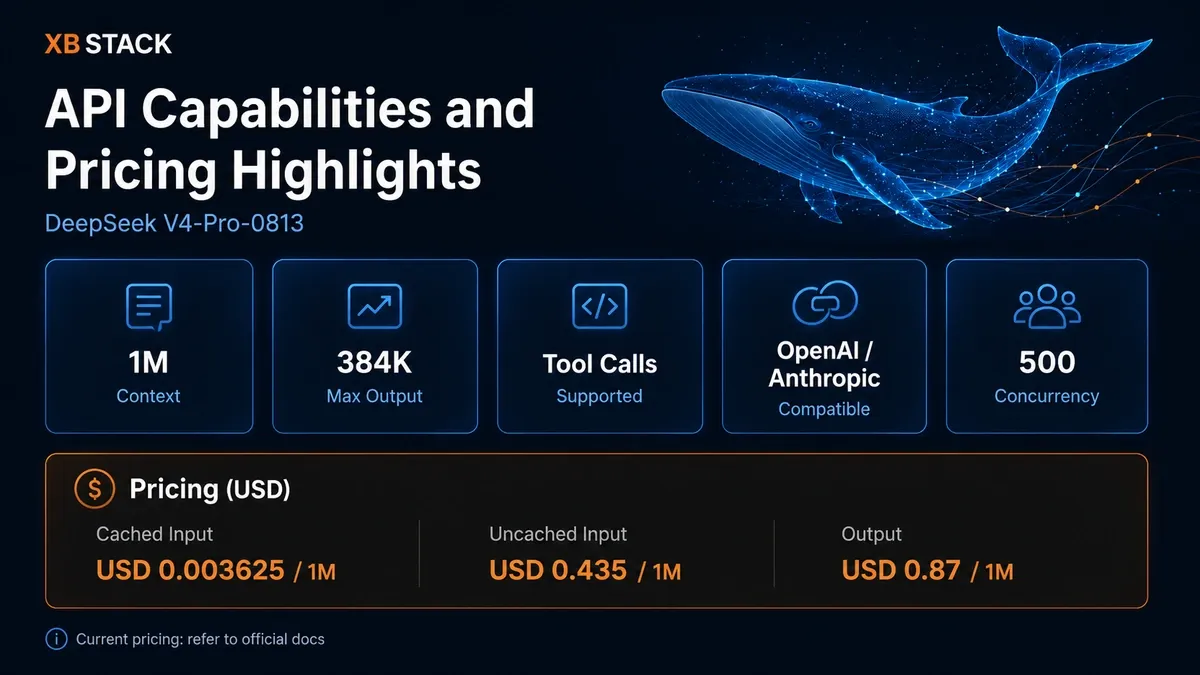
DeepSeek’s official Models & Pricing page gives a clear capability profile. Both V4-Pro and V4-Flash have a 1M context length and a maximum output of 384K. V4-Pro supports non-thinking and thinking modes, JSON Output, Tool Calls, the Responses API, the Anthropic API, Chat Prefix Completion, and FIM Completion in non-thinking mode.
For chat, those limits can look like marketing numbers. In an agent system, they have more concrete implications. A coding agent does not operate on a single prompt. It may need repository structure, dependency files, relevant source files, terminal output, failing tests, Git diffs, policy documents, tool results, and previous reasoning state. A larger context window gives the runtime more room to carry engineering state—but only if the harness can assemble, trim, summarize, cache, and prioritize that state well.
The same applies to the 384K output ceiling. It does not mean a production agent should routinely emit hundreds of thousands of tokens in a single response. Long outputs increase cost, parsing pressure, timeout risk, and verification load. The value is headroom for unusually large migrations, structured generation, code transformation, or long tool-driven sessions. A model limit is a capacity ceiling, not an operating recommendation.
Protocol compatibility is just as important as raw limits. DeepSeek lists https://api.deepseek.com for the OpenAI-compatible format and https://api.deepseek.com/anthropic for the Anthropic format. That means V4 can enter existing SDKs, gateways, coding tools, and agent frameworks without forcing every team to build around a proprietary transport.
A minimal OpenAI SDK call remains straightforward:
from openai import OpenAI
import os

client = OpenAI(
    api_key=os.environ["DEEPSEEK_API_KEY"],
    base_url="https://api.deepseek.com",
)

response = client.chat.completions.create(
    model="deepseek-v4-pro",
    messages=[
        {"role": "system", "content": "You are a senior software engineer."},
        {"role": "user", "content": "Review this change and identify production risks."},
    ],
    reasoning_effort="high",
    extra_body={"thinking": {"type": "enabled"}},
)
The production detail is not that this snippet works. It is that your long-running evaluation system should record both the public model identifier and the concrete revision in effect at test time. If deepseek-v4-pro points to a later backend next month, a regression dataset that stores only the alias may not explain why results drifted.
Pricing: a single static token price is no longer enough
As of August 15, 2026, DeepSeek’s official pricing page lists V4-Pro at USD 0.003625 per 1M cache-hit input tokens, USD 0.435 per 1M cache-miss input tokens, and USD 0.87 per 1M output tokens. V4-Flash is currently listed at USD 0.0028, USD 0.14, and USD 0.28 respectively.
But copying those three numbers is no longer sufficient. The same official page announces that, starting August 16, 2026 at 16:00 UTC, DeepSeek will move to peak / off-peak pricing. For V4-Pro, the announced off-peak rates are USD 0.022 cached input, USD 0.66 cache-miss input, and USD 1.98 output per million tokens. Peak rates are USD 0.044, USD 1.32, and USD 3.96.
That change moves time-of-day into model economics. Offline repository indexing, batch code review, documentation regeneration, and test-generation jobs can potentially be scheduled into cheaper windows. Interactive coding agents cannot simply wait for off-peak hours, so they need to balance latency, quality, and price. Once pricing depends on cache behavior and time window, “cost per million tokens” becomes only one part of the system design.
Concurrency belongs in the same calculation. DeepSeek’s official Rate Limit & Isolation page lists an account-level concurrency limit of 500 for V4-Pro and 2500 for V4-Flash. That may not matter for a single developer, but it matters immediately for multi-tenant SaaS, batch review queues, parallel agent workers, and systems that retry aggressively after failures.
A more realistic model-routing policy therefore looks like this:
- use Pro for high-value reasoning, architecture decisions, difficult debugging, and final review;
- use Flash for high-throughput classification, extraction, preprocessing, or lower-risk steps;
- design prompts and context assembly for cache stability;
- schedule deferrable jobs around pricing windows where possible;
- make 429 handling, timeouts, model fallback, and retry budgets runtime features rather than manual operations.
Notice what happened: as soon as pricing, routing, retries, and task types enter the discussion, we are no longer talking about the model alone. We are talking about the harness.
What DeepSeek Harness is: an agent runtime layer, not a chat wrapper
The official README’s definition is short and consequential: an open-source agent harness developed by DeepSeek AI. The repository can currently be started with:
npx @deepseek-ai/dsh web
which serves the Web UI at http://127.0.0.1:3080 by default. The official Web UI guide explains the workflow: configure a model, select a workspace, then run a session. The agent can read and edit workspace files, run commands, delegate work, maintain a plan, and request approval for operations that require it under the active permission policy.
That is enough to place Harness conceptually. It is not the model, and it is not merely a chat box around the API. It is the control layer that translates model reasoning into engineering actions:
- Context management — decide which files, history, tool results, and task state belong in the next model turn.
- Planning — decompose an objective into executable steps and update the plan as evidence changes.
- Tool execution — read files, edit code, run commands, call search or plugin tools.
- Workspace boundaries — define what the agent can see and modify.
- Approval and permissions — hold high-risk operations behind human or policy gates.
- Delegation — split work across subagents or specialized capabilities.
- Observability — preserve task state, failures, and execution traces for debugging and audit.
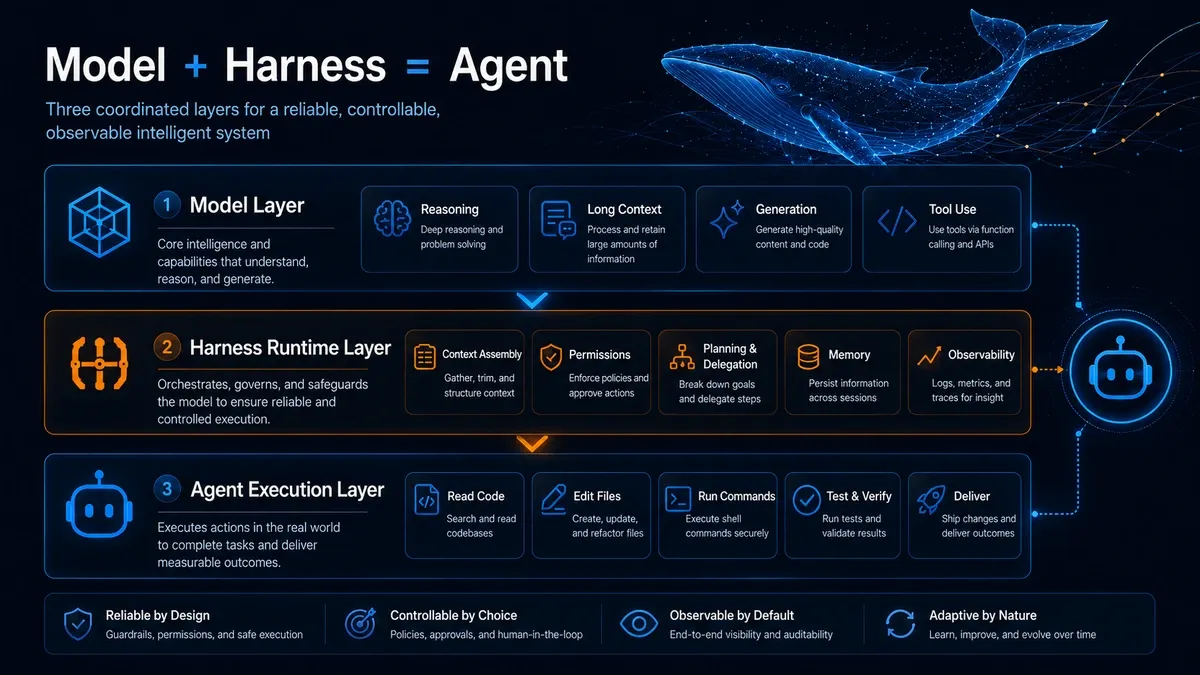
Anyone who has built a production agent knows that many failures are not “the model forgot how to code.” They are bad context assembly, malformed tool arguments, edits that were never tested, unsafe command permissions, duplicate side effects after retries, or long-running state that was not persisted correctly. These problems barely appear on model leaderboards, but they determine whether a coding agent is trustworthy.
“Model + Harness = Agent” is therefore more than a slogan. It separates two engineering responsibility domains: the model determines the reasoning ceiling; the harness determines whether that capability can be exercised in a controlled, verifiable, recoverable system.
Why DeepSeek needs a harness now
DeepSeek was already present inside agent ecosystems before publishing its own harness. Its official documentation includes integration paths for Claude Code, GitHub Copilot, OpenCode, Deep Code, Reasonix, and other tools. The official OpenCode guide tells users to connect the DeepSeek provider and select V4-Pro. The Deep Code guide uses MODEL: deepseek-v4-pro in its configuration. The Reasonix documentation describes a workflow where Flash handles cost-sensitive defaults and Pro can be armed for higher-end reasoning.
That creates both an opportunity and a strategic gap. If DeepSeek remains only the model behind someone else’s harness, it participates in inference but does not necessarily own the full developer workflow. How context is assembled, which tool calls fail most often, why users reject edits, where tokens are spent in a coding task, and when developers need manual approval—all of that high-value operational feedback lives at the harness layer.
Claude Code is strategically useful to Anthropic for more than API consumption. Codex is useful to OpenAI for more than giving developers another CLI. These products create a high-frequency feedback loop between model capability and real engineering work. DeepSeek building its own harness is a logical way to participate in that loop directly.
To be precise, that is XBSTACK’s interpretation of the product move, not a commercial strategy statement published by DeepSeek. But the inference is supported by observable facts: DeepSeek maintains the model API, publishes multiple agent integrations, and now operates an official agent harness repository. The competitive surface is expanding beyond a model endpoint.
What this changes for AI coding: system conversion rate matters more than raw benchmark advantage
For a long time, developer model selection could be summarized by leaderboards: a better SWE-bench score, stronger code generation, or better reasoning was taken as evidence that a model should be better for coding. In agentic coding, that is increasingly incomplete.
A real coding task looks more like this:
User objective → repository scan → context assembly → plan → tool calls → code edits → tests/build → failure recovery → approval → delivery.
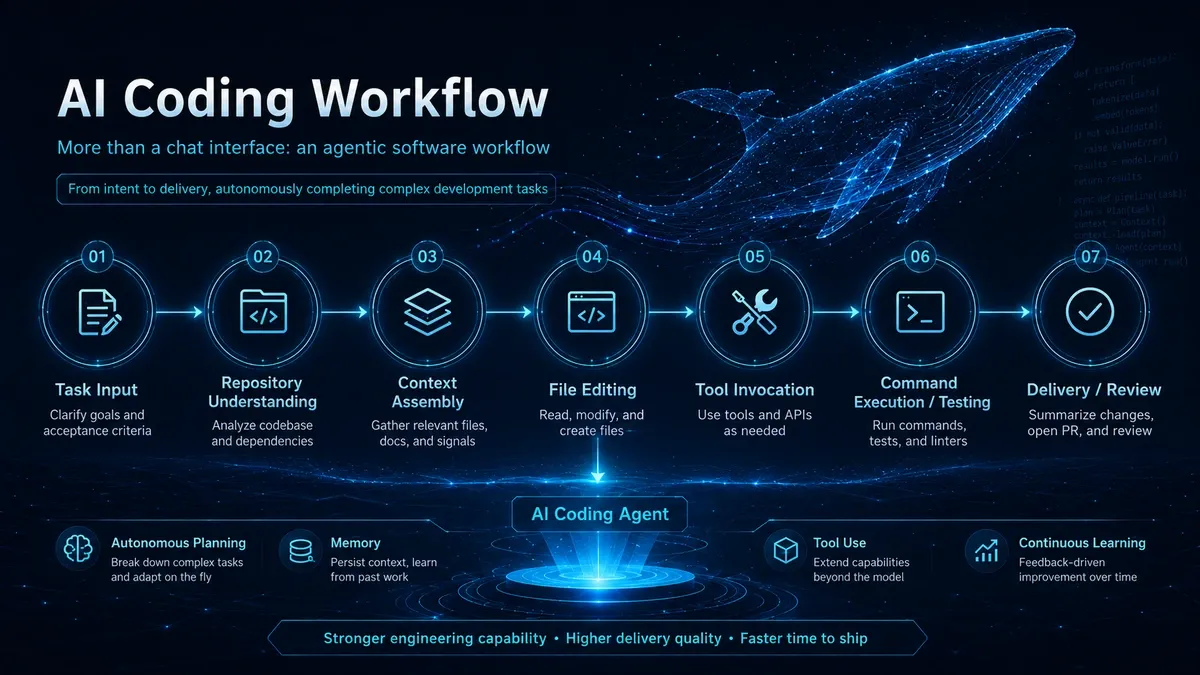
Model quality influences every step, but harness quality determines whether those steps are connected correctly. A model can be stronger on isolated tasks and still deliver a lower real-project completion rate if the harness selects poor context, fails to run tests after edits, cannot recover from tool errors, or hides the execution trail developers need to inspect.
That is why I would track four operational metrics before making a serious coding-agent decision:
- Task completion rate — how often does the system actually finish the full engineering task?
- Verification rate — how often are edits followed by tests, linting, type checking, or a build?
- Recovery quality — can the runtime diagnose failure, retry safely, roll back, or resume from a known-good state?
- Human intervention cost — how often must a developer supply missing context, repair commands, reject edits, or take over the workflow?
If DeepSeek Harness eventually becomes strong on those dimensions, its competitive set will no longer be “other model APIs.” It will be compared directly with Claude Code, Codex, OpenCode, and custom in-house agent runtimes.
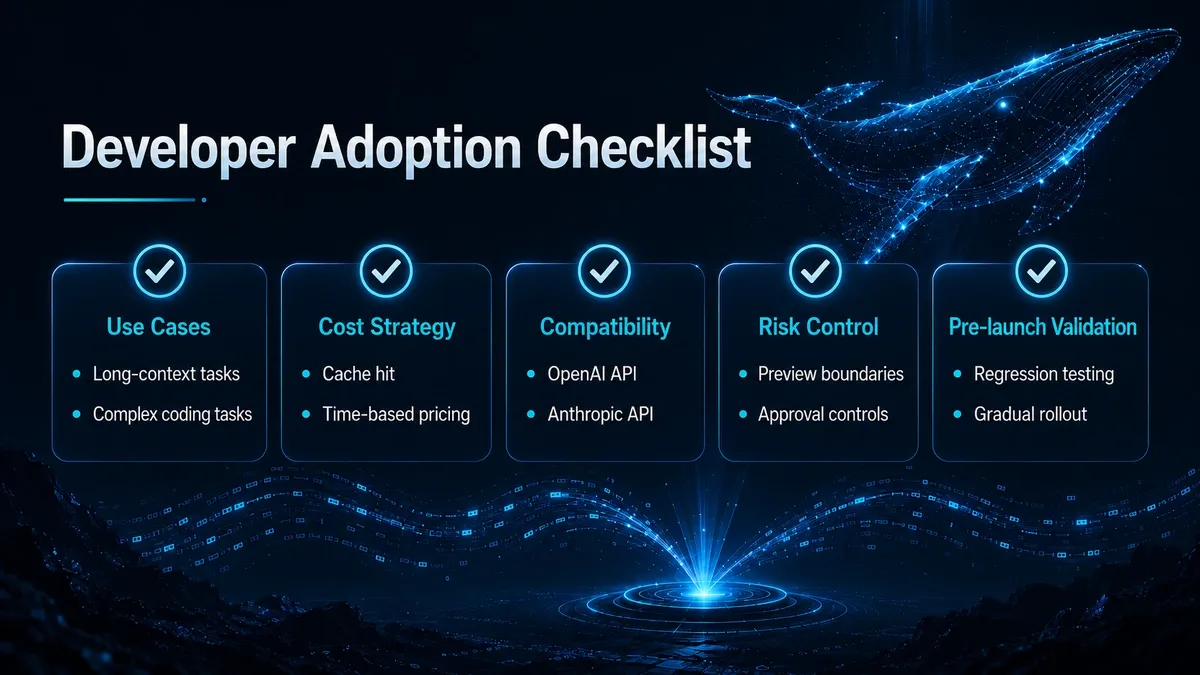
How to adopt it now: V4-Pro-0813 can enter a controlled model rollout; Harness should remain an evaluated dependency
If you already call the DeepSeek API, adopting V4-Pro-0813 does not require a broad code migration because the public model identifier remains deepseek-v4-pro. The right response is a controlled regression pass: freeze a set of real tasks, log the date and model revision, and compare success rate, tool behavior, latency, token usage, and failure modes.
If you access DeepSeek through an OpenAI-compatible gateway, pay special attention to protocol details around thinking mode, reasoning_content, tool calls, multi-turn message replay, and streaming behavior. “OpenAI-compatible” should never be interpreted as “every client behavior is identical.” Compatibility needs to be validated across the specific agent loop you actually operate.
If you want to evaluate DeepSeek Harness itself, I would keep it inside an isolated development workspace and focus on five questions:
- Are workspace access boundaries explicit enough?
- Can high-risk commands be held behind approval or policy gates?
- Do file changes consistently flow into verification?
- How do plugin interfaces behave across upgrades?
- Is the execution trail sufficient for debugging and audit?
The reason for caution is not hypothetical: the official README already says developer preview and warns about breaking changes. A preview can be strategically important and technically useful without yet being an appropriate production-critical dependency.
V4-Pro or V4-Flash: treat them as routing tiers, not “good model vs bad model”
V4-Pro and V4-Flash should not be reduced to a prestige hierarchy. The official price and concurrency tables already imply different operating roles. Flash is substantially cheaper and has a much higher concurrency ceiling. Pro is where you reserve more expensive inference for steps that truly need deeper reasoning.
Inside an agent harness, the natural pattern is model routing. Repository listing, lightweight classification, keyword search, or routine transformations can use Flash. Architecture decisions, difficult bug isolation, cross-file refactoring, and final review can escalate to Pro. That reduces both cost and queue pressure while keeping the expensive model focused on high-leverage decisions.
This is another reason the harness becomes strategically important. Once an agent has multiple models, multiple tools, multiple task stages, and a budget, model selection itself becomes a runtime decision. The harness is what decides which model runs which step, how much context to provide, when to retry, and when to escalate.
Final view: the important story is not “0813”; it is DeepSeek entering the agent runtime layer
V4-Pro-0813 clearly matters. A 1M context window, 384K maximum output, Tool Calls, the Responses API, the Anthropic API, current pricing, and the announced time-based billing model all affect real developer choices. But an article that stops at “DeepSeek updated the model” will age quickly and misses why Harness is showing up in the same developer story.
The longer-term shift is that AI coding competition is moving from Model to Model × Harness × Workflow. The model provides intelligence. The harness provides context, tools, permissions, execution, and recovery. The workflow determines how those capabilities integrate with actual teams. All three layers need to work before model capability becomes reliable productivity.
For DeepSeek, that means a more explicit move from being a highly cost-competitive model provider toward becoming part of the developer agent stack. Harness is still developer preview, and a great deal of production engineering remains unresolved. But the direction is now official enough that anyone building coding agents, developer tools, or AI automation should track it closely.
If I had to reduce the whole update to one line: V4-Pro-0813 determines how capable DeepSeek’s model can be; Harness determines whether that capability can stay inside a developer’s daily workflow.
Official sources
- DeepSeek API homepage
- DeepSeek Models & Pricing
- DeepSeek Rate Limit & Isolation
- DeepSeek Harness official GitHub
- DeepSeek Harness Web UI guide
- DeepSeek + OpenCode integration guide
More to Explore
Next step: continue the Agent system
Full decision path →Choose the next architecture, tool, memory, evaluation, security, or production decision instead of starting over.

DISCUSSION
Questions, verification and corrections
Sign in to comment. Every new comment is reviewed before publication; while pending, it is visible only to you and the administrator.