

GPT-6 Astra API Guide: Pricing, Claude/Gemini Comparison, 1.05M Context and Migration
GPT-6 Astra API pricing, 1.05M context, Responses migration and rollout, plus Claude Fable 5.1 and Gemini 3.8 Flash comparisons for coding, agents and cost.
Evidence 10 cited sources
On this page
Short answer: GPT-6 Astra is released, but as of September 4, 2026 it is still rolling out. The practical questions are what a completed API task costs, whether the 1.05M-token window is worth using, whether Chat Completions/tool-calling code must move to Responses, and—if you are choosing an AI coding or agent model—how Astra compares with Claude Fable 5.1 and Gemini 3.8 Flash.
For hard coding, computer use, cross-tool long-running work or large research tasks, Astra belongs in the first test batch. If your workflow already depends heavily on Claude Code, Fable 5.1 should be in the same-task A/B. If API unit price, throughput and generative-AI/agent economics matter more, Gemini 3.8 Flash is also a serious candidate. Classification, extraction, format conversion and high-volume low-cost requests do not justify an automatic migration just because Astra is newer.
This is an official-information, cross-vendor selection and migration guide, not an XBSTACK hands-on leaderboard. OpenAI’s launch page already places Astra, Claude Fable 5.1 and Gemini 3.8 Flash in the same coding/professional benchmark tables; those numbers are useful context, but they remain vendor-published results. A controlled repository A/B should come later with the same prompt, tools, permissions and success criteria before claiming which model is actually stronger or cheaper per completed task.
What actually changed with GPT-6 Astra?
OpenAI released GPT-6 Astra on September 3, 2026 and positions it for complex reasoning, coding, computer use, research and polished professional artifacts. The important product shift is that these capabilities are being combined around end-to-end work: not simply writing an answer, but operating across browsers, desktop applications, code repositories and professional tools over many steps.
The official model page lists a 1,050,000-token context window, 128,000 maximum output tokens and an April 30, 2026 knowledge cutoff. reasoning.effort supports low, medium, high, xhigh and max.
For teams already using GPT-5.6 in real workflows, the interesting question is no longer only “does the model fit the context?” Cost and reliability increasingly depend on what you put into that context, how much gets repeated, and whether the model sees only the tools that are relevant to the current step.
OpenAI also describes a new Codex mechanism for Astra that can preserve notes and retrieve older context windows after the active window fills. Earlier windows remain searchable, allowing the agent to recover requirements, test results or tool output that may not survive ordinary compaction. That points in the same direction as the broader coding-agent memory and context-engineering trend, but it is not equivalent to unlimited persistent memory.
Official launch: https://openai.com/index/gpt-6-astra/
Official model page: https://developers.openai.com/api/docs/models/gpt-6-astra
GPT-6 Astra API pricing
OpenAI currently lists the following Standard text-token prices:
| Item | GPT-6 Astra Standard |
|---|---|
| Input | $10 / 1M tokens |
| Cached input | $1 / 1M tokens |
| Cache writes | $12.50 / 1M tokens |
| Output | $50 / 1M tokens |
| Batch / Flex | 50% of Standard |
| Fast mode | 2x the applicable rate |
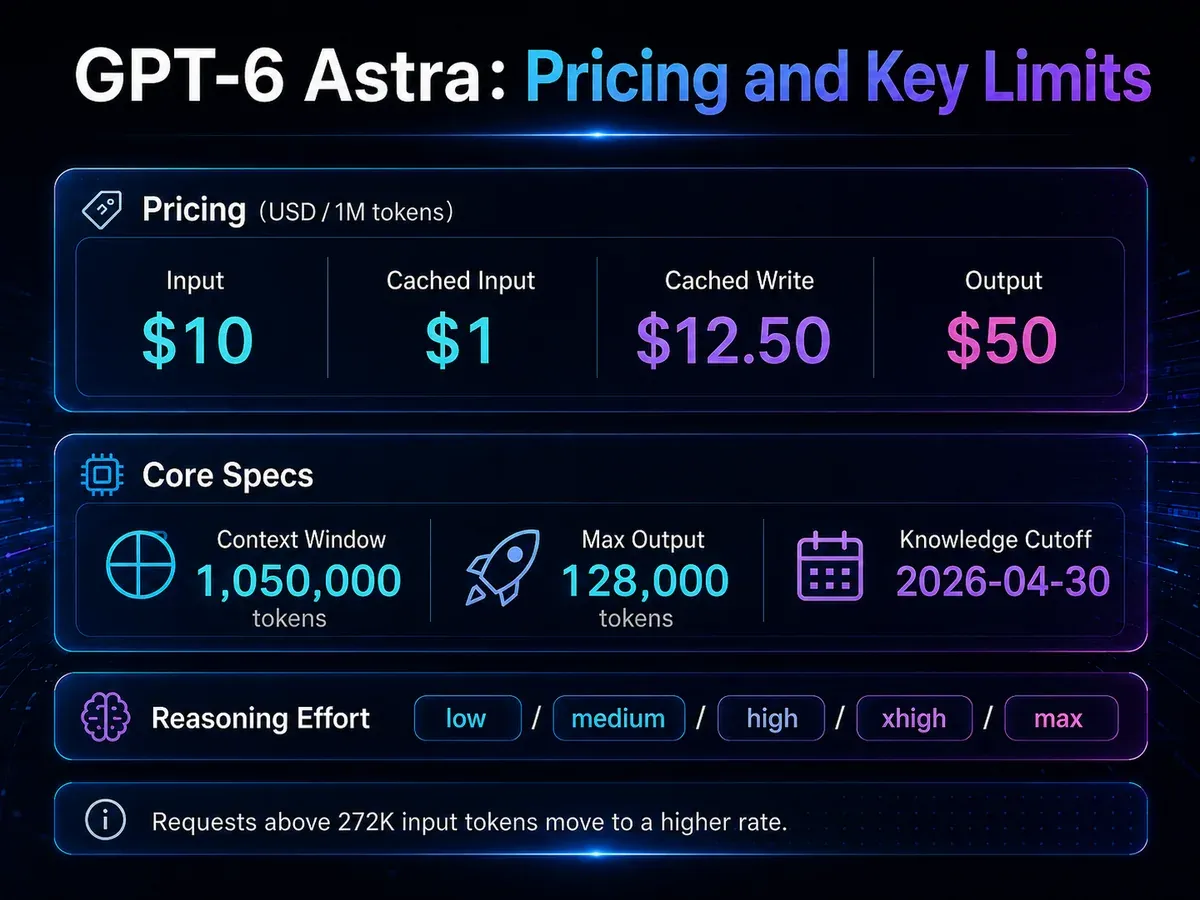
A critical detail is easy to miss: prompts above 272K input tokens are charged at 2x input/cache rates and 1.5x output for the full request. A one-million-token window therefore does not mean it is economical to paste an entire repository, all logs and all prior conversation history into every turn.
For a simple fee illustration only, 100K uncached input plus 10K output would cost roughly $1 + $0.50 = $1.50 in model text-token fees at Standard rates, before web search, computer-use or other tool charges. In an agent loop that makes a dozen requests, repeated context can dominate the final cost.
The useful cost metric is therefore not “price per million tokens.” It is cost per completed outcome: number of model calls, repeated context, cache hit rate, tool calls, retries and human rework. That is also why production agent governance matters as much as model selection.
After GPT-6.1 Sol, when is Astra still worth it?
OpenAI released gpt-6.1-sol on September 29, 2026 and positions it as a lower-cost model with near-Astra capability for complex work. As of October 6, the two models share a 1,050,000-token context window, 128,000-token maximum output and an April 30, 2026 knowledge cutoff. The clearest product difference is the price/capability tier.
| Item | GPT-6 Astra | GPT-6.1 Sol |
|---|---|---|
| Standard input | $10 / 1M tokens | $2 / 1M tokens |
| Cached input | $1 / 1M tokens | $0.10 / 1M tokens |
| Cache write | $12.50 / 1M tokens | $2.50 / 1M tokens |
| Standard output | $50 / 1M tokens | $10 / 1M tokens |
| Context | 1.05M | 1.05M |
| Max output | 128K | 128K |
| Official positioning | flagship for the most demanding work | balance complex-work capability and cost |
Keep OpenAI’s positioning separate from XBSTACK evidence. OpenAI describes GPT-6.1 Sol as near-Astra intelligence and publishes coding, professional-work and computer-use evaluations, but XBSTACK has not yet completed an Astra-vs-6.1-Sol A/B with the same repository, prompts, tool permissions and success criteria. A five-times lower token list price is not evidence that every completed task costs five times less, nor is “near-Astra” proof of equal quality on your workload.
For now, a defensible routing rule is to use GPT-6.1 Sol as the cost baseline for routine complex coding, document analysis and professional work, then compare Astra on the highest-failure-cost or most demanding long-horizon tasks. Measure completion rate, total tokens, tool calls, retries, elapsed time and human rework—not only list price or vendor benchmarks.
OpenAI’s current model-selection guidance uses the same broad separation: Astra for the most demanding work, GPT-6.1 Sol when you want complex capability with a better cost balance. That makes an update to this existing selection page more useful than another launch-summary URL; a dedicated comparison page should wait for a controlled first-party benchmark.
Does a 1.05M context window mean you should load the whole project?
Usually not.
A larger window buys headroom, but it does not remove three engineering constraints.
First, cost. Crossing 272K input changes the pricing tier.
Second, relevance. Unrelated files, old logs and duplicate instructions can make the model spend attention on the wrong evidence.
Third, persistence. A huge inference context is still a working set for the request, not a durable cross-day, cross-agent project memory. Long-lived state still belongs in repositories, issues, databases, memory layers or trace stores that can be retrieved deliberately.
The better way to treat Astra’s context window is as room for difficult tasks, not as an excuse to stop doing retrieval, tool filtering and context engineering.
The migration trap: changing the model name is not enough
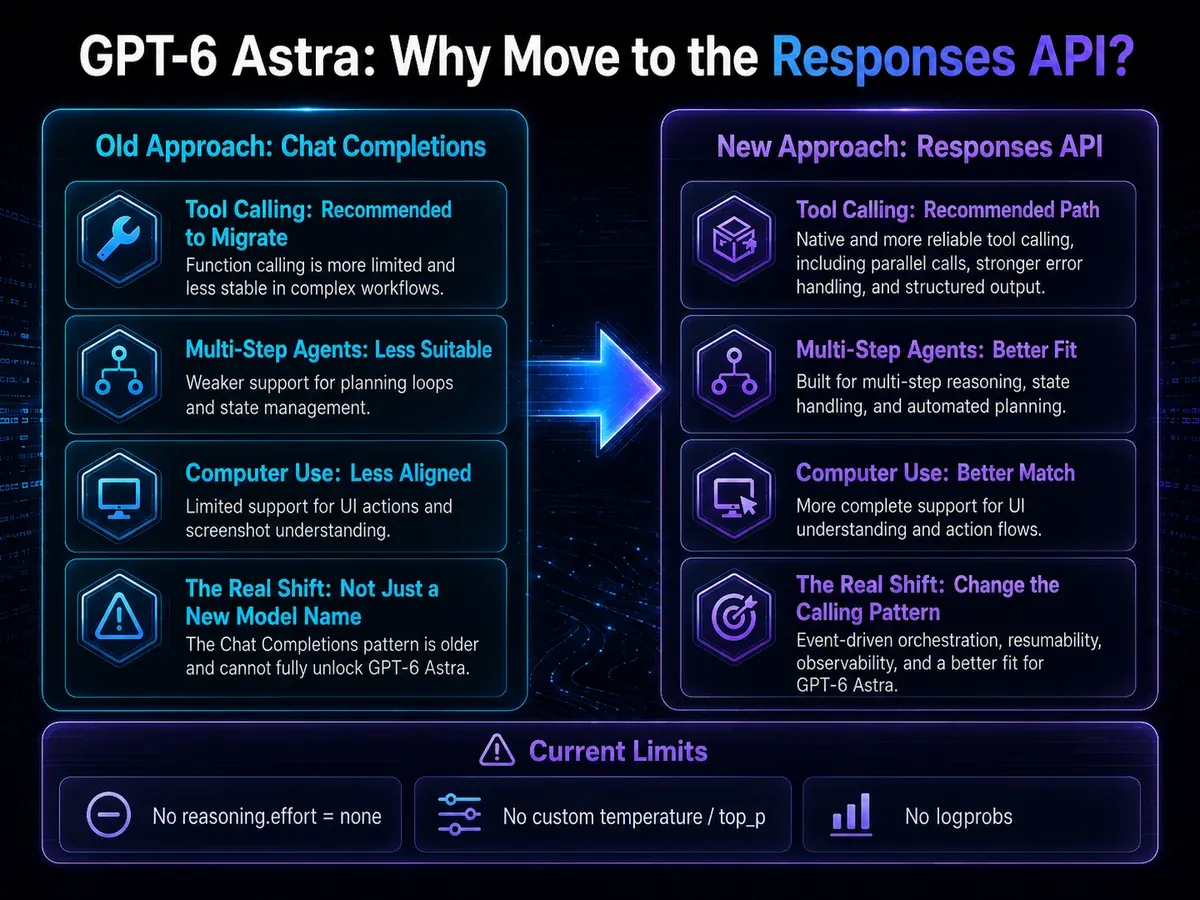
OpenAI’s September 3 API changelog lists several concrete differences:
- GPT-6 Astra does not support
nonereasoning effort; - it does not support custom
temperatureortop_pvalues; - it does not support
logprobs; - tool calling requires the Responses API;
- Responses adds long-running controls including async tool calling, mid-turn steering and changing reasoning effort during a conversation.
If your current migration plan is just:
model = "gpt-5.6-sol" -> model = "gpt-6-astra"
that may not be enough. An agent still using tools through Chat Completions should first review the Responses path, streaming event parser, tool-result return flow, retry policy and state recovery. XBSTACK’s existing Responses API streaming failure analysis is a useful adjacent reference.
A safer order is:
- move the tool path to Responses while keeping the old model;
- freeze a real task set and success criteria;
- switch to Astra and test multiple effort levels;
- record total requests, input/output tokens, tool calls, failures and retries;
- route only the workloads that justify Astra’s cost.
Which reasoning effort should you use?
Astra supports low, medium, high, xhigh and max. “max is always better” is not a production rule.
Structured extraction, basic classification and short code transformations rarely justify the highest effort. Higher effort is more defensible for expensive failures: migrations, multi-system research, computer use, high-stakes engineering decisions and tasks where the model must repeatedly inspect and verify tool output.
Treat effort as a routing parameter. Start lower, raise it when the task or validation failure justifies more compute, and measure whether success rate or reduced rework pays for the extra latency and token cost.
The right A/B is not “which answer sounds smarter?” It is whether a higher effort level improves:
- successful task completion;
- tool-selection accuracy;
- number of retries;
- human corrections;
- total time and total cost.
GPT-6 Astra vs GPT-5.6 Sol
OpenAI publishes many benchmarks comparing Astra with GPT-5.6 Sol across Terminal-Bench, OSWorld, long context, science and safety. These results show where OpenAI sees improvements, but they are not a substitute for your own production workload.
A practical starting point is:
| Workload | Better first test |
|---|---|
| Hard agentic coding and cross-tool work | Astra |
| Browser/desktop computer use | Astra |
| Very long research and multi-document work | Test Astra, but manage context |
| Routine medium-complexity coding | A/B cost first |
| Extraction, classification, routing | Usually a cheaper model |
| Stable GPT-5.6 Sol agent | Migrate/evaluate Responses first, then switch model |
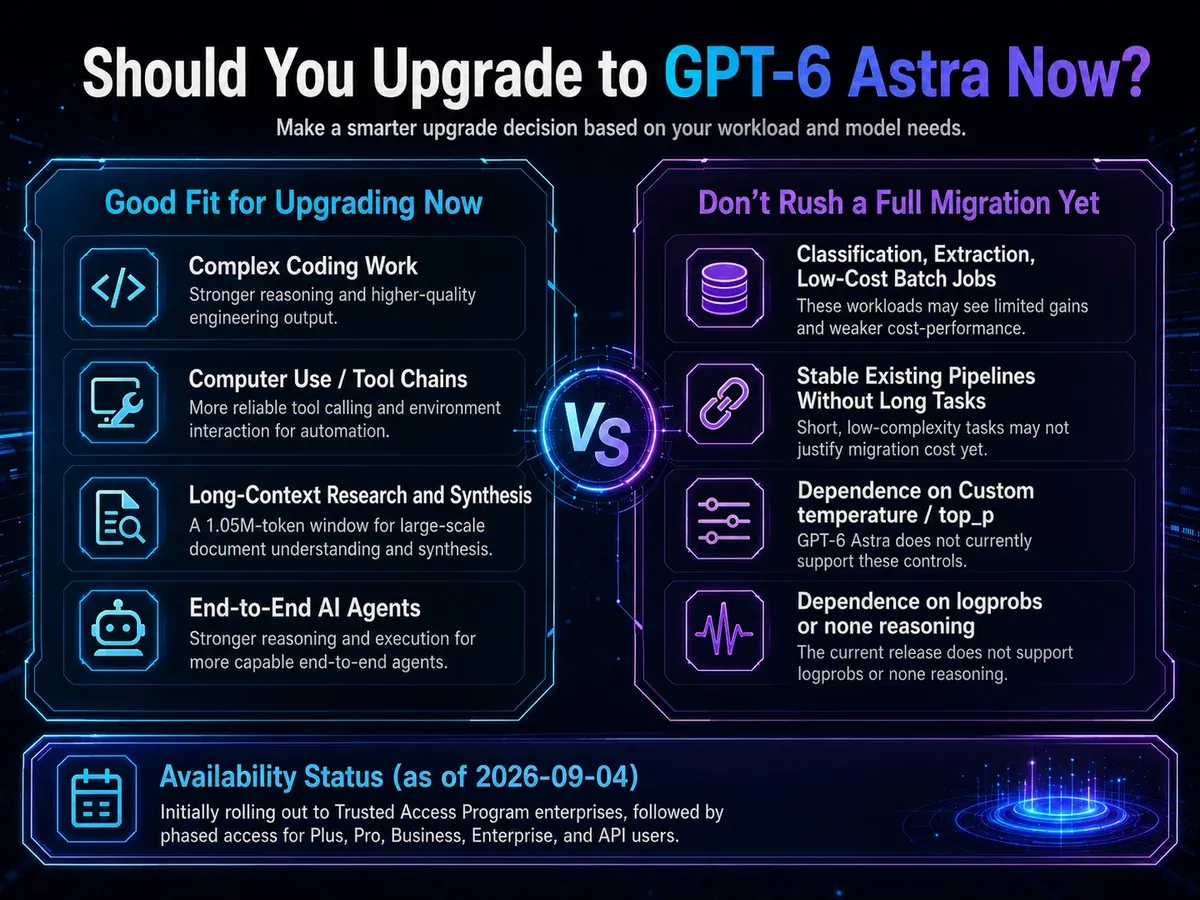
Do not convert OpenAI’s estimated benchmark cost advantages into your own claimed savings. Harness, effort, tools, prompt design and retry behavior all change the economics.
GPT-6 Astra vs Claude Fable 5.1 vs Gemini 3.8 Flash
People landing on an Astra guide are rarely making only an OpenAI-internal upgrade decision. A more realistic search is: for AI coding, should I use GPT, Claude or Gemini? Is a more expensive flagship model worth it for complex agents? Does long context matter more than tool behavior? Those are legitimate adjacent intents, so they should be answered in the body rather than hidden in metadata.
The boundary matters: this is not a controlled XBSTACK cross-vendor benchmark. The comparison below uses vendor-published pricing, product positioning, context/tool constraints and migration behavior. A real “winner” still requires the same repository, prompt, tool permissions, task set and success criteria.
OpenAI’s Astra launch page already publishes a cross-model table that includes GPT-6 Astra, Claude Fable 5.1 and Gemini 3.8 Flash. For searches such as “GPT-6 Astra vs Claude” or “GPT-6 Astra vs Gemini,” these numbers are more useful than a vague “which is best?” claim, but the source must stay explicit: this is OpenAI-published comparison data, not an independent XBSTACK benchmark and not a guarantee of production performance.
| Benchmark listed on OpenAI’s launch page | GPT-6 Astra | Claude Fable 5.1 | Gemini 3.8 Flash |
|---|---|---|---|
| Terminal-Bench 4.0 | 57.9% | 55.8% | 19.1% |
| DeepSWE v1.1 | 74.1% | 67.4% | 73.8% |
| Artificial Analysis Intelligence Index v4.1.1 | 61.2 | 65.7 | 58.7 |
| AutomationBench | 41.4% | 31.4% | — |
The table itself argues against a simplistic winner. Astra leads Terminal-Bench 4.0 and AutomationBench, Gemini 3.8 Flash is very close to Astra on DeepSWE, and Fable 5.1 is higher on the Artificial Analysis Intelligence Index entry shown by OpenAI. Model selection still has to return to workload, cost, tools and reliability.
| Dimension | GPT-6 Astra | Claude Fable 5.1 | Gemini 3.8 Flash |
|---|---|---|---|
| Current published API input/output pricing | 50 per 1M tokens | 50 per 1M tokens; lower cache-read pricing | Promotional 3.75 per 1M tokens through end-2026 |
| Best first workloads to test | Hard coding, computer use, cross-tool long-running work, very long research | Claude Code, complex knowledge work, coding agents | Cost-sensitive coding/agents, generative AI and higher-throughput workloads |
| Context/reasoning issue to watch | 1.05M context; prompts above 272K change the rate tier; multiple reasoning-effort levels | Do not choose by model name alone; evaluate Claude Code behavior, caching and task cost | 1M context; Thinking Level plus additional reasoning/tool iterations can change cost per task |
| Migration issue to check first | Responses API for tool calling and old parameter compatibility | Existing Claude API / Claude Code workflow and cache strategy | Gemini API/Interactions API, Thinking Level and old prompt/parameter compatibility |
| Decision logic | Put high-cost-of-failure complex tasks into the first A/B | If Claude Code is already central, include Fable 5.1 directly in the A/B | Evaluate early when unit price, throughput and multi-task economics dominate |
The pricing contrast is useful but easy to misuse. Astra and Fable 5.1 sit in the same published 50 input/output tier, while Gemini 3.8 Flash has a much lower promotional token price. That does not automatically make Gemini the cheapest completed task. Google explicitly notes that 3.8 may perform more reasoning steps and tool iterations on harder work; Astra can also become materially more expensive once the prompt crosses its 272K threshold. Cost per successful outcome still depends on total tokens, tool calls, retries and human rework.
For a one-person company (OPC), creator workflow, self-media operation or AIGC content pipeline, that usually argues against moving every task to Astra. Topic collection, summarization, bulk rewriting and media classification are high-volume jobs where unit cost and throughput matter more. Astra is more rational to test on AI coding, automation-tool development, difficult research, cross-app agents, high-stakes business documents or the kind of work where one person is effectively covering product, engineering and operations. A solo business often gets better economics from cheap models for routine pipelines and stronger models for high-value, long-chain, high-rework-cost tasks rather than one flagship model everywhere.
If your stack is already centered on Claude Code, see Claude Fable 5.1 vs Mythos 5.1: pricing, access and coding/agent selection. If low API price, 1M context and long-running agents matter more, see Gemini 3.8 Flash vs 3.7 Flash: coding, agents and task cost. Those pages keep the vendor-specific evidence deeper without turning this article into a generic leaderboard.
Why computer use and long-running control matter
One of Astra’s clearest product directions is the shift from answering to operating software. OpenAI describes form filling, CRM updates, calendar work, research, document editing, website QA, software installation and troubleshooting.
That also expands the blast radius. A browser agent can click the wrong control. A desktop agent can operate the wrong window. A coding agent can modify files. A long task can accumulate a small assumption error for dozens of steps.
The more capable the model is at completing work, the more important it becomes to retain:
- read-only defaults;
- explicit approval for consequential writes;
- credential isolation;
- tool allowlists;
- visible plans before execution;
- diffs/logs/results after execution;
- interruptible and recoverable state.
For adjacent implementation details, see tool authorization and policy gates and OpenAI Agents SDK RunState approval/resume.
Who can use GPT-6 Astra now?
This is the fastest-moving part of the article, so the date matters.
As of September 4, 2026, OpenAI says Astra is rolling out first to enterprises in the Trusted Access Program. API and ChatGPT Plus, Pro, Business and Enterprise access are expected to expand over the following days. OpenAI also says Astra Pro access will be provided to Pro, Business and Enterprise plans.
If the model does not appear in your account yet, do not assume your API key, SDK or network configuration is broken. Check rollout and organization eligibility first.
Security: Critical cyber capability is not a feature badge
OpenAI says Astra is the first broadly deployed model to reach the Critical cybersecurity capability threshold under its Preparedness Framework and published a dedicated safety overview with the launch.
For ordinary developers, the practical lesson is not to celebrate offensive capability. It is that stronger models demand stronger runtime boundaries. OpenAI’s provider-side monitoring, your own tool permissions, approval workflows, data authorization and sandboxing are separate controls. None of them should be treated as a complete replacement for the others.
Safety overview: https://openai.com/index/safety-overview-gpt-6-astra/
Final decision: should you migrate now?
If you do not have Astra access yet, do not churn production code for the headline. Prepare the Responses migration, real task set, cost telemetry and permission boundaries so that you can test immediately when access arrives.
If you already have API access and your core tasks are hard coding, computer use, research or end-to-end agent workflows, Astra belongs in the first A/B batch. I would still avoid an all-at-once migration: choose 5–10 reproducible tasks, keep input and permissions consistent, and compare completion rate, total time, total tokens, tool calls and human rework.
If the workload is mostly lightweight generative AI, short Q&A, extraction, routing or high-volume commodity requests, a flagship model may not improve unit economics. Judge Astra by whether it completes a full outcome more reliably and economically, not by the model name.
The current XBSTACK position is narrow: GPT-6 Astra deserves early testing for difficult coding and agent workflows, but on September 4, 2026—while rollout is still expanding and API migration requirements are fresh—“new model” is not a reason for an unconditional production switch.
FAQ
How much does GPT-6 Astra cost?
Standard text pricing is 1 cached input, 50 output. Requests above 272K input use higher rates. Batch/Flex are 50% of Standard and Fast mode is 2x the applicable rate.
How large is the GPT-6 Astra context window?
1,050,000 tokens, with up to 128,000 output tokens. The larger window does not remove the need for retrieval and context management, and crossing 272K input affects pricing.
Does GPT-6 Astra support Chat Completions?
The model page lists Chat Completions, but OpenAI’s September 3 changelog states that tool calling requires the Responses API. A plain non-tool chat request and an agentic tool workflow therefore have different migration requirements.
Can I set temperature or top_p on GPT-6 Astra?
OpenAI currently states that Astra does not support custom temperature, top_p or logprobs.
Is GPT-6 Astra better than GPT-5.6 Sol for coding?
OpenAI’s published coding and computer-use benchmarks show gains in several areas, but XBSTACK has not yet completed a controlled real-repository A/B. Hard long-running work should test Astra early; stable production workflows should validate regression and cost before switching.
GPT-6 Astra vs Claude Fable 5.1 vs Gemini 3.8 Flash: which should I use?
For hard coding, computer use and cross-tool long tasks, Astra belongs in the first test batch. If your team is already built around Claude Code, include Fable 5.1 in the same-task A/B. If API unit price, throughput or generative-AI/agent economics matter more, Gemini 3.8 Flash is a strong comparison candidate. Judge the result by task completion, total cost, latency, tool calls and human rework rather than brand.
How should I read GPT-6 Astra vs Claude/Gemini benchmark results?
On OpenAI’s launch-page table, Terminal-Bench 4.0 is 57.9% for Astra, 55.8% for Claude Fable 5.1 and 19.1% for Gemini 3.8 Flash; DeepSWE v1.1 is 74.1%, 67.4% and 73.8%. The mixed results are exactly why a single benchmark cannot decide the model choice. These remain OpenAI-published numbers, not an independent XBSTACK comparison, so a real project should still use the same tasks, prompts, tools, permissions and success criteria.
Official sources
- OpenAI: GPT-6 Astra launch
- OpenAI API: GPT-6 Astra model page
- OpenAI API changelog
- OpenAI: GPT-6 Astra Safety Overview
- OpenAI: latest model guide
- Anthropic: Claude Fable 5.1 and Mythos 5.1
- Google: Gemini 3.8 Flash
- Gemini API pricing
Continue reading
- GPT-5.6 real-workflow evaluation and Sol/Terra/Luna selection
- OpenAI Agents SDK RunState approval and resume
- AI agent tool authorization and policy gates
- Production AI agent governance
- Claude Fable 5.1 vs Mythos 5.1: pricing, access and coding/agent selection
- Gemini 3.8 Flash vs 3.7 Flash: AI coding, agents and token cost
Continue from one agent pattern to the complete production system
The AI Agent hub organizes architecture, memory, tool use, evaluation, security, deployment and multi-agent coordination into a single learning path.
Next step: continue the Agent system
Full decision path →Choose the next architecture, tool, memory, evaluation, security, or production decision instead of starting over.

DISCUSSION
Questions, verification and corrections
Sign in to comment. Every new comment is reviewed before publication; while pending, it is visible only to you and the administrator.