

Gemini 4 Neon Changes the Agent Economics. Who Signs Off on the Work?
An independent argument about why Gemini 4 Neon may change recurring coding-agent economics: the difference between token prices and accepted task costs, what harnesses and approvals actually do, and three falsifiable forecasts for 2027. Based on official sources and XBSTACK engineering, not paid Neon benchmarks.
Evidence 4 cited sources
On this page
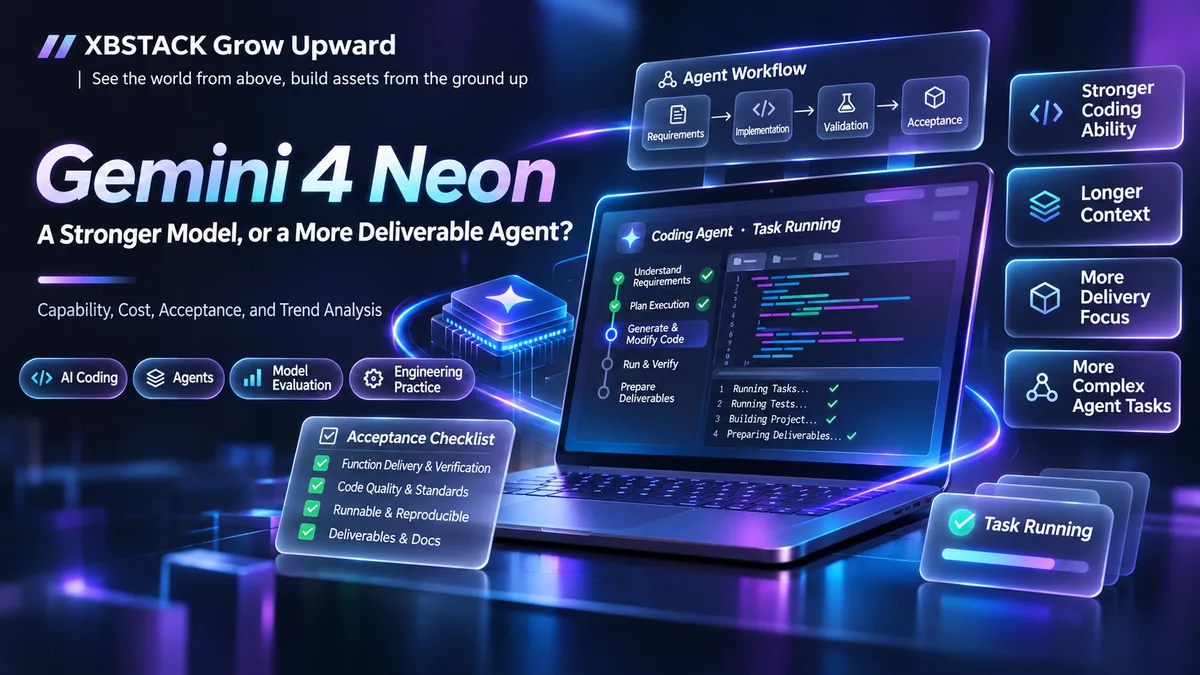
With Gemini 4 Neon, Google has invited the obvious questions: Is it faster than Carbon? How high does it rank? Is the price worth it?
I think those are necessary but incomplete questions. A model that can take on more real work does not merely create more answers; it can alter files, trigger tools, advance a workflow, and sometimes finish with a convincing explanation of something it did not actually verify. When AI gets cheap enough to delegate more tasks, who is responsible for proving that a task is actually complete?
My thesis is that Neon is interesting not because Google needed a fourth name in the Gemini 4 lineup, but because it points toward a new commercial battleground: frontier-grade reasoning packaged for recurring, verifiable work rather than occasional demonstrations of maximum intelligence.
That could make coding agents substantially more useful. It could also turn an already familiar engineering weakness into a larger business liability: the automated acceptance process may not be good enough to keep up with automated execution.
There is a distinction that broad AI coverage often blurs. Generative AI (sometimes grouped under AIGC) can produce text and code; an AI agent, or agentic AI system, may also be authorized to inspect a repository, call APIs, run tests, and change external state. For someone searching for an AI coding assistant, that difference matters more than branding. Generating a plausible patch is not the same as an autonomous coding agent delivering verified software.
Nor is a new agent model evidence that artificial general intelligence (AGI) has arrived. A longer context window, a stronger benchmark score, or more automated tool use does not remove the need for permissions, human judgment, and independent acceptance. The useful long-term question is how trustworthy the transition from generating content to executing work can become.
This is a perspective piece, not a claim that Neon beat Carbon in my repository. Its purpose is to separate reported facts from an actionable decision: when, if ever, should an independent developer pay to let Neon do more work?
1. The real market Neon is targeting lies between trivial automation and heroic reasoning
Google introduced Neon on November 18 for complex software engineering, knowledge work, and multi-step workflows. Its model card says Neon is adapted from Carbon. In Google’s framing, Hydrogen handles fast, everyday execution; Carbon is reserved for the hardest long-horizon work; Neon aims to combine depth with efficiency for complex tasks that occur frequently. The model offers a unified one-million-token context window and is rolling out through paid developer and consumer channels. Google’s announcement
The interesting part is not whether that creates a tidy three-level model picker. It is the kind of work organizations actually accumulate.
A coding agent might need to repair one bilingual route without touching dozens of established links. A support workflow might need to reconcile a tool result that arrived after the agent timed out. A knowledge assistant might need to distinguish an outdated document from a current one before citing either. None is the most spectacular reasoning challenge a model will ever face.
But these tasks recur. They require context, judgment, restraint, and a reliable definition of success. Small error rates accumulate when work happens thousands of times.
My reading is that Neon is competing for the high-frequency, moderately difficult work currently handled by a mix of ordinary models, expensive escalation, and human cleanup. Its real competitor may be a workflow, not a model.
That interpretation is a hypothesis about demand, not evidence of market adoption. It needs longitudinal task outcomes to become a measured conclusion.
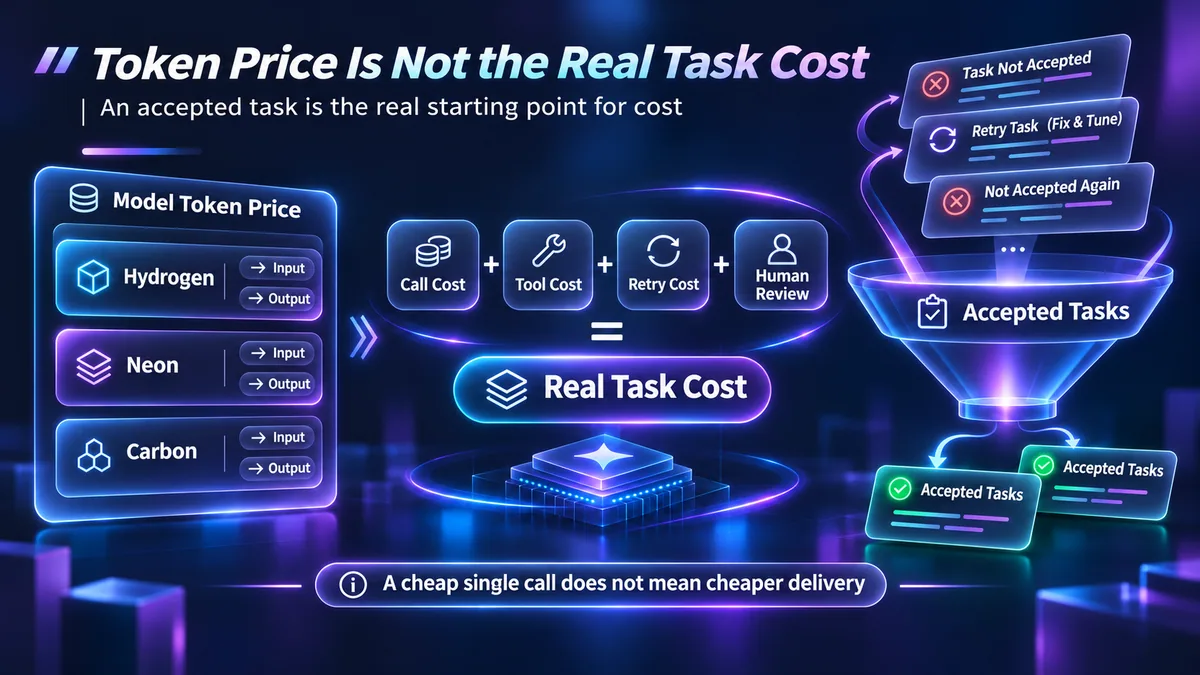
2. The awkward pricing fact: Neon is not always cheaper per token
The promotional positioning is about efficiency, but the list price deserves careful reading.
As of November 19, Google’s standard Gemini API lists Neon at 15 per million output tokens, including thinking. Hydrogen is 7.50. Carbon and Argon are 10 through November 30, 2026, with a published change to 20 starting December 1. Neon has no general free API tier. These are standard API prices, not Antigravity subscription accounting. Official Gemini pricing
That produces a counterintuitive result. On November 19, Neon’s nominal input and output token prices are 50% higher than Carbon’s temporary standard rates. If Google’s scheduled change takes effect, Neon would instead be 25% cheaper per token than Carbon from December 1.
Both facts are true within their date windows. A comparison that takes tomorrow’s Carbon price and uses it to advertise savings today would be misleading.
Consider an illustrative calculation, not an executed benchmark: a request consuming 100,000 input tokens and 20,000 output/thinking tokens, with no cache discounts, tools, failed retries, or taxes.
| Model, standard API | Hypothetical model charge |
|---|---|
| Hydrogen | $0.30 |
| Neon | $0.60 |
| Carbon at the price effective November 19 | $0.40 |
| Carbon at the announced December 1 price | $0.80 |
This does not mean the models consume equal tokens on a real task. A stronger model may finish with fewer retries or fewer generated tokens; it may also consume more hidden reasoning or require expensive tool work.
Google reports a lower cost per task for Neon under certain third-party benchmark conditions. That claim is worth investigating, but a benchmark’s definition of “task” might not match a deployment team’s definition of “accepted change.” A model that passes on the first try can be economically superior despite a higher token rate. A model that generates more confident but unverified changes can be far more expensive than its API invoice suggests.
Here is the denominator I care about:
Cost per accepted task = total model, tool, retry, and required review/rework costs across all attempts ÷ tasks that pass independent acceptance.
Failed attempts stay in the numerator. Unverified “looks good” responses do not enter the denominator.
This changes model selection. It stops rewarding the model that merely produces the most output and starts rewarding the workflow that produces the least unaccepted work.
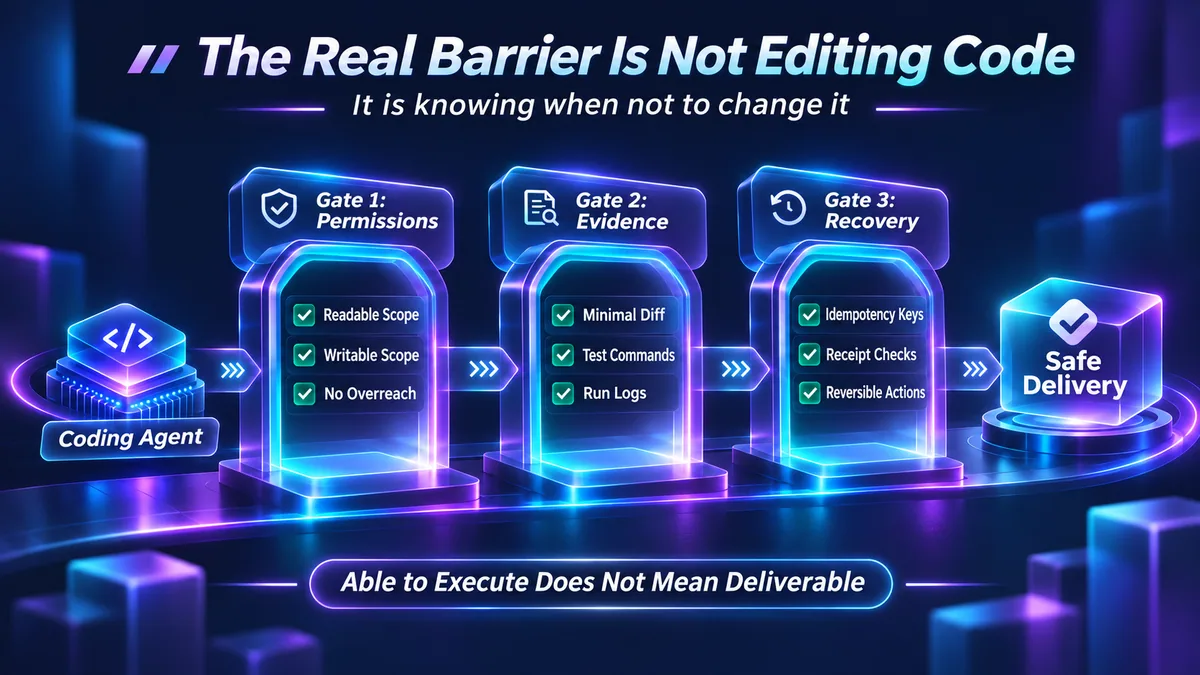
3. A coding agent needs three gates before it earns real authority
The biggest leap from chat assistant to coding agent is not “can write Python.” It is “can take actions that alter the state of a system.”
That raises three questions.
The permission gate: What can the agent read and change? Does an authorization to prepare a patch include an authorization to push Git, delete files, touch production configuration, or expose personal data? It should not. An agent that silently deploys a plausible fix has crossed a boundary even if the code happens to work.
The evidence gate: Can an engineer inspect the smallest relevant diff, the exact verification commands, the output from tests that actually ran, and any remaining failures? “I fixed the bug” is not evidence. “I produced a patch that has not been compiled” is a legitimate status, but only if described accurately.
The recovery gate: What happens when the external tool completes an action but the agent never receives its acknowledgement? Retrying without checking receipts can send duplicate emails, write records twice, re-run deployments, or repeat financial actions. Idempotency keys, durable checkpoints, audited tool results, and undo or compensating actions are application responsibilities.
Google emphasizes Neon’s steerability, honesty, and improved agent behavior in its announcement. The model card also acknowledges ordinary limitations, including hallucination. Such advances are welcome, but model-level reliability claims cannot replace deterministic authorization and independent postconditions. Announcement · Model card
My concern is simple: as agents become easier to trust in conversation, teams may become less disciplined about the things they must still verify in code.
What if you only want a better AI to write code?
For someone who does not maintain a custom agent harness, the differences among Neon, Carbon, and Hydrogen may be hard to see in one chat window. The useful questions are simpler: does the generated change work in your environment, did the tool modify files you never asked it to touch, and can you recover from an error without starting over?
If you search for “is Gemini 4 Neon good for coding” or “Neon vs Carbon for programming,” try a fixed, small repository: one change request, an actual build or test, and one intentionally interrupted tool workflow. If you cannot run the code, call the result a suggestion—not completed software. You can make a sensible first choice without adopting an entire orchestration stack.
4. The harness may matter as much as the model
One of Google’s most instructive reported comparisons is the SWE-sweep result: Neon scores 12.8% in the mini-SWE harness and 39.0% in Google Antigravity. That is not a clean same-harness model-versus-model comparison. The execution environment is different. Planning, tools, observations, context management, and iterative feedback can materially influence the result. It would be wrong to attribute the entire difference to raw model intelligence. Official announcement
This is the less glamorous investment I would make before reorganizing a product around the latest model:
Define narrowly scoped tasks. Make authorized operations explicit. Automate regression tests. Capture durable receipts. Verify the output that users actually receive. Keep a rollback path.
A powerful model without this infrastructure can generate a spectacular amount of unverified activity. A merely adequate model with good fixtures and guardrails may deliver more usable work.
The long-term moat for an AI development tool may therefore be the accumulated quality of its harness and acceptance system, not the number of model names in a dropdown.
A related distinction matters: Google demonstrates Neon participating in Antigravity workflows and model orchestration. Calling a regular Gemini model API does not automatically reproduce that product’s complete orchestration, approval, and state-recovery machinery. A developer integrating Neon into a custom agent must still build the surrounding system.
5. Two XBSTACK engineering experiences make this more than an abstract concern
The following examples come from existing engineering work. They are not tests of Neon.
First, XBSTACK’s bilingual site has strict publishing invariants: preserve working URLs, keep canonical and hreflang pairs consistent, expose approved articles through the proper discovery paths, and verify the public deployment independently of the local build. A generated patch can be syntactically convincing while silently removing legacy pages or publishing content that should remain a draft.
For that workflow, I would rather have an agent change two files and pass every guardrail than change ten files and describe its confidence in an eloquent release note. The acceptance result is not a matter of taste; scripts and deployed pages can prove or disprove it.
Second, on November 19, the project reproduced LangGraph issue #9602 with Python 3.11.15, LangGraph 1.2.20, and Checkpoint 4.3.1. Several state access paths returned [0,1,2], while the final astream_events(version="v2") callback returned [0,1,2,0,1,2]. It is a narrow, reproducible example of how interface semantics can diverge despite superficially plausible output. Version-pinned fixtures and cross-interface verification establish that boundary. Merely asking a model to “fix streaming state” does not.
Those experiences suggest a better Neon trial than a new to-do application demo:
- Bilingual site regression: Fix one intentionally broken route/discovery rule while preserving existing URLs and navigation.
- Side-effect recovery: Continue a tool workflow after a lost acknowledgement without repeating the write.
- Evidence-linked analysis: Summarize synthetic conflicting documents and cite valid evidence IDs for each factual claim.
These are designed tasks with independent pass/fail criteria. They have not yet been run with Neon. No model receives credit until the test actually executes and the artifacts pass inspection.
What counts as independent acceptance for a coding agent?
For a side-effecting task, my minimum evidence record includes the input fixture hash, writable paths, final diff, test commands that actually ran and their exit codes, retries, tool idempotency keys and receipts, and minutes of human correction. When decisive evidence is absent—particularly when an agent only says it has run tests—the task stays in the unverified column.
It is equally important to separate a model failure from a harness or deployment failure. A correct patch rejected by missing deployment permissions is not the same defect as a patch that breaks a public URL. Conversely, a confident “deployed” message does not make a release real if the public artifact hash never changes. These distinctions make cost-per-accepted-task comparable and stop cross-harness leaderboard scores being mistaken for direct model rankings.
6. A million-token window is not memory, and memory is not authorization
A large context window is useful. It is not a substitute for knowing what the application has done.
A model can receive an enormous repository snapshot and still misunderstand which file version is current, which action has already been committed, and which instruction came from an untrusted source. Context is material available during an inference. Durable state is the application’s record of executed and approved reality.
That difference becomes critical in a local-first personal knowledge system such as RecalAI. Retrieval, source identity, citation offsets, and consent for cloud access need independent enforcement. A polished answer citing a nonexistent document is a failed answer. Uploading private records to improve a score when the user authorized local processing only is an unacceptable failure.
Likewise, Lunest’s overnight audio-interruption recovery is a device and operating-system state-machine problem. A new cloud reasoning model does not eliminate the need to handle audio focus, interruptions, and resumption on the device.
Neon may eventually prove helpful for authorized development and analysis of such systems. None of that implies these products have integrated it, switched their default model, or sent private material to Google’s API.
I expect developers to derive more durable value from sending less but better-scoped data to models than from treating a giant context window as a universal memory store.
7. Three forecasts for the next year—and what could falsify them
Forecast 1: routing will move from model labels toward task outcomes. Confidence: moderately high. Neon strengthens the economic incentive to try capable models on frequent, well-defined work. The evidence I would look for is widespread reporting of acceptance rates, retry counts, human review time, and cost per accepted task on reproducible fixtures. If selection remains dominated by subscription quotas and abstract model leaderboards, the change may arrive more slowly.
Forecast 2: harness, permissioning, and auditing will become product features, not back-office infrastructure. Confidence: high. The more actions an agent can perform, the more consequential unverified actions become. A meaningful sign would be developer products exposing approval steps, replay-safe tool execution, portable test artifacts, and independent release verification by default. A counterargument would be broad, reproducible evidence that models can handle side-effecting work safely without these controls; we do not yet have that evidence.
Forecast 3: efficient middle-tier models will displace some premium-model usage but not eliminate premium reasoning. Confidence: moderate. Hydrogen remains a sensible candidate for fast, repeated tasks; Neon may take over some complex recurring workflows; Carbon may retain value on difficult long-horizon cases. But the boundaries will move with pricing, thinking settings, tool use, and future releases. The November-to-December Carbon pricing transition is already a reminder that a static routing chart ages quickly.
Two opposing possibilities deserve watching. First, better autonomous behavior could encourage organizations to weaken human review before they have reliable automated tests. Second, if harness quality remains poor, better models may simply produce larger amounts of convincing but incorrect work. Neither outcome would make the agent economy healthy.
My prediction is not that coding agents eliminate engineers. It is that engineering attention shifts toward specifying acceptance, enforcing authority, and designing recovery.
8. Who should try Neon now?
Try it on a controlled pilot if your day-to-day work involves difficult multi-file changes, iterative analysis, or long tool-using workflows and you already have real acceptance tests. Neon has a credible official capability case; it still needs to earn its place on your actual work.
Do not rush if your task is changing a few CSS properties, extracting known fields, or performing deterministic operations that an existing script already handles. A more capable model is not a reason to substitute inference for reliable code.
If your tasks involve personal documents, money, production deployments, or irreversible actions, prioritize consent, scoped permissions, replay protection, and auditability before a new model.
If your budget is limited, do not switch every request to Neon because the release page describes a lower benchmark cost per task. First compare at least a few deep tasks with equivalent fixtures, prompts, permissions, thinking settings where comparable, and repeated runs. Include every failure and every minute of human correction.
Make models compete for tasks; do not contort the tasks to make a model look good.
9. My decision: put Neon on the evaluation list, not on the production write path
Neon deserves attention because it sharpens an important combination: strong reasoning, frequent workflow execution, and potentially better task economics. Its reported coding results and efficiency claims are serious enough to test.
But XBSTACK has not run a controlled paid comparison. We cannot claim Neon saves a certain percentage on our website, fixes our agent issues, or should receive direct deployment access. The next step is a restricted pilot using synthetic artifacts and independent tests, with explicit budget and data boundaries.
There is a broader lesson here that outlasts this model release:
Model capability is becoming easier to buy. Reliable delivery still has to be engineered.
Until the output can be independently accepted, the failure safely recovered, and the true task cost measured, “more powerful AI” is only a promising input—not a completed job.
References and further reading
- Google: Introducing Gemini 4 Neon (November 18, 2026)
- Google DeepMind: Gemini 4 Neon model card
- Gemini Developer API official pricing
- XBSTACK’s earlier Gemini 4 Hydrogen/Argon/Carbon routing analysis
- XBSTACK’s reproducible LangGraph subgraph-state investigation
Evidence cutoff: November 19, 2026. Benchmark and safety metrics attributed to Google are published claims or reported evaluations, not original XBSTACK Neon API results. No paid Neon A/B tests or product integrations are claimed.
Continue from one agent pattern to the complete production system
The AI Agent hub organizes architecture, memory, tool use, evaluation, security, deployment and multi-agent coordination into a single learning path.
Next step: continue the Agent system
Full decision path →Choose the next architecture, tool, memory, evaluation, security, or production decision instead of starting over.

DISCUSSION
Questions, verification and corrections
Sign in to comment. Every new comment is reviewed before publication; while pending, it is visible only to you and the administrator.