

Gemini 4 Hydrogen, Argon, or Carbon? Model Routing for RecalAI and Lunest Engineering
A source-grounded comparison of Gemini 4 Hydrogen, Argon and Carbon for coding and tool-using agents. RecalAI's existing BYOK and citation controls, Lunest's audio recovery and XBSTACK's bilingual deployment gates illustrate model routing, December 2026 pricing changes, idempotency and verified-task costs without inventing model A/B results.
Evidence 7 cited sources
On this page
A model picker with Hydrogen, Argon and Carbon can look like three choices along a simple spectrum of speed and intelligence. In a coding agent that edits files, resumes interrupted sessions, calls tools and touches private information, the relevant engineering question is different: which steps justify deeper reasoning, which steps should never depend on a language model, and what must survive the handoff when the first model fails?
Google introduced Gemini 4 Hydrogen on November 12, 2026 for high-throughput everyday coding and agent work. It positions Argon for broad software engineering and knowledge-intensive tasks, while Carbon concentrates on difficult multi-step and longer-horizon reasoning. Google Antigravity’s Orchestrator demonstrates the idea of distributing work among models inside a development workflow. These are Google’s product claims and benchmark results, not RecalAI, Lunest or XBSTACK performance measurements. Hydrogen launch · Carbon launch.
We examine three real project obligations: RecalAI’s citation-grounded answers and privacy boundary, Lunest’s background audio interruption and recovery, and XBSTACK’s bilingual publishing safety checks. Each creates a reproducible task and acceptance gate. None implies the applications have already integrated all three Gemini models.
Paid model reasoning is not the same product as cloud ASR or TTS
This article evaluates how a metered or quota-limited cloud reasoning model should be assigned within an engineering agent, not a paid variant of Google AI Edge offline speech. RecalAI speech-to-text is a distinct ASR decision: an explicit user-selected cloud path could use Google Cloud Speech-to-Text, which bills processed audio under its own SKU, if local recognition cannot meet requirements. Spoken output is another decision involving Google Cloud Text-to-Speech, with character-based or generative-audio token pricing depending on the voice. Hydrogen/Argon/Carbon reasoning tokens cannot be substituted for those speech charges.
One authorized RecalAI pipeline could be local ASR → local search and evidence → user-approved Gemini reasoning → local TTS, while another remains local end to end. Each link has independent offline eligibility, data export consent and fallback. Lunest generally needs deterministic overnight control rather than any live paid general-purpose LLM; Gemini models are more relevant to complex development and debugging tasks around its playback recovery. See the separate no-paid-API local voice and agent analysis for an honest alternative, and the Google AI Edge speech study for SDK and device compatibility.
We already have BYOK and auditable agent operations—not a verified Gemini 4 three-model router
RecalAI is not starting from a blank cloud integration. Android CloudProviders contains real provider code for OpenAI, Anthropic, Gemini, Qwen, DeepSeek, Kimi, GLM, Hunyuan, Grok and OpenAI-compatible endpoints. Each configuration carries an endpoint, model ID and consent state; requests require a user-approved provider and credential before private evidence can be sent. The current Android Gemini preset is gemini-2.5-flash. Supporting a Gemini provider is not the same as having measured or deployed Hydrogen/Argon/Carbon routing.
| Engineering boundary | What exists in the project | What a Gemini 4 upgrade must still demonstrate |
|---|---|---|
| Provider selection | User-configured BYOK, cloud permissions and selectable providers across RecalAI clients | Real Gemini 4 API identifiers, entitlement, tool compatibility and request failure behavior |
| Private retrieval | On-device evidence and citation workflows; Android HybridSearchEngine, MediaPipe/LiteRT embeddings and RRF | Only user-approved minimal evidence leaves the device; no bulk cloud migration of the index |
| Auditable Agent actions | iOS PMAgentKnowledgeOperations declares policy, permitted evidence, diff and audit records; Android prepares metadata changes for confirmation with undo; macOS full-library synthesis uses durable content-derived checkpoints | LLMs can propose plans but cannot override the existing permission or deterministic validation boundary |
| Lunest’s overnight audio | Already contains iOS AVAudioSession and Android AudioFocus recovery plus local acoustic and health processing; its server-side privacy contract excludes raw sleep audio/reports | A paid model is better evaluated for authorized development/debugging, not automatic overnight user-data processing |
| XBSTACK publishing | Content evidence, bilingual checks and actual deployment receipts are independent of model choice | A model suggestion must not be presented as verified deployment |
The realistic trajectory is to preserve the existing local-first and BYOK architecture, then evaluate a Gemini 4 step only when complexity, explicit approval and a measurable quality gain justify it. Hydrogen/Argon/Carbon task assignment in this article is a proposed assessment, not production telemetry. Compare the already implemented local speech and free-stack options or review the Google AI Edge speech-versus-platform API boundary before paying for the wrong layer.
A slow iPhone 13 does not justify paid routing by itself
The RecalAI developer reports usable local search and speech input but slower-than-desired interaction on an iPhone 13. With no per-stage latency trace, this does not identify the bottleneck or establish an advantage for Hydrogen, Argon or Carbon. A paid reasoning step should follow a demonstrated reasoning need and explicit consent, not substitute for local performance diagnosis. The free local AI architecture article examines the device performance constraints in detail.
Why a generic “fast/balanced/smart” ranking fails in production
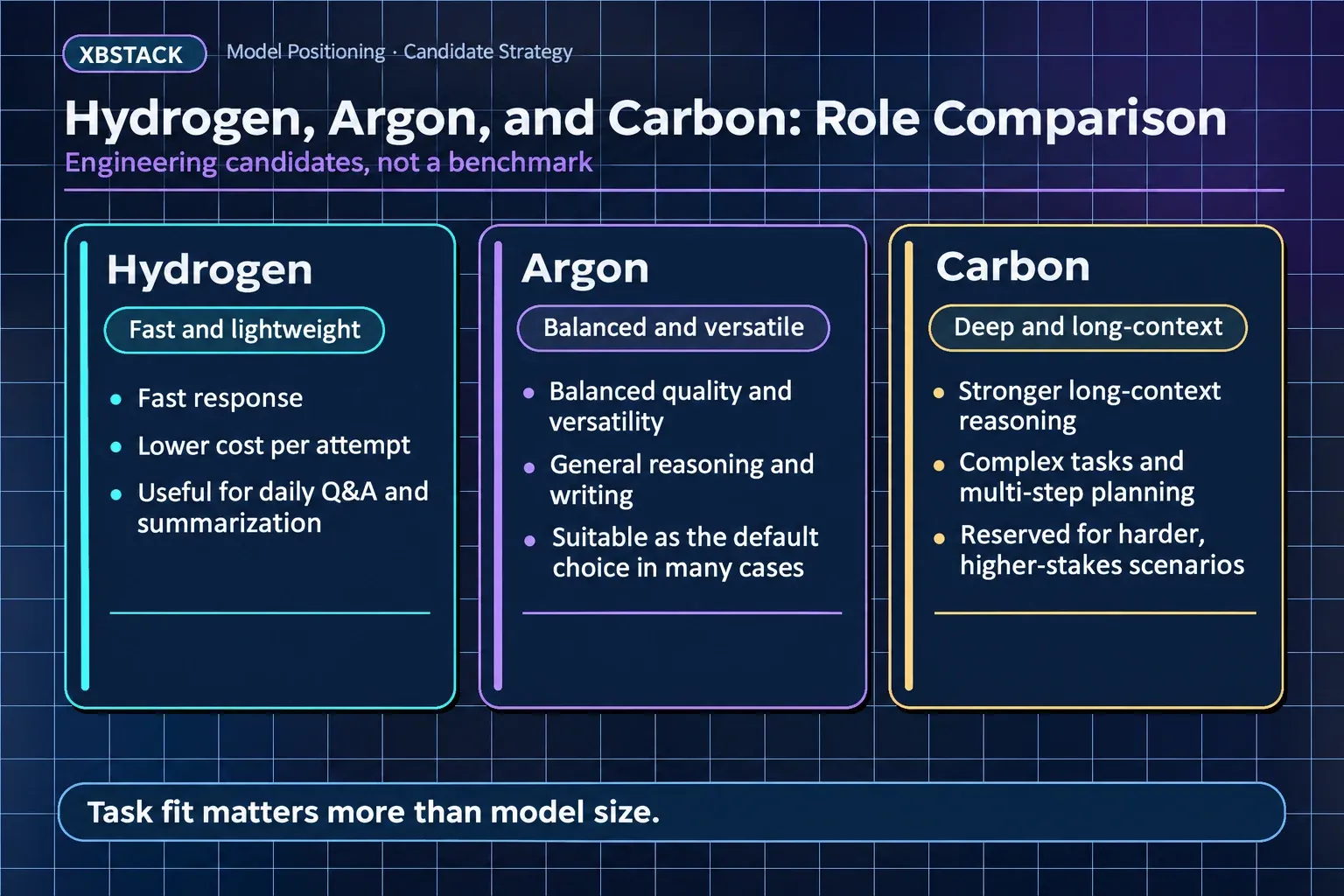
Figure: Engineering candidates are not a verified model ranking; evaluate under the same tools and acceptance rules.
Hydrogen is not merely a model for trivial work. It supports configurable thinking and its published capability varies by benchmark. On highly testable, repeated engineering actions, faster turnaround can be more valuable than choosing the nominally strongest model every time. Conversely, a long context and powerful reasoning model do not prove that it can safely execute a stateful action with external side effects.
Carbon and Argon have the same listed standard paid token prices as of November 17, even though their typical reasoning workloads can produce different effective bills. Hydrogen has a limited free API tier and a cheaper paid standard tier; this matters for a no-cost pilot but introduces different data-use and quota constraints.
| Model | Google’s primary positioning | Free developer API tier | Paid standard input / output per 1M tokens |
|---|---|---|---|
| Gemini 4 Hydrogen | Responsive everyday coding and agent tasks | Available with limits | 7.50 |
| Gemini 4 Argon | Broad engineering and reasoning | No | 10 through Nov 30; 20 starting Dec 1 |
| Gemini 4 Carbon | Deep reasoning, long multi-stage agents | No | 10 through Nov 30; 20 starting Dec 1 |
These are standard API figures, not guaranteed IDE subscription entitlements or total workflow costs. Billed output includes thinking tokens; tool execution, retrieval, caching, retries and taxes may add costs. Free Hydrogen traffic has rate and feature restrictions; Google’s free-tier terms allow data to be used to improve its products. A private, local-first knowledge base must not use a free cloud endpoint as an undisclosed automatic fallback. Google Gemini API pricing.
A handoff is not a copied conversation. A safe multi-model process transfers a validated task goal, tool permissions, committed checkpoints, observable results and unsettled external effects. It cannot assume that one model’s hidden reasoning state is a portable execution journal for another provider or configuration.
The architecture being evaluated is therefore a permissioned, checkpointed task system with model selection, not a leaderboard.
Three real engineering tasks require different routing policies
The test cases below differ in what can be verified: RecalAI requires source-linked evidence, Lunest requires deterministic overnight audio recovery, and XBSTACK requires actual build and deployment checks. Those boundaries are more decisive than a generic model leaderboard. The independent Agent evaluation guide explains why acceptance criteria must be fixed before a model comparison.
RecalAI: grounded citation quality is more important than model eloquence
A local knowledge-base question might ask: “Summarize every document mentioning the encryption retention decision, with exact source links.” There are several independent failure modes: incomplete retrieval, confusing documents with similar titles, negation errors, irrelevant passages, stale offsets after document edits, and an answer that attributes facts to nonexistent chunk IDs.
The proposed task boundary is deliberately deterministic before it becomes generative:
| Stage | Deterministic owner | Possible model role | What proves success |
|---|---|---|---|
| Import and parse | File identification, OCR, chunk offsets, hashes, local full-text index | No cloud model necessary | Traceable original file and chunk |
| Retrieve candidates | FTS/vector retrieval, reciprocal-rank fusion, filtering, deduplication | Optional, authorized reranking experiment | Relevant source recall and permission compliance |
| Select evidence | Known chunk whitelist, token budget, evidence pointers | Optional on-device or user-selected cloud synthesis | Each statement can be checked against allowed evidence |
| Verify answer | Citation-ID validation, file existence, offset integrity | Difficult authorized review may use Argon/Carbon | No unsupported citation, correct source jump |
A model’s fluent summary is not permission to skip the citation verifier. For RecalAI specifically, documents default to local storage and user-selectable cloud providers are configured via user-controlled API keys. Even when the user enables cloud synthesis, the router must respect the specific service, task and minimum required evidence scope. It must not upload an entire knowledge base because Carbon might provide a better answer. This privacy constraint can cause the correct outcome to be local-only execution or a clear refusal, not a hidden alternative provider.
Using Hydrogen for first-pass analysis and Carbon for final synthesis is not inherently correct. If deterministic retrieval already supplies the answer, an additional model can make it less reliable. If the task is hard but can only be completed by sharing confidential documents beyond consent, no priced model should run. These are proposed safeguards, not measured Gemini routing implementations.
RecalAI’s published hybrid retrieval case study provides relevant evidence-retrieval context. It does not document an already-shipped Gemini 4 router.
Lunest: why a repair agent should not be a sleep-monitoring agent
Lunest must preserve long-running audio playback and sleep sessions through incoming calls, Bluetooth changes, background process transitions, cache errors and device interruptions. Imagine a player losing audio focus in the sixth hour. Recovering the correct position requires an authoritative session identifier, actual decoder and route state, known playback progress, and a decision about whether the session should remain active.
A language model cannot replace the client’s audio lifecycle state machine. Neither the customer’s raw overnight recording nor a sleep analysis report should be uploaded to Carbon just to ask it what happened. The most realistic application of Gemini 4 routing here is software development and test triage, using non-sensitive synthetic traces of actual failure conditions.
A quick model may propose a focused patch for a reproducible playback issue. A deeper model can independently review interdependent iOS/Android session transitions, concurrent recovery paths or state ownership. But both are hypotheses. Only a compiled application, deterministic integration checks and an overnight hardware run can demonstrate that playback continuity is preserved.
The acceptance criterion is a complete and correct recovery without introducing a new regression, not “the model wrote convincing code.” If Carbon produces a longer analysis but fails the playback test, its effort cannot be counted as a success. If Hydrogen passes repeated tests without needing a stronger model, escalating by default adds cost without proven value.
Separating application-time intelligence from developer-time assistance also protects user privacy and keeps Lunest’s service boundary coherent: runtime sleep/session processing remains local; model assistance for code review is separately authorized and limited to appropriate development fixtures.
XBSTACK: a model can propose a release, but it cannot attest the release
The publishing workflow for XBSTACK offers a different but equally useful task benchmark. Bilingual articles need accurate citations, independent Chinese and English metadata, truthful AEO/GEO summaries, preserved canonical URLs, paired hreflang, and media that do not cross language versions incorrectly. A build can pass while a public deployment still fails or a search engine has not crawled the changed page.
One possible model route is to let Hydrogen perform narrow-source edits and evidence organization; use Argon for more interconnected technical or editorial decisions; reserve Carbon for ambiguous cross-system problems after a reproducible failure. Yet Astro checks, content gates, exact Git changes, public HTTP responses, and Search Console evidence must remain independently evaluated. The model cannot declare the site deployed merely because it wrote an apparently correct commit message.
This also gives a measurable stop rule: if a cheap model completes the edit and passes all acceptance gates, do not automatically spend a second model call. If repeated edits cannot reconcile a schema/canonical conflict, preserve the error and escalate review under a fixed budget. Never keep retrying after an ambiguous external operation without first checking its outcome.
For a bilingual article task, the finished result means correctly released URLs with verifiable HTML, not just high-quality-looking English or a generated sitemap.
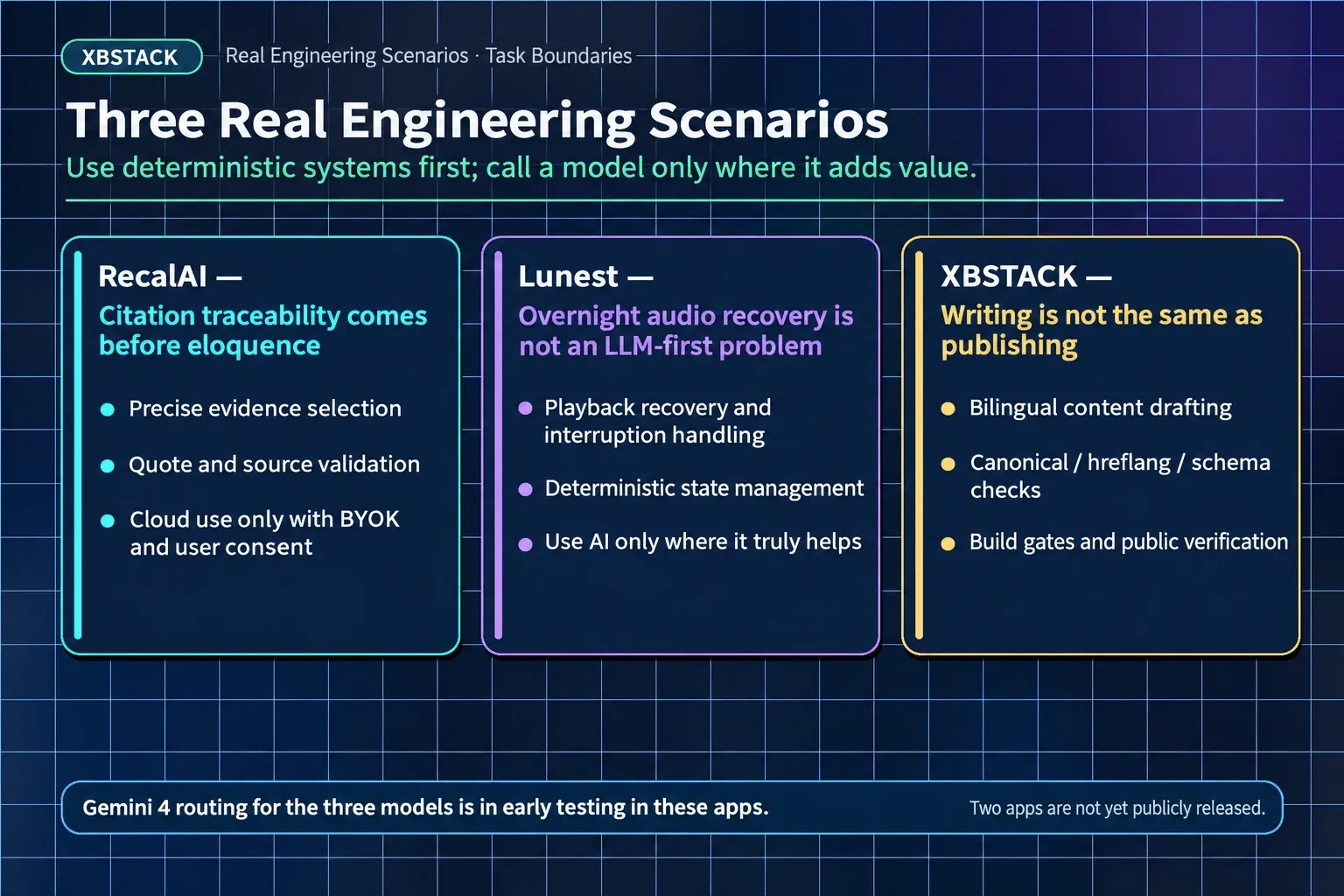
Figure: Deterministic checks come first; the three-model architecture has not been benchmarked in these projects.
Five policies every model router must enforce
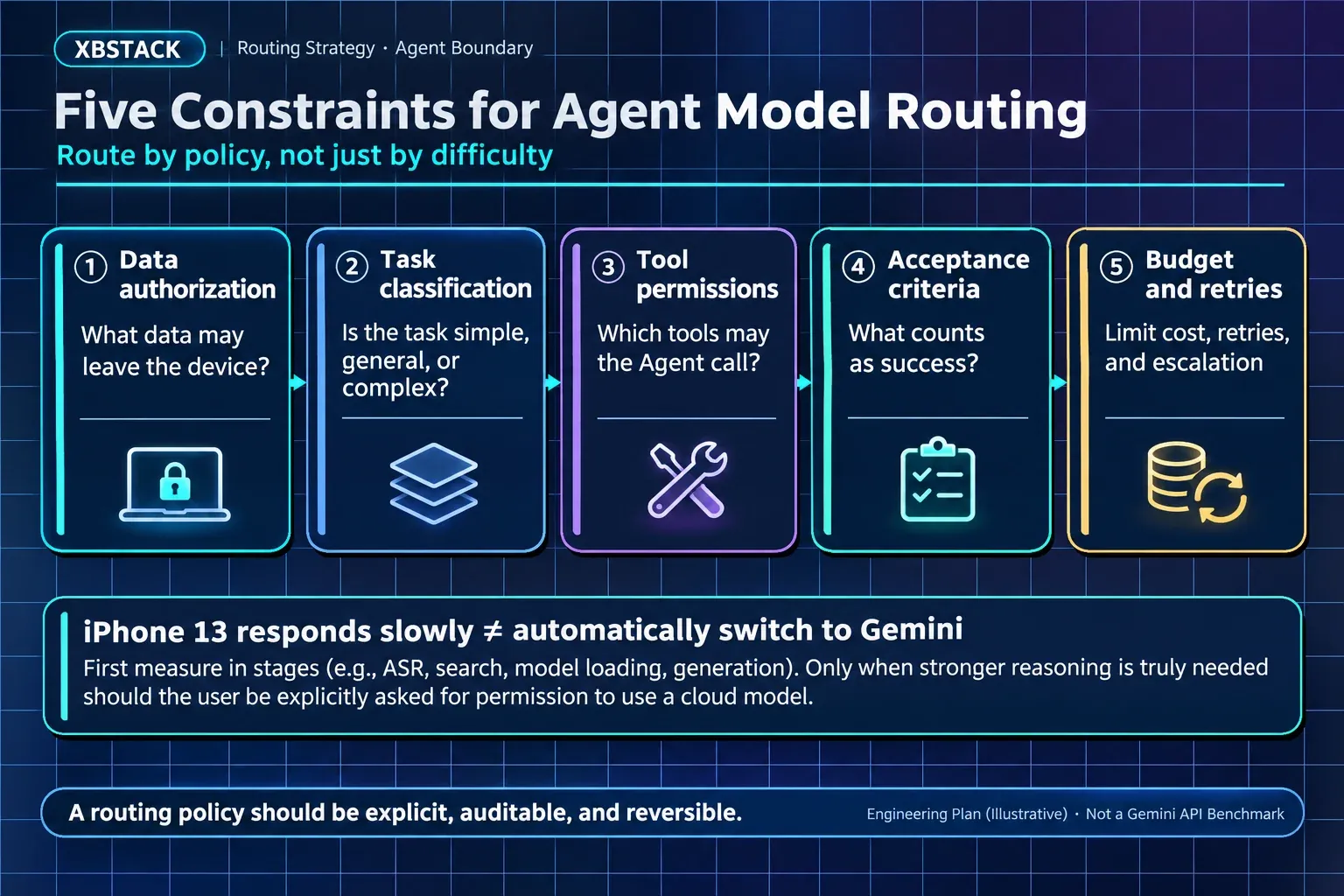
Figure: Model complexity does not override user consent or tool safety boundaries.
Data authorization. Each task records the actual data boundary: local-only, public code, user-authorized remote snippet or sensitive personal material. Default local data cannot be routed to a free API to save money. Switching providers never expands consent automatically.
Verifiability. Tasks with deterministic outcomes should use deterministic checks. A failing unit test, missing citation, mismatched canonical or broken playback state is not fixed by a model’s confidence score.
Side effects. Read-only research, draft edits, modifying local files and deleting remote records require different permissions. Stronger language models do not remove the need for user approval or idempotency.
Latency and money budgets. The route must know whether the task needs near-interactive response or can afford long review; its maximum output, thinking, retries, tools and human intervention should be bounded.
Escalation triggers. Complex unresolved evidence, repeated reproducible failures or cross-domain reasoning may justify Argon or Carbon. “The previous API returned an error” is not an automatic escalation trigger; sometimes it signals insufficient permissions, unavailable assets or a confirmed external action.
A deterministic/local → Hydrogen → Argon → Carbon → human review chain is a candidate policy to test, not a universal best-practice ranking. Safety-critical work may start with manual authorization, and some tasks may be unsuitable for cloud processing at every tier.
Compare cost per accepted task, not the price of one successful HTTP request
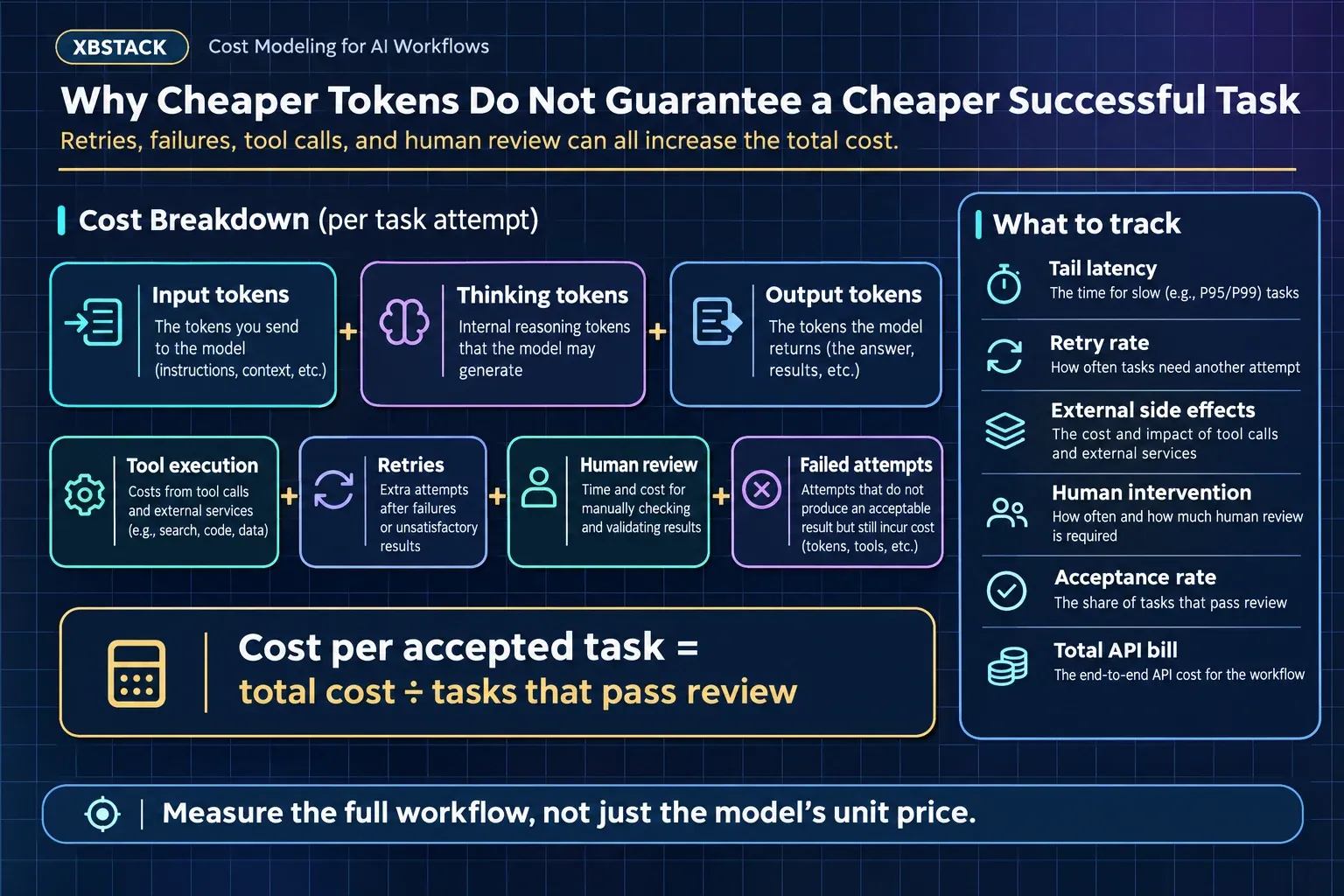
Figure: Lower per-token pricing does not necessarily lower the full verified task cost.
Consider a purely illustrative workload of 100,000 input and 20,000 output tokens in a single paid standard API request, held equal across models. Using November 17 advertised rates and ignoring cache or external tools:
| Model | Input | Output | Hypothetical sum |
|---|---|---|---|
| Hydrogen | 0.1 × 0.15 | 0.02 × 0.15 | $0.30 |
| Argon | 0.1 × 0.20 | 0.02 × 0.20 | $0.40 |
| Carbon | 0.1 × 0.20 | 0.02 × 0.20 | $0.40 |
These are arithmetic examples only. No real task was run, none of these models is known to use the same number of thinking tokens, and there is no measured success rate behind the table. Hydrogen’s limited free tier is a distinct product entitlement; its existence does not turn the paid price calculation into a free benchmark.
A useful evaluation metric is:
Cost per accepted successful task = total model, failed attempt, retry, tool and verification costs ÷ number of tasks passing independently fixed acceptance criteria.
For example, if a hypothetical set of 30 citation tasks produces 25 plausible summaries but only 18 pass the source-integrity gate, the denominator for accepted citations is 18, not 25. A returned HTTP 200 is not evidence of task completion.
To test a routing policy, compare four cohorts: Hydrogen-only, Argon-only, Carbon-only, and an explicit policy that uses local deterministic work and escalates only when needed. Pin the same inputs, permissions, tools, timeouts, output validation and human-review process. Track median and tail completion time, failure cause, retries, source integrity, actual billed tokens (including thinking), and human correction time.
Only then can a claim such as “routing saves money” be justified for these applications.
Model switching is dangerous when the previous tool call may already have succeeded
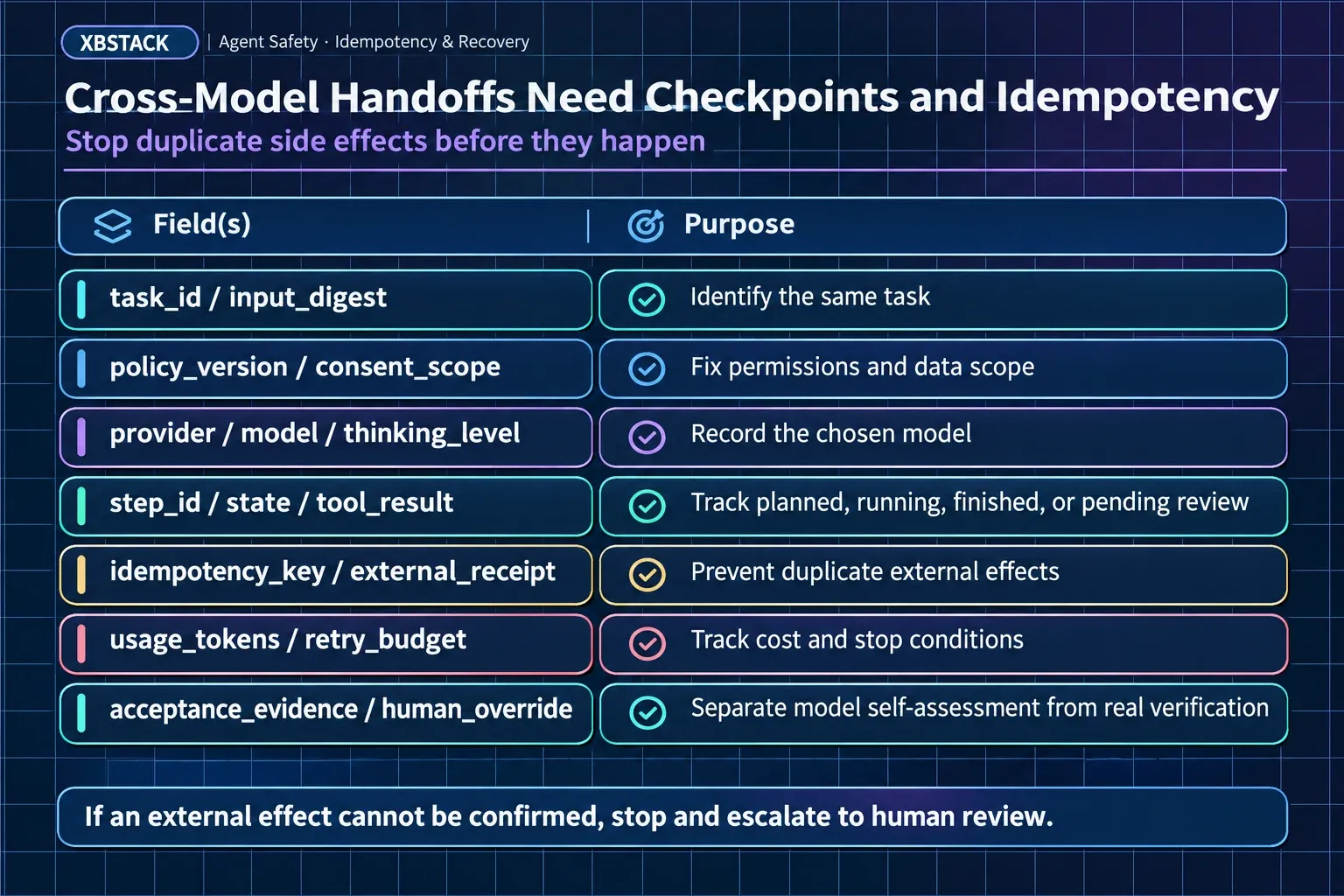
Figure: Stop and request human review when the result of an external side effect is uncertain.
The worst failure case is not a shorter answer; it is a duplicated external action. A file may have been written, a message sent or a publish step started, yet the original model’s response times out. The next model is given “the previous attempt failed” and repeats a side effect that was already committed.
A real routing ledger therefore needs:
| Record | What it protects |
|---|---|
task_id, input_digest | Identifies the same unit of work |
policy_version, consent_scope | Freezes allowed data and tools |
provider, model, thinking_level | Explains which route was used |
step_id, state, tool_result | Separates proposed, running, committed and uncertain actions |
idempotency_key, effect_receipt | Verifies external consequences before retry |
token_usage, retry_budget, cost | Supports spending limits |
acceptance_evidence, human_override | Distinguishes a model opinion from verified completion |
If a tool outcome cannot be verified, the safe state is needs investigation, not “run the same action with Carbon.” A summary of conversation context is insufficient as an audit trail. Model-internal reasoning blocks are not interchangeable transaction logs.
This same principle applies to a developer evaluating RecalAI and Lunest: use public, synthetic or expressly approved sanitized fixtures, rather than uploading someone’s private documents or sleep recordings as free testing material.
What would substantiate a multi-model advantage?
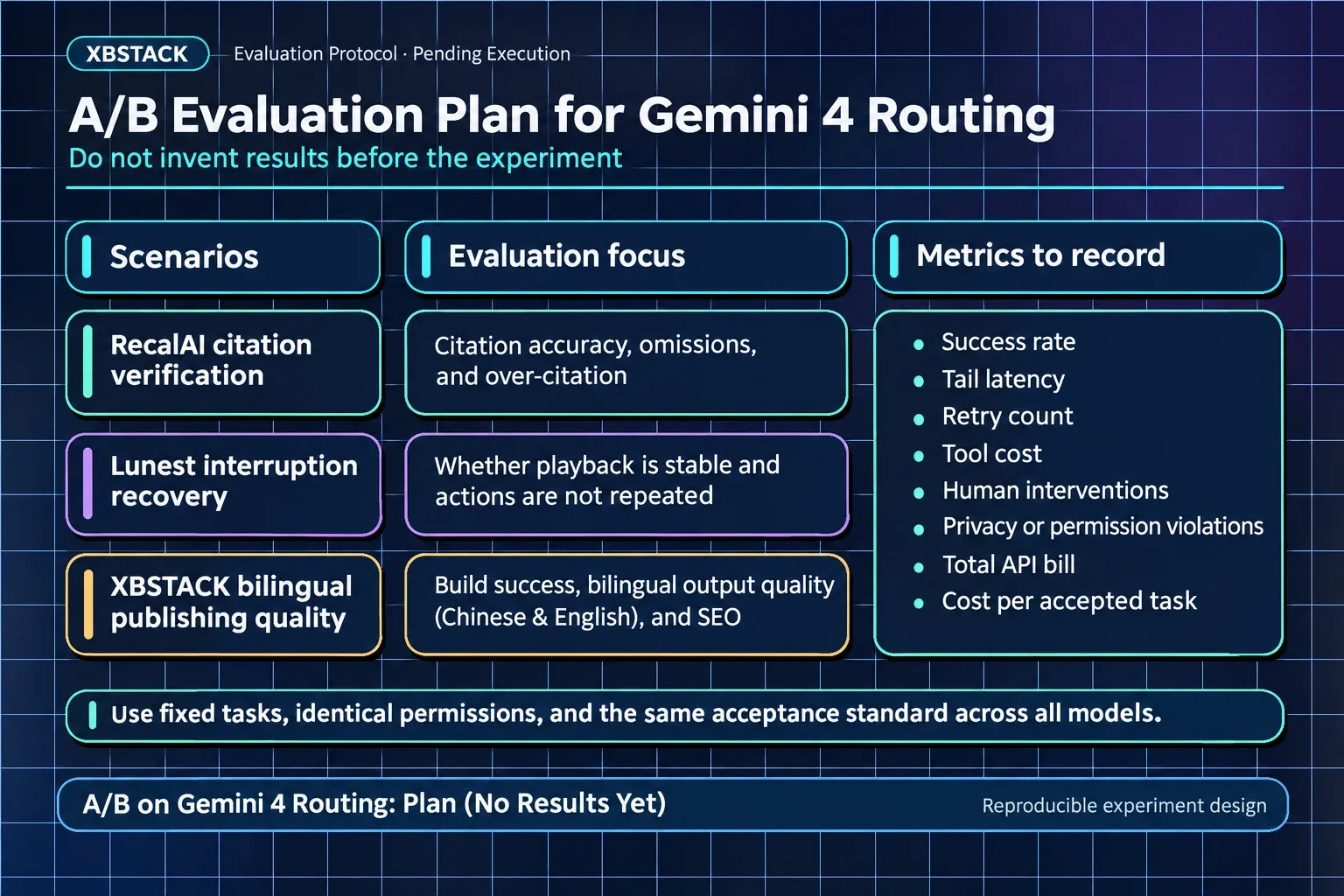
Figure: The graphic describes tests to run, not completed model performance or cost benchmarks.
Google describes an Orchestrator using Hydrogen and Carbon together in selected software-engineering benchmarks. That can motivate an experiment; it does not establish the same improvement in a personal knowledge app, sleep audio client or static website. Nor does availability in Antigravity prove that a fully managed, equivalent routing service is present in a developer’s Gemini API quota. Google’s developer announcement.
A defensible project-specific benchmark would include three independent task families:
- RecalAI citations: synthetic records with duplicate names, conflicting versions, negation and anchor offsets. Score source correctness, missing evidence, unauthorized disclosure and human repair effort.
- Lunest recovery: sanitized interruption traces for phone calls, Bluetooth changes, background playback, repeated start actions and corrupt audio cache. Score state correctness and real hardware playback continuity.
- XBSTACK publishing: known repository cases involving canonical/hreflang, bilingual media, GEO/schema truthfulness and old URL protection. Score actual validation and live release, not model self-assessment.
Results must separate provider-advertised capabilities, locally tested fixture outcomes and paid API usage receipts. Until the same projects run fixed Gemini 4 experiments, there is no legitimate “best model for our apps” verdict based on direct measurement.
Conclusion: the first optimization is often fewer model calls
A trustworthy agent assigns deterministic checks to deterministic tools, protects local data even when a free cloud endpoint exists, makes external actions auditable and refuses to call a more expensive model merely because a previous attempt failed. Hydrogen can be a strong candidate for testable high-frequency work; Argon for general cross-file reasoning; Carbon for unresolved long-horizon conflicts. Those are experiment hypotheses, not guaranteed results.
For RecalAI, Lunest and XBSTACK, the successful system is the one that proves a correct outcome, knows when it failed, preserves source integrity and respects the user’s data—not the system that lists the most frontier models on its settings screen.
The products behind these cases
Both RecalAI and Lunest remain in development and do not yet offer public app-store downloads. See the RecalAI project’s current Recalia-labeled product page and the Lunest product page for their actual scope. This study is not an announcement of deployed Gemini 4 three-model routing in either app.
Sources and evidence boundaries
- Google (Nov 12, 2026), Introducing Gemini 4 Hydrogen.
- Google (Nov 10, 2026), Gemini 4 Carbon now available.
- Google Developers, Build with Gemini 4 Hydrogen.
- Google Gemini API, official pricing and free-tier data terms.
- XBSTACK’s existing Argon API pricing and evaluation article covers an individual model’s stated specifications. This article deals with project-level routing, privacy and accepted task cost. Neither article establishes a live three-model benchmark.
What if the product should have no paid cloud API calls at all?
Paid model routing is not the default answer for a local-first application. Our separate free offline voice and local AI agent engineering analysis evaluates Apple Speech, Android ML Kit, MediaPipe/LiteRT, llama.cpp and limited free cloud tiers against RecalAI and Lunest constraints. It addresses the absence of an API invoice rather than comparing Gemini model rankings. For a closer look at speech-specific support, permissions, Mandarin coverage and interruptions, see the Google AI Edge offline ASR/TTS integration analysis.
Next step: continue the Agent system
Full decision path →Choose the next architecture, tool, memory, evaluation, security, or production decision instead of starting over.

DISCUSSION
Questions, verification and corrections
Sign in to comment. Every new comment is reviewed before publication; while pending, it is visible only to you and the administrator.