
Claude Fable 5.1 vs Mythos 5.1: Pricing, Access, Coding, and Agent Trade-offs
Claude Fable 5.1 and Mythos 5.1 share the same underlying model but differ in safeguards and access. Compare pricing, cache costs, coding benchmarks, and who should use each.
Evidence 3 cited sources
On this page
Claude Fable 5.1 and Claude Mythos 5.1 are not a normal “standard model versus stronger model” pair. Anthropic says they are the same underlying model with different safeguards and access rules. Fable 5.1 is generally available across Claude products, the API, and major cloud platforms. Mythos 5.1 is restricted to vetted cybersecurity and life-sciences organizations through trusted access programs.
If you are searching for Fable 5.1 vs Mythos 5.1, Fable 5.1 pricing, whether Mythos is available to regular developers, or whether Claude Code users should switch, the short answer is: most developers only need to evaluate Fable 5.1. Mythos 5.1 is not a premium tier you unlock by paying more; eligibility is the gate.
Evidence boundary: this is an official-information verification and developer decision guide, not an XBSTACK benchmark. We will only publish first-hand speed, success-rate, token, or cost comparisons after a controlled A/B using the same repository, prompt, tools, and acceptance criteria.
Are Fable 5.1 and Mythos 5.1 different models?
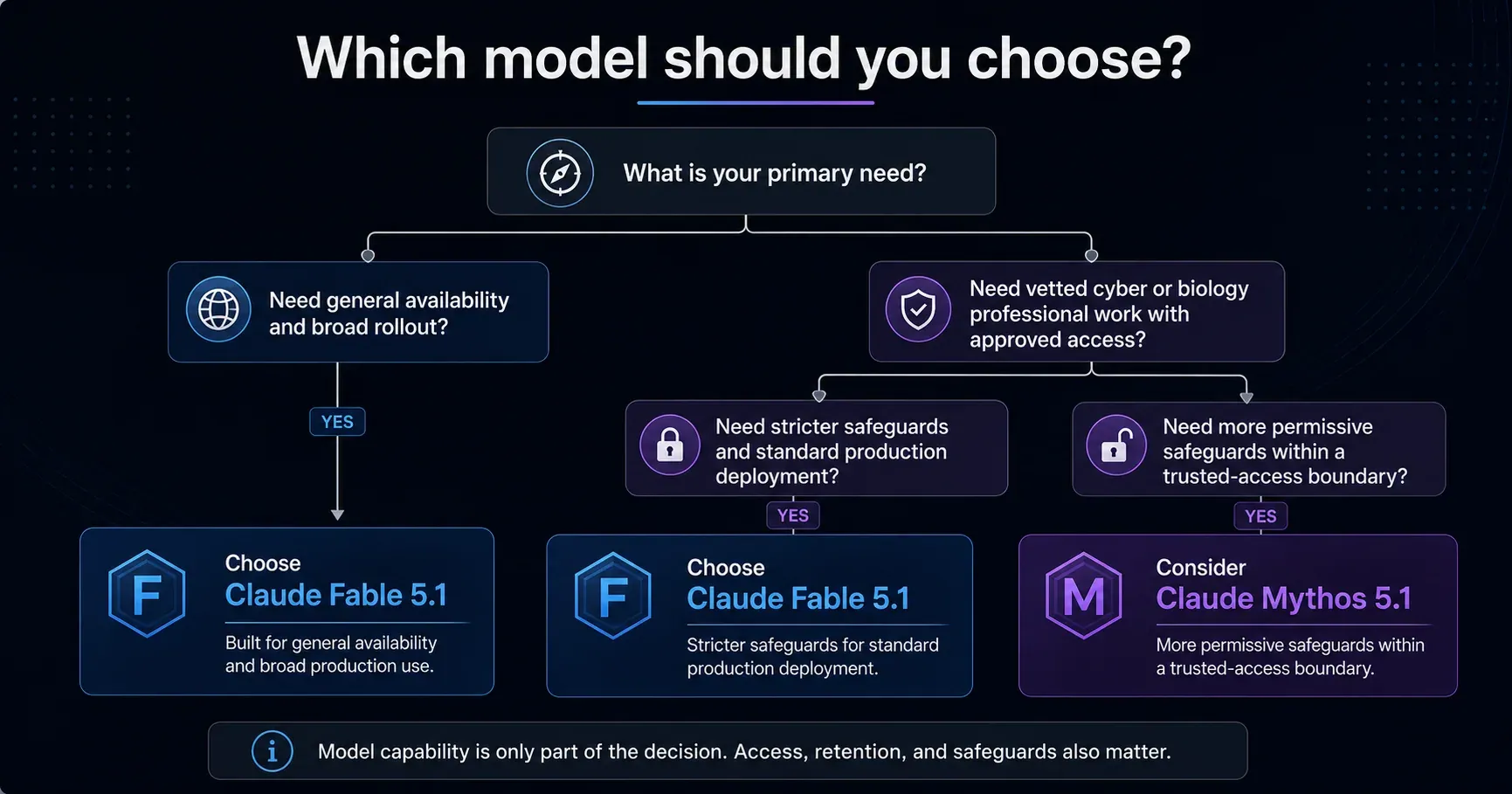
Anthropic explicitly states that Claude Fable 5.1 and Claude Mythos 5.1 are the same underlying model. The difference is how safeguards are applied and who is allowed to use the more permissive research configuration.
- Fable 5.1 is the generally available model for coding, knowledge work, and long-running tasks.
- Mythos 5.1 exposes a more permissive safeguard configuration for vetted cybersecurity defenders and life-sciences researchers.
That distinction matters because Mythos should not be treated as a conventional performance upgrade. For most product teams, the real decision is whether Fable 5.1 is worth adding to the model-routing and evaluation matrix.
Official source: Anthropic — Claude Fable 5.1 and Mythos 5.1
For a developer decision, the shared model specifications and the real access boundaries are easier to see side by side:
| Item | Fable 5.1 | Mythos 5.1 |
|---|---|---|
| Underlying model | Same as Mythos 5.1 | Same as Fable 5.1 |
| Context window | 1M tokens | 1M tokens |
| Max output | 128K tokens | 128K tokens |
| API input / output price | 50 per MTok | 50 per MTok |
| Availability | Generally available | Trusted-access / invite-only |
| Main difference | Cyber/biology safeguards and fallback behavior | More permissive safeguards for vetted professional work |
| Data retention | Anthropic says eligible enterprise customers can use ZDR while EFS rolls out | Anthropic’s Mythos page currently states a default 30-day retention policy for safety monitoring |
That makes Mythos 5.1 more than a model-performance choice. Eligibility, retention, and safeguard policy are architecture constraints alongside model capability and price.
What does Claude Fable 5.1 cost?
Fable 5.1 keeps the same base token rates as Fable 5:
| Billing item | Fable 5.1 official price |
|---|---|
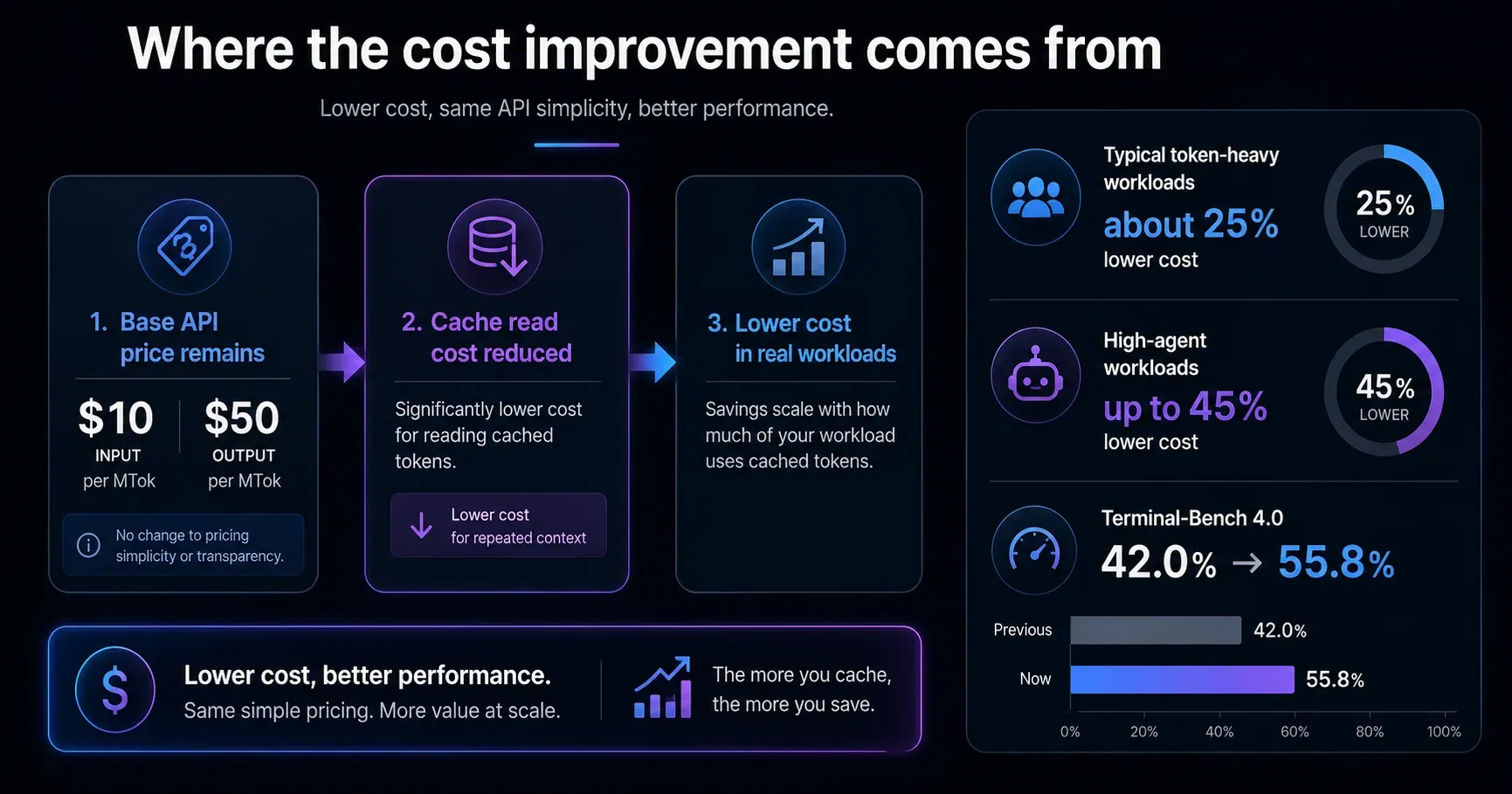
| Input | $10 / 1M tokens |
| Output | $50 / 1M tokens |
| Cache reads | $0.25 / 1M tokens |
The important change is cache-read pricing, which Anthropic says is 75% lower. Based on four weeks of August 2026 usage, Anthropic estimates this translates to about 25% lower total cost for typical Fable workloads and up to about 45% for highly agentic, context-heavy workloads.
Those percentages are Anthropic estimates, not XBSTACK measurements. Still, the mechanism is relevant to coding agents: repository context, tool schemas, project instructions, and long-running state are often read repeatedly, so cache economics can affect cost per completed task more than a simple headline input-token rate suggests.
Why is Fable 5.1 relevant to coding agents?
Anthropic positions Fable 5.1 around coding, knowledge work, and long-running problem solving. Its launch page reports:
| Benchmark | Fable 5.1 | Fable 5 | Opus 5 | GPT-5.6 Sol |
|---|---|---|---|---|
| Terminal-Bench 4.0 | 55.8% | 42.0% | 52.3% | 37.3% |
| CursorBench 3.2.0 | 73.4% | 70.5% | 70.0% | 67.2% |
| AutomationBench | 31.4% | 17.1% | 26.9% | 19.6% |
These are vendor-reported benchmark results under specific evaluation setups. They do not prove that Fable 5.1 will outperform another model on your codebase. Anthropic also notes uncertainty on Terminal-Bench-Science and explains that safeguards can affect scores on some tasks.
For XBSTACK, the useful next test is a controlled real repository task: inspect an existing Astro project, modify multiple files, run validation, preserve unrelated changes, and compare task completion, diff quality, build success, token usage, cache behavior, and human correction cost.
Should Claude Code users switch immediately?
Fable 5.1 is worth evaluating if your Claude Code workload is dominated by long repository sessions, multi-file changes, tool use, and repeated context reads. Three changes matter most:
- Long-running task positioning: Anthropic is explicitly optimizing for sustained work rather than only short responses.
- Lower cache-read cost: potentially important for repository-heavy and tool-heavy sessions.
- More precise cybersecurity safeguards: Anthropic says Claude Code sessions should see about 60% fewer interventions from its cyber safeguards compared with the previous Fable 5 safeguards.
A direct switch is not automatically justified for short edits or cost-sensitive lightweight tasks because the base 50 token rates remain high. The right metric is cost per accepted task, not price per million tokens in isolation.
Can normal developers access Mythos 5.1?
Not as a standard public model tier.
Anthropic currently places Mythos 5.1 behind trusted access programs for:
- vetted defensive cybersecurity work;
- vetted professional life-sciences research.
The company says access is currently limited to a set of US organizations and plans to expand it. That means normal developers should not design a default production route that depends on Mythos availability.
Fable 5.1 vs Mythos 5.1: which should you choose?
| Use case | Practical choice |
|---|---|
| General coding and knowledge work | Evaluate Fable 5.1 |
| Long-context coding agents and tool-heavy agents | Evaluate Fable 5.1 with cache-hit and task-cost measurements |
| Approved defensive cybersecurity research | Apply for Mythos access if eligible |
| Approved life-sciences research | Apply for Mythos access if eligible |
| You only want a “stronger Fable” | Do not treat Mythos as a normal upgrade tier |
The selection variables are task type, eligibility, cache-hit rate, total cost per completed task, human review cost, and safeguard requirements.
What this release means for agent engineering
The most useful signal is not a single leaderboard score.
First, model vendors are increasingly competing on cost per long-running task, not only token list price. Cache reuse, context growth, tool loops, and retries matter heavily in real agents.
Second, one underlying model can now be exposed through different permission and safeguard layers. Model routing therefore needs to consider access policy and organizational eligibility alongside quality and price.
Third, models are being pushed toward longer autonomous execution. That increases the importance of Tool Authorization, Human Gates, durable state, and observability around the model.
Continue with:
- AI Agent Frameworks 2026: LangGraph vs Google ADK vs Microsoft Agent Framework vs AI SDK 7
- AI Agent Tool Authorization Policy Gate
- AI Agent Observability: Trace, Tool Calls, State, Cost, and Quality
Is Fable 5.1 worth using now?
Teams already using Fable 5 for Claude Code, Claude API, or complex knowledge work should put Fable 5.1 near the top of their controlled A/B queue. Regular developers do not need Mythos 5.1 as an upgrade target.
Until XBSTACK completes a controlled real-project evaluation, we will not claim a specific speedup, success-rate gain, or universal win over GPT-5.6 or Opus. What can be verified today is the official availability, pricing, cache-read change, benchmark disclosure, and safeguard/access split.
The next search question worth answering with evidence is:
On the same real multi-file coding-agent task, how do Fable 5.1 and the current default model compare on completion rate, change scope, build success, tokens, cache hits, and human correction cost?
Official sources
Continue from one agent pattern to the complete production system
The AI Agent hub organizes architecture, memory, tool use, evaluation, security, deployment and multi-agent coordination into a single learning path.
Next step: continue the Agent system
Full decision path →Choose the next architecture, tool, memory, evaluation, security, or production decision instead of starting over.

DISCUSSION
Questions, verification and corrections
Sign in to comment. Every new comment is reviewed before publication; while pending, it is visible only to you and the administrator.