Gemini 3.8 Flash vs 3.7 Flash: Same Price, Different Agent Cost?
Gemini 3.8 Flash vs 3.7 Flash: compare price, 1M context, thinking levels, AI coding, AIGC, Claude/GPT selection context, agent routing, migration and token cost.
Evidence 5 cited sources
On this page
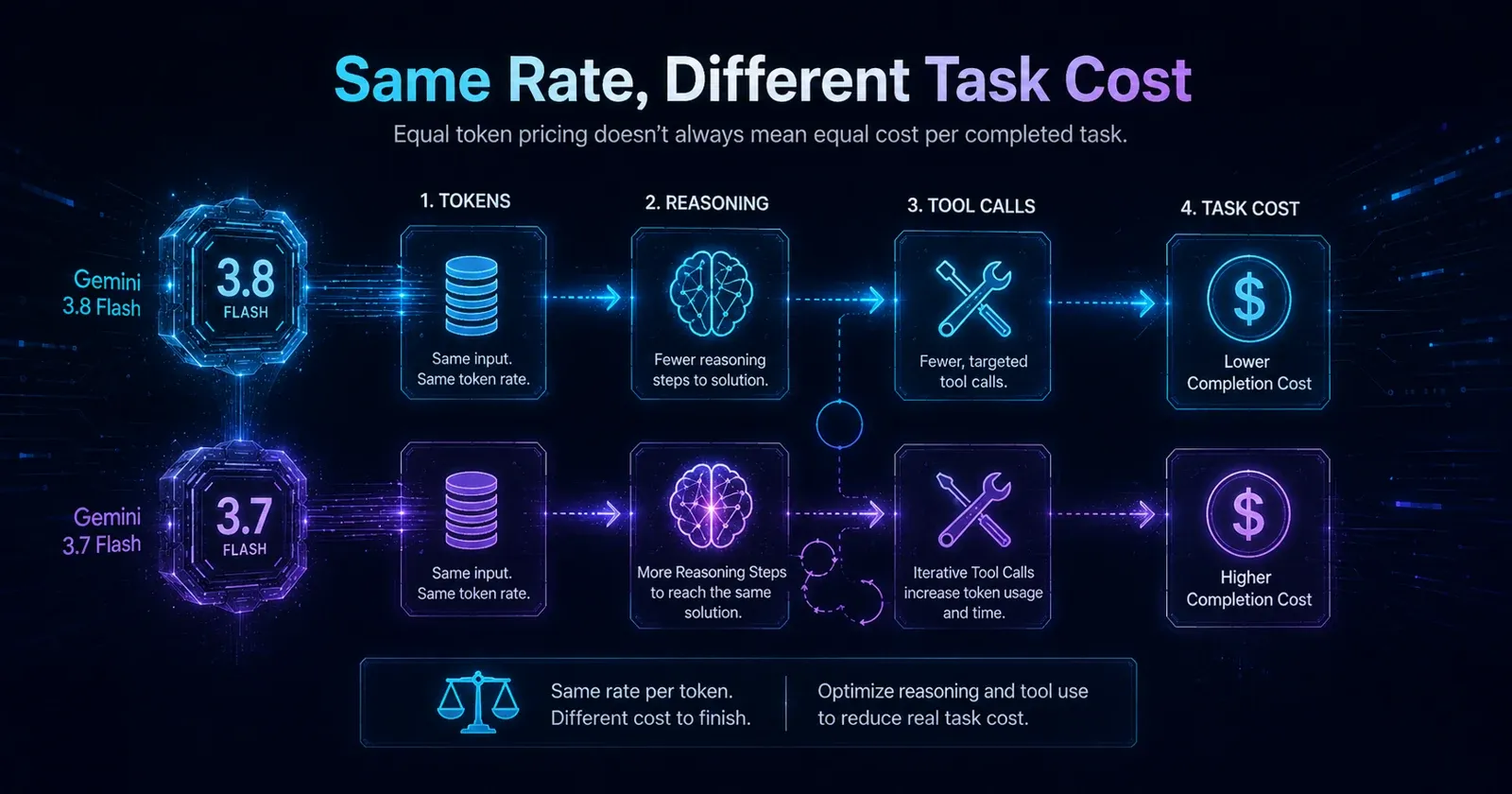
The most important Gemini 3.8 Flash vs 3.7 Flash distinction is not the API rate card. The two models currently have the same token prices, but that does not mean they will cost the same to finish the same job. Google released Gemini 3.8 Flash on September 2, 2026 and kept the same introductory input/output rates as 3.7 Flash. At the same time, Google explicitly says 3.8 “works harder” on complex tasks: it can take more reasoning steps, call tools iteratively, and verify its work, which can increase token use on longer agentic runs.
If you are searching for Gemini 3.8 Flash vs 3.7 Flash, 3.8 pricing, the API model ID, whether coding agents should upgrade, or why the same token price can still produce a higher bill, the practical answer is: 3.8 is a stronger migration candidate for long-horizon software engineering and multi-tool agents; stable, latency-sensitive and efficiency-first workloads do not need to leave 3.7 just because a newer model exists.
Evidence boundary: this page is an official-evidence migration and model-selection guide, not an XBSTACK API A/B benchmark. We have not yet run 3.8 and 3.7 through the same repository tasks, prompts, thinking levels and tool permissions in a repeatable test matrix, so Google benchmark results remain Google results rather than “our tests.”
Gemini 3.8 Flash vs 3.7 Flash at a glance
| Item | Gemini 3.8 Flash | Gemini 3.7 Flash |
|---|---|---|
| Model ID | gemini-3.8-flash | gemini-3.7-flash |
| Release status | GA | GA |
| Context window | 1M tokens | 1M tokens |
| Max output | 64K tokens | 64K tokens |
| Thinking levels | low / medium / high | low / medium / high |
| Default thinking | medium | medium |
| Input price through 2026-12-31 | $0.75 / 1M tokens | $0.75 / 1M tokens |
| Output price through 2026-12-31 | $3.75 / 1M tokens | $3.75 / 1M tokens |
| Primary positioning | Long-horizon software engineering, autonomous agents, complex enterprise workflows | Efficient coding, agents and reliable multi-step execution |
| Still supported by Google | Current flagship Flash | Yes, fully supported |
Google’s current pricing documentation also gives a date for the next step: the introductory rates run through December 31, 2026. Starting January 1, 2027, the listed standard rates become 7.50/M output tokens.
That means the obvious specification table is not where the real decision lives. The bigger difference is how the model spends reasoning and tool-use budget inside a task.
Official source: Gemini API — What’s new in Gemini 3.8 Flash
Why can Gemini 3.8 cost more per task if the token rate is identical?
Google is unusually explicit about this trade-off. On difficult tasks, 3.8 may take smaller reasoning steps, call tools multiple times and verify intermediate work. At higher effort levels, this can increase token consumption.
So a production model-cost calculation should not stop at:
input rate + output rate
A better unit is:
task completion cost = input tokens + output/thinking tokens + extra tool-call turns + retries/failures + human correction time
If 3.8 consumes more tokens but significantly reduces failed loops, rework and manual correction, it may still reduce the cost of completing the job. If the job is simple and already succeeds in one pass, extra reasoning can simply become extra spend.
That is why Google presents both paths as valid:
- use 3.8 with medium/high effort for hard workflows;
- lower the effort for efficiency-sensitive work, or keep using 3.7 Flash.
For XBSTACK, that is the key reason we will not translate “same price” into “same task cost” without a controlled workload test.
What actually improved for coding and agents?
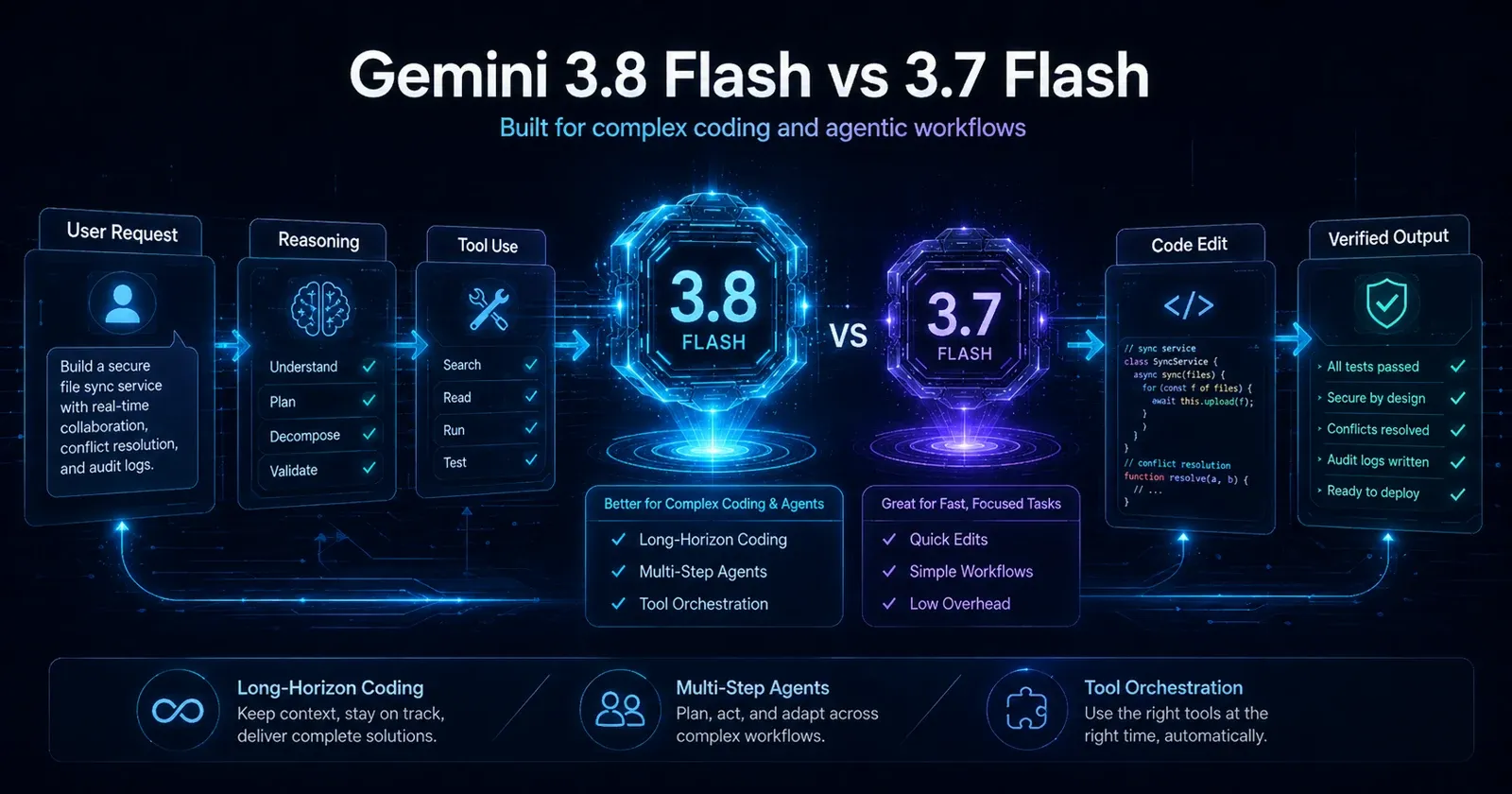
Google positions Gemini 3.8 Flash around long-horizon software engineering and autonomous agents, not generic chat quality.
The launch material points to four practical areas:
- Long-running software engineering: multi-file and multi-stage tasks that require continued verification;
- Agentic workflows: multi-step planning and tool orchestration with fewer failed loops;
- Complex professional workflows: analytical and reporting tasks that need multiple checks;
- Iterative tool verification: more willingness to use tool feedback to refine a result instead of stopping after one generation.
Google’s published DeepSWE and Vals Finance Agent results support that direction, but they remain vendor evaluations. Whether 3.8 is better in your repository still depends on tool definitions, codebase size, run length, recovery design and budget constraints.
How do you call Gemini 3.8 Flash in the API?
The model ID is straightforward:
gemini-3.8-flash
Google currently labels the model GA and provides examples through the Gemini Interactions API.
The migration work is more important than the model string. Google’s 3.8 migration checklist calls out several configuration changes:
- remove deprecated
temperature,top_pandtop_kgeneration parameters; - replace
thinking_budgetwith the stringthinking_levelenum; - do not use
minimalwith 3.8 Flash; - remove unsupported
candidate_count; - standardize multi-turn conversations on server-side
previous_interaction_id; - audit function-calling payloads, including
call_idandnamewhere required; - do not assume older Gemini 2.x or early 3.x sampling/prompt behavior will migrate unchanged.
If a project only replaces gemini-3.7-flash with gemini-3.8-flash and ignores those constraints, a migration error can easily be mistaken for a model-quality regression.
Which thinking level should you use?
Google’s current guidance maps cleanly to a production routing strategy:
| Workload | Reasonable starting point | Why |
|---|---|---|
| Real-time chat, short summaries, light data work | low | Prioritize latency and token efficiency |
| Code analysis, general agents, multi-step business flows | medium | Default balance of quality and cost |
| Hard reasoning, difficult coding, complex multi-tool workflows | high | Maximize reasoning and tool orchestration |
Do not treat high as a universal production default. One common way to waste agent budget is to run every task at maximum reasoning intensity.
A better policy is task routing: simple jobs on low, complex jobs on medium, and only truly hard paths on high.
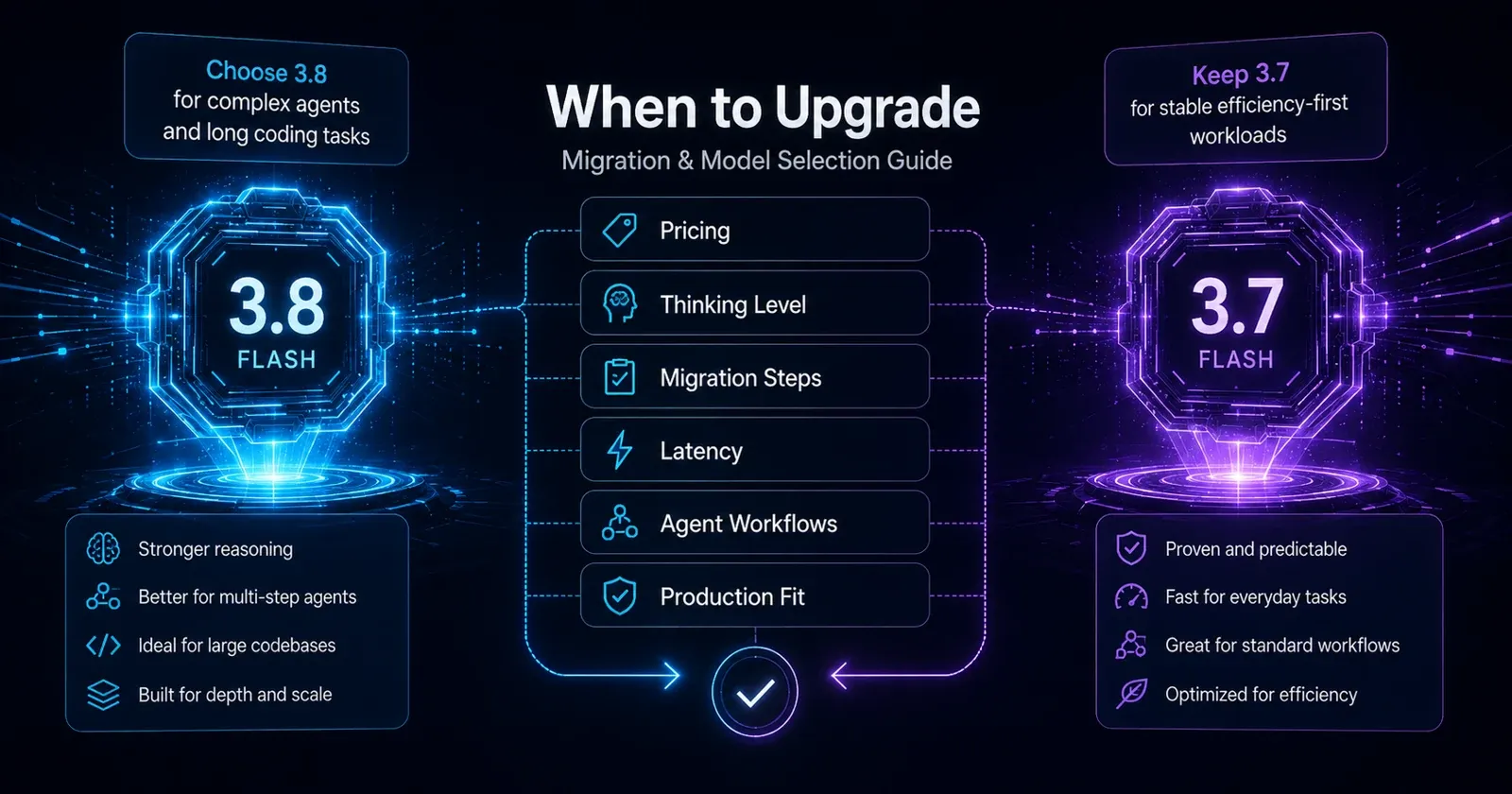
Should existing Gemini 3.7 Flash workloads upgrade now?
Stronger candidates for immediate 3.8 evaluation
- coding agents that routinely edit multiple files;
- workflows that run across many steps and repeatedly execute tests or builds;
- agents that call multiple tools and plan from their results;
- workloads where 3.7’s main problem is failed loops or human takeover rather than single-call latency;
- systems that already record token use, success rate, retries and correction time per task.
Reasons to stay on 3.7 for now
- the workload is stable and cost/latency are already predictable;
- tasks are short and tool use is light;
- you do not yet have a repeatable regression suite to measure migration impact;
- per-task token budget matters more than hard-task completion rate.
Google explicitly says 3.7 Flash remains fully supported, so there is no official “3.8 shipped, therefore migrate now” requirement.
Is Gemini 3.8 Flash Cyber just a stronger 3.8 Flash?
Not for normal API selection.
Gemini 3.8 Flash Cyber is intended for high-permission defensive cybersecurity work and is distributed through the Fairwind Program to trusted governments, critical-infrastructure operators, software maintainers and other approved defenders. It has a different safety/access boundary and should not be treated as the normal “Pro” tier of Gemini 3.8 Flash.
For ordinary coding agents and enterprise workflows, the useful comparison is 3.8 Flash vs 3.7 Flash, not “can I get Cyber?”
Gemini 3.8 Flash vs 3.7 Flash: which one should you choose?
| Situation | More reasonable choice |
|---|---|
| New complex coding agent | Evaluate 3.8 Flash first |
| Existing agent has multi-step failure loops | Run a controlled 3.8-vs-3.7 regression suite |
| Cost-sensitive short tasks | Keep 3.7 or test 3.8 at low effort |
| “Same price means automatic upgrade” | Compare per-task tokens and completion cost first |
| Need high-permission cyber defense | Review 3.8 Flash Cyber/Fairwind eligibility separately |
| No regression suite exists | Build the task set before migrating |
If you are also comparing the newest Claude coding/agent releases, see Claude Fable 5.1 vs Mythos 5.1: pricing, access, coding and agent trade-offs. Read together, the releases point to the same broader trend: model competition is moving from single-turn chat scores toward long-running coding, agent tool use and total cost to complete a real task.
To turn that model choice into production routing, cost controls, approvals and regression evaluation, continue with Production Governance for AI Agents. For repository, issue, log and engineering workflows, use AI Developer Engineering Agents as the next implementation layer.
What would a real XBSTACK benchmark need to test?
A useful test should not repeat a vendor leaderboard. It should lock a set of real tasks:
- the same multi-file code change;
- the same tool-calling agent workflow;
- the same long-document or data-analysis job;
- identical thinking levels and tool permissions;
- success rate, manual edits, input/output tokens, tool-call count and final cost;
- at least one preserved failure case instead of only best-case outputs.
Only after that matrix is repeatable should “3.8 is more reliable” or “3.8 is cheaper per completed task” become an XBSTACK hands-on conclusion.
FAQ
Is Gemini 3.8 Flash available through the API now?
Yes. Google’s developer guide lists gemini-3.8-flash as GA and provides Interactions API examples.
Is Gemini 3.8 Flash more expensive than 3.7 Flash?
Not on the current per-token rate card. Both are 3.75/M output through December 31, 2026. But 3.8 can use more reasoning/tool-call tokens on difficult tasks, so the total bill for one completed task can differ.
What is the Gemini 3.8 Flash context window?
Google currently lists a 1M-token context window and a 64K-token maximum output.
Does Gemini 3.8 Flash support minimal thinking?
No. The current supported levels are low, medium and high. Google says minimal will return an error.
Is Gemini 3.7 Flash being discontinued?
Google explicitly says 3.7 Flash remains fully supported and presents it as an option for efficiency-first workloads.
Should I switch production traffic directly to 3.8?
Not based on the version number alone. Run your real regression tasks first and compare success rate, token use, tool calls, corrections and latency before changing the default route.
Official sources
- Google — Introducing Gemini 3.8 Flash and 3.8 Flash Cyber
- Gemini API — What’s new in Gemini 3.8 Flash
- Gemini Developer API pricing
- Google DeepMind — Gemini 3.8 Flash Model Card
- Google DeepMind — Gemini 3.7 Flash Model Card
Continue from one agent pattern to the complete production system
The AI Agent hub organizes architecture, memory, tool use, evaluation, security, deployment and multi-agent coordination into a single learning path.
Next step: continue the Agent system
Full decision path →Choose the next architecture, tool, memory, evaluation, security, or production decision instead of starting over.

DISCUSSION
Questions, verification and corrections
Sign in to comment. Every new comment is reviewed before publication; while pending, it is visible only to you and the administrator.