AI Agent Tool Authorization: Policy Gates, HITL, and Per-Call Access Control
The local lab is a deterministic Python Policy Gate. It does not integrate a specific Agent SDK, commercial authorization engine, or real enterprise identity platform. It verifies policy layering and decisions, not legal, regulatory, or zero-trust compliance for an organization.
AI Agent Tool Authorization: Policy Gates, HITL, and Per-Call Access Control
An Agent that can see send_email, query_customer, and issue_refund has been given capabilities. That does not mean every model-generated call is authorized. One of the most dangerous architecture mistakes is treating “the tool is registered,” “the arguments match JSON Schema,” “the guardrail passed,” and “the user may execute this action” as the same fact.
Consider a call that is syntactically valid: query a customer record, then send the result to an external email address. The input can look normal, the arguments can match the schema, and both tools can belong to the Agent. The combination can still be data exfiltration. What is missing is a deterministic pre-execution authorization layer that reads trusted identity, tenant, scope, resource ownership, destination, and exact arguments before a real side effect occurs.
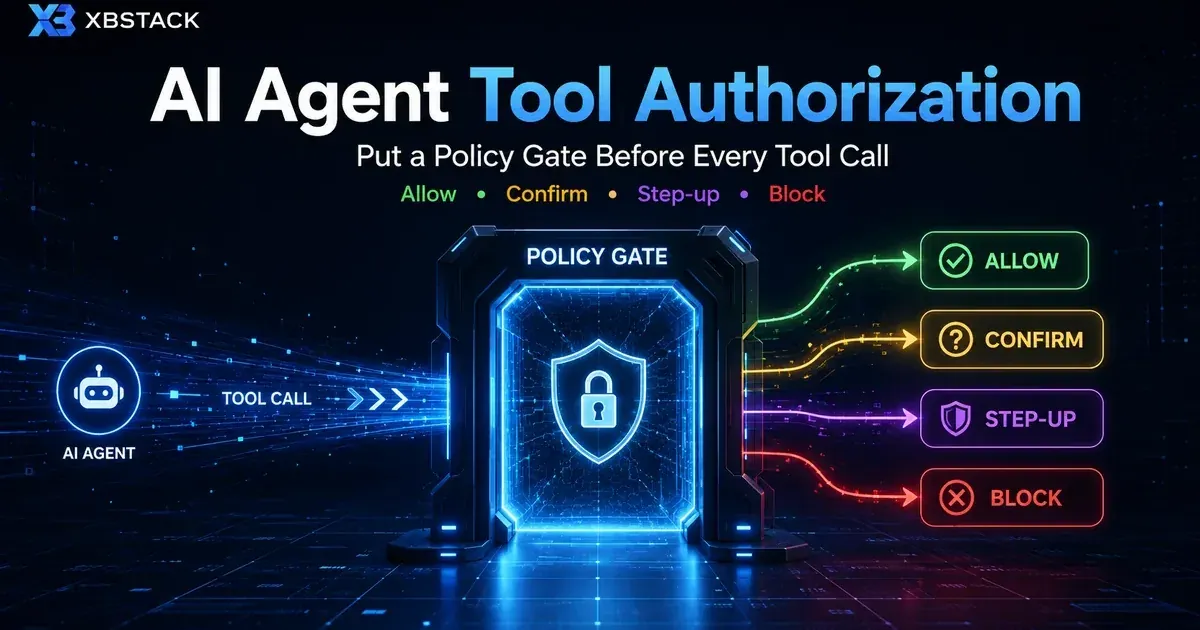
The load-bearing design rule is: put a Policy Gate between the model output and the Tool Executor, not only in the prompt, UI confirmation, or tool description. At minimum, it should return ALLOW, REQUIRE_CONFIRM, STEP_UP, or BLOCK, and generate a structured, redacted, traceable audit record for every decision.
Guardrails, HITL, and authorization solve different problems
The OpenAI Agents SDK documents Tool Guardrails and Human-in-the-loop. Tool Guardrails can inspect function-tool input and output, block or replace results, and trigger a tripwire. HITL can turn a sensitive call into an interruption that waits for approval or rejection. Guardrails Human-in-the-loop
Authorization remains distinct. Issue #2868 requests per-tool authorization middleware that evaluates identity, role, scope, rate limits, and session context before execution, supports non-binary decisions, and emits structured audit records.
| Layer | Question | Typical inputs | Typical result |
|---|---|---|---|
| Authentication | Who is calling? | Token, certificate, session | Verified principal |
| Capability exposure | Which tools can the Agent see? | Registry, filters | Candidate tool set |
| Guardrails | Is the content or argument shape safe and valid? | Prompt, arguments, result | Pass, block, replace, tripwire |
| Authorization | May this principal execute this exact call now? | Identity, tenant, scope, resource, parameters, policy | ALLOW, BLOCK, STEP_UP, DEFER |
| HITL | Does a person need to decide this call? | Pending call and context | Approve, reject, edit, expire |
| Idempotency | Will the same side effect land only once? | Stable key and ledger | Execute once or reuse result |
HITL can handle REQUIRE_CONFIRM, but it cannot replace authorization. Cross-tenant access, missing scope, and unknown tools should normally be blocked immediately rather than consuming human review capacity.
Where the Policy Gate belongs
A production topology should look like this:
User Request
  -> Agent / Model
  -> Proposed Tool Call + Arguments
  -> Policy Enforcement Point
       -> Identity verification
       -> Tenant and ownership check
       -> Scope / role check
       -> Argument and destination policy
       -> Risk and assurance evaluation
       -> ALLOW / REQUIRE_CONFIRM / STEP_UP / BLOCK
  -> Approval Service when required
  -> Idempotency Ledger
  -> Tool Executor
  -> Audit / Trace
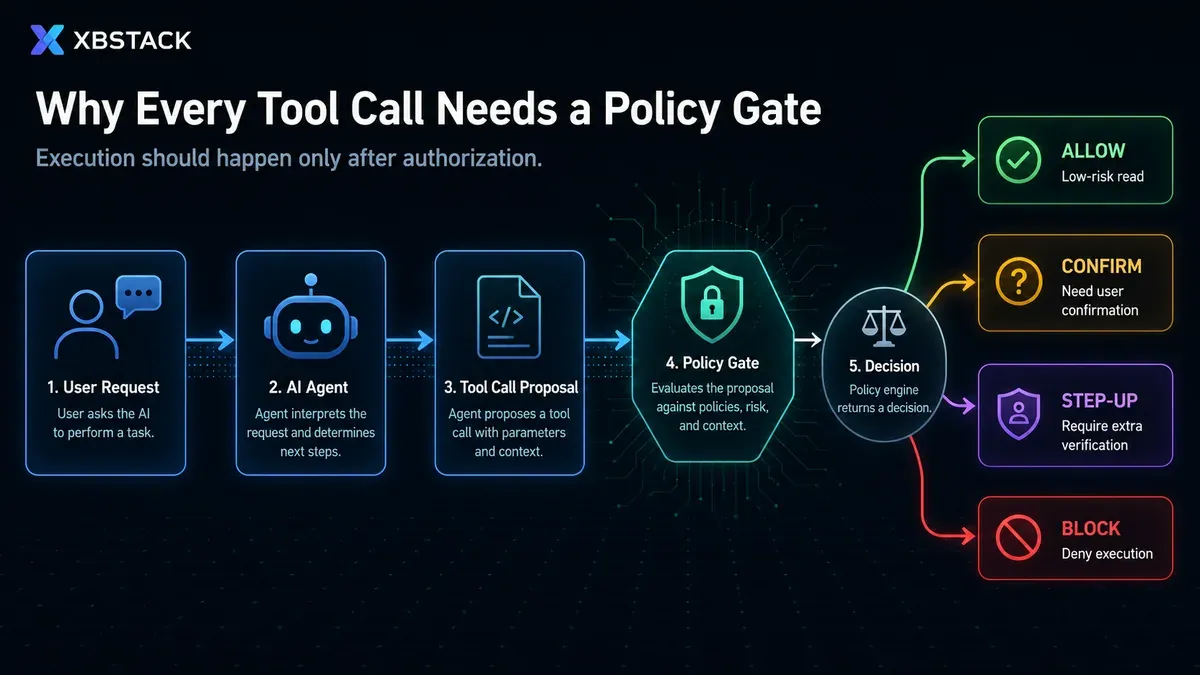
The Policy Enforcement Point intercepts the call; a Policy Decision Point evaluates the rules. A small application can keep both in one process. A distributed platform can use a gateway or external policy service. Two conditions are non-negotiable:
- the Tool Executor cannot be reached around the gate;
- identity and tenant context cannot come from model-generated arguments.
The model may propose target_tenant_id=tenant-b, but the trusted tenant must come from a verified session, service token, or gateway context. Treating model-generated tenant data as an authorization fact is equivalent to letting the request sign its own access pass.
The local lab: seven per-call decisions
The experiment lives in:
experiments/agent-tool-authorization-policy-gate/
It evaluates a trusted principal and a proposed call:
Principal(
    user_id="user-17",
    tenant_id="tenant-a",
    scopes={"customer:read", "email:send", "refund:write"},
    assurance_level=1,
)

ToolCall(
    name="issue_refund",
    arguments={"amount": 8000, "currency": "CNY"},
    target_tenant_id="tenant-a",
    risk_level="write",
)
All seven deterministic cases pass:
| Case | Expected decision | Result |
|---|---|---|
| Same-tenant customer read | ALLOW | Allowed |
| Cross-tenant customer read | BLOCK | Denied immediately |
| Customer data sent to an external recipient | REQUIRE_CONFIRM | Human confirmation |
| CNY 8,000 refund with low assurance | STEP_UP | Stronger authentication |
| Record deletion | REQUIRE_CONFIRM | Human confirmation |
| Refund without the required scope | BLOCK | Denied immediately |
| Unregistered arbitrary shell tool | BLOCK | Default deny |
The audit record redacts sensitive fields:
{
  "decision": "REQUIRE_CONFIRM",
  "reason": "customer_data_to_external_recipient",
  "policy_id": "email-dlp-v1",
  "audit_id": "c3d46b41f63c84c50927",
  "redacted_arguments": {
    "recipient": "[email protected]",
    "body": "[REDACTED]",
    "contains_customer_data": true
  }
}
The lab includes five unit tests and a generated verification.json covering all seven cases. It does not integrate an actual Agent SDK, so the evidence verifies policy semantics rather than end-to-end SDK behavior.
Why binary allow/deny is insufficient
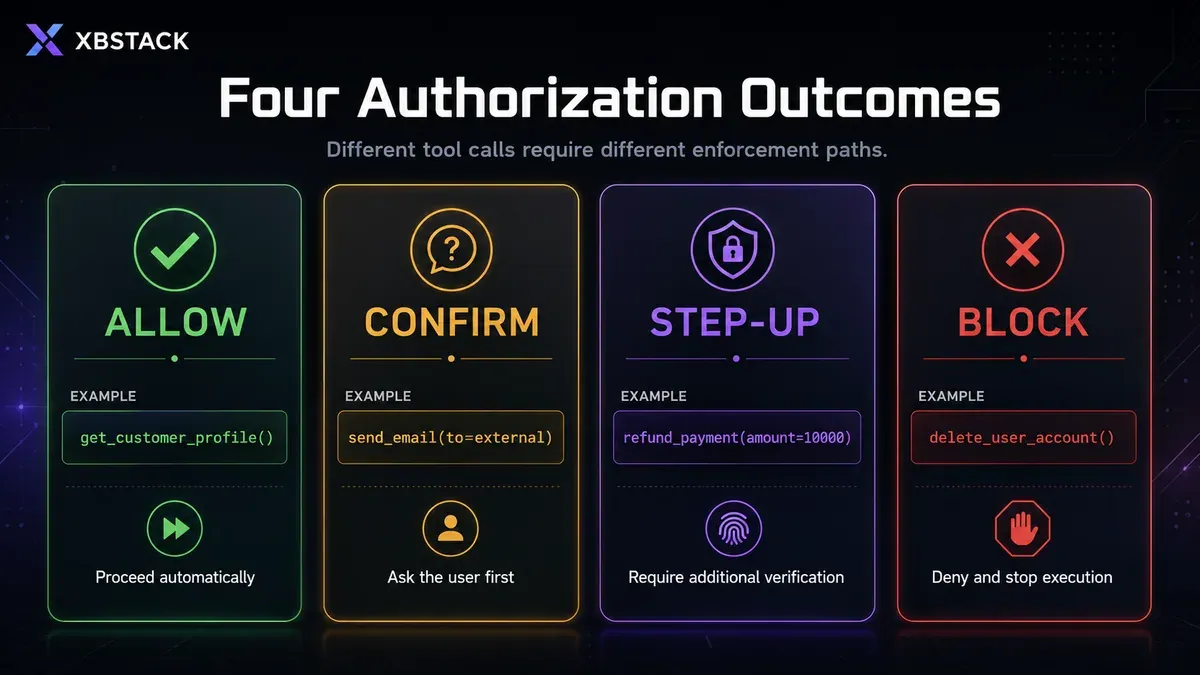
ALLOW
Use for low-risk, same-tenant, correctly scoped operations with clear ownership, such as reading the current user’s order status.
REQUIRE_CONFIRM
Use for side effects that a human can meaningfully review, such as sending customer data externally, deleting a record, or issuing a moderate refund. The Policy Gate first proves that the request is not obviously unauthorized, then routes it to HITL.
STEP_UP
Use when the principal may have permission but the current authentication assurance is too weak. A high-value refund can require password re-entry, MFA, a hardware key, or an administrator signature. This differs from ordinary approval: the goal is to strengthen the caller’s identity evidence.
BLOCK
Use for cross-tenant access, missing scope, ownership mismatch, unknown tools, expired policy, or disabled targets. Fail closed when the policy service is unavailable; a timeout must not become implicit permission.
Production systems may add MODIFY or DEFER, for example capping an amount or scheduling a call inside a business window. Any policy-side mutation should preserve an original argument digest and a reason so the audit trail remains reconstructable.
Combining RBAC, ABAC, and argument-level policy
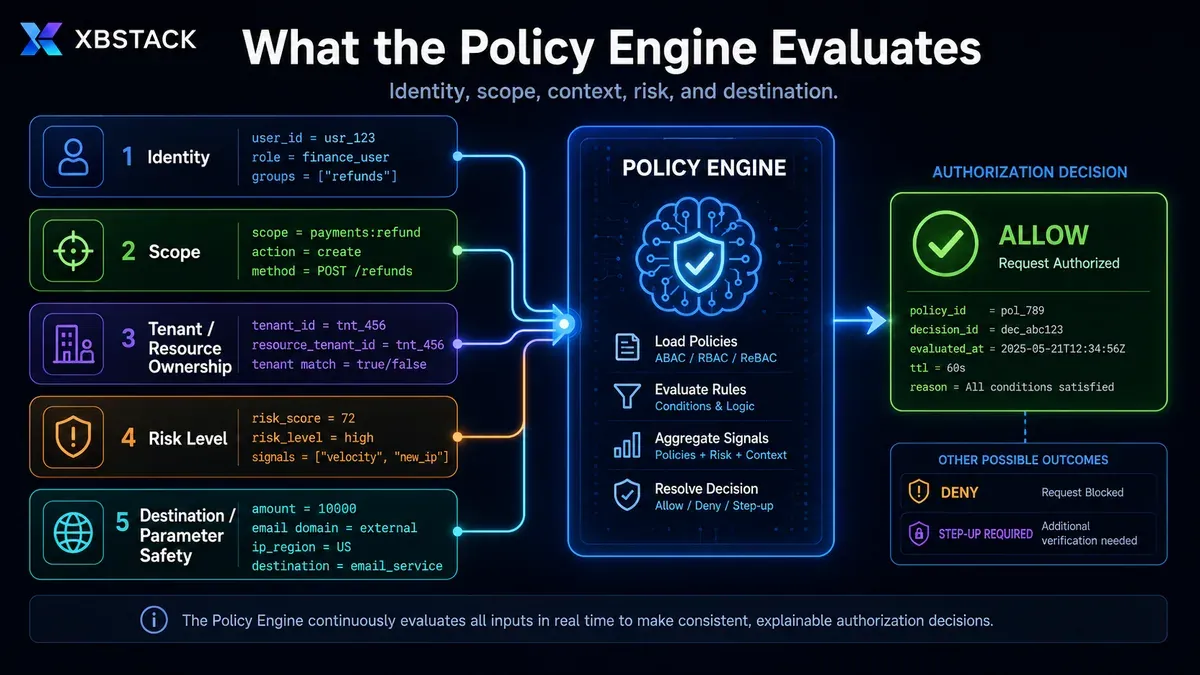
RBAC answers coarse questions such as whether a support role may access a refund tool. ABAC answers contextual questions such as whether this support user can refund this order for this tenant at this amount.
A real decision can inspect:
- principal: user ID, service ID, role;
- tenant and organization boundary;
- scope:
customer:read,refund:write; - resource: owner, region, classification;
- arguments: amount, recipient, environment;
- session: assurance level, device, risk score;
- time: policy version, expiry, maintenance window;
- rate: calls or cumulative amount per window.
For example:
IF tool = issue_refund
AND principal.scope includes refund:write
AND order.tenant_id = principal.tenant_id
AND amount <= 500
THEN ALLOW

IF amount > 500 AND amount <= 5000
THEN REQUIRE_CONFIRM

IF amount > 5000 AND assurance_level < 2
THEN STEP_UP
The model does not evaluate this policy. It can explain why a refund was requested, but it cannot decide that its caller satisfies the scope or amount threshold.
Integration with OpenAI Agents SDK, LangGraph, and MCP
OpenAI Agents SDK
needs_approval and Tool Guardrails are integration points. Evaluate the Policy Gate first: continue on ALLOW, return a denial on BLOCK, surface an interruption on REQUIRE_CONFIRM, and route STEP_UP to stronger authentication. Preserve the policy ID, decision reason, and audit ID rather than reducing the result to a boolean.
LangGraph
Add a dedicated Policy Node before the Tool Node. It reads trusted context and the proposed Tool Call, then writes the decision into graph state. Route REQUIRE_CONFIRM to interrupt(), BLOCK to a safe terminal state, and only ALLOW to the executor. The existing LangGraph Human-in-the-loop guide covers pause and resume; the Policy Gate determines whether the call is eligible to enter approval at all.
MCP
Tool filtering can reduce which MCP capabilities a client sees, but the remote server should still authorize every tools/call using trusted principal, tenant, resource, and arguments. Client-side approval cannot replace server-side authorization because a faulty or malicious client may bypass the UI and call the server directly. Continue with MCP Server production governance and MCP security best practices.
Minimum audit fields
Store at least:
audit_id
request_id / trace_id
principal_id
trusted_tenant_id
tool_name
tool_version
argument_digest
redacted_argument_summary
policy_id
policy_version
decision
reason
approval_id when present
assurance_level
created_at
executor_result_id after execution
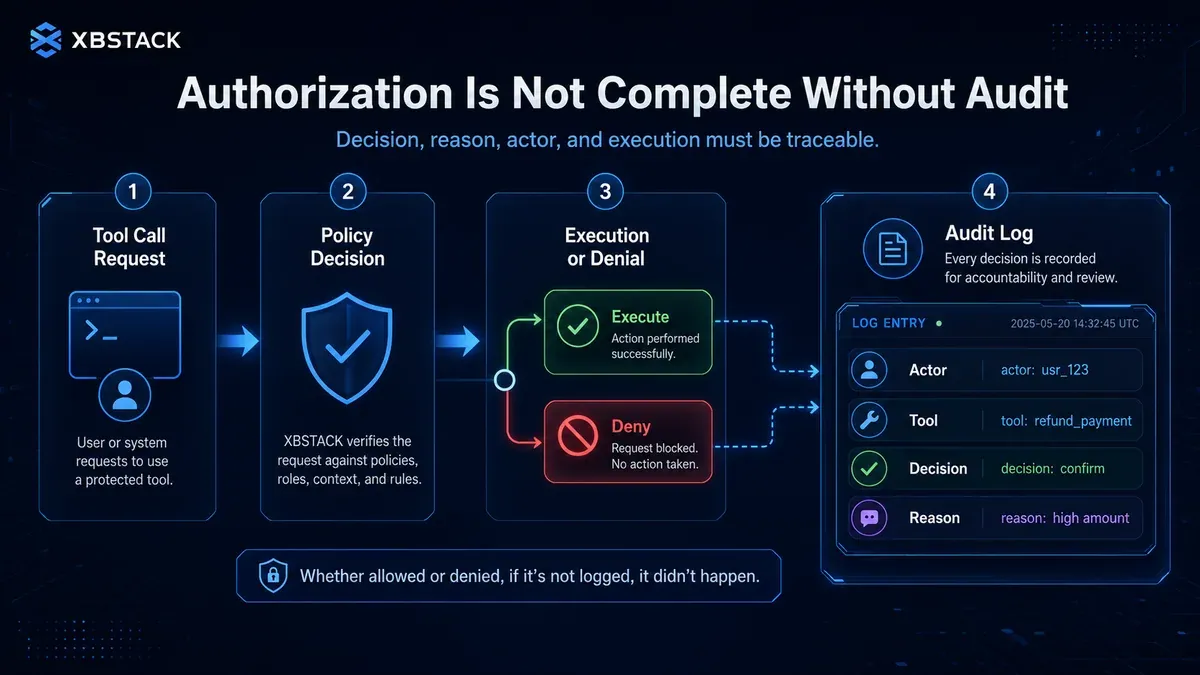
Do not place complete customer records, tokens, or email bodies into the audit log. Store a redacted summary and irreversible digest, then use controlled access to retrieve authoritative data during an investigation.
Record the policy version as well. If an approval waits for two days, permission rules may change. Resume should re-evaluate the current policy rather than blindly trusting an old approved flag.
Why authorized calls still need idempotency
The Policy Gate answers whether a call may execute, not whether it already executed. Queue redelivery, network timeout, worker restart, or a duplicate click can send the same authorized call to the executor again.
A side-effecting tool needs a stable key:
idempotency_key = hash(
  tenant_id,
  business_action,
  business_object_id,
  approved_call_id
)
The executor checks a ledger first: return the stored result if complete, reject concurrent work if processing, and retry only under explicit failure policy. Authorization, approval, idempotency, and audit are separate layers.
Minimum production checklist
- Can the Tool Executor be reached only through the Policy Gate?
- Do identity and tenant come from trusted context?
- Are unregistered tools default-denied?
- Is cross-tenant access blocked immediately?
- Do high-risk actions use
REQUIRE_CONFIRMorSTEP_UP? - Does a policy-service failure fail closed?
- Are audit arguments redacted?
- Does resume re-evaluate the current policy version?
- Do writes use idempotency keys?
- Has the team tested bypassing the frontend and calling the Tool API directly?
- Are revocation, expiry, and emergency disable controls available?
Final decision
Agent tool safety cannot rely on a compliant model. The Tool Registry determines visible capabilities, schemas determine argument shape, guardrails inspect content and format, HITL collects human decisions, and authorization proves whether the current principal may execute this exact call.
A reliable system lets the model propose an action, lets the Policy Gate decide whether it can proceed, and lets the Tool Executor accept only authorized requests protected by idempotency. Prompt injection, model misunderstanding, or unauthorized arguments then meet a deterministic execution boundary before they can affect the real system.
Continue with AI Agent Tool Use: registry, validation, and audit, AI Agent Security, and OpenAI Agents SDK RunState approval resume.
Continue from one agent pattern to the complete production system
The AI Agent hub organizes architecture, memory, tool use, evaluation, security, deployment and multi-agent coordination into a single learning path.
Next Reading
View Hub →OpenAI Agents SDK RunState: Resume Tool Approvals Across Processes
A reproducible openai-agents 0.18.3 case study covering Tool Approval interruption, RunState serialization, cross-process approve/reject and worker resume, plus duplicate side effects, context-secret leakage, idempotency, and version gates.
AI Agent Memory Retrieval Architecture: Hybrid Search, Re-ranking, Freshness and Conflict Resolution
A production-focused guide to AI Agent memory retrieval. Design a safe retrieval pipeline with identity filters, structured lookup, vector recall, re-ranking, freshness control, conflict resolution, prompt budgets and regression tests.
Production Governance for AI Agents: Evaluation, Observability, Deployment, Cost Control, and Human-in-the-Loop
A systematic breakdown of the governance capabilities required to transition AI Agents from demos to production. Covers task evaluation, trace observability, tool call auditing, state management, deployment architecture, task queues, model routing, cost control, human approval workflows, canary releases, and rollback mechanisms. Helps developers build deployable, monitorable, and auditable agent systems.
AI Agent Protocol and Framework Selection: How to Choose Between MCP, Function Calling, A2A, LangGraph, AutoGen, and CrewAI?
A systematic overview of protocol and framework selection for AI Agent development, covering Function Calling, MCP, A2A, LangGraph, AutoGen, CrewAI, LangChain, custom workflows, multi-agent collaboration, tool invocation, state management, and production deployment boundaries. Helps developers choose the appropriate tech stack based on specific scenarios.

Xiaobai
Full-Stack AI Engineer
Xiaobai, a full-stack AI engineer building production Agent systems, product tools and independent software assets.
About Xiaobai & XBSTACK →Liked this article?
Join the newsletter
Every issue condenses production AI engineering changes, real failures, reproducible experiments, useful tools and new XBSTACK assets. No generic news digest and no filler.

DISCUSSION
Questions, verification and corrections
Sign in to comment. Every new comment is reviewed before publication; while pending, it is visible only to you and the administrator.