

GPT-5.6 Review: Real Coding, Content and Data Tests
GPT-5.6 review from a real Astro project: coding, content operations, Search Console and GA4 tests, failures, limits, and when Sol, Terra or Luna makes sense.
On this page
Direct answer: this GPT-5.6 review is based on a real Astro content repository rather than isolated prompts. In the tested workflow, GPT-5.6 was most useful when repository reading, multi-file edits, data recalculation, and verification had to stay connected across one long task. It still needed explicit permission boundaries and human review before deployment or destructive actions. For most day-to-day work I route to Terra first, reserve Sol for higher-failure-cost tasks, and use Luna for cheaper extraction, classification, and routing.
If you searched for gpt 5.6 coding or chatgpt 5.6 review, this is the English test page. If you searched for a GPT-5.6 parameter count, I could not find an official parameter-count disclosure in OpenAI’s current GPT-5.6 launch page or GPT-5.6 Sol model documentation; those sources publish model tiers, pricing, context/output limits, and availability instead. I therefore do not infer a parameter count from third-party estimates.
Continue through the English AI Tools Lab for adjacent real-world model tests and production-oriented comparisons.
Search performance review, updated September 14, 2026: Search Console currently has data through September 11. This page recorded 61 impressions, a 0% CTR, and an average position of 19.61 in the latest 28-day opportunity window. None of those 61 impressions are represented by usable visible query rows, so there is still not enough query evidence to justify another Title/H1 rewrite. The current action is to keep the search promise stable, strengthen internal links and official evidence, and wait for a denser query sample rather than creating a competing URL.
The original workflow snapshot was captured on July 10, 2026. The 218-item content inventory, the site-wide 16 clicks from 794 impressions, and the historical 404 summary describe that earlier test. They are not current site totals. Historical evidence, current opportunity data, and incomplete metric dates remain separate throughout this article.
Five questions this test had to answer
The workflow was designed around five practical questions:
- Can GPT-5.6 understand and safely modify an existing Astro and React content project?
- Does it improve technical content production, or merely produce a more complete report?
- Can it analyse aggregate GSC and GA4 data without inventing page-level attribution?
- How should Sol, Terra, Luna, max, and ultra be routed in everyday production?
- Which actions can a coding agent perform automatically, and which still require explicit approval?
Who is this article for?
- Independent developers and engineering teams evaluating AI tools in real repositories.
- Site owners and growth engineers using AI for content operations, SEO, Search Console, and GA4 analysis.
- Developers building coding agents who need explicit permission, evidence, and production-safety boundaries.
The conclusion: it closes more of the loop, but it still needs a human stop condition
The most useful change I observed was continuity across a long, mixed workflow. GPT-5.6 had to read an Astro content system, respect existing routes and frontmatter, compare the proposed topic against a published inventory, recalculate Search Console and GA4 metrics, write the article, and run local verification. The value was not a better isolated answer. It was the ability to keep earlier constraints active while moving from research to files, data, and validation.
That does not make it an autonomous project owner. The task was bounded: no navigation changes, no production deployment, no credential access, no destructive file operations, and no database migration. The model could plan and execute inside the allowed scope, but the author still decided which conclusions were supported, which sections should be deleted, and whether the final change was safe to publish.
The central tension is simple: a model that is more willing to finish the job also needs clearer permission boundaries. In content work, over-completion produced a 25-heading report instead of a readable technical essay. In analytics, correct arithmetic could still become an unsupported causal story if the input dimensions were too coarse. In code, a valid change would still be unacceptable if it exceeded the authorized file or deployment scope.
My 87/100 score applies only to this XBSTACK workflow. It is not a general model ranking, a latency benchmark, or a claim that GPT-5.6 beats every alternative on every task.
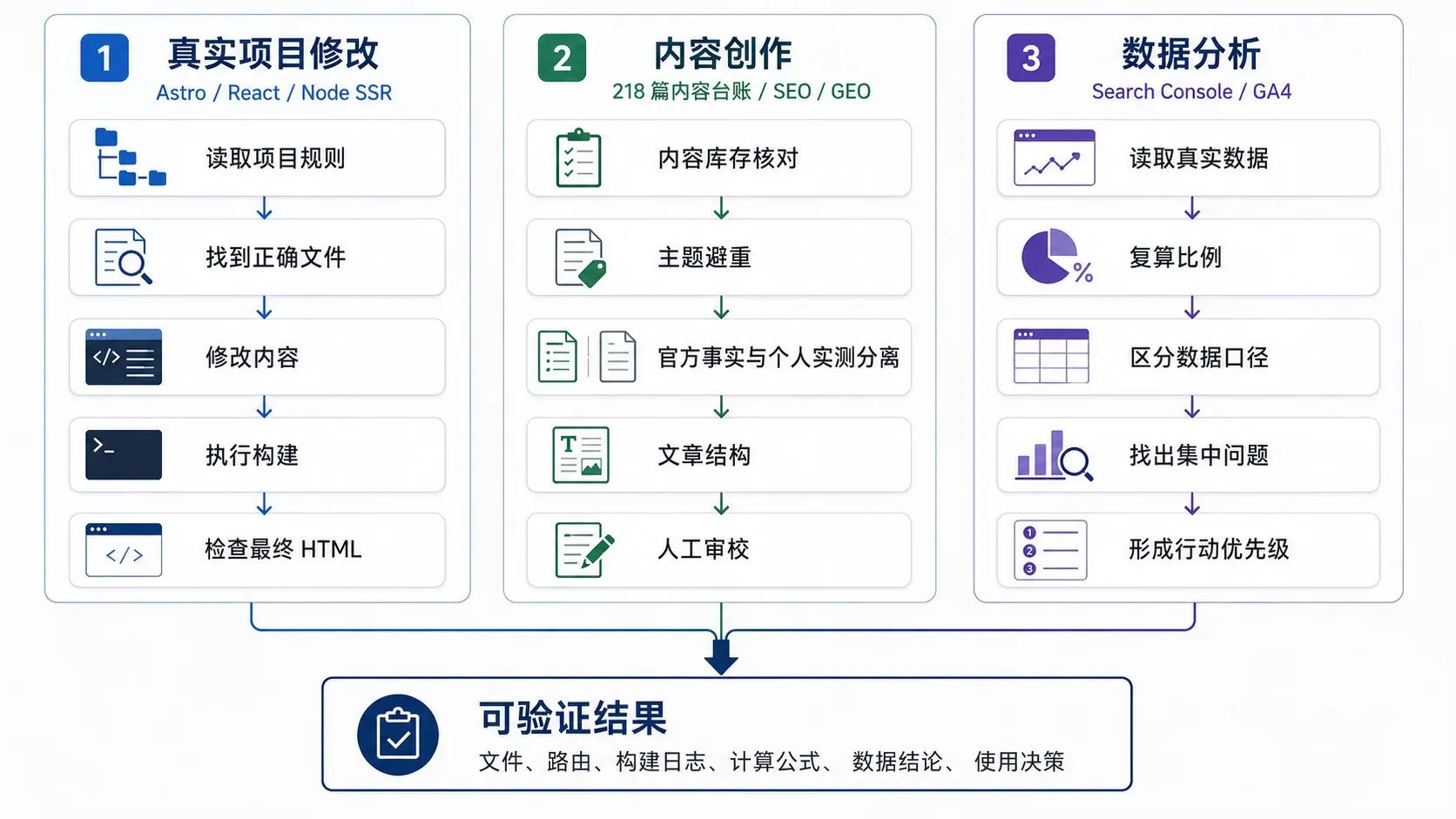
Test design: three real tasks and explicit boundaries
I did not use puzzle questions or a synthetic demo repository. I placed GPT-5.6 inside XBSTACK’s existing Astro content workflow and asked it to complete three connected tasks. The acceptance criteria were project artifacts, recalculated data, and local verification—not how persuasive the chat response sounded.
I kept three deep tasks:
| Task | Inputs | Success criteria | Evidence |
|---|---|---|---|
| Real project modification | Astro, React, Node SSR, content collections, dynamic routes, and build scripts | Find the existing content path, preserve the information architecture, and pass local verification | File diff, route, build log, generated HTML |
| Content review | A 218-item inventory, existing articles, writing rules, and SEO/GEO requirements | Avoid a duplicate search intent, separate official facts from observations, and produce valid metadata | Draft history, metadata, internal links, manual edits |
| Data analysis | GSC daily exports and a GA4 404 page-title summary | Recalculate the metrics, state the supported conclusion, and stop where the dimensions are insufficient | Formula, date range, metric definition, unsupported claims removed |
This was a production-shaped test, not a controlled model laboratory. It involved file reads, official-document verification, local edits, several rounds of revision, and build checks. GPT-5.6 could inspect the repository and edit the specified article, but it was not authorized to deploy, delete production resources, migrate credentials, alter navigation, or write to a production database.
I also did not run a rigorous GPT-5.5 A/B test. There were no repeated trials under the same API account, prompt, cache state, network path, and tool permissions, and I did not capture a complete latency and token ledger. This article therefore makes no personal claim about a speed multiplier or a universal win rate. Official benchmarks remain external evidence, not my test result.
The analytics inputs had limits as well. The original GSC export was an aggregate snapshot, and the GA4 material contained 404 page titles and views rather than the original failing URLs. The model could verify the arithmetic and identify concentration, but it could not support page-level attribution or a causal explanation without the missing dimensions.
The updates that actually changed how I work
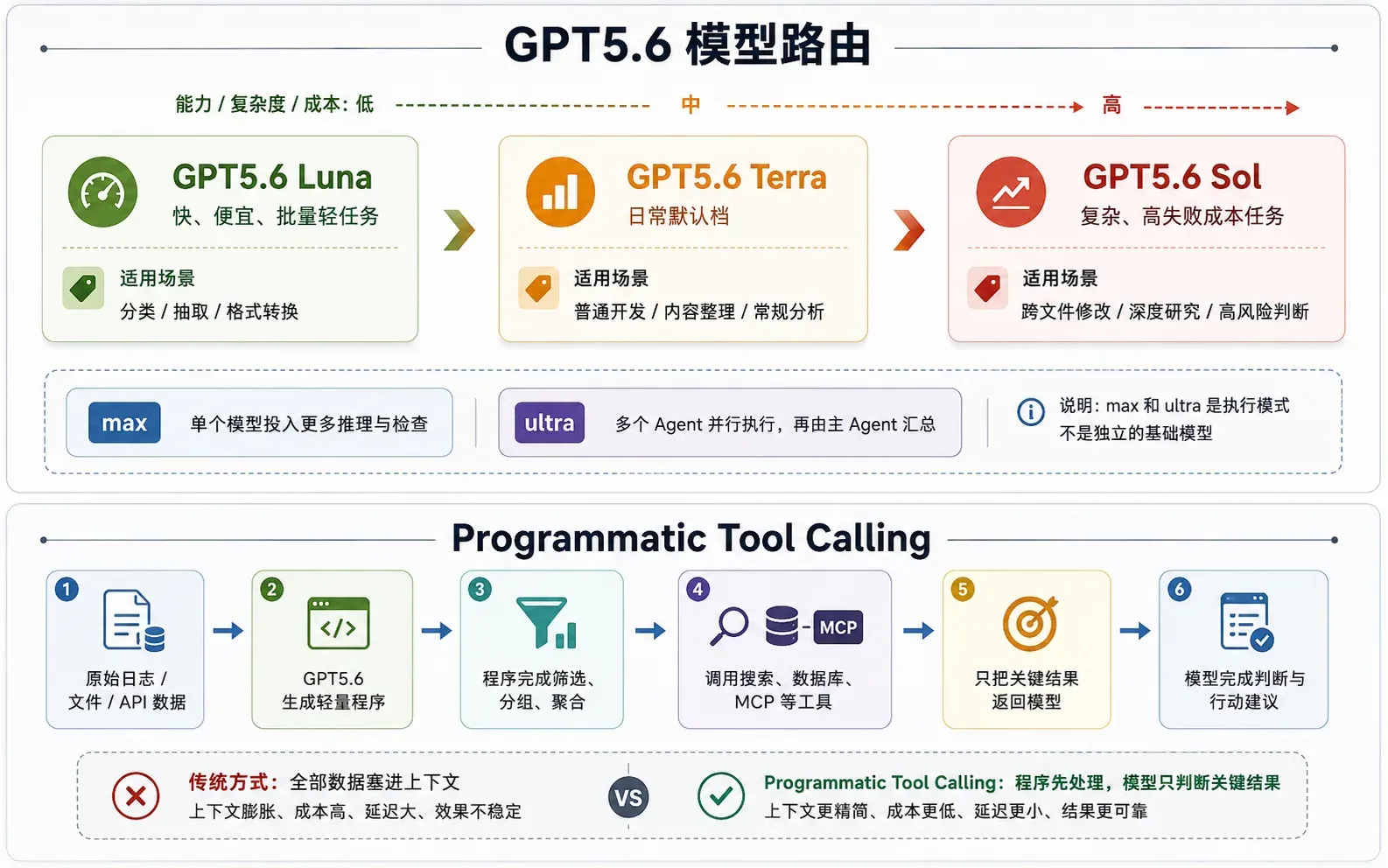
The changes that matter here are not a larger parameter count. They are the Sol, Terra, and Luna tiers, Programmatic Tool Calling, prompt caching, and the max and ultra runtimes. Together, they make model routing, tool-result preprocessing, and failure-cost management part of the application architecture instead of an afterthought.
How to choose Sol, Terra, and Luna?
OpenAI’s public positioning gives each model a different capability, speed, and price envelope. This review did not run a controlled latency benchmark across accounts, regions, prompts, cache states, and repeated trials, so the earlier draft’s precise latency ranges, “strong/medium/weak” tool ratings, and fixed usage percentages have been removed.
| Model | Official role | Input price | Output price | My workflow decision |
|---|---|---|---|---|
| Sol | Highest-capability tier for complex work | $5 / 1M tokens | $30 / 1M tokens | Reserve it for cross-file changes, deep research, and high failure-cost tasks |
| Terra | Balanced quality and cost for everyday work | $2.50 / 1M tokens | $15 / 1M tokens | The default candidate for routine development, editing, and data explanation |
| Luna | Faster, lower-cost tier for lighter work | $1 / 1M tokens | $6 / 1M tokens | Use it for classification, extraction, routing, and low-risk batch processing |
The final column is an XBSTACK routing decision, not an OpenAI recommendation for every application. A production router still needs its own success rate, human rework time, cache behavior, and failure-cost data.
max and ultra are not the fourth or fifth models. max allows individual models to spend more time on inference, explore solutions, run checks, and revise results; ultra is a multi-agent parallel model. The official default is that four agents handle different workflows separately, which are then aggregated by the main agent. Simply put, Max is one person thinking several rounds of work, Ultra is about splitting tasks into several people to complete simultaneously.
If Ultra is used for this work, it can be broken down into four branch lines: official document verification, project structure check, content inventory analysis, and GSC/GA4 recalculation. But if you change a title, extract a few fields, or format data, there’s no need to enable four agents. Multi-agent entities increase the upper limit and completion speed of complex tasks, while also consuming more tokens; When tasks can’t be disassembled, they only create repetitive work.
Another change that deserves more attention from developers is Programmatic Tool Calling. Traditional tool calls often push a large number of intermediate results back into the context before the model judges the next step. GPT-5.6 can write and run lightweight programs within the Responses API, filtering, grouping, and aggregating tool results first, retaining only the truly important content.
For example, when handling 10,000 logs, a more reasonable process is not to send each log to the model individually, but to first group them by status code, count repeat paths, extract abnormal samples, and then let the model determine the cause and priority. The program is responsible for stable computation, while the model handles uncertainty judgment. This is more practical for website logs, financial reports, MCP, multi-tool agents, and n8n workflows than “the model can write a script.”
Real project test: did it read the rules before editing files?
In this bounded task, GPT-5.6 read the content collection, Tools Lab routing, and frontmatter conventions before it edited the article. It used the existing directory and route, did not invent a new collection, and did not change navigation. Those inspectable actions are stronger evidence than a generic claim that it “understood the project.”
The instruction was not simply “write a GPT-5.6 article.” It first had to determine whether the topic duplicated an existing page, identify the correct collection and route, preserve the frontmatter contract, and only then edit the file.
The resulting content placement was:
content file: src/content/ai/gpt56-test.md
section: tools-lab
hub: tools-lab
subcategory: tools-lab
series: ai-tools-lab
page route: /ai/tools-lab/gpt56-test/
The path itself is simple. The important part is what happened next: the task continued through the content ledger, Astro build, target route, sitemap, Pagefind, canonical URL, JSON-LD, and generated HTML. In that historical build snapshot, the page pre-rendered successfully, Pagefind indexed 820 static HTML pages, the structured data parsed, and machine-oriented metadata did not leak into the visible article. Those checks belong to the July 10 test snapshot; they are not the site’s current global page count.
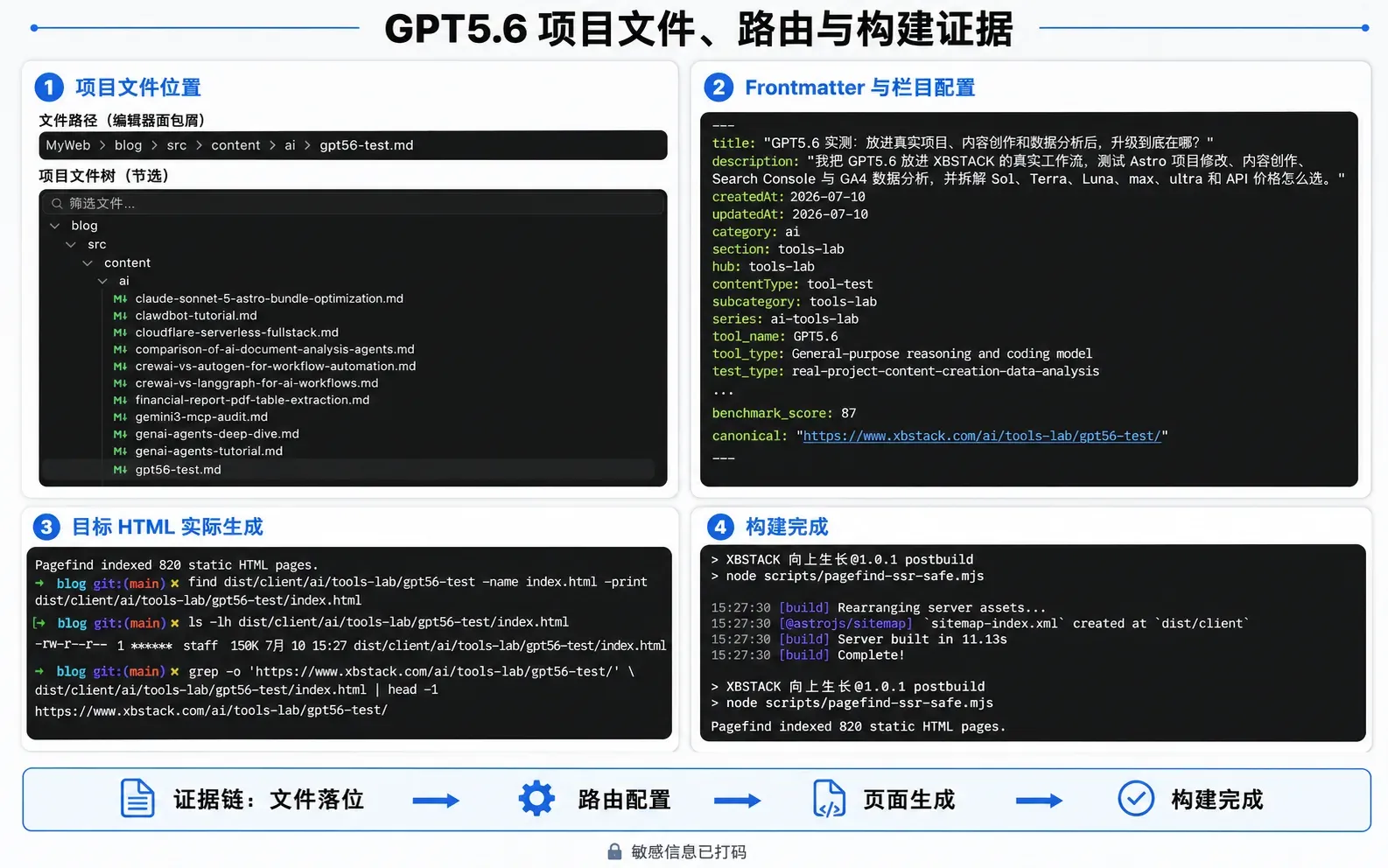 in XBSTACK Astro projects
Continuity was the strongest part of the project task. Repository rules read at the beginning still constrained the later file edit and verification steps. An abstract requirement such as “GEO must not pollute the visible article” was translated into concrete checks around hideStructuredBlocks, frontmatter, JSON-LD, the layout, and the generated page head.
This does not prove that GPT-5.6 can independently maintain an arbitrary production system. The change was narrow and reversible. I did not test a database migration, a large refactor, an automated deployment, or a live rollback. The defensible conclusion is narrower: when a repository already has clear rules, a bounded file scope, and testable outputs, GPT-5.6 can absorb a substantial amount of reading, locating, editing, and verification work.
Content test: strong evidence collection, weak editorial hierarchy
The content task exposed a different failure mode: over-structuring. GPT-5.6 was good at retrieving facts, checking metadata, and making sure every requirement appeared somewhere. That same behavior produced a draft with 25 H2 headings. It was complete in a checklist sense and weak as a continuous technical essay.
The historical inventory contained 218 published entries, including 134 files in the AI collection and 96 entries with category: ai. Those are different dimensions: one describes storage, the other a business category. The model kept them separate and correctly placed the article in AI Tools Lab rather than Agent, LangGraph, or general Notes.
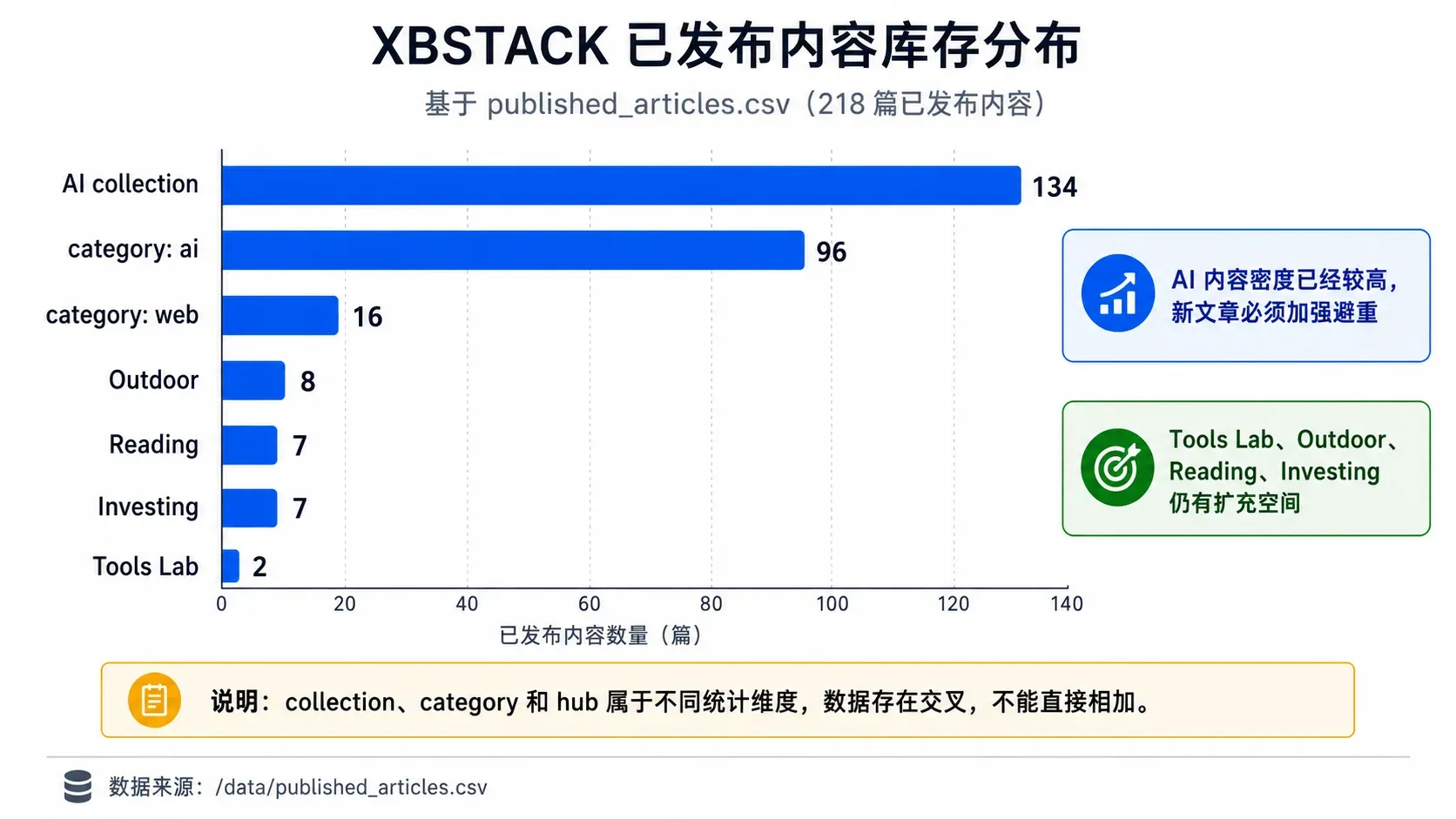
The useful work included duplicate-intent checking, metadata alignment, canonical and internal-link planning, and separating official specifications from observations. The weak point was editorial judgment. Test scope, data definitions, inventory, GSC, GA4, GEO, build evidence, benchmarks, pricing, security, and audience were each turned into separate sections. Most facts survived review, but the reading experience resembled a delivery report.
I had to merge sections, remove repeated conclusions, delete unsupported precision, and rebuild the article around one tension: GPT-5.6 can close more of a complex workflow, but the stronger the execution capability, the more important human acceptance and permission boundaries become.
That is the division of labor I would keep. The model handles evidence collection, recalculation, inventory checks, a first structure, metadata, and repetitive validation. The author decides which evidence matters, what to remove, what order serves the reader, and whether the final article still reflects an accountable point of view.
Data test: correct arithmetic is not the same as correct attribution
The arithmetic was easy. The real test was whether the model would stop before turning an aggregate ratio into a causal explanation. It correctly recalculated the historical GSC CTR and the distribution of views across three 404 page titles. It did not have the original failing URLs, referrers, unique users, or redirect chain, so those inputs could not support a page-level root cause.
The first calculation was:
CTR = 16 ÷ 794 × 100%
    = 2.0151%
Rounded to two decimals, the historical site-wide CTR was 2.02%. The supported conclusion was limited: Google was already showing the site, but much of that visibility occurred at weak average positions and produced few clicks. That does not prove that the titles alone were the problem.
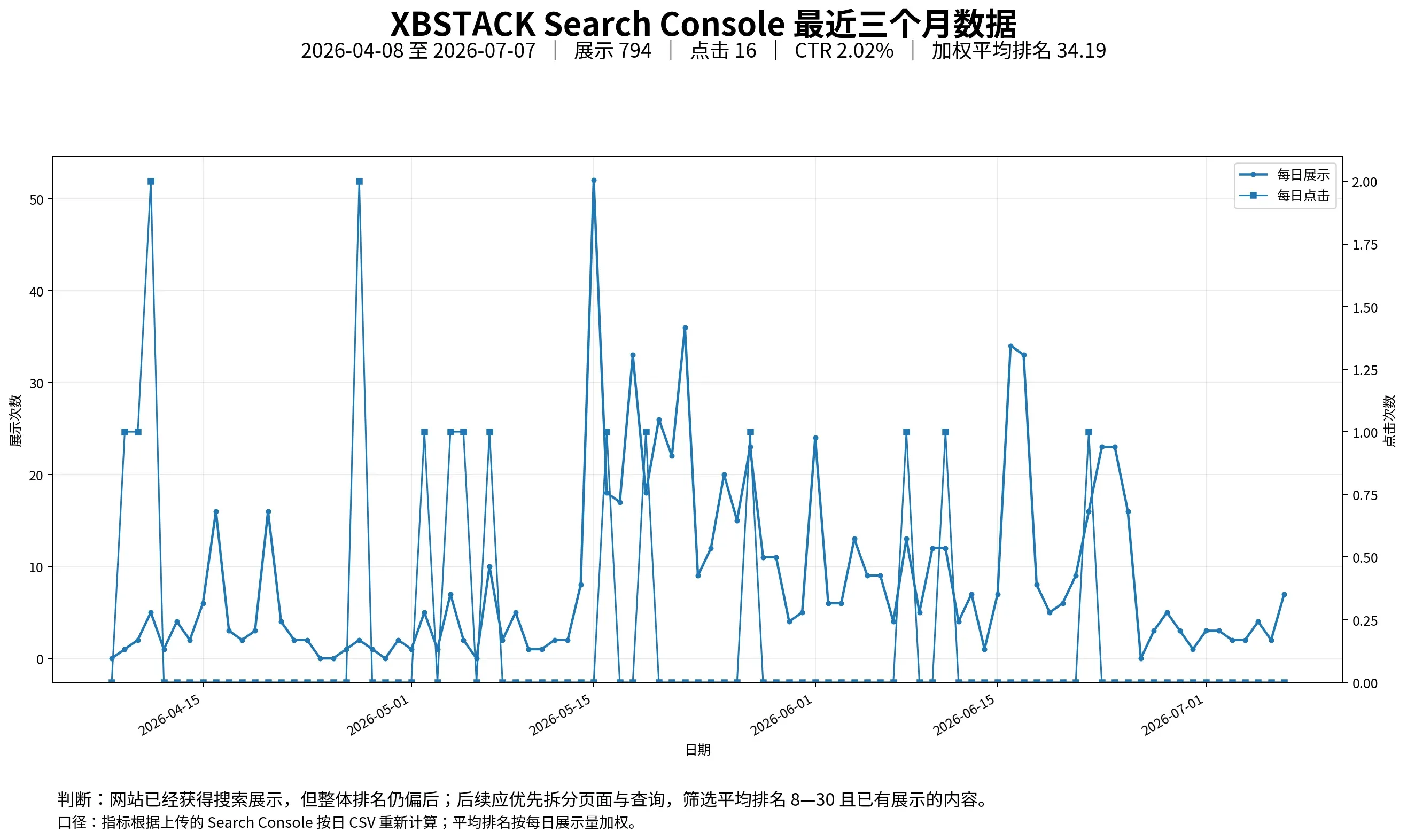
However, it does not directly attribute the problem to “the title not being attractive enough.” A weighted average ranking of 34.19 means that many impressions occur in lower positions in the search results, which in itself lowers the CTR. A more prudent course of action should be to first break down the data by page and query, identify pages with an average ranking of 8–30 that already have a certain number of impressions, and then check the title, meta description, and search intent. Pages ranked beyond the thirtieth position with few impressions should not have their titles frequently changed solely because of low CTR.
The second data set came from the GA4 Page titles and screens report for April 11 through July 9, 2026. Three explicit 404 titles recorded 523, 57, and 25 views, for a total of 605. The currently used “No Man’s Land | 404 - XBSTACK” title accounted for 523 of those views.
523 ÷ 605 × 100% = 86.4463%
Rounded to one decimal, the share was 86.4%. It only means that most views across these three named 404 titles were attached to the current title. It does not mean that 86.4% of broken URLs came from one page type, one route migration, or /tags/. The export did not contain those dimensions.
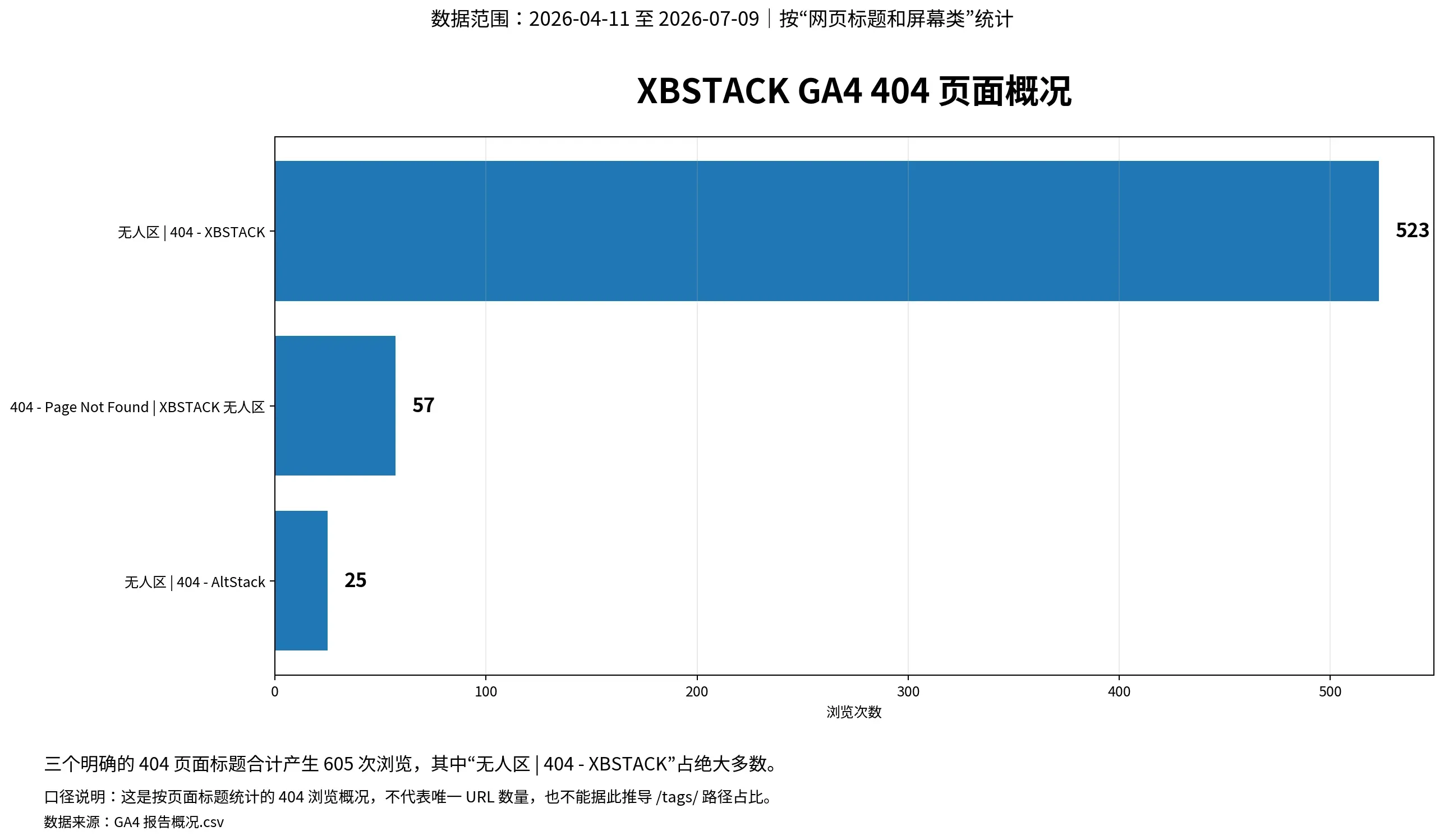
What really tests the model here is not division, but whether it can stop at the data boundary in time. The current exports only have page titles and view counts, without triggering the original page path of 404, so it is impossible to further determine whether these visits come from tabs, historical article addresses, case values, URL encoding, or external old links. 605 is just the total number of views for three categories of 404 titles, not 605 unique visitors or 605 unique invalid URLs.
Combining the content inventory, GSC, and GA4 produced a clearer action order. First export the original 404 paths and sources, then fix the concentrated broken destinations. In parallel, improve pages that already have impressions and average positions near the first two result pages. New AI content should pass a stricter duplicate-intent check, while weaker sections should be expanded only with real material. The model did not choose the site’s strategy; it separated supported actions from questions that still required more data.
Official benchmarks are context, not project evidence
Official benchmark gains are useful background, but they are not the acceptance test for this article. I used local build results, recalculated metrics, preserved constraints, and the amount of manual correction as the evidence. A benchmark can explain why a capability may have improved; it cannot prove that a particular repository change, analytics conclusion, or publishing decision was correct.
| Review | GPT-5.6 Sol | GPT-5.6 Sol Ultra | GPT-5.5 |
|---|---|---|---|
| Terminal-Bench 2.1 | 88.8% | 91.9% | 85.6% |
| BrowseComp | 90.4% | 92.2% | 84.4% |
| OSWorld 2.0 | 62.6% | Not listed | 47.5% |
| SWE-Bench Pro | 64.6% | Not listed | 59.4% |
| DeepSWE v1.1 | 72.7% | Not listed | 67.0% |
The benchmark pattern is directionally consistent with the workflow I observed: the model was most useful when browsing, repository reading, tool use, and repeated verification had to remain connected. That is still an interpretation, not a private reproduction of the benchmark.
The official table also shows that GPT-5.6 is not first on every evaluation, and each benchmark has its own environment and success criteria. I did not run a controlled GPT-5.5 comparison, so the supported claim is limited to a better experience with long-task continuity—not a measured percentage gain in overall ability.
Benchmarks explain why a capability may be worth testing. The project decides whether it is useful. In this review, a passing build, a correctly bounded analytics conclusion, and the amount of manual restructuring mattered more than a small difference on an unrelated leaderboard.
Pricing and model routing: daily work does not need Sol everywhere
The published prices make a single-model strategy difficult to justify. A router should consider not only token price, but also task failure cost, expected human rework, input stability, and whether cached context can be reused. The cheapest request is not cheaper if it regularly produces a result that must be redone.
| Model | Input / 1M tokens | Output / 1M tokens |
|---|---|---|
| GPT-5.6 Sol | $5 | $30 |
| GPT-5.6 Terra | $2.50 | $15 |
| GPT-5.6 Luna | $1 | $6 |
GPT-5.6 also supports explicit prompt cache breakpoints and a cache lifecycle of at least 30 minutes. Cache writes are charged at 1.25 times the input price of uncached inputs, while cache reads continue to enjoy a 90% discount on input prices. For workflows containing a large number of stable project rules, duplicate documents, or fixed tool descriptions, caching strategies directly affect costs.
This test took place in the ChatGPT/Codex workflow, and I didn’t have a complete API token bill, so I couldn’t give “the exact amount cost to complete this article.” If there is no real billing record, only the API unit price is listed, without falsifying the cost per task.
My actual route would be:
Tagging, classification, formatting, simple extraction  → Luna
Routine editing, summaries, standard data explanation   → Terra
Cross-file changes, deep research, high failure cost    → Sol
One difficult task that needs deeper checking            → Sol + max
A task that cleanly splits into independent workstreams  → ultra / multi-agent
Terra is more suitable as the default setting for daily use. Many content organization tasks, general development, and routine Agent tasks do not require paying Sol’s output price. Sol should be reserved for work with high failure costs, cross-file or cross-tool tasks, and results that need thorough review. Ultra is also not a free quality button; when tasks cannot be naturally divided, multiple Agents will repeatedly read materials, perform reasoning, and consume tokens.
The failures and limits that were actually observed
I re-audited the earlier version of this section and removed three examples that did not have preserved logs or a direct official source: an Astro API error, a fabricated-looking prompt-cache threshold error, and a credential-search shell error. A review cannot promote a plausible incident into an observed one merely because it sounds technically possible.
Failure 1: a complete draft that read like a project report
The first draft tried to satisfy every requirement as a separate section. A roughly 6,500-Chinese-character article ended up with 25 H2 headings. The problem was not missing information. It was the absence of editorial hierarchy. The model optimized for checklist coverage; the author needed a single argument, a deliberate pace, and evidence placed where it changed the decision.
Failure 2: correct arithmetic could still become an unsupported attribution
The historical GSC CTR and the 404 title-view share were recalculated correctly. The input still lacked the dimensions required to explain the root cause. The model could say that 523 of 605 views belonged to one 404 title. It could not say those views came from one route, one migration, one platform, or one class of broken URL.
The useful behavior in an analytics task is often a stop condition: “this calculation is supported; the attribution is not.” A model that always returns a complete explanation can be less useful than one that explicitly identifies the next data export required.
Failure 3: no controlled A/B means no personal speed claim
I did not run GPT-5.6 and GPT-5.5 repeatedly under the same API, account, prompt, cache state, network path, and tool permissions. I also did not preserve a full token and latency ledger. The article can describe a better experience with long-task continuity. It cannot claim a measured speedup, win rate, or cost reduction.
The previous version included precise first-token latency ranges and fixed model-usage percentages without test logs. Those figures have been removed. Deleting unsupported precision improves the review more than adding another benchmark table.
Limit 4: the task ran inside explicit permissions
GPT-5.6 was not allowed to deploy, push, delete files, change navigation, migrate credentials, or write to production data. It completed a bounded local task. That result does not prove that an unsupervised coding agent should control an arbitrary production environment.
OpenAI’s GPT-5.6 System Card also discusses a somewhat greater tendency than GPT-5.5 to exceed the user’s original intent in a small number of agentic coding cases, while noting that the absolute rates remain low. That finding supports permission design; it does not justify claiming that the model will inevitably overreach.
Greatest Risk: The more it wants to get things done, the more it needs to limit what it can do
The risk is not limited to incorrect code. A coding agent can produce technically valid code and still perform an unauthorized action. That changes the safety question from “is the patch correct?” to “was this action allowed, reversible, and independently verified?”
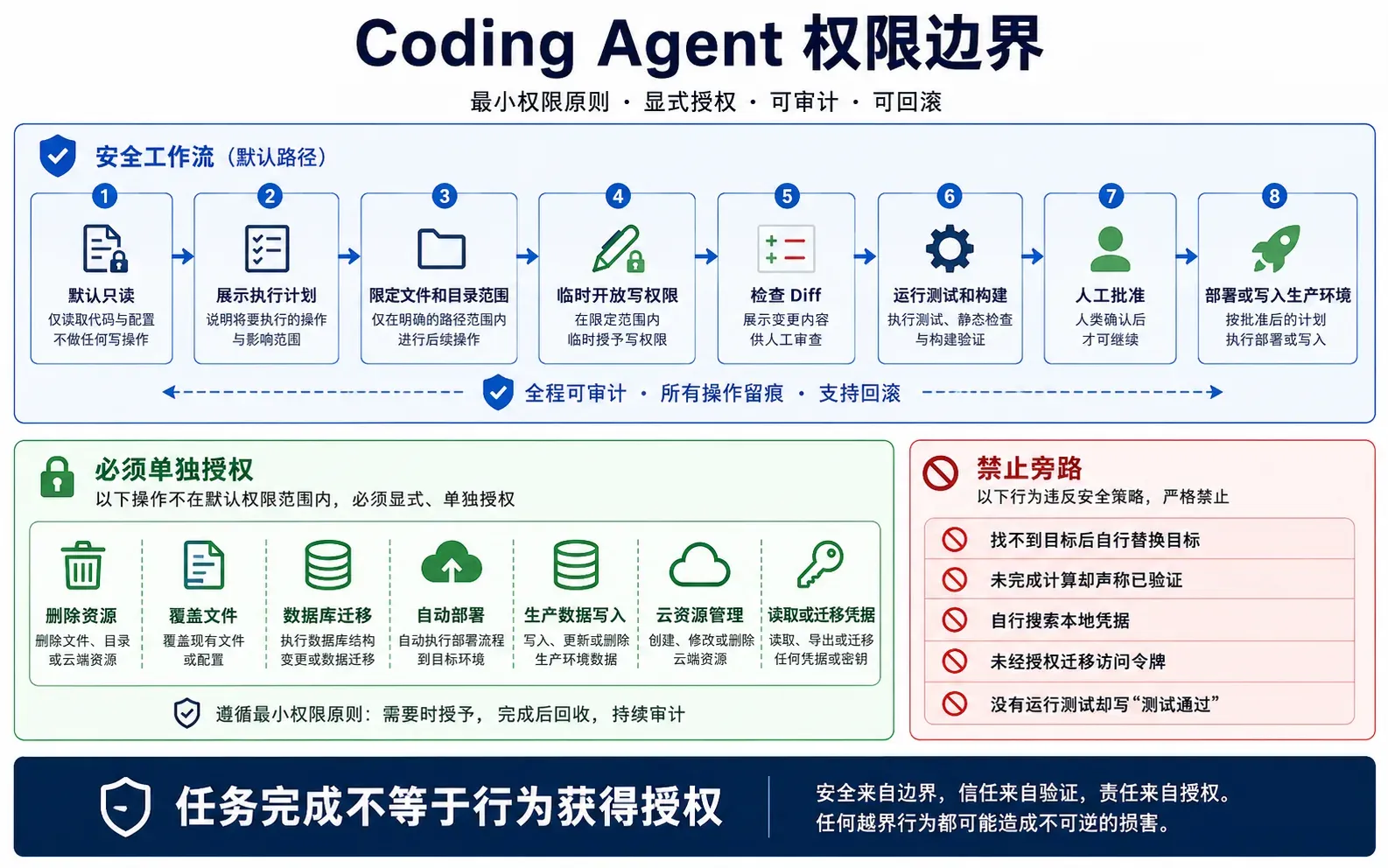
Permissions should follow action risk, not a single on/off switch
I use four permission levels. Read-only inspection, repository search, public-document research, and plan generation are allowed by default. Scoped local edits and test commands are allowed only in named directories with a visible diff. Deletion, overwrite, dependency changes, database migrations, push, deployment, external messages, and public publishing require separate approval. Credential discovery, cross-environment token copying, bypassing safety checks, and altering audit records are prohibited.
The same principle applies to sub-agents: parallel workers must not inherit more authority than the parent task, and their operations must return to the same audit trail. Multi-agent execution can reduce elapsed time, but it also increases the number of actions that need to be observable.
Data analysis needs explicit stop conditions
I now define both the allowed conclusion and the stopping point before asking for an analytics explanation. Aggregate page metrics can support prioritisation; they cannot identify a page-level cause. A 404 title report can show concentration; it cannot identify the original broken URL. A high Direct share can justify better campaign tagging; it cannot prove which untagged platform caused the visits. When a required dimension is missing, the output should name the next export instead of completing the story with a plausible guess.
Evidence has three different owners
I now separate every major statement into three categories. Official facts—model roles, prices, benchmarks, product features, and safety findings—must point to OpenAI material. Project evidence—file paths, diffs, build output, route checks, recalculated metrics, and generated HTML—must come from the local workflow. Routing choices and editorial decisions are author judgments, not universal product claims.
This separation prevents a common review failure: writing an official benchmark, one successful project run, and a personal preference in the same authoritative voice. A reader should be able to tell whether a claim came from the vendor, this test, or my operating context.
A file write is not the end of a project test
For this Astro task, the verification chain was longer than “the markdown file exists.” The content path had to match the collection, the frontmatter had to parse, the route had to generate, the build had to pass, the canonical URL and structured data had to be correct, the sitemap and Pagefind output had to include the page, and machine-oriented metadata had to remain outside the visible article.
Any broken link in that chain would change the status from complete to partial. This is why a polished answer or a successful file edit is not enough evidence for a coding-agent review. The acceptance criteria must be specified before the model starts, and each completed check needs an artifact.
What the human editor changed
The final article is not the model’s untouched output. I merged the 25-heading structure, removed repeated conclusions, separated historical and current data, changed the model name to the official GPT-5.6 form, corrected the 86.4% interpretation, and deleted unsupported latency ranges, tool-capability ratings, cache errors, and credential errors.
The model handled a large amount of retrieval, organization, recalculation, file work, and validation. The human work was evidence review, deletion, sequencing, and deciding how far each conclusion could go. Hiding those edits would overstate the model’s contribution and make the test impossible to learn from.
Reproducing the method
The exact result will change with the repository, model service, and data window, but the method is reproducible. Use a real repository, define the allowed files and prohibited actions, provide a mixed task with a measurable output, preserve the prompt and plan, record the diff and test commands, and include at least one task where the correct behavior is to stop for missing evidence or permission.
For analytics, preserve the date range, dimensions, metric definitions, and formulas. For content, preserve the first draft and the human-edited version. The goal is not to reproduce the same score. It is to reproduce the evidence format: what went in, what changed, what failed, how the result was verified, and which conclusions remain out of scope.
Why I updated this page instead of publishing a second GPT-5.6 review
For the 28-day period ending July 17, the page had 46 impressions, 3 clicks, and an average position of 12.8. The sample is too small for a causal SEO claim, but it shows that Google already associates this URL with the relevant intent. Publishing another page with the same core query would split signals and create a duplicate-intent problem.
The update therefore keeps the route and canonical URL, improves the title and description, adds evidence and boundaries, and removes weak claims. I will review indexing after seven days, query growth after fourteen days, and page-level impressions, clicks, CTR, and average position after twenty-eight days. Short-term volatility will be recorded, not promoted as proof that the rewrite succeeded.
Release acceptance needs its own stop conditions
The article does not pass merely because the prose is finished. Publication stops if a core number cannot be recalculated, a screenshot exposes a local path or credential, the English page is only an unreviewed literal translation, the canonical or schema fails, or the build and article gates do not pass. An untested production action remains unverified, and an undeployed change cannot be described as live. These conditions prevent a timely review from becoming a less trustworthy one.
2026-07-19 Update: Compare It with the Kimi K3 Real-Project Test
I later tested Kimi K3 on the same type of Astro content-architecture problem. Kimi K3 correctly identified Collection ownership, dynamic routing, and legacy URL risks in its first pass, but its final recommendation initially tried to hide a valid warning through an exception; it withdrew that recommendation only after receiving additional evidence. The result reinforces the conclusion of this article: the model’s greatest value is reducing investigation and review time, but routing, canonical URLs, redirects, and production changes still require human approval. See the full process in Kimi K3 Real-Project Test: Strong Cross-File Analysis, but Final Decisions Still Need Human Review.
Final decision: use more of the workflow, not more authority
GPT-5.6 earned a larger role in my research, repository reading, content inventory, data recalculation, drafting, and local verification workflow. The reason is continuity: it connected work that would otherwise be split across browsing, code inspection, spreadsheets, metadata, and build commands without discarding most of the earlier constraints.
It did not replace editorial judgment, data acceptance, business priority, or permission decisions. The 25-heading draft showed that complete coverage can still produce poor reading. The analytics task showed that correct math can still support an incorrect story. The permission analysis showed that a technically valid action can still be unauthorized.
I would route low-risk batch work to Luna, most daily production work to Terra, and genuinely complex or expensive-to-fail tasks to Sol. Max is for one difficult task that benefits from deeper checking. Ultra is useful only when the work can be split into independent branches with clear aggregation criteria.
Production writes, deletion, deployment, credentials, database changes, cloud resources, and public publishing remain human-approved. The practical upgrade is not that GPT-5.6 should receive every task and every permission. It is that more of the workflow can be delegated while the stop conditions become explicit.
FAQ
Is GPT-5.6 good for content creation?
Yes, especially for evidence collection, duplicate-intent checks, structural drafts, metadata, internal links, and revision passes. Its tendency toward complete coverage can produce too many sections and a report-like rhythm, so the author still needs to control evidence selection, sequence, voice, and factual boundaries.
Can GPT-5.6 Analyze Search Console and GA4 Data?
It can recalculate metrics, identify concentration, compare priorities, and turn the available dimensions into an action list. In this test it verified 16/794 = 2.02% and 523/605 = 86.4%. Without page, query, referrer, or original broken-URL data, it could not support page-level attribution or a causal claim.
How to Choose Between GPT-5.6 Sol, Terra, and Luna?
Use Sol for cross-file development, deep research, long tasks, and work with a high failure cost. Use Terra as the everyday default for development, editing, and routine agent work. Use Luna for classification, extraction, routing, format conversion, and high-volume low-risk tasks.
Is GPT-5.6 Ultra a More Powerful Standalone Model?
No. Ultra is a multi-agent parallel mode, with four Agents by default dividing tasks and then summarizing them. It can increase the upper limit and completion speed of complex tasks, but consumes more tokens; simple tasks are usually not worth activating.
How Much Faster Is GPT-5.6 Than GPT-5.5?
This article did not conduct rigorous personal A/B testing, so it cannot provide speed multipliers. The token, latency, and success rate improvements announced by the official and partners can only be used as external references and cannot be directly equated with the actual performance of all projects.
Is GPT-5.6 suitable for directly taking over production projects?
No. Start read-only, show the plan before execution, restrict directories and tools, approve risky actions separately, inspect the diff, run verification, and keep a rollback point. Deletion, dependency changes, deployment, credentials, database changes, and production data writes require explicit approval.
Official Information
Keep reading
- Kimi K3 real-project test: strong cross-file analysis, but final decisions still need human review
- ChatGPT Chat vs Work: what is the difference, and when should you use Codex? in a real website workflow
- AI Tools Lab: Model and Tool Testing
- Model Updates: Large Model Update Portal
- Growth Lab: SEO, GEO, Search Console, and Content Operations Experiment
- Claude Sonnet 5 test: Astro chunk over-optimizes the entire process
- Pre-release data quality inspection for personal websites: How to determine whether GSC, GA4, 404, and product evidence are sufficient?
- Search Console exposed but not clicked, only then did I realize the issue wasn’t in indexing, but in the title and entry
- My personal website posted 160 articles, and only then did I realize the reason for the lack of traffic
- AI Agent Production-Based Governance: Evaluation, Observability, Cost Control, and Closed-Loop Human Approval
Next step: continue the Agent system
Full decision path →Choose the next architecture, tool, memory, evaluation, security, or production decision instead of starting over.

DISCUSSION
Questions, verification and corrections
Sign in to comment. Every new comment is reviewed before publication; while pending, it is visible only to you and the administrator.