AI Industry Trends 2027–2028: Cloud Agents, Edge AI, Small Models & Privacy
An evidence-led industry outlook on persistent cloud agents, on-device AI, small and frontier model routing, multimodal retrieval, privacy and controllable execution, inference economics, infrastructure capacity and enterprise ROI, with falsifiable 2027–2028 scenarios.
Evidence 22 cited sources
On this page
XBSTACK industry research | Evidence cutoff: October 26, 2026. This report separates observable product releases and official research findings from institution forecasts and the author’s hypotheses for 2027–2028. It makes no claim of original enterprise interviews or completed RecalAI iPhone performance tests.
For organizations planning around AI trends 2027 and the 2028 technology investment cycle, the central question is where computation, data and verified tasks should live.
The defining AI trend for 2027 is not cloud replacing devices, nor small models replacing frontier models. It is the emergence of a layered allocation of AI work: cloud agents for long-running, complex, cross-application execution; on-device AI for responsive interaction, private data and offline tasks; specialist small models for high-volume work; frontier models for more demanding reasoning; and multimodal systems joining retrieval, understanding and action. Privacy, user sovereignty, least-privilege access and auditable controls are the trust layer connecting every part of this system; infrastructure economics, distribution and accountable execution determine whether those capabilities become sustainable businesses.
For concrete engineering implementations behind the industry thesis, start with XBSTACK’s AI engineering hub, which organizes Agent systems, local AI and security research.
This matters more to a product or engineering leader than another list of recent model names. The useful questions are where to execute each task, which model class to use, what evidence supports the answer, what the complete task costs, and why customers would return and pay.
1. Ten structural AI trends to watch through 2028
| Industry shift | Observable signal by October 2026 | 2027–2028 hypothesis, not a current fact | Test it with |
|---|---|---|---|
| Cloud agents become an execution platform | Persistent context, cloud runtimes, identity and sandbox announcements | Cloud platforms differentiate on durable execution, not only tokens | Long-task success, recoverability, approvals and cost |
| On-device AI becomes a default product layer | Apple and Google invest in local inference | Private, immediate and offline functions remain close to the user | Device RAM, P95, power, offline completion |
| Frontier and small models specialize | New frontier, mini/nano and E2B/E4B releases coexist | Routing and specialist models often beat one-model-for-all design | Cost per verified success, misroutes, fallback |
| Multimodal moves beyond chat | Unified text, image, audio and video embedding models | Evidence retrieval across documents and media becomes foundational | Grounded visual retrieval, table accuracy, latency |
| Inference economics move to workflow-level | More tokens, retries, tools and agent substeps | Total task economics matter more than input-token list prices | All-in task cost, retry rate and user retention |
| Open and proprietary stacks coexist | Open weights, quantization and cloud frontier APIs both advance | Portability and workload specialization become strategic | Switching cost, regression tests, licenses |
| Infrastructure constraints widen | Power, HBM, packaging and data centers constrain expansion | Deployment capacity, not just chip benchmarks, shapes growth | Energy, utilization, CapEx and cash flow |
| Privacy protection and controllable AI | Apple PCC verifiability, Android AISeal isolation, NIST/OWASP agent security research | Data sovereignty, least-privilege tools, revocable memory and verifiable private computation become trust requirements | Blocked unauthorized actions, deletion tests, revocation latency, data egress audit |
| Personal AI and controlled memory develop | Local retrieval and cross-device state improve | Private context and permissioned long-term memory become product moats | Provenance, deletion, recall and retention |
| Embodied AI progresses unevenly | Better multimodal planning, persistent physical-world complexity | Repeatable controlled tasks commercialize before universal household robots | In-field task completion, safety, repair cost |
These trends reinforce one another. More cloud agent activity raises infrastructure demand. Better local small models increase privacy-preserving interaction. Multimodal understanding adds data and retrieval complexity. The result is a distributed system rather than a winner-take-all choice between two model sizes.
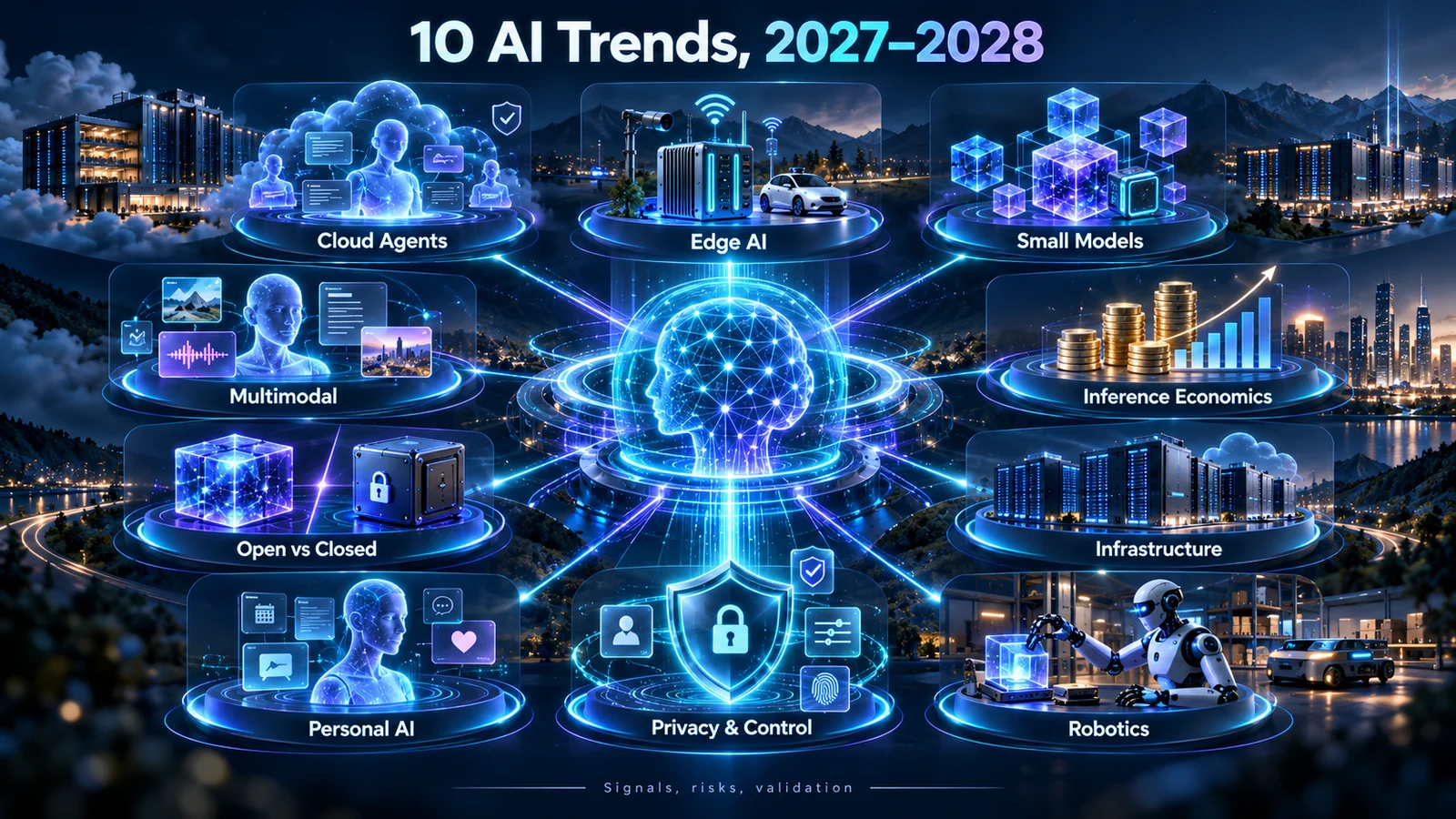
GPT-generated editorial overview of ten interconnected trends. Illustrative concept art, not a measured forecast of adoption or market share.
2. Cloud agents: from remote inference APIs to durable task execution
The old cloud pattern was simple: submit a prompt, receive a response. The emerging pattern includes a maintained workspace, context, files, browser interaction, tool authorization, subagents, retries and the ability to continue when a user closes the app.
On October 8, Google Cloud described a Gemini work agent with persistent cloud context and the ability to coordinate work across devices and applications for hours or days. On October 22, Google introduced Agent Compute Engine for stronger hardware-isolated sandboxing and agent governance; importantly, the company said the new compute service would enter preview in the coming months, not that it was already universally available in production. OpenAI’s 2026 Agents SDK also strengthened controlled sandbox execution and long-horizon tool use. Primary sources: Google Gemini at Work, Agent Compute Engine, OpenAI Agents SDK.
Our outlook: Cloud service providers may increasingly compete on a trustworthy agent runtime, including environment isolation, files and tool use, state recovery, identity, network control and billing, alongside the underlying model. This is a platform opportunity but may also increase vendor lock-in and operational costs.
For the operational trade-offs behind durable execution—shared versus dedicated workspaces, network restrictions and retention—see AI Agent sandboxes: hosted versus self-hosted.
Do not conflate a cloud model API with persistent cloud execution, cloud storage, or an organization’s privately hosted deployment. They have different privacy, authorization and pricing implications.
3. On-device AI: the cloud’s complement rather than its casualty
Local inference solves needs that remotely hosted models cannot always satisfy: immediate device interaction, intermittent connectivity, tight coupling to sensors and files, reduced exposure of selected information, and predictable simple-task latency.
Apple’s June 2026 third-generation Apple Foundation Models report describes both device models, including a roughly three-billion-parameter AFM 3 Core, and models for Private Cloud Compute. Google’s LiteRT-LM describes a cross-platform on-device inference stack covering Android, iOS, desktop and Web, with accelerator support, multimodal inputs and function calling. Sources: Apple research, Google LiteRT-LM.
Local execution is not automatically secure: device storage, file access, backup, logging, encryption keys and user consent still require controls. Likewise, a cloud service cannot be assumed to have zero retention or confidential execution solely from branding.
The relevant engineering quality bar is not peak tokens per second. Report cold-start time, downloaded model footprint, RAM/RSS and memory spikes, P50/P95, energy, thermals, offline ability, and background recovery at the actual supported device tier. Vendor demonstrations on flagship hardware do not establish results for an iPhone 13 or other baseline phone.
Our outlook: Offline search, on-device document classification, voice input, private indexing and light summarization will be compelling local features. Complex research and multi-step remote actions may still need optional cloud escalation. A local-first app can remain local for most functions while transmitting consented context for BYOK cloud calls; privacy statements must disclose each boundary.
Model artifact size and runtime peak memory are not the same. The Mac GGUF/MLX and memory requirements analysis examines quantization and deployment constraints without presenting unperformed cross-device benchmarks.
4. Why “small model” means three different things
Industry commentary often merges fundamentally different categories under the label SLM:
- Downloadable small generative models, such as Gemma 4 E2B/E4B, target device constraints and offline operation. Actual compatibility depends on RAM, quantization and supported runtimes.
- High-throughput cloud models, such as OpenAI’s GPT-5.4 mini/nano and Anthropic’s October 2026 Claude Haiku 5.5, target low-latency and high-volume tasks. A cloud API’s “mini” designation does not mean its weights can be downloaded to a phone.
- Specialized embedding, reranking, speech, OCR and function-call models may not generate chat answers at all. Google’s 740-million-parameter EmbeddingGemma 2 provides a common embedding space for text, images, audio and video, with the goal of improving retrieval rather than replacing a frontier reasoning system.
Sources: Gemma 4, OpenAI mini/nano, Anthropic models, EmbeddingGemma 2.
Our outlook: Routing based on task difficulty and data locality will matter. Fixed rules or local classifiers should handle simple tasks; only ambiguous or difficult tasks should escalate to stronger models. Caching, quantization, distillation, speculative decoding and batching may help, but their value depends on quality regressions and total integration burden. Small models are not automatically cheaper per verified successful task if they require more failed attempts and human corrections.
Conversely, if a frontier model becomes faster and cheaper on the same workload, maintaining a separate routing layer may cease to be worth it. This is a workload decision, not a permanent model-size ideology.
5. A practical cloud–edge workload placement table
| User task | Default placement | Reason and escalation | Verify |
|---|---|---|---|
| Search an exact note field | Local full-text index | Exact and private; add semantic retrieval only when needed | Exact answer and source |
| Search personal PDFs, photos and charts | Local parsing, OCR and embeddings when feasible | Explicitly consented cloud vision if needed | Visual/table accuracy, data flow |
| Voice capture and interface intent | Prefer device when supported | Cloud enhancement only when justified | Latency, permissions, offline behavior |
| Deep multi-document reasoning | Source selection locally, cloud reasoning optionally | Larger compute and context budget | Faithful citation, spending limit |
| Long browser/file automation | Secured durable cloud runtime | Needs persistent state and controlled tools | Resumption, audit, cancellation |
| Send a message or modify business data | User interface + authorized executor | External side effects require explicit scopes and approval | Verified effect, idempotency |
| Repeating background work | Supported server or persistent platform | Cannot assume a mobile OS will run arbitrary background tasks forever | Continuity and user notification |
This is an architecture decision framework, not a statement that all operating systems permit cross-app automation. Platform SDK permissions and background constraints differ substantially.
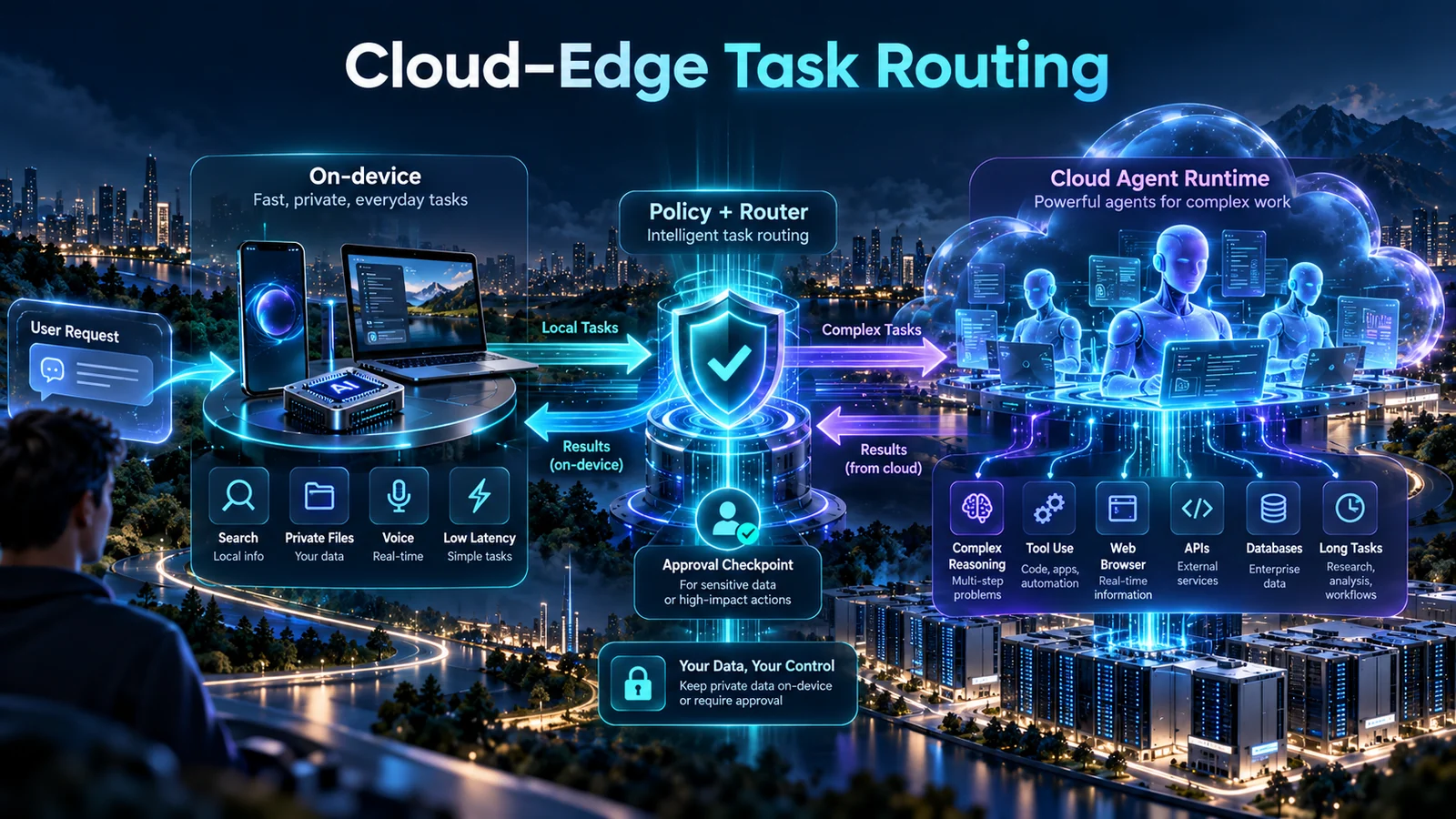
A conceptual routing design, not an assertion that every mobile operating system exposes the depicted tools or background execution capabilities.
6. Multimodal AI moves into retrieval and real-world workflows
The useful multimodal breakthrough is not merely a model describing an image. Private knowledge is stored in tables, receipts, screenshots, meeting audio, charts, video clips and documents with layout. A reliable assistant has to find the right evidence across those media, understand its structure, and know when it cannot substantiate an answer.
Google’s October 6 EmbeddingGemma 2 release brings a roughly 740M-parameter multimodal embedding model designed for device-side retrieval of text, image, audio and video. Meanwhile the October 13 Gemini 4 Argon frontier release illustrates the distinct cloud trend toward demanding, multimodal and long-context reasoning. These models are complementary, not benchmarks for the same function. Sources: EmbeddingGemma 2, Gemini 4 Argon.
Our outlook: Successful applications will increasingly be evaluated on pinpointing evidence in a particular video segment, PDF table cell, screenshot or speech interval—not on producing fluent generic responses. But that also means more work in OCR, segment indexing, timestamp alignment, storage, privacy and source verification.
For a narrower, reproducible retrieval comparison, the EmbeddingGemma 2 Mac local retrieval test separates lexical retrieval, embeddings and RRF under an explicit dataset and hardware scope, rather than claiming mobile production results.
Native multimodal reasoning, multimodal embeddings, and an OCR-plus-text-RAG pipeline remain different implementations. Claims of feature parity require the same test corpus and error rubric.
7. AI agents and Personal AI: context, memory, access and trust
Cloud work agents and private assistants share a need for good task state, but the customer priorities differ. Enterprise agents prioritize business integrations, authorization and recovery. Personal AI particularly depends on the user’s own files, permissioned memory, provenance, portability and effective deletion.
XBSTACK’s existing RecalAI hybrid retrieval analysis documents source-reviewed combinations of exact, lexical and semantic candidates, fusion and citation controls. It is not a phone-performance claim. A separate public-document research baseline created in October 2026 uses ten arXiv PDFs and twenty page-anchored questions. Its Mac-based lexical/non-neural proxy evaluation included a case in which the wrong source document ranked first. This illustrates why “the correct document is somewhere in the results” is not the same as “the first answer is grounded”; it does not measure RecalAI’s neural embeddings or real user documents.
Long-term memory should answer: Where did the fact originate? Has it expired? Who is authorized to read it? What happens to indexes, backups and logs when data is deleted? The Personal AI architecture study and Agent Security hub examine those engineering boundaries in more detail.
Our outlook: Private context, cross-device continuity, controlled memory and externally verifiable outcomes may become more defensible than simply wrapping the latest chat model. The corresponding risks include platform access restrictions, cloud data policies and maintenance complexity.
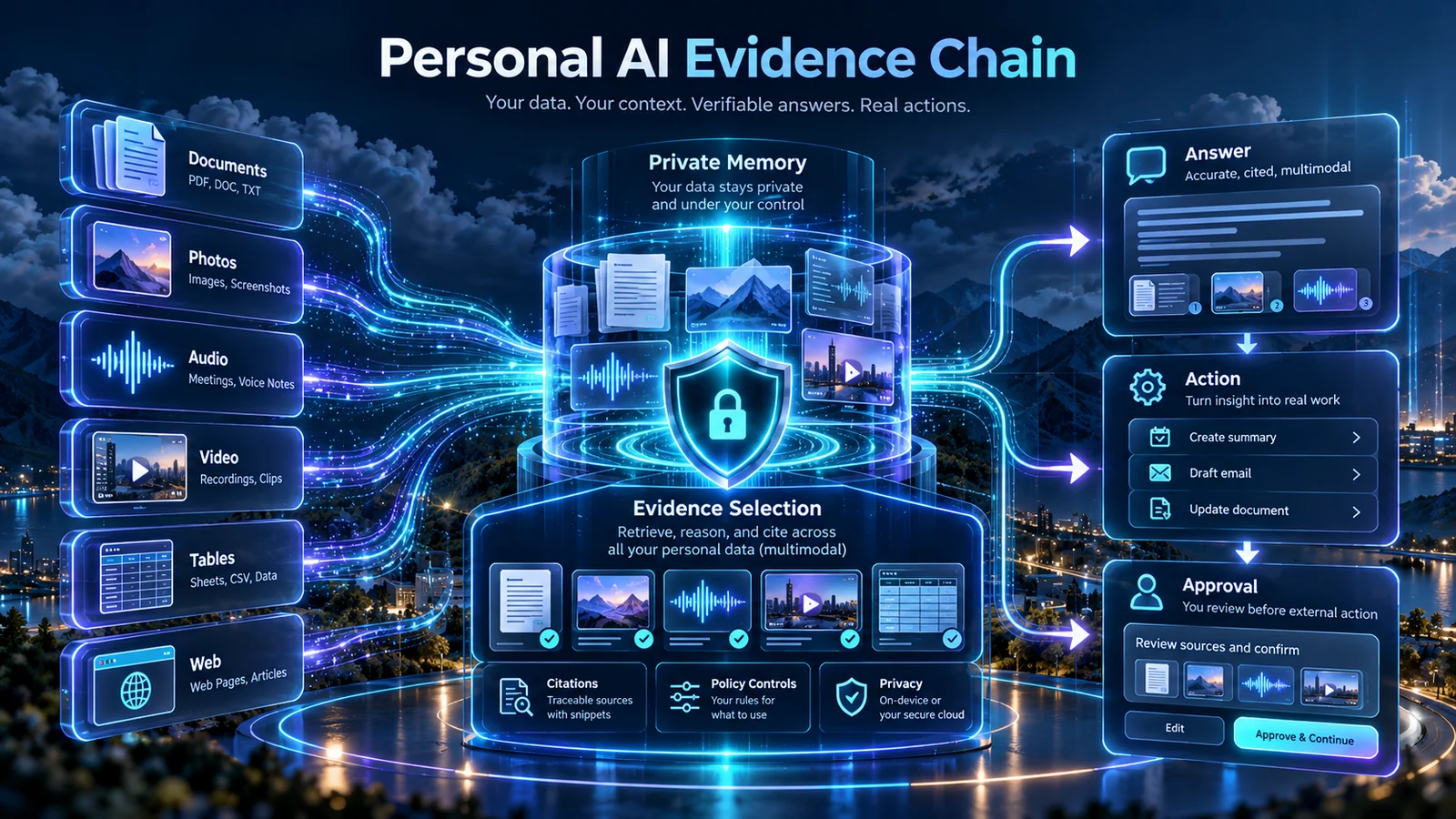
Conceptual Personal AI evidence chain. Privacy and local control depicted are requirements and design goals, not a certification or guarantee for an existing product.
8. Privacy, security and controllability become an AI industry layer
Privacy cannot be reduced to a legal checkbox, and agent security cannot be bolted on after models have been granted access to browsers, messages and personal files. In May 2026, NIST’s AI 800-5 analysis of public responses on agent security reported broad agreement that agent systems introduce novel threats and barriers to adoption. The OWASP Top 10 for Agentic Applications organizes risks that arise when autonomous AI is trusted with tools, data and memory. These are documented risk frameworks, not proof of a particular future incident rate. NIST original source.
The technology response is already visible. Apple’s Private Cloud Compute sets out data-processing and restricted-retention requirements and provides verifiable transparency for independent security scrutiny. On October 7, 2026, Google introduced Android AISeal, a protected-VM approach intended to isolate sensitive personal AI context. These are vendor designs within specific products and deployment assumptions; they do not establish that every cloud AI system has zero retention, or that every Android phone and third-party application already benefits from the same isolation.
Six concrete, testable dimensions of user control
| Boundary | User-centered promise | Engineering requirement | Audit evidence |
|---|---|---|---|
| Data residency and purpose | Know what stays local, what is transmitted and why | Task-scoped cloud opt-in, data minimization, explicit retention rules | Egress logs, scoped uploads, no unexpected transfer |
| Identity and least privilege | The model cannot grant itself broad access | Per-tool read/write scopes, expiry and immediate revocation | Negative access tests and post-revocation denial |
| Approval for irreversible actions | Users approve deletion, payments and communications | Pre-execution preview, confirmation, spending limits, idempotency | Blocked unapproved writes, duplicate-side-effect tests |
| Trustworthy memory | Untrusted web content cannot silently rewrite personal memory | Source labeling, retention/deletion flows, separated instructions and data | Memory-poisoning tests, index/cache/backup deletion checks |
| Model and cloud choice | Local-first modes and approved cloud providers behave as promised | Explicit BYOK/provider routing, transparent network paths | Offline checks, complete data-flow inventory |
| Auditability and accountability | Know what the agent did and how to stop it | Minimally sensitive logs, user-readable approvals and cancellation | Action receipts, access history, incident response |
Controls should be proportional to risk, not a requirement to overload every low-risk local search with consent dialogs. An agent reading a note, sending a message, and deleting a record should not share the same permissions. The international CISA-coordinated 2026 guidance likewise calls for limited autonomy, strong identity, layered defense, monitoring and risk assessments.
Why is this a structural trend, rather than a security footnote?
First, AI systems are becoming actors, not just advisors: incorrect text becomes a side effect when linked to real tools. Second, personal context is aggregating across mail, calendars, files, photographs and long-term memory, raising the impact of unauthorized retrieval. Third, enterprise procurement increasingly needs accountable access and verified data boundaries. The third point is a scenario inference from technical standards and security engineering, not a published global procurement adoption percentage.
Our 2027–2028 test is whether protections become observable product behavior. Can a user revoke a tool and verify future calls fail? Can they delete a remembered fact from indexes and backups? Does offline mode truly avoid external traffic? Can a malicious document instruct an agent to exfiltrate data? Can a running task be stopped and audited? If those tests remain poor, the strong-privacy-as-market-differentiator thesis must be revised.
Privacy policy depends on each service boundary, not a single retention setting. The OpenAI Zero Data Retention and MCP data boundaries guide distinguishes model-side controls from third-party tools, caches and persisted state.
XBSTACK already maintains an Agent Security hub and a related Agent Security Auditor. This industry report focuses on what privacy, safe execution and controllability imply for market structure, device/cloud architecture and business trust, rather than duplicating a full technical security tutorial.
9. The infrastructure layer: beyond GPU counts
Persistent agents, subagents, larger context windows and multimodal input can drive up aggregate compute needs even as a given inference operation becomes cheaper. The infrastructure bottleneck widens from compute chips to HBM, advanced packaging, electricity, cooling, networks and data-center construction.
IDC’s October 22 industry analysis argues that capacity constraints in memory, power, packaging and construction will shape growth through 2027–2028. This is an industry forecast, not a guarantee of shortage for every component and region. Gartner’s September forecast projects roughly 49.5% growth in total worldwide AI spending in 2026. Spending, supplier revenue, operating profit and free cash flow must not be treated as equivalent. Sources: IDC, Gartner.
Three distinct layers of industry returns
Three economic layers need distinct analysis:
- Capacity providers: GPU/ASICs, memory, packaging, servers, power and cooling. Watch delivery, utilization, procurement cycles and capital intensity.
- Managed platforms: Cloud inference, agent sandboxes, retrieval storage, security and observability. Watch unit gross margin, compute utilization, reliability and switching costs.
- Applications: Personal AI, specialist workflows and developer tools. Watch real task quality, willingness to pay, recurring usage and support burden.
The size of global AI investment cannot, by itself, justify an equity valuation. Separate segment revenue, gross margin, operating profit, nonrecurring investment gains, capital spending and operating cash flow.
10. Open models versus closed frontier platforms
Stanford HAI’s 2026 Technical Performance chapter reports continued improvements in high-end models but also measurable gaps between the strongest closed and open offerings at certain dates. It would be inaccurate to claim every open model already matches the leading closed models. Yet open-weight releases and inference toolchains expand options for deployment control, quantization, model customization and local execution. Sources: Stanford HAI, Gemma 4.
Our outlook: The competitive stack may stratify into closed frontier services, portable open-weight general models, and high-efficiency specialist/device models. A robust application architecture must account for license, model replacement, regression evaluation, user permissions, geographic availability and vendor-specific tooling. “Multi-model” is useful only when switching produces measured reliability or economic benefits.
11. Commercialization: distribution and verified task outcomes
As model access becomes easier, differentiating an AI business requires something besides a chat interface: a user distribution channel, authorized data context, consistent task completion, domain expertise, accountable support or integration into an established workflow.
A more realistic economic unit is total cost per verified successful task: model tokens plus retrieval, tool execution, storage, approvals, failed retries, correction, governance and support, allocated to actual outcomes.
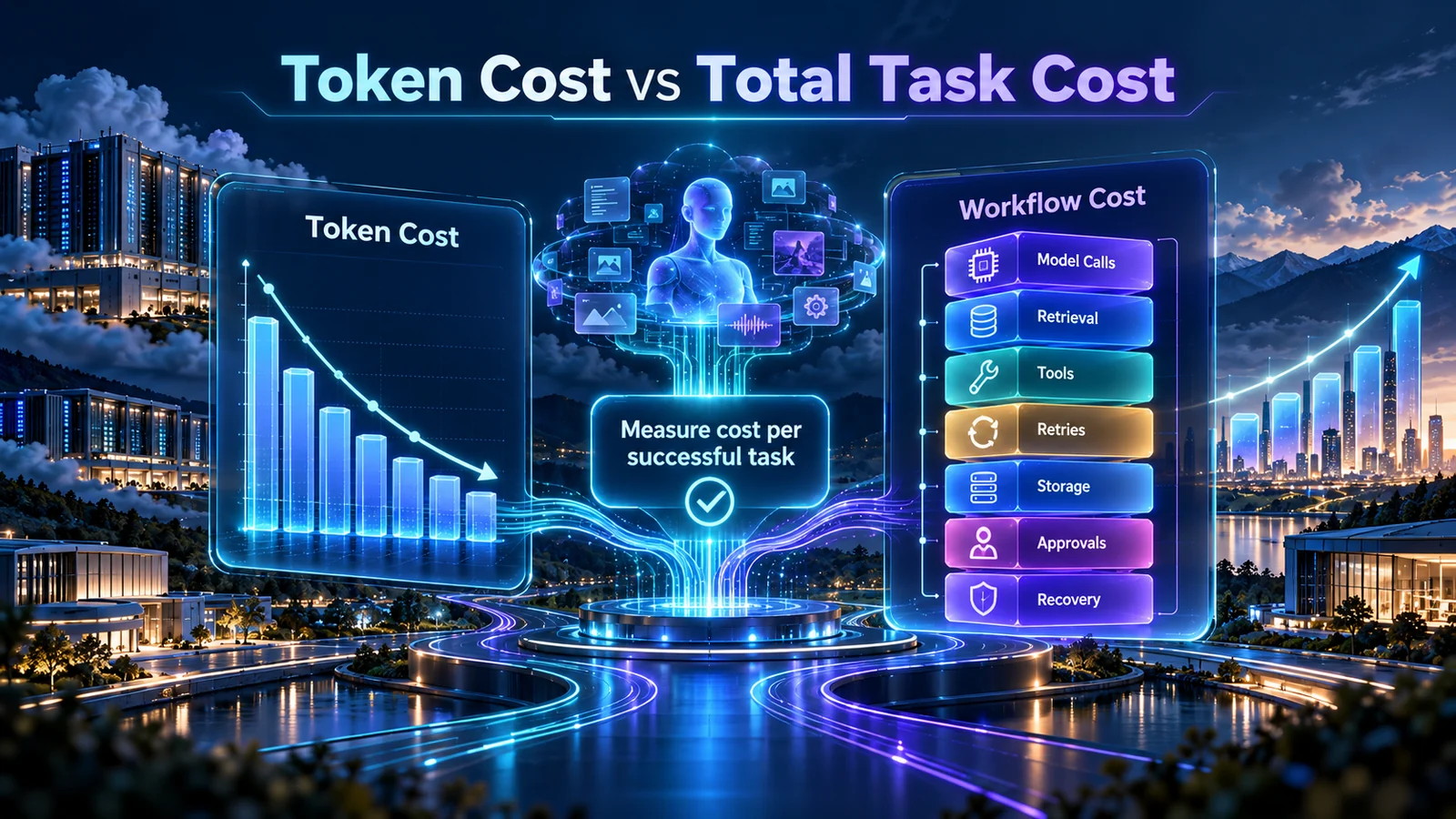
Illustrative economics only. The plotted curves are not sourced market measurements; actual ROI requires end-to-end cost per verified successful task.
A complementary engineering approach is Context Engineering for retrieval, tools and memory cost, which covers wasted context and prompt budgets without assuming that lower token count automatically means better task outcomes.
Consider an explicitly hypothetical example: ten actions at 0.50. A later workflow may require a hundred actions at only 1.00 total. Unit action price fell 80%, but inference for the full task doubled. This does not predict a vendor’s actual bill; it illustrates why token price is an incomplete ROI metric.
Financially viable products must connect the feature to a user result, repeat use and payment, not merely count prompts, automation demonstrations or agent invocations.
12. Embodied and physical AI: a different adoption clock
Better multimodal perception, planning and tool use help robotics, vehicle autonomy and industrial applications. Yet moving from software workflows to physical environments adds sensor error, actuator reliability, long-tail physical variation, safety certification, field service and liability.
Stanford’s 2026 Technical Performance chapter documents a material gap between robot performance in controlled simulation and real household tasks. Robot opportunities are therefore more plausibly staged: bounded, repetitive and measurable environments before general-purpose household autonomy. This is an industry scenario, not a claim that a universal consumer robot will reach mass adoption by 2028. Stanford technical performance.
13. Scenarios through 2028 and what would disprove them
| Scenario | Conditions | Likely consequence | Falsifying evidence |
|---|---|---|---|
| Base: layered cloud/edge architecture | Reliable cloud long tasks improve; small-device models handle frequent private tasks | Persistent agents and local indexing both grow | High failure rates, heavy support and low retention persist |
| Upside: verified task costs fall | Routing, retrieval, caching and recovery improve outcomes on a fixed task mix | More real Personal AI and business workflows | Tokens get cheaper but total corrected task cost does not |
| Downside: governance and economics lag | Energy, CapEx, compliance, error correction and integration costs exceed value | Projects narrow or revert to human-supervised tools | Independently verified ROI spreads across sectors |
Review each quarter: cloud task completion and recovery, on-device P95/RAM/energy and offline success, routing mistakes and escalation rates, total completed-task spending plus retention, and infrastructure utilization plus cash flow. Good industry research should make it possible to discover when a thesis is wrong.
14. A 90-day action plan for engineering leaders and independent builders
Month 1 — Establish the task corpus. Collect ten repeated real user jobs. Separate exact-field retrieval, visual search, evidence-grounded writing, tool actions and persistent external work. Define correct outcomes, privacy boundaries, time budgets and source requirements before choosing models.
Month 2 — Build a cloud–edge split. Measure local FTS, OCR, embeddings and interface response on baseline devices. Escalate expensive inference or persistent work only behind a consented cloud boundary. Compare a specialist/small-model baseline against a stronger-model baseline using identical tasks and source evidence.
Month 3 — Evaluate whether to scale. Examine wrong citations, revoked permissions, side effects, retry costs, peak memory and actual user return visits. Preserve failure cases and the ability to disable a risky capability. For RecalAI specifically, make reliable import, exact search, evidence citations and revocable private data the baseline before marketing larger models.
15. Eight decision questions behind the 2027–2028 AI outlook
Will cloud agents replace edge AI? Not directly. Durable cross-app execution fits managed cloud runtimes, while offline retrieval, immediate responses and controlled private-data processing fit devices. Select based on device capacity, authorization and verified task cost.
Are on-device SLMs and hosted mini models equivalent? No. A downloadable device model is constrained by weights, RAM, quantization and offline operation. A hosted mini or nano model is a cloud service tier; their data pathways and deployment rights are not interchangeable.
Will small language models replace frontier models? That is not established. Small and specialist models can be efficient for extraction, search and classification; harder reasoning may justify stronger models. Compare success rates and total costs on the same workload.
Why might completed agent tasks cost more as tokens get cheaper? More tool calls, subagents, retries, persistent environments, reviews and recovery can overwhelm a lower per-call price. Count the total cost per verified successful task, with stable evaluation criteria.
Does privacy-first AI prohibit all cloud processing? No. It requires clear, task-scoped choice of where data goes, which provider handles it, what is retained and how access is revoked. Local execution and confidential cloud processing solve different trust problems.
What makes an AI agent controllable? Limit tool and data scopes, require approval for consequential actions, provide cancellation and audit trails, and test whether malicious webpages, emails or PDFs can induce unauthorized behavior.
Can personal AI promise that deleted memories leave no traces? Not without verifying primary records, indexes, caches, synchronized copies, backups and logs against stated retention policies. Products should disclose real deletion scope and timing.
How can builders check whether these industry forecasts are wrong? Track cloud-task success and recovery, device P95/RAM/power, tool revocation tests, cost per completed task, retention, utilization and cash flow. Physical robots need separate field-success and service-cost measures.
Conclusion
The next two years should not be framed as an all-cloud future or an all-local future. Cloud agents make complex work persist, edge AI brings immediate and private understanding to the device, small and large models divide work by cost and difficulty, and multimodal retrieval expands accessible information. Privacy, safety, user-controlled data and verifiable controls determine whether systems earn trust; infrastructure plus product economics influence who captures value.
The central strategic question is therefore how AI work should be allocated across runtimes, model sizes and data boundaries—and which verified result the end user is willing to pay for.
Research method and verification boundaries
This is a synthesis of public primary reports, model release notes and an explicitly limited engineering case, with an evidence cutoff of October 26, 2026:
- Stanford AI Index 2026, Technical Performance
- Google Gemini at Work, Agent Compute Engine, OpenAI Agents SDK
- Apple Foundation Models, Google LiteRT-LM, Gemma 4, EmbeddingGemma 2, OpenAI mini/nano, Anthropic models
- IDC October 22, Gartner September AI spending forecast, McKinsey State of AI 2026, Gartner AI Hype Cycle
Future statements are scenario judgments, not observed outcomes or an official industry consensus. We did not conduct fresh enterprise interviews or a production RecalAI iPhone neural-search benchmark. Illustrations are GPT-generated conceptual artwork, and neither forecasts nor hypothetical cost diagrams represent measured future market outcomes.
Next step: harden the execution boundary
Full decision path →Continue with the control that should be enforced before the next tool call, credential handoff, or production rollout.

DISCUSSION
Questions, verification and corrections
Sign in to comment. Every new comment is reviewed before publication; while pending, it is visible only to you and the administrator.