

Gemini 4 Argon: Capabilities, Pricing, Migration, and a Real-Project Evaluation Plan
Google released Gemini 4 Argon on October 13, 2026. This source-grounded guide explains its unified 1M-token window, text-only output, introductory pricing, API changes and a reproducible coding-agent evaluation plan. No Gemini model benchmark is claimed.
Evidence 6 cited sources
On this page
Direct answer: Google released Gemini 4 Argon on October 13, 2026 under the model ID gemini-4-argon. Its unified context window covers up to 1,048,576 input, thinking and output tokens; standard synchronous responses default to a 65,536-token output cap. It supports multimodal input (text, images, video, audio and PDFs) but only text output. Introductory API prices are 10 per million output tokens until November 30, rising to 20 on December 1. Those are Google’s published specifications and list prices, not XBSTACK benchmark results.
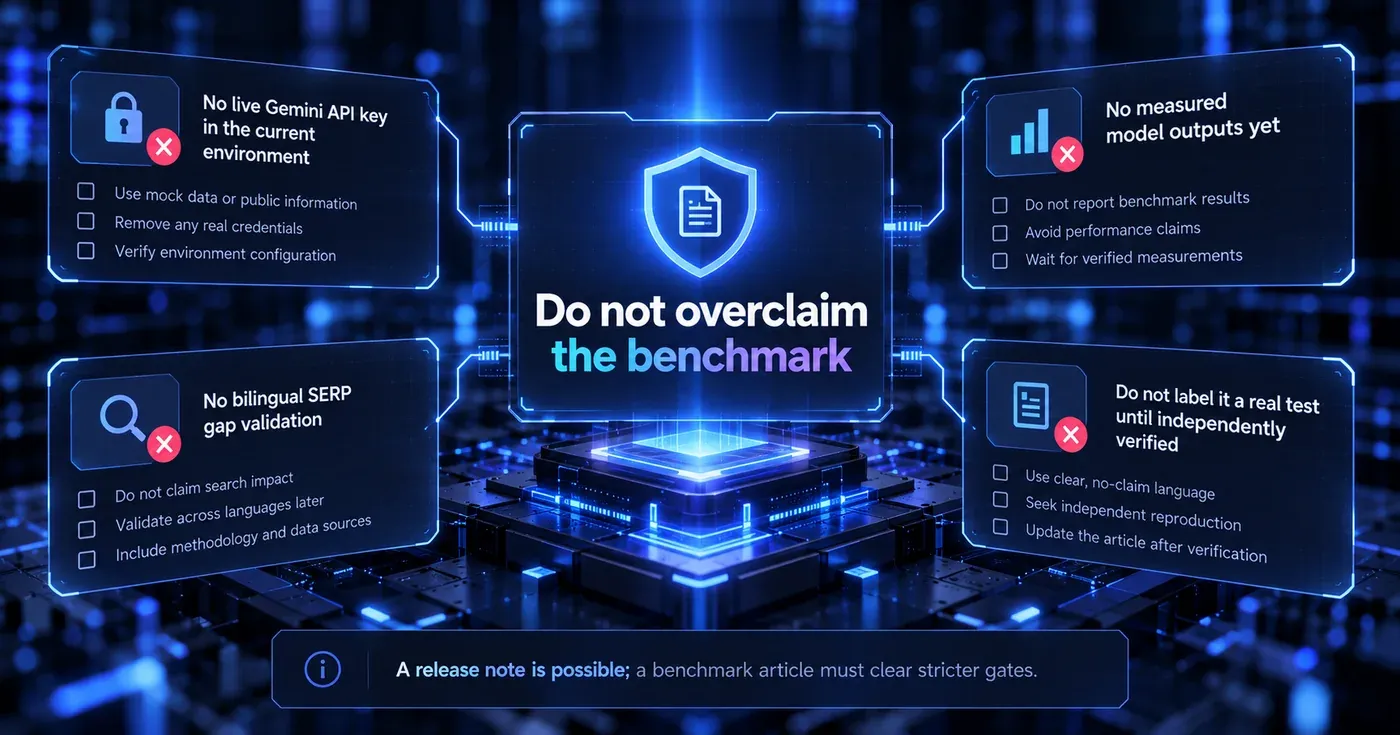
Testing status: We have prepared two tasks against a real Astro site and a separate LangGraph recovery fixture. We have not run a live Gemini 4 Argon request because the project execution environment had no authorized API credential. A screen showing “evaluation done” in the conceptual cover is illustration, not a real terminal capture. The article explains how to validate the model rather than claiming an unperformed test.
1. What is actually new in Gemini 4 Argon?
Google announced general availability in its October 13 Gemini API release notes. The launch guide focuses on harder coding, multi-step agents, scientific reasoning and long decode. Those are product positioning statements. An engineering adoption decision still depends on whether the model can apply a correct change to your repository and whether your evaluation distinguishes proposed code from verified code.
Here is the specification boundary as of October 14, 2026:
| Property | Google documentation | What it does not prove |
|---|---|---|
| Model ID | gemini-4-argon (stable) | Compatibility with every SDK integration |
| Context window | 1,048,576 tokens shared across input, thinking and output | That a model will use every retrieved file correctly |
| Default output limit | 65,536 tokens (synchronous) | That a long answer will finish if your own timeout is short |
| Long decode | Up to the shared 1M limit using background continuation | A single uninterrupted synchronous response |
| Input types | Text, image, video, audio, PDF | Multimodal generation |
| Output type | Text only | Image, video or audio generation |
| Thinking | Low, medium (default), high | High always delivers better unit economics |
| Cache | Implicit caching; explicit caching unsupported | Guaranteed cache hits on every call |
| Availability | Paid-tier access; no free Gemini API tier for Argon | Access through every Google AI consumer subscription |
The separate official model card is the source of truth for output types, supported APIs and tool features. In particular, avoid confusing “video understanding” with video generation, and “audio input” with audio output.
2. How much will the API cost?
Google’s launch and pricing guide specifies two time-bounded list-price phases in US dollars per million tokens.
| Token category | Until November 30, 2026 | From December 1, 2026 |
|---|---|---|
| Input tokens | $2.00 | $4.00 |
| Output tokens, including thinking | $10.00 | $20.00 |
| Implicit-cache-hit input tokens | $0.10 | $0.20 |
The cache-hit row describes the vendor’s 95% implicit caching discount, not a promised discount on all input. There is no explicit-cache creation API for Argon. The apparent per-token price alone cannot tell a developer what a coding task costs: complex tasks may consume more thinking tokens, tool attempts, time and output than simple prompts. Actual bills also depend on caching, consumption mode and provider billing rules.
A useful measurement is total cost per accepted change, not cost per raw million tokens. Record all attempts, retries, thinking/output usage and any separate execution infrastructure. A model that produces a longer-looking patch but fails the build has no validated task success.
3. Minimal API request and migration checklist
Google’s current recommended starting point is its Interactions API. The REST request shape is:
curl 'https://generativelanguage.googleapis.com/v1beta/interactions' \
  -H 'Content-Type: application/json' \
  -H "x-goog-api-key: $GEMINI_API_KEY" \
  -X POST \
  -d '{"model":"gemini-4-argon","input":"Review this proposed code change for correctness."}'
This is a documented example, not a command executed in our model test. Store the key in a trusted local secret manager or environment configuration; do not hard-code or publish it. The official Gemini 4 Argon migration guide identifies several concrete changes:
- Replace the model ID with gemini-4-argon, then verify feature support for your actual endpoint.
- Evaluate low, medium and high thinking levels separately; medium is the default.
- Revisit max_output_tokens because reasoning and final text share the output budget. Existing limits below 32K can prematurely cut off difficult tasks.
- Remove explicit context caching calls. Argon uses implicit caching instead.
- Remove temperature, top_p and top_k overrides: the launch guide says they are ignored.
- Use background execution for outputs beyond 64K and allow a sufficiently long client timeout. A long-decode interaction may consist of multiple model_output steps that must be joined.
- Preserve multi-turn state deliberately with previous_interaction_id if you choose the Interactions API.
An API call succeeding is an integration smoke test. It does not certify an autonomous agent, a secure tool boundary, or correct changes in production.
4. The real-project experiment: two falsifiable tasks
A model review is valuable when its failures are visible. The local research folder includes a versioned preflight plan and Python harness at research/gemini-4-argon/. It selects real repository files and records source checksums. It is intentionally read-only with respect to production code.
Task A — audit a real Astro route
The first input is the source file for the XBSTACK AI article route. The model should identify any genuine correctness or maintenance problem, propose a limited patch and explain validation. Human or isolated automation must then inspect the diff, test route preservation, run Astro type checking and build, and decide whether the patch is acceptable.
An evaluation record should include the input checksum, model/version, prompt, exact output, applied changes if any, build/test status, reviewer decision and actual token cost. A narrative answer that sounds plausible earns no pass without evidence. The route is not permission for a model to rename production URLs or alter navigation.
Task B — recognize ambiguous Agent side effects
The second input is a runnable local LangGraph fixture in which a fake payment provider commits the charge, but the HTTP response arrives after a Tool timeout. The resumed Tool might repeat the external operation. The correct engineering answer must distinguish graph checkpoint durability from business-side effect deduplication.
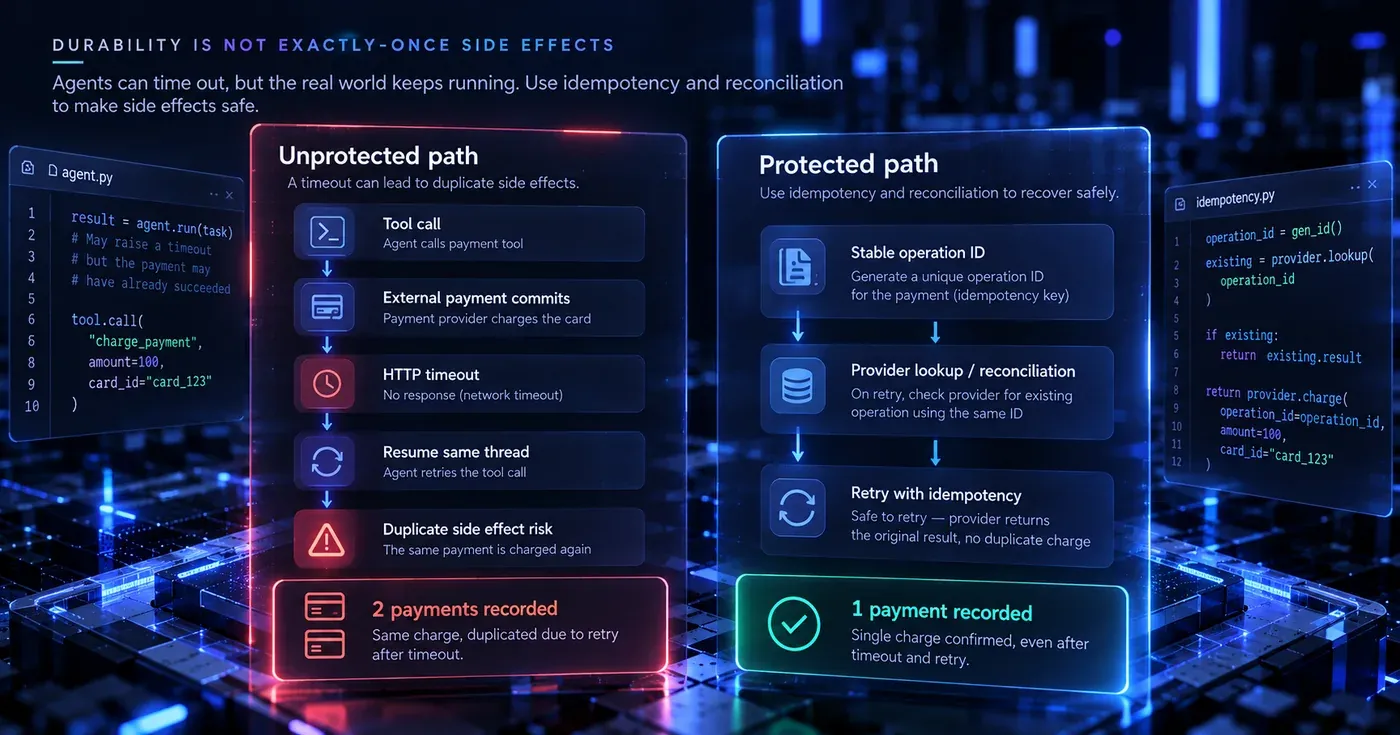
The public XBSTACK LangGraph fixture was independently rerun on October 14 with pinned LangGraph 1.2.12 dependencies. All five local verification checks passed. In its mock provider scenario, the unprotected replay recorded two payments, while stable operation identity and reconciliation retained one. This is not evidence that Gemini 4 Argon recognized or solved the problem; the model still needs to be tested on the fixture separately.
A safe coding-agent answer should state when the provider can atomically deduplicate a write, when an ambiguous external outcome requires reconciliation, and when human review and current authorization are necessary before any retry. Exactly-once semantics are not granted by a graph’s checkpoint mode.
5. How to grade a model answer without overstating it
The scoring process will be defined before model outputs are collected:
| Dimension | Pass evidence | Rejection signal |
|---|---|---|
| Repository understanding | Names concrete functions, routes and relevant line spans | Invents APIs or files |
| Patch correctness | Small reviewable diff; independently passes check/build | Claims success without tests |
| Regression safety | Preserves site paths, metadata and stable behavior | Silently changes published URLs |
| Agent recovery | Recognizes committed-but-unacknowledged writes and stable operation IDs | Blindly retries a payment |
| Evidence honesty | Clearly separates proposed from executed steps | Claims external side effects were tested by the model |
| Resource cost | Reports actual usage and elapsed time for the whole task | Uses vendor leaderboard scores as local results |
We should repeat each task, log failed as well as successful attempts, and compare configurations at a fixed environment. Where multiple thinking levels are tested, the rubric stays constant. Only then could XBSTACK publish pass rates, latency or model cost per accepted change. Until that happens, these are evaluation criteria, not measured outcomes.
For the previous generation, consult XBSTACK’s Gemini 3.8 Flash vs 3.7 Flash model-choice guide. The LangGraph failure-recovery guide covers the independent side-effect reproduction, and the AI Tools Lab organizes other engineering verification routes. These are relevant reading paths, not evidence of live Argon benchmarks.
The same evidence standard can later be applied to GPT and Claude coding agents using cloud AI APIs. That would be a separate controlled comparison: XBSTACK has not run one here. Nor does a single successful code patch demonstrate broader AI or AGI capabilities.
6. Decision guide: should you migrate today?
Consider a controlled Argon pilot if you operate a difficult coding/agent workload, can use a paid Gemini API tier, and can keep the evaluation in a sandbox. Start with tasks that already have objective success criteria, like compiling a specific package, fixing a reproducible test or evaluating known agent replay boundaries.
Do not switch all workloads just because the context window is larger or Google describes the model as more capable. Keep stable models in production until their specific application checks, cost budget, retry policy, security review and rollback procedure pass. Particularly for payments, email or production file edits, the enforcement layer must remain outside the model.
A useful decision record should say what changed, what stayed the same, what failed under load, whether human supervision is still required, and which use cases should not migrate. Without that, “model upgrade” is a headline rather than an engineering result.
Frequently asked questions
Is Gemini 4 Argon available on the free API tier?
No. As of October 14, 2026, Google lists it outside the free Gemini API tier and Google AI Pro plan. Consult the current pricing page before testing paid requests.
Can Gemini 4 Argon produce images, audio or video?
Its documented input types include text, images, video, audio and PDF; its output is text. It is not an image/audio/video-generation endpoint.
Did XBSTACK actually benchmark Gemini 4 Argon?
No. We prepared an experiment and independently verified a separate LangGraph timeout/recovery fixture, but did not receive or score real Gemini 4 Argon model outputs. The article is a source-based release and evaluation-plan guide. Any future benchmark claim must first pass authorized API execution, evidence review and an additional editorial check.
Sources and evidence boundary
For model capabilities and costs, consult the official model card, release notes, migration/pricing guide and pricing table. The LangGraph public reproduction supplies evidence for the separate application-level recovery discussion. The diagrams are GPT-generated editorial illustrations, not screenshots from Gemini 4 Argon.
Publication boundary, October 14, 2026: This is an official-source migration guide with a pre-defined real-project testing method, not a tested Gemini model performance report. Future measured results require actual authorized API runs and independent validation.
Continue from one agent pattern to the complete production system
The AI Agent hub organizes architecture, memory, tool use, evaluation, security, deployment and multi-agent coordination into a single learning path.
Next step: continue the Agent system
Full decision path →Choose the next architecture, tool, memory, evaluation, security, or production decision instead of starting over.

DISCUSSION
Questions, verification and corrections
Sign in to comment. Every new comment is reviewed before publication; while pending, it is visible only to you and the administrator.