Can Offline Voice and a Local AI Agent Run Without Paid APIs? Lessons from RecalAI and Lunest
Using real RecalAI native on-device speech, segmented transcription, FTS/RRF retrieval, quantized local generation and scoped Agent operations, plus Lunest audio recovery, compare no-paid-API voice assistants and optional cloud services. Covers iPhone 13 memory and latency, licensing, device compatibility and privacy without inventing benchmarks.
Evidence 13 cited sources
On this page
“Speech recognition, voice output and an AI assistant for free” sounds like a pricing choice. For a mobile developer, however, the difficult parts are device eligibility, language coverage, model memory, audio-session ownership, data privacy and a believable exit path when the feature fails. Avoiding a metered inference service does not automatically make the application lightweight, battery-friendly, truly offline or inexpensive to maintain.
Two concrete products make the distinction useful. RecalAI is a local-first personal knowledge application that needs to find and cite the right passage of a document. Lunest is a sleep and audio application that must preserve long-running playback, monitoring, wake behavior and recovery. Both could benefit from less reliance on cloud inference, but the first is primarily a source-integrity problem, while the second is primarily an audio-lifecycle reliability problem. They do not need the same default voice stack.
Evidence boundary: This is a source-backed engineering and product decision analysis. It does not claim that a Google AI Edge speech integration has shipped in either app, or that the models were benchmarked on an iPhone 13 and a fleet of Android devices. For the specific 2026 speech SDK change, read our on-device ASR/TTS architecture and fallback analysis. For the paid model decision, see Gemini 4 Hydrogen, Argon and Carbon for real engineering tasks.
Start with the real products: what is already coded and what remains optional
A “no paid API” proposal should not pretend RecalAI and Lunest are greenfield demos. The repositories show real on-device speech, retrieval, models, bounded Agent actions and audio recovery. Implemented below means a code path exists, not that every target phone and release has passed device acceptance.
| Capability | Evidence from the project | Remaining limitation |
|---|---|---|
| RecalAI iOS/iPadOS microphone dictation | PMSpeechInputController checks Speech and microphone authorization, verifies supportsOnDeviceRecognition and enforces device-only recognition | Actual locale coverage, offline language assets, Chinese accuracy and energy still require target-device runs |
| RecalAI Android spoken query | OnDeviceVoiceInput uses createOnDeviceSpeechRecognizer rather than relying on the unreliable offline-preference flag of a generic recognizer | Android vendor, OS and locale support have not been established through a complete device matrix |
| Local audio/video transcription import | iOS segments media at roughly 50 seconds with protected fingerprint-derived checkpoints; Android requires Android 13+ and local recognition before processing roughly 30-second audio segments | Actual CER, timed-alignment error, interruptions and corrupted-file recovery; segment labels are not universal word timings |
| Answer and study-card speech | Android OfflineAnswerReader excludes uninstalled and network-dependent platform voices; an iOS study-card feature uses AVSpeechSynthesizer | Does not prove every page and locale exposes offline TTS |
| Private retrieval and local models | Android FTS/dense HybridSearchEngine with RRF, MediaPipe EmbeddingGemma and LiteRT-LM EmbeddingGemma 2; iOS uses llama.swift/llama.cpp with GGUF; macOS has local inference and durable full-library synthesis checkpoints | Model readiness and cross-device memory/quality acceptance remain separate |
| Agent and user-owned model credentials | Scoped evidence-based metadata plans, preview/approval/undo paths across clients to varying degrees; Android BYOK offers multiple cloud providers and explicit consent, with gemini-2.5-flash as its current Gemini preset | Not a verified unrestricted autonomous file agent or deployed Gemini 4 three-model router |
| Lunest’s overnight functionality | iOS and Android audio interruption/focus handling, local snoring/possible sleep-speech acoustic events and device-local HealthKit/Health Connect fusion | Still needs overnight target-device acceptance; detecting possible sleep speech is not transcribing what someone says |
| Newly announced ML Kit GenAI ASR/TTS, sherpa-onnx, whisper.cpp, cloud speech APIs | Evaluated options, not confirmed app dependencies: searches found no such new GenAI speech, sherpa or whisper integration; Android’s existing MediaPipe/LiteRT code is used for embedding/retrieval rather than the new Google speech SDK | Introduce only after locale/device benchmarks, model-weight licensing, privacy and cost checks |
The practical no-metered-cloud-API foundation already exists in parts: RecalAI can place device-only dictation in front of its existing local evidence path and use appropriate native read-aloud components; Lunest already separates local acoustic detection from overnight playback control. That is more precise than claiming that a full voice agent has shipped. Our Google AI Edge versus existing speech implementation study covers what is new, and the Gemini 4 task routing study addresses optional paid reasoning—not a substitute for these established local components.
Hands-on feedback: recognition is promising, latency still needs work
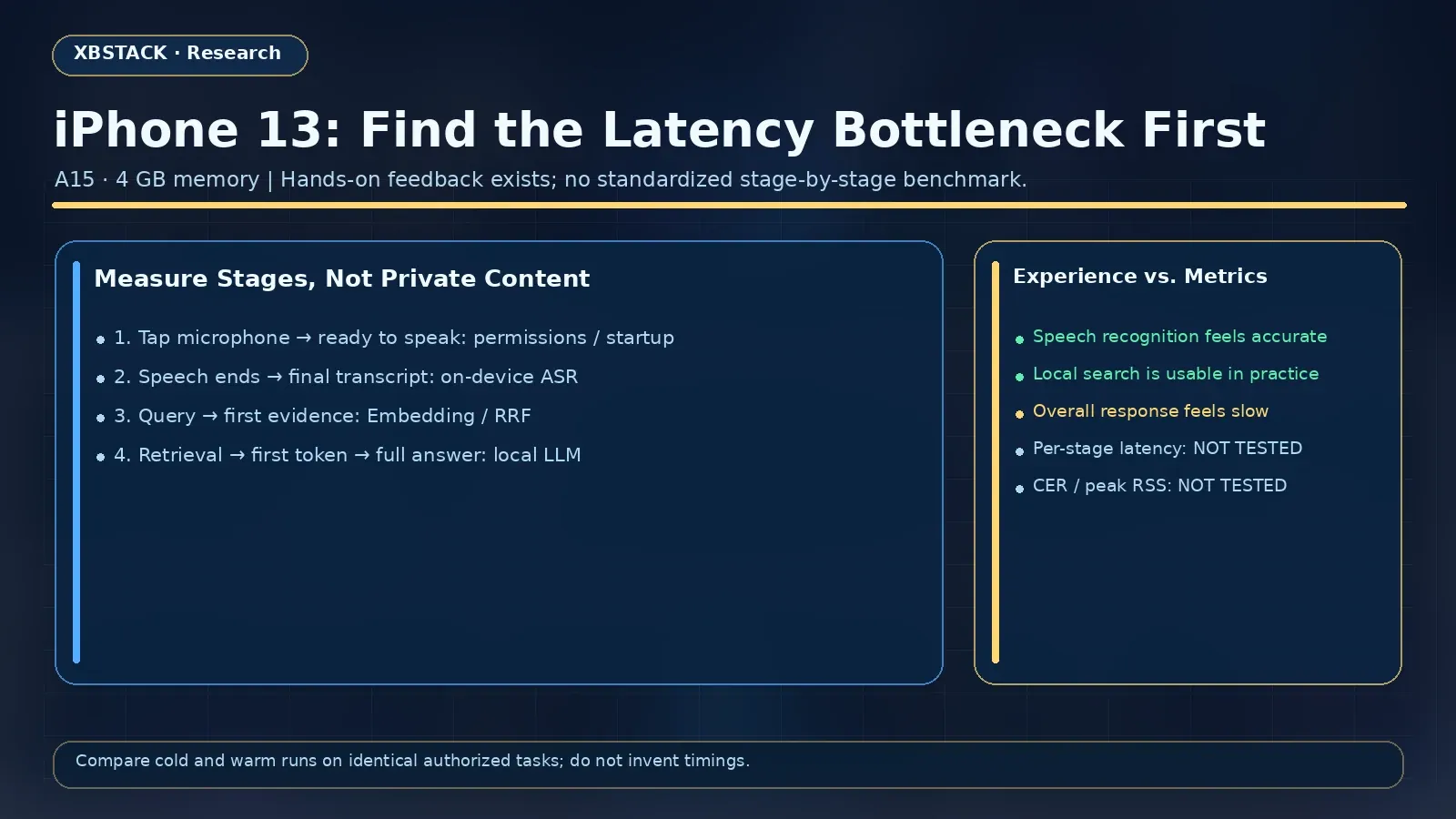
Figure: The developer reports useful search and generally accurate speech, but no reproducible latency trace exists yet.
Source code establishes what has been implemented; field experience identifies what actually needs attention. The developer reports subjectively about 99% recognition accuracy with the current device-side speech workflow, reasonably useful search, and an overall sluggish experience on an iPhone 13. No labeled transcript count, corpus, test noise level or error calculation has been supplied, so this is an informal observation—not a validated character error rate, cross-language score or Google AI Edge benchmark. Search usefulness is similarly qualitative rather than measured recall.
That changes the zero-API engineering priority: retain the working native speech and local evidence pipeline before adding another resident sherpa-onnx or whisper.cpp model for a theoretical accuracy gain. On the iPhone 13, trace the separate delays for finalized transcription, query embeddings, retrieval/reranking, LLM cold start, first token and full response. Use authorized repeatable inputs and cold/warm comparisons without storing private voice or knowledge contents in logs. Consider a paid reasoning step only if a measured capability gap—and explicit user consent—justify it.
The iPhone 13 already has implementation hooks worth measuring before replacing anything. RecalAI iOS PMMemoryModel.prepareSearch prepares semantic query vectors; PMEmbeddingProvider caches query embeddings by model identity and normalized text, and exposes an unload path to avoid keeping a heavy embedding runtime resident alongside the local generative model. These code paths are useful starting points, not evidence that cold start, cache hit rates or device pressure have been optimized.
| User-visible step | Existing boundary to inspect | Conditional optimization | Privacy-preserving signal |
|---|---|---|---|
| Tap microphone → ready to speak | On-device SFSpeechRecognizer, permission state, AVAudioEngine startup | Preflight availability without automatically starting capture; avoid redundant permission cycles | Startup duration, device and errors; no raw recording |
| Stop speaking → finalized transcript | Partial/final callbacks and text field updates | Separate recognizer delay from UI propagation; do not treat partial text as a committed query | Timing and error codes, not private dictated text |
| Query submitted → first evidence | FTS, cached or newly generated embeddings, RRF/reranker and citation selection | Reuse the existing query cache; assess lexical-first progressive results only if citation consistency is preserved | Stage timings, cache-hit counts, candidate counts; no private snippets |
| Ask assistant → first/final token | Embedding unload, GGUF load, evidence assembly, decoding, streaming UI | Compare cold/warm LLM startup, avoid memory overlap on 4 GB devices, bound context | First-token and completion latency, peak RSS; no private prompt text |
Do not optimize the wrong metric: a high subjective speech accuracy estimate does not settle LLM latency, and a slow generated answer does not justify a new speech recognizer. If a labeled Mandarin corpus later reveals ASR problems, evaluate new local speech models on identical audio; if the slowdown belongs to model loading or generation, fix that layer first.
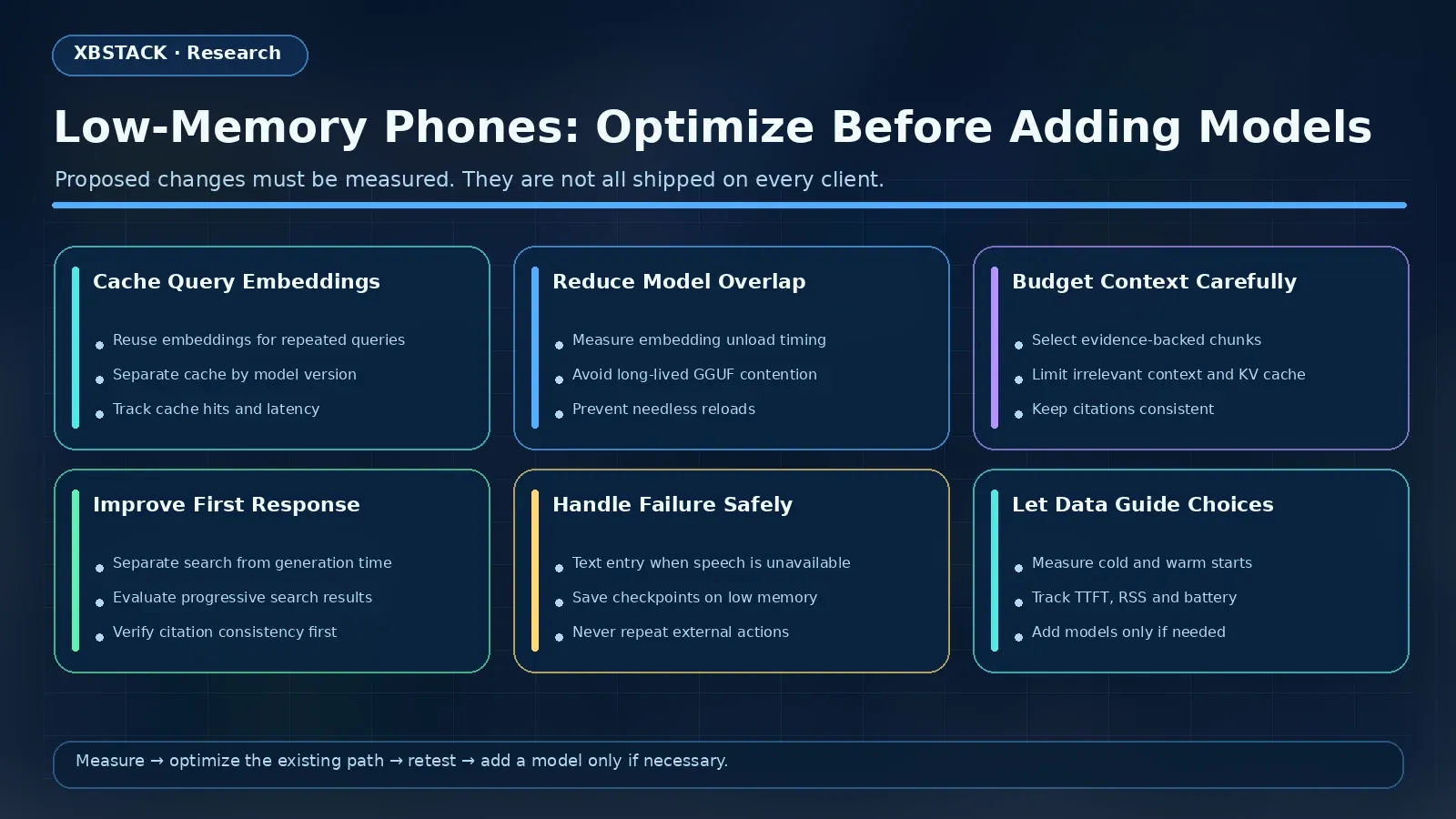
Figure: Measure the bottleneck before loading another large speech model.
“Free” describes three fundamentally different technical arrangements
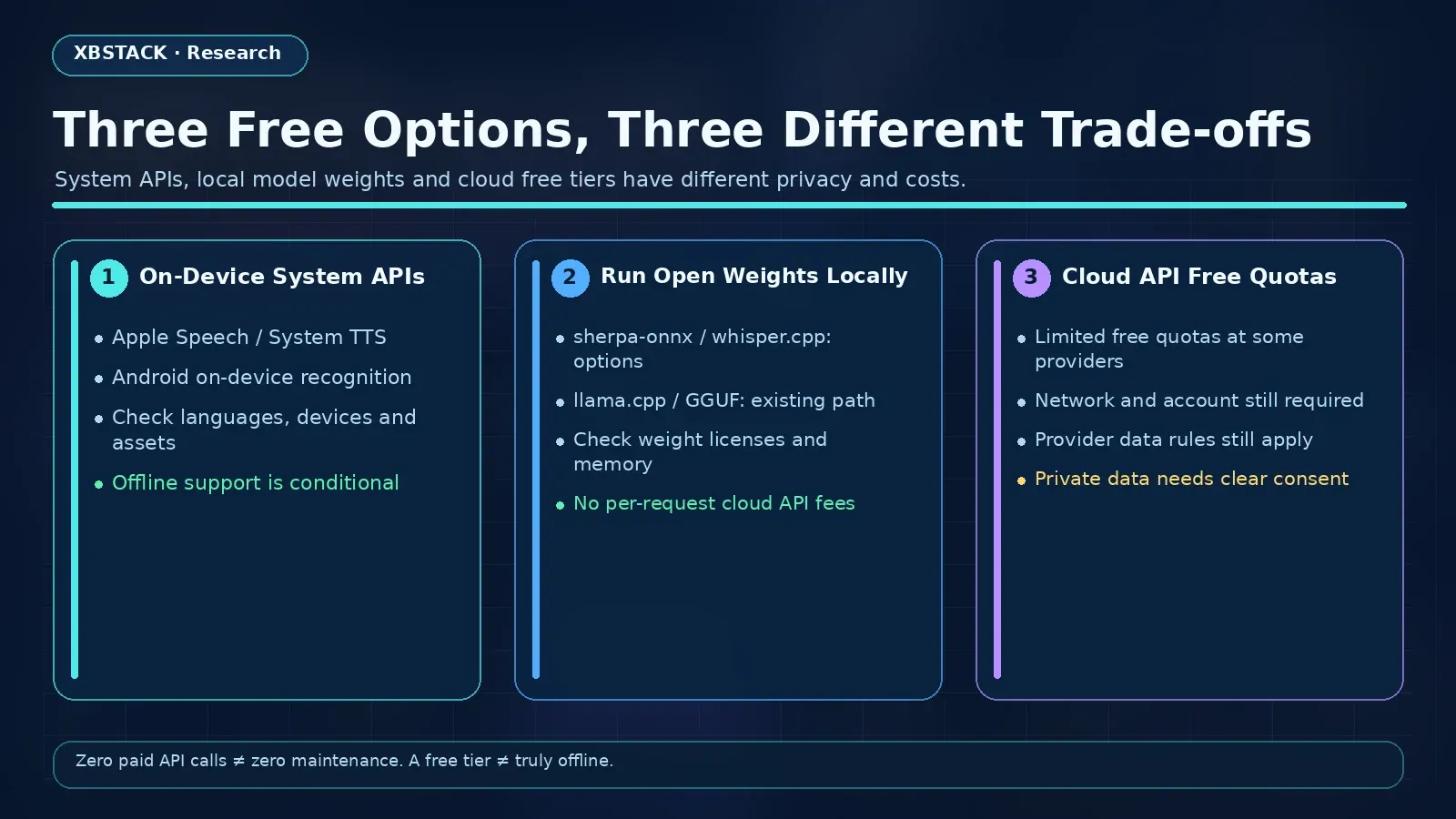
Figure: A cloud API free tier still requires a network connection and is not offline inference.
The first is a system-provided capability. Apple exposes speech recognition and speech synthesis. Android exposes platform speech recognition and text-to-speech services. An application usually does not pay a separate metered speech API fee to call these interfaces. Whether they actually work offline, with a requested language, and with already-downloaded assets is not a universal guarantee. Permission handling, interruptions and platform regressions remain the app developer’s responsibility.
The second is a runtime plus independently supplied local model weights. An inference engine such as LiteRT or llama.cpp can run without sending a request to a paid cloud model. This often transfers operational work from the cloud to the application: model download and distribution, low-level audio processing, quantization, platform-specific kernels, CPU/GPU/NPU scheduling, memory, battery, storage and upgrade testing. An open-source runtime license is not a blanket commercial license for every ASR, TTS or language-model weight file distributed through a model hub.
The third is a quota-limited free cloud API tier. Gemini Hydrogen provides such an entry point, but the service is still remote: it needs network access, its quotas and access rules can change, and provider data-use terms matter. Google explicitly differentiates free-tier content use from paid-tier treatment. That is incompatible with quietly sending private knowledge-base snippets or sleep recordings to an endpoint merely because this month’s invoice would be zero. See the official Gemini API pricing and data-use terms.
The interesting question is therefore not simply “which model is free?” It is which tasks can be completed under the application’s existing privacy, device and reliability promises without adding a cloud bill.
| Candidate path | Cloud inference charge | Availability and language boundary | Main engineering burden |
|---|---|---|---|
| Apple Speech and AVSpeechSynthesizer | No third-party metered cloud speech API call | Recognizer must report local support; voice must exist and work in the selected locale | Permissions, audio session, interruptions |
| Android ML Kit GenAI ASR Basic | No incremental server cost per local invocation | Android API 31+; simplified Mandarin listed in beta | Device version, recognition quality, asset preparation |
| Android ML Kit GenAI ASR Advanced | No incremental server cost per local invocation | Selected Gemini Nano/AICore devices only | Hardware fragmentation and Alpha API changes |
| Android ML Kit GenAI TTS Alpha | No incremental server cost per local invocation | Restricted supported devices; Mandarin is absent from listed locales | Separate Chinese TTS fallback |
| Platform Android SpeechRecognizer / TextToSpeech | Usually no app-specific metered endpoint | Real offline status depends on installed implementation, voice and assets | Provider-specific behavior, weak offline hints |
| MediaPipe/LiteRT and eligible voice weights | No cloud ASR/TTS request bill | Depends on model architecture, language, runtime packaging and target device | License checks, model size, memory, compatibility |
| llama.cpp and eligible local LLM weights | No cloud language-model request bill | Language quality and memory depend on the actual model and configuration | Quantization, KV cache, battery and maintenance |
| Gemini Hydrogen free quota | Free only within cloud-tier limits | Requires service eligibility and an internet connection | Consent, privacy policy, quota and remote failure |
Google calls ML Kit a free SDK and states that its GenAI APIs run on-device without an additional server charge for each call. That does not mean all APIs are available on every phone. The new GenAI Speech Recognition Alpha distinguishes Basic from the hardware-limited Advanced mode: Basic itself requires Android API 31 or above. The GenAI TTS Alpha has a narrower supported-device list and no Mandarin locale in its documented November 17, 2026 list. Sources: ML Kit overview, GenAI local processing, ASR device and language requirements, and TTS support list.
Compare free and paid options by capability, not by product label
A fundamental distinction makes a simple “free versus paid AI” comparison misleading: Google Cloud’s paid speech APIs are different services from paid Gemini 4 reasoning models; AI Edge Gallery is not a free-tier replacement for either cloud endpoint. ASR turns speech into text, TTS produces audio, language models synthesize or reason over evidence, and an agent runtime governs authorized tools, task state and recovery. Each layer has a separate local-versus-remote decision.
| User job | Candidate with no paid cloud inference API | Explicitly authorized remote alternative | What changes |
|---|---|---|---|
| Mandarin speech to text | Eligible Apple on-device recognition, Android ML Kit Basic/Advanced, or locally bundled licensed ASR weights | Google Cloud Speech-to-Text or comparable cloud ASR | Audio may leave the device; usage is billed under audio-processing SKUs; network failure becomes possible |
| Read an answer aloud | Verified local system voice or licensed bundled TTS | Google Cloud Text-to-Speech or another cloud TTS | Some voice SKUs charge by characters and generative TTS by tokens; no-network fallback remains necessary |
| Retrieve and cite private documents | RecalAI FTS, embeddings, RRF and deterministic citation anchors | A user-authorized cloud reranker or Gemini-based reasoning step | Evidence and permission checks cannot be replaced by model fluency |
| Summarize complex material | Local quantized language model within the device’s actual memory budget | Gemini Hydrogen, Argon or Carbon under a priced API tier | Accepted answer rate, privacy, output and thinking tokens, retries and latency |
| Execute an engineering task safely | Deterministic task runner, checkpoints, tool policy and optional local LLM | An approved paid cloud model proposes or reviews a step | The model is metered; the application’s own permission, effect receipts and recovery logic remain mandatory |
Billing is not uniform across these services. Google Cloud Speech-to-Text prices processed audio; Text-to-Speech has voice/SKU-specific character or generated-audio token pricing and some limited free usage. Gemini 4’s per-token API pricing is a separate billing product. Our Gemini 4 task-routing analysis addresses that latter decision, while Google AI Edge speech device boundaries covers the native ASR/TTS eligibility problem. Free quotas, where provided, are not equivalent to a local guarantee.
A no-paid-API agent still needs an execution system
“A local model can generate an answer” does not mean “a local agent can safely perform tasks.” In RecalAI, FTS and hybrid retrieval can handle discovery, a deterministic evidence validator can verify citations, and a small persistent task controller can store the task ID, authorized local tools, checkpoint and actual outcome. An on-device LLM should only be invoked where natural-language synthesis or ambiguity genuinely requires it. OCR, import, indexing, exact citation IDs and recovery are not improved by calling a model simply to make the product feel more agentic.
Suppose a user asks the app to “find every backup decision and prepare a cited summary.” A confirmed transcript enters an authorized read-only search. Each claim must refer back to a real chunk and document revision. A timeout resumes from a durable checkpoint rather than repeating file writes. If the local model exceeds the iPhone’s memory budget, the correct fallback is a saved partial task and an explicit smaller or typed operation—not an undisclosed call to Hydrogen’s free cloud tier. Lunest uses an even narrower contract: reversible playback commands only, while sleep monitoring remains under a deterministic lifecycle controller.
This architecture may avoid metered cloud inference calls, but it does not establish equal success rates against paid Gemini 4 models. Runtime implementation and multi-turn hardware tests are still required; the above is an engineering design, not a reported benchmark.
Concrete local speech candidates beyond a supported Google device
“Bundle an open model” needs a real technical shortlist. For devices outside ML Kit Advanced eligibility, there are credible cross-platform inference paths to evaluate. Their public repositories and samples are not evidence that RecalAI or Lunest has integrated or benchmarked them, nor permission to redistribute every model weight.
| Candidate | Intended capability | Relevant platform evidence | What must still be verified |
|---|---|---|---|
| sherpa-onnx | On-device ASR, TTS, voice activity detection and keyword spotting | Official project lists ARM64 iOS/Android and Swift, Kotlin and C++ interfaces, plus Chinese ASR examples | Separate weight licenses, specific Mandarin accuracy, live versus non-live decoding, memory and power |
| whisper.cpp | Whisper-family local ASR | Official iOS/Android examples, quantized weights and multiple compute backends | Exact model licenses, Chinese CER, long-audio latency and interference with a resident LLM |
| sherpa-onnx VITS/Kokoro TTS model paths | Local speech synthesis | A model pipeline that can potentially work across iOS and Android | A verified Mandarin-capable voice asset, pronunciation, quality and redistribution rights |
| Native speech plus local retrieval and deterministic task controller | Lightweight spoken query, answer reading and constrained actions | Fewer simultaneously loaded neural components on a 4 GB baseline | Offline locale assets, permissions, audio focus, durable checkpoints and tool policy |
The sherpa-onnx runtime code carries Apache-2.0 licensing and whisper.cpp’s runtime code is MIT, but model files and voice assets require independent license review. A Chinese ASR evaluation could include sherpa-onnx’s documented SenseVoice model alongside system recognition and whisper.cpp on the same authorized corpus. That is a test design, not a fabricated comparison. RecalAI should judge speech quality against citation integrity; Lunest must additionally veto any configuration that damages long-running playback. Source-code platform support is not the same as stable performance on an iPhone 13.
RecalAI: a voice feature is only useful when it preserves evidence
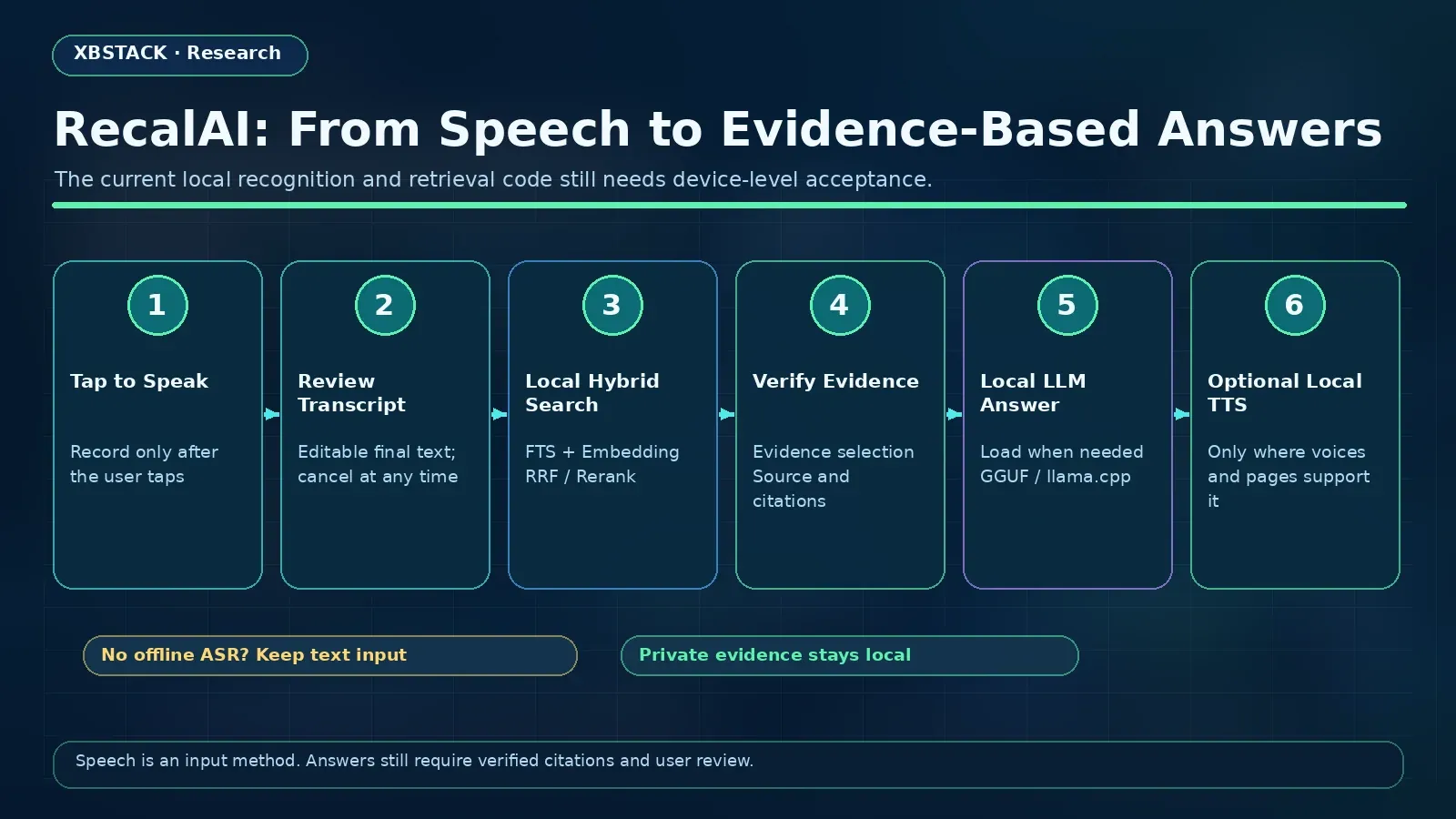
Figure: Voice is an input method; private evidence and source checks remain essential.
RecalAI’s distinctive requirement is not an especially expressive conversation voice. Its local knowledge base follows a retrieval path: document import, OCR and parsing, FTS indexing, optional embeddings, hybrid retrieval, evidence selection and citations that point back to actual passages. A voice transcript should become an editable way to enter a question into that path, not an alternative source of authority.
Consider a user asking for “the backup encryption decision from last year.” If a recognizer drops a negation or confuses “encrypt” and “decrypt”, a perfectly fluent LLM response might answer the wrong request while still linking to real files. That is a more serious failure than a missed punctuation mark. In a private knowledge assistant, the trust boundary is between the user’s intended question and the set of permitted evidence, not merely between the microphone and the tokenizer.
A sensible candidate pipeline starts only after a deliberate mic action, tests whether the selected system recognizer genuinely supports local processing for that locale, collects unstable partial text for display, waits for a final candidate, and lets the user correct it. The confirmed transcript then enters RecalAI’s existing retrieval and evidence-validation path. Local TTS, if requested, reads the finished answer; it should not speak a provisional response as though it had already been source-checked.
Apple offers a particularly clear API boundary. supportsOnDeviceRecognition must be true for an SFSpeechRecognitionRequest to honor requiresOnDeviceRecognition. If it is false, setting the request flag cannot manufacture an offline recognizer. Android illustrates the danger of similar-sounding controls: the platform’s RecognizerIntent.EXTRA_PREFER_OFFLINE is only a preference, and Android documentation explicitly says the recognition implementation may ignore it. A marketing claim that “we set offline=true” therefore says very little about data handling. See Apple’s recognition capability, Apple’s local-only request, and Android RecognizerIntent.
The iPhone 13 is a useful low-memory acceptance baseline because its 4 GB memory makes simultaneous resident models risky. That is a hardware constraint, not a benchmark result from our app. RecalAI already needs memory for its search index, document presentation, embedding and local model operations. Adding a separate ASR engine, a local LLM and a TTS voice is not automatically the right architecture, even when none incurs cloud token fees. The product has to measure actual peak resident memory, model warm-up, cache pressure, latency under load, background eviction and thermal behavior. Where the system recognizer handles the desired locale reliably, it can avoid another resident model. Where it does not, typed input is a more honest fallback than silently uploading private recordings.
Cloud processing can remain an explicit user-selected alternative under RecalAI’s BYOK design, but it cannot become the hidden continuation of a failed local recognition request. Consent needs to identify the selected provider and the data actually leaving the phone. The distinction is covered separately in our local-first model privacy and BYOK analysis.
Lunest: keeping the nighttime audio session intact matters more than a free recognizer
Lunest’s primary workload is very different. It has to sustain soundscape playback, preserve monitoring state, recover from calls and audio-route changes, and maintain understandable sleep results. A voice command might be a useful convenience, but it should not be allowed to compete indefinitely with the audio resources that make the app useful.
Take a seemingly trivial command: “turn the sound down.” A recognition session that opens the microphone may reconfigure the iOS audio session or capture Android audio focus, interrupt a playing soundscape, or react badly when a call arrives. Bluetooth disconnection, alarm interruptions, an unexpected background transition and low-memory reclamation compound the problem. A high accuracy score on clean speech does not establish that the application still resumes the correct audio at the correct position.
For this product, the safer candidate is short, deliberately activated foreground voice interaction. The recognizer produces a candidate, limited command; the existing deterministic playback controller applies a validated reversible action. Failure releases the temporary voice session while leaving sleep records, playback queues, alarms and wake policy under their original lifecycle owners. A generic ASR transcript must never be relabeled as a validated snoring event, sleep-stage measurement or wake-decision input.
This is also a cost decision. A UI button is sometimes the superior no-cloud-fee solution: its battery, privacy and regression risks are smaller than an always-listening model. A speech model being free to execute does not make uninterrupted background recognition a free product feature.
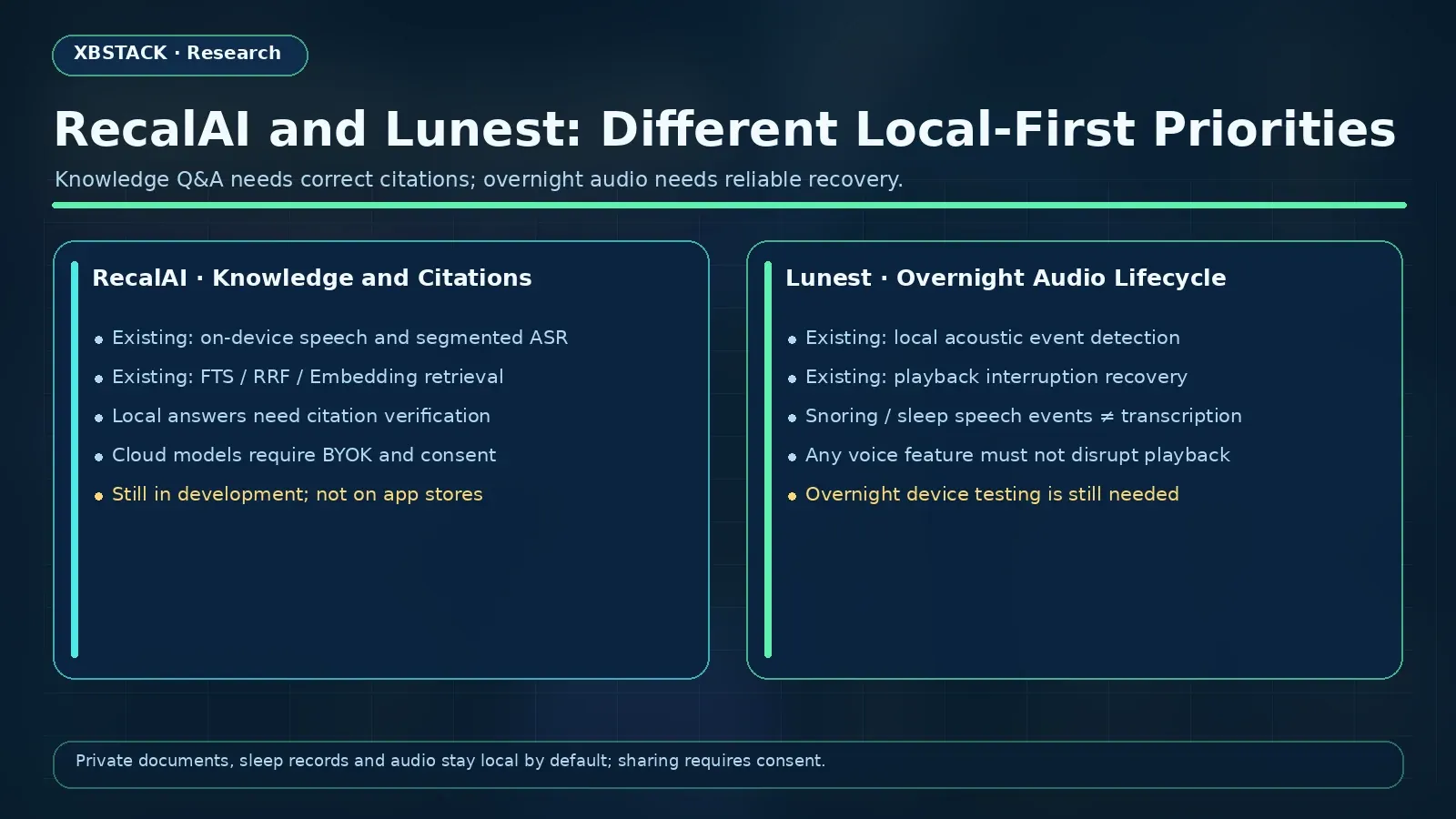
Figure: Both products are in development; sleep sound events do not imply speech transcription.
The model license is not the same thing as the inference engine license
Frameworks such as MediaPipe and LiteRT describe how models are packaged and executed. llama.cpp’s source code is available under the MIT license. None of these facts establishes that arbitrary weights from a model repository may be bundled, redistributed, sold and updated in a commercial mobile application without conditions. An ASR model, TTS voice and LLM can each have different licenses, attribution requirements, usage restrictions and distribution sizes. The llama.cpp runtime license is therefore only one part of diligence.
Three distinct claims must be validated: a codebase is available for reuse, model weights are available to download, and the complete shipped application can legally distribute and execute those weights. The third claim also depends on app-store rules, privacy disclosures and the actual device runtime. A convincing Android demonstration does not guarantee that the same model architecture and decoding stack can be shipped on an iPhone 13 with acceptable memory and interruption behavior.
This argues for minimizing the number of separately maintained neural components. RecalAI’s search and citation verification should remain inspectable local mechanisms; only genuinely generative steps need a language model. Lunest’s long-running state and playback restoration should remain deterministic rather than outsourced to a text generator.
Where the cost moved: the true expense of “zero API”
There are at least five places where costs survive after cloud token fees disappear. First is engineering integration: capturing audio, managing permission prompts, preparing locale and voice assets, dealing with streaming partial/final semantics and maintaining two mobile stacks. Second is device coverage: every Android SDK alpha, hardware restriction or missing voice increases the acceptance matrix.
Third is reliability engineering: a user can withdraw microphone access, take a phone call, switch Bluetooth output, run out of storage or put the app under memory pressure at exactly the wrong moment. Fourth is on-device consumption: the user pays in storage, download bandwidth, battery, thermal headroom and opportunity cost for other apps sharing limited memory. Fifth is ongoing maintenance: OS changes, runtime incompatibilities, new voice asset revisions and evolving license terms need repeated verification.
System speech shifts more maintenance to the OS vendor, but narrows control over device and language availability. Bundled open models offer greater control in exchange for larger release artifacts and difficult runtime verification. A small free cloud quota adds service and data-policy dependencies while still losing functionality offline. There is no single winner without specifying the user action, supported devices, acceptable failure and ongoing maintenance budget.
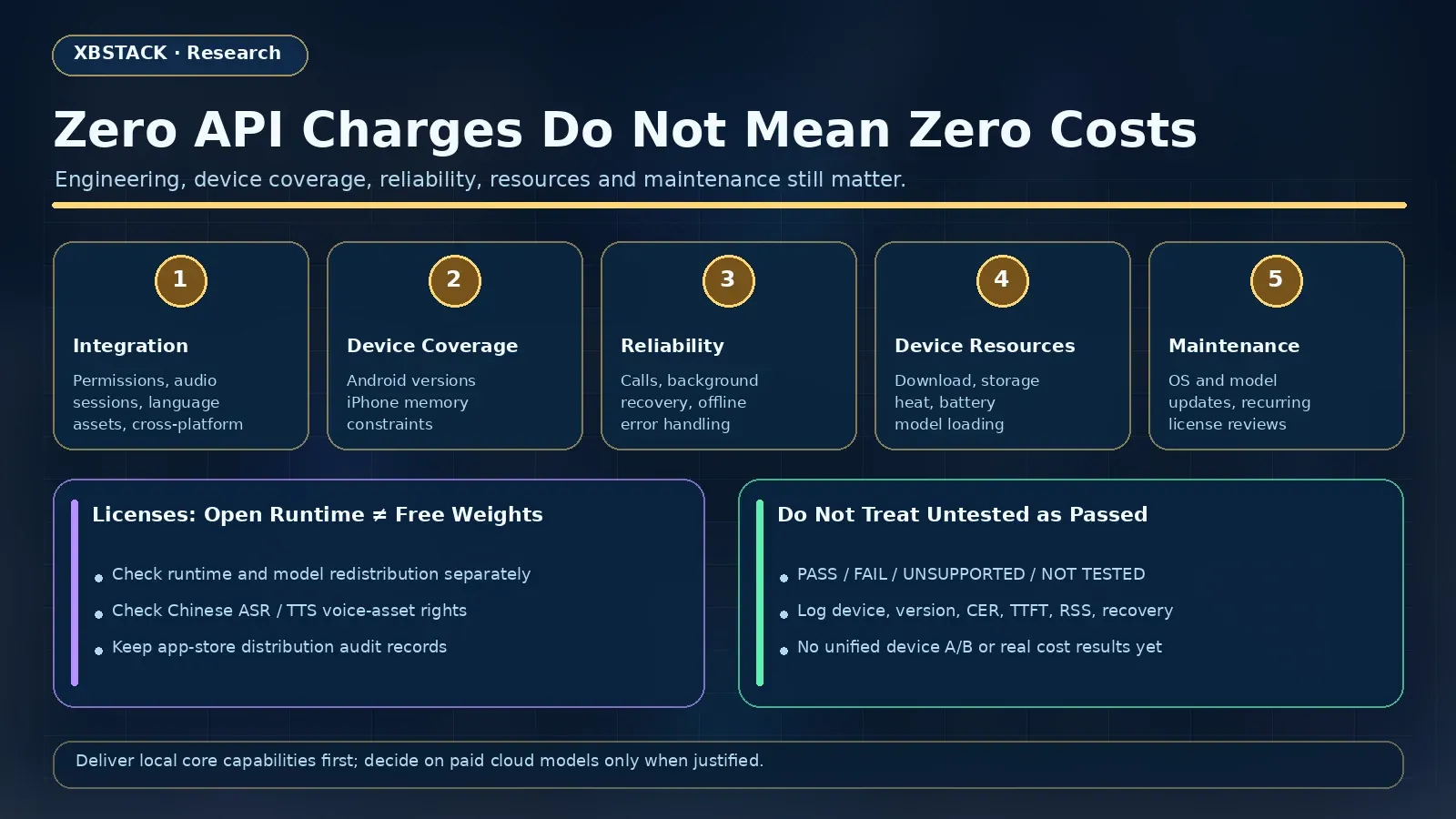
Figure: No metered API charge does not mean zero cost, and candidate SDKs are not deployed features.
Evidence and release gates: unsupported is not the same as failed
A credible comparison needs the same authorized test audio, manually verified reference transcript, actual SDK/model build, locale, asset readiness and physical device. ASR should be measured by Chinese character error rate where appropriate, first partial and final latency, memory and recovery. TTS needs different metrics: time to first audio, language/voice availability, intelligibility and completeness. RecalAI additionally needs correctness of every attached citation and the treatment of negations. Lunest needs playback continuity across calls, background transitions and Bluetooth changes.
Each execution has to distinguish PASS, FAIL, UNSUPPORTED, NOT_TESTED and an invalid input. A phone that lacks the required Advanced mode is not a failed recognition sample. A voice that has not been downloaded is not evidence of true offline availability. A developer’s laptop demonstration cannot stand in for measured iPhone memory behavior. Zero recorded API charges do not establish zero support cost.
None of the proposed native, ML Kit or bundled-model combinations has been run through a controlled RecalAI/Lunest mobile A/B in this research. There are no invented memory peaks, accuracy numbers, charge receipts or battery-life claims. What is established here is the product-specific evaluation and honest fallback contract.
The practical decision is to protect existing product value
For RecalAI, start by assessing a genuinely local platform recognizer, preserving user-editable final text and the existing FTS/embedding/citation workflow. A local language model should be invoked only where necessary. A missing offline locale should produce a truthful fallback rather than an undisclosed cloud call.
For Lunest, protect the overnight playback and monitoring session first. A limited optional spoken command is worthwhile only if it does not destroy restoration behavior. If a free recognizer resets a soundscape or risks losing a sleep recording, it is not a viable feature for the product.
For XBSTACK’s engineering and editorial agents, deterministic checks, local inputs and open components can often do more to reduce spend than routing every operation through a free cloud tier. When complex work genuinely warrants a paid model, the right metric is the complete cost of an independently accepted result. Our separate Hydrogen/Argon/Carbon routing analysis examines that boundary.
The objective is not to ban cloud AI. It is to do genuinely local work locally, to make any remote processing a deliberate informed choice, and to keep failures from breaking the original product promises.
Follow the development of these real projects
Neither case study is a claim about an already listed app. The RecalAI knowledge project has a public product page currently labeled Recalia, while Lunest has its own product overview. Both are still in development, with no verified public app-store download. These links are for product context and progress, not fictitious install calls to action.
Official sources and limitations
- Google Developers: ML Kit SDK pricing and scope; GenAI local processing and server cost.
- Google Developers: ASR Alpha capabilities, TTS Alpha supported locales and devices, and November 10 AI Edge Gallery speech announcement.
- Apple: supportsOnDeviceRecognition and requiresOnDeviceRecognition. Android: RecognizerIntent’s offline preference limitation.
- Google: Gemini API free and paid terms. GGML: llama.cpp’s license.
This is an unpublished XBSTACK engineering research draft, not evidence of a shipping feature or completed phone benchmarks. A device-specific result requires actual execution, independently verifiable records and explicit limitations.
Continue from one agent pattern to the complete production system
The AI Agent hub organizes architecture, memory, tool use, evaluation, security, deployment and multi-agent coordination into a single learning path.
Next step: continue the Agent system
Full decision path →Choose the next architecture, tool, memory, evaluation, security, or production decision instead of starting over.

DISCUSSION
Questions, verification and corrections
Sign in to comment. Every new comment is reviewed before publication; while pending, it is visible only to you and the administrator.