


Xiaobai
Developer · Builder
Building AI engineering systems, developer tools and long-term digital assets at XBSTACK.
About Xiaobai & XBSTACK →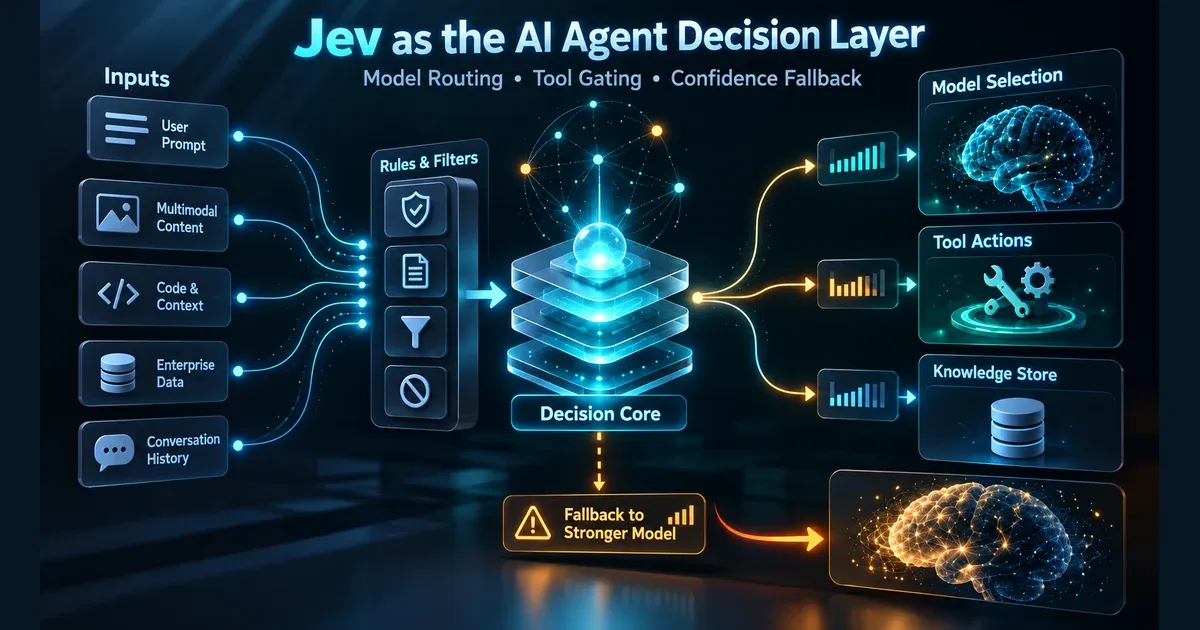
Can Jev Be the Decision Layer for AI Agents? Model Routing, Tool Gating and Confidence Fallbacks
Jev is TypeSafe AI’s System One decision model, released on September 15, 2026. This article does not present vendor claims as XBSTACK hands-on results. It combines official API material, Microsoft Agent Framework integration discussions and independent benchmarks to evaluate Jev for model routing, tool gating, risk classification and confidence-based fallback.
Short answer: Jev is worth serious attention from AI-agent developers, but the most misleading way to think about it is as a smaller, faster LLM. The more interesting idea is architectural: move the many agent-loop steps that only require a decision, not prose generation, into a typed probabilistic Decision Layer.
Those steps are everywhere. Should this request use a cheap model or a stronger one? Is a tool call readonly, destructive or privileged? Should the loop continue, stop or escalate? Which worker or skill should handle the task? Which retrieval candidates deserve more expensive processing? Today many systems spend a full LLM completion on each of these decisions, then parse JSON, validate schemas and recover from output drift.
Jev proposes a different interface: if software ultimately needs a finite decision, the model should return a finite decision directly.
That does not mean Jev has already proven it can replace LLMs. As of September 25, 2026, the public evidence is more nuanced. One independent agent tool-risk benchmark reported the exact same 55/60 accuracy for Jev and Claude Sonnet 5, with lower Jev latency and estimated cost. Another LLM-routing experiment found that the main gain came from retrieval evidence; removing the Jev difficulty signal left the frontier almost unchanged.
So the opportunity is real, but the most plausible role is narrower than “universal AI router”: Jev may fit between deterministic rules and generative LLMs as a fast probabilistic decision primitive.
This is not an XBSTACK Jev hands-on benchmark. The current workspace has no TYPESAFE_API_KEY, so vendor numbers and third-party results are kept clearly separate from XBSTACK measurements.
Jev changes the software interface, not just model size
TypeSafe AI released Jev on September 15, 2026 as its first public System One Model. The API takes state plus predefined questions and returns typed decisions instead of open-ended text.
The current API exposes three core answer shapes:
- Choice for selecting from defined options with probabilities;
- Score for rating against an ordered scale;
- Noul for yes/no-style probabilistic judgments.
That may resemble JSON mode or structured output, but the design goal is different. A conventional LLM is still a generator constrained by a schema. Jev is positioned around the decision itself.
TypeSafe’s current public API requires a Bearer API key and exposes POST /v1/systemone. The company currently lists $0.042 per million input tokens, with output not separately metered.
Official launch: https://typesafe.ai/blog/introducing-system-one-models-and-jev
API docs: https://api.typesafe.ai/docs
A crucial caveat is the phrase “zero hallucinations.” Type safety can prevent a model from inventing an output outside the allowed schema. It does not guarantee that the selected valid option is semantically correct. A wrong choice can still be perfectly type-safe.
For production agents, the metrics that matter are decision accuracy, calibration, error cost and fallback behavior.
Why agents need a separate Decision Layer
A production agent contains many decisions that do not inherently need text generation:
user request
  ↓
hard permission/capability filters
  ↓
task-difficulty decision
  ↓
model routing
  ↓
planner / generation
  ↓
tool candidates
  ↓
risk classification and approval
  ↓
execution
  ↓
continue / retry / stop?
  ↓
finish, escalate or hand off
Using a full generative model at every one of those nodes creates four common problems.
Latency compounds. A multi-step agent already waits on models and tools. Extra routing and judging completions multiply end-to-end delay.
Valid JSON is not stable behavior. Constraining output to a schema does not remove prompt drift, model-version changes or semantic mistakes.
Small decisions become a large cost center. The final reasoning call may not dominate spend if every loop includes additional routing, scoring and judge calls.
Confidence is often bolted on rather than calibrated. Many LLM workflows ask a model to invent a confidence number. Jev at least makes probabilities part of the model interface, which creates a cleaner path to thresholding and fallback.
This is why current Microsoft Agent Framework community proposals are notable. They do not simply ask for another chat provider; they propose a separate decision-client abstraction for routing, tool gating, workflow edges and loop evaluation.
Proposal: https://github.com/microsoft/agent-framework/issues/8556
External evidence one: tool gating is a credible Jev use case
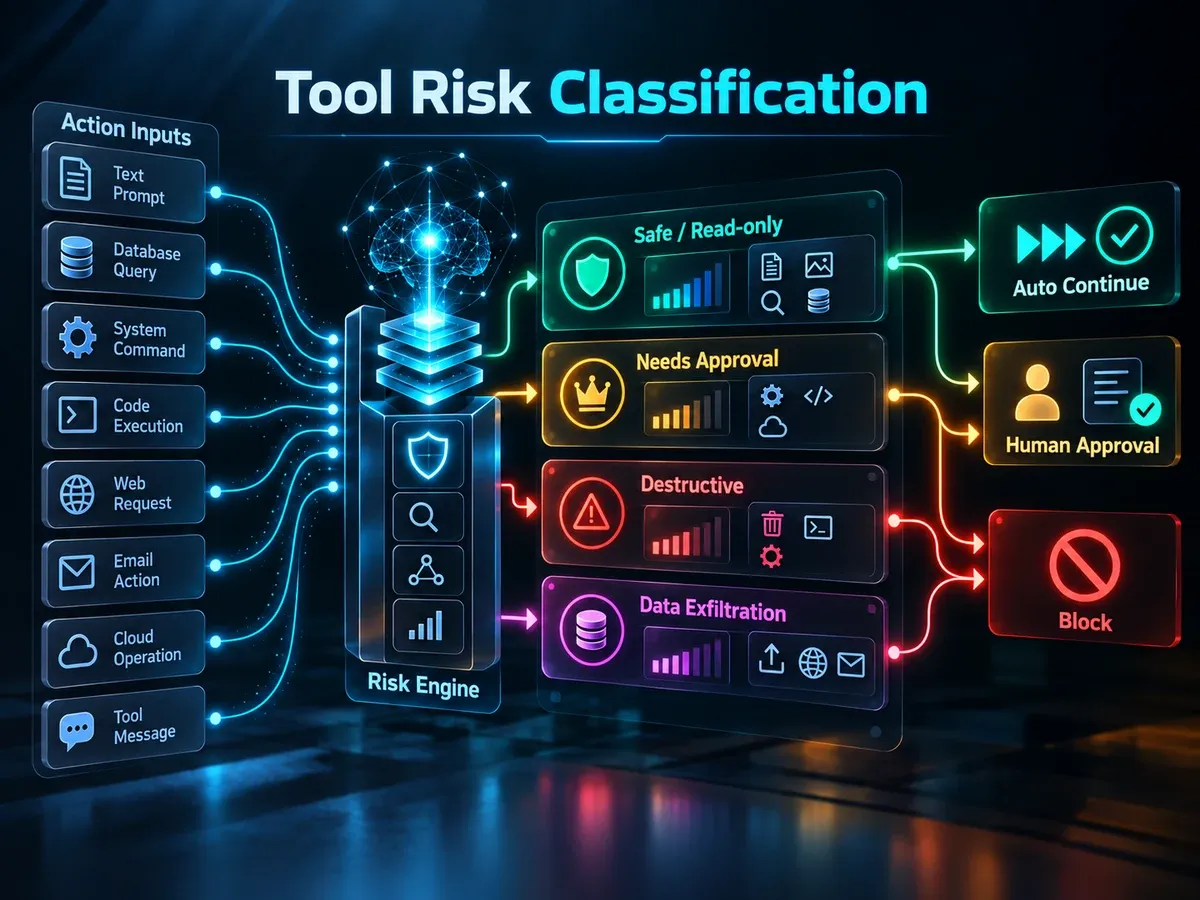
The most relevant independent test I found is not sentiment classification. It is agent tool-call risk.
themsquared/jev-benchmark publishes 60 labeled tool calls across readonly, destructive, privileged and exfiltration classes, including 34 clear, 14 ambiguous and 12 adversarial cases. Every backend receives the same task definition and must return the same choice-plus-confidence shape.
| Third-party 60-case tool-risk benchmark | Jev latest | Jev preview | Claude Sonnet 5 |
|---|---|---|---|
| Accuracy | 91.7% (55/60) | 91.7% (55/60) | 91.7% (55/60) |
| Clear | 100% | 100% | 100% |
| Ambiguous | 71.4% | 71.4% | 71.4% |
| Adversarial | 91.7% | 91.7% | 91.7% |
| p50 latency | 421.6 ms | 378.5 ms | 1371.0 ms |
| p95 latency | 542.0 ms | 484.3 ms | 2719.1 ms |
| Estimated cost/call | ~$0.0000173 | ~$0.0000173 | ~$0.0007035 |
These are the repository author’s measurements on one small dataset and one network path. They are not XBSTACK measurements.
The useful result is not merely that Jev was faster. All three backends tied on accuracy. On this narrow, typed task, a frontier LLM did not buy additional correctness.
The failure slice is equally important: all three reached only 71.4% on ambiguous cases. One disputed example involves port-forwarding to a production database, where the human label and all model judgments are not obviously aligned. That is evidence that tool gating depends heavily on the quality of the risk taxonomy itself.
Repository: https://github.com/themsquared/jev-benchmark
External evidence two: adding Jev to a router does not guarantee a better router
The natural next step is to make Jev an LLM router. TokenTrim/jev-routing-experiment provides a useful counterexample to simplistic routing claims.
On an LLMRouterBench setup with a 13-model pool, the published Jev-difficulty-plus-retrieval approach reaches 62.4% accuracy below the cost of the best single model. But the project also runs the critical ablation: retrieval evidence without Jev.
The no-Jev ablation also reaches 62.4%, at slightly lower cost.
The router improved, but Jev was not what created the improvement.
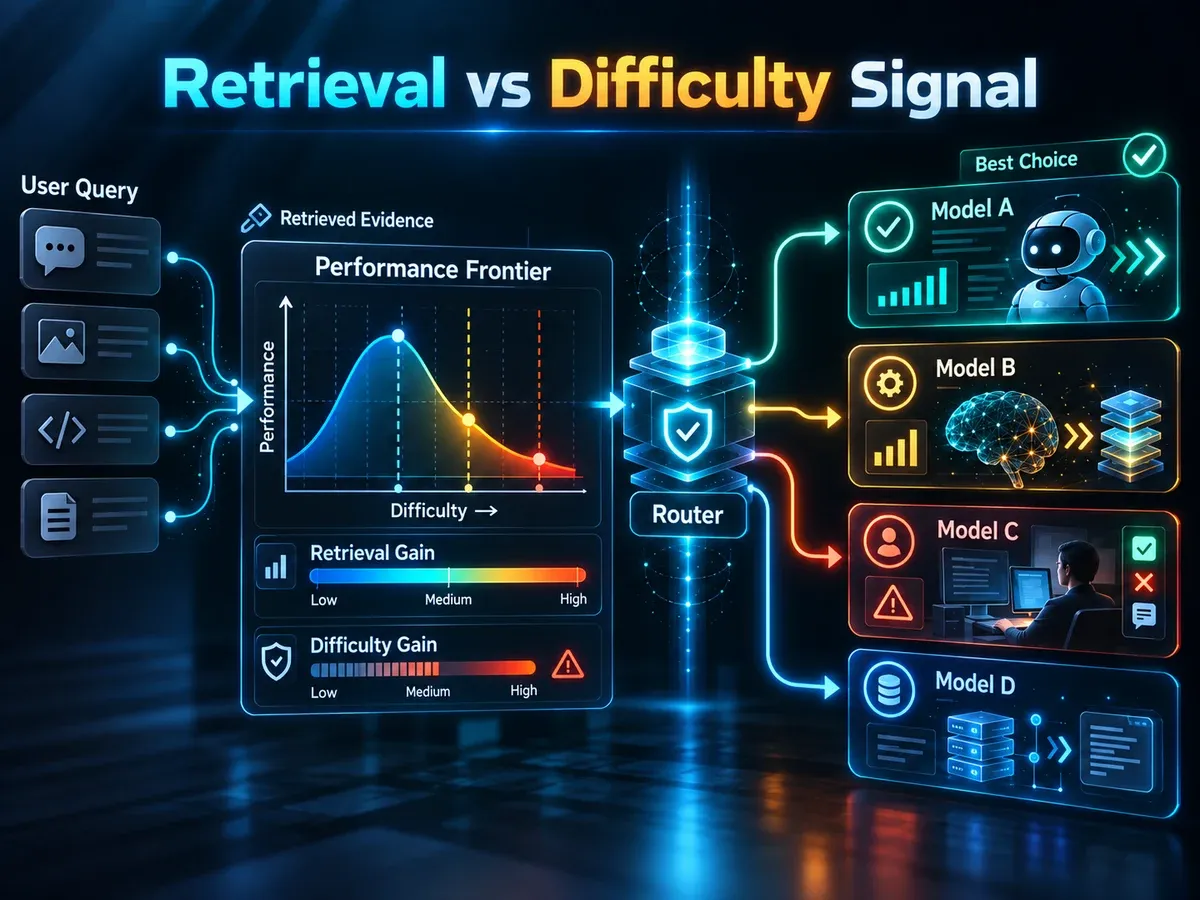
That matters because production routing is a system composed of:
- hard capability filters;
- price and context limits;
- tool and vision support;
- historical task outcomes;
- retrieval of similar tasks;
- difficulty estimation;
- failure cost;
- fallback policy.
If retrieval already predicts which candidate succeeds, an extra difficulty model may be redundant.
A credible Jev routing evaluation therefore needs ablations:
rules only
vs
rules + retrieval
vs
rules + Jev
vs
rules + retrieval + Jev
vs
LLM router
Without that structure, you cannot tell which component earned the gain.
Repository: https://github.com/TokenTrim/jev-routing-experiment
The fair comparison is not only Jev vs GPT or Claude
If the task is classification, routing or scoring, the strongest baseline may not be a frontier LLM at all.
dhruvmehra/jevbench compares Jev with an open System One model, a small LLM, a frontier LLM, a fine-tuned DistilBERT classifier and BART-MNLI zero-shot NLI across SST-2, AG News and Banking77.
That comparison frame is closer to a real engineering decision.
- If labels are stable and you have training data, a fine-tuned classifier deserves priority.
- If labels or criteria change per request, a dynamic typed-decision model becomes more attractive.
- If the judgment depends on broad implicit knowledge or complex reasoning, an LLM may still be stronger.
- If the boundary can be expressed as policy, a hard rule should win.
- If data cannot leave your environment, local classifiers or open models move up the list.
Jev’s most interesting niche may therefore be the region between hard rules and full generative models: dynamic semantic decisions with a finite output space.
Repository: https://github.com/dhruvmehra/jevbench
Personal AI, Private AI and Local AI make the boundary even more important
For a Personal AI, Private AI or local-first AI agent, Jev is not a component that should be inserted by default. Jev is currently a cloud API decision layer, which means the state sent for classification or routing may leave the device or private network. For personal memory, private documents, health/finance context or device telemetry, the first question is not whether Jev can make the decision; it is which fields are allowed to leave the local trust boundary.
A safer Personal/Private AI architecture keeps identity, authorization, file scope and sensitive-field filtering local. Only minimized or redacted semantic state should be eligible for a cloud decision model. If the product requirement is fully local, self-hosted or data-never-leaves-device, Jev should not sit on the critical path; local classifiers, small open models or deterministic policy are better baselines.
That makes Jev an optional cloud decision service for Personal AI, not the default brain of a private assistant. The durable foundation remains local data boundaries, memory/RAG, permission controls and a replaceable model layer. Related XBSTACK guides include the local-compute and data-sovereignty setup and OpenClaw vs Hermes for a Private AI Stack.
A production architecture: Rules → Jev → LLM/Human
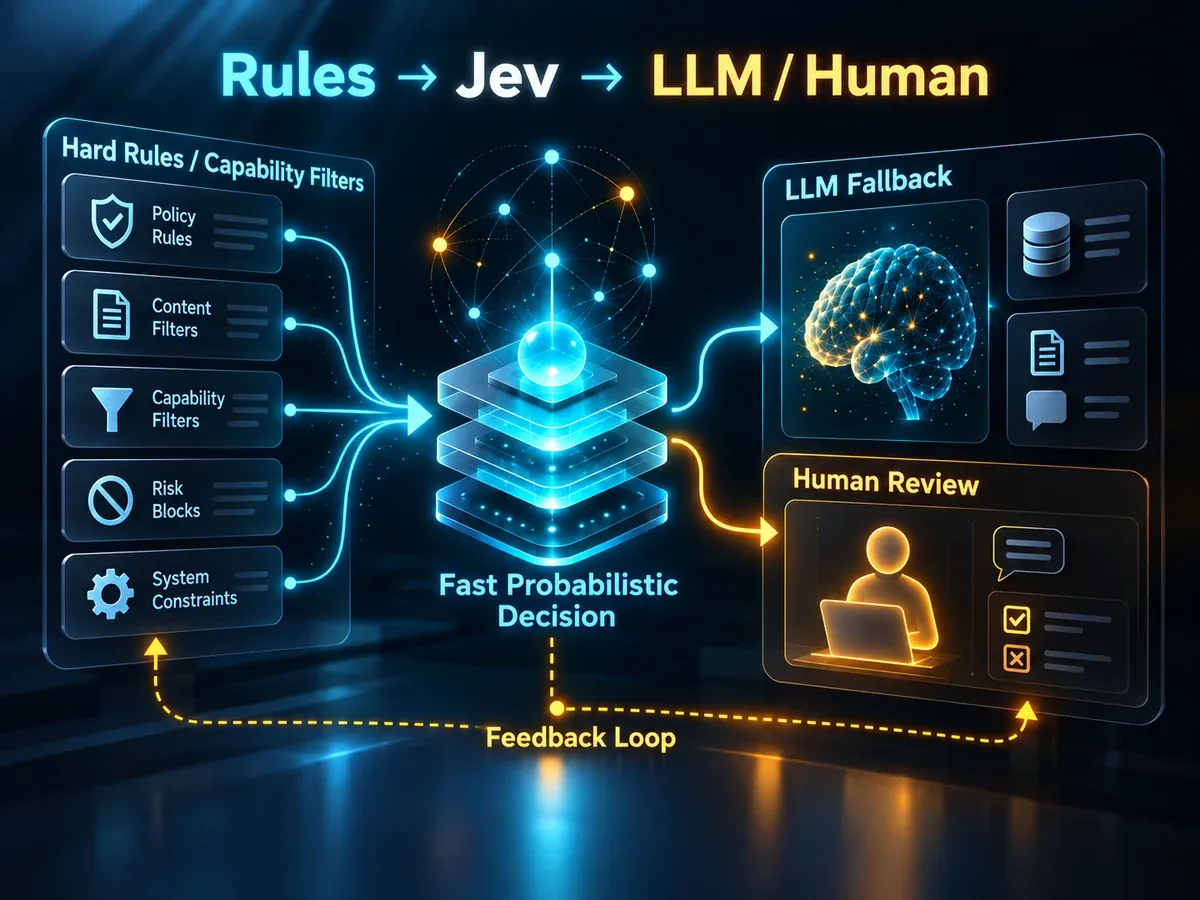
If XBSTACK gets Jev API access, I would not start by letting it control an agent end to end. I would test a three-layer control plane.
The first layer is Hard Rules / Capability Filters. Reject models without required vision or context. Deny tools forbidden by policy. Require approval for production deletion, payment, publishing or other high-consequence actions. Reject resources outside tenant scope.
These boundaries are deterministic; replacing them with probability is a regression.
The second layer is the Jev Decision Layer. Candidate tasks include:
- model-tier selection;
- semantic tool-risk classification;
- deciding whether a stronger reviewer is needed;
- intent routing;
- candidate relevance scoring;
- manual-review routing;
- loop-completion judgment.
The third layer is Fallback / Escalation.
Jev high confidence + low risk
    → continue automatically

Jev medium confidence
    → stronger LLM / secondary classifier

Jev low confidence
    → human review

hard policy hit
    → deny / mandatory approval
The key rule is simple: confidence is not permission. A model can predict that a tool call is safe; the authorization layer still decides whether the identity may execute it.
That matches XBSTACK’s existing AI Agent Tool Authorization and Policy Gate principle: authentication, semantic judgment, resource authorization and human approval are separate control boundaries.
Confidence is useful only after task-specific calibration
The most interesting Jev feature may be probability output, because it enables fallback. But a probability is only useful if it is calibrated for the task you actually run.
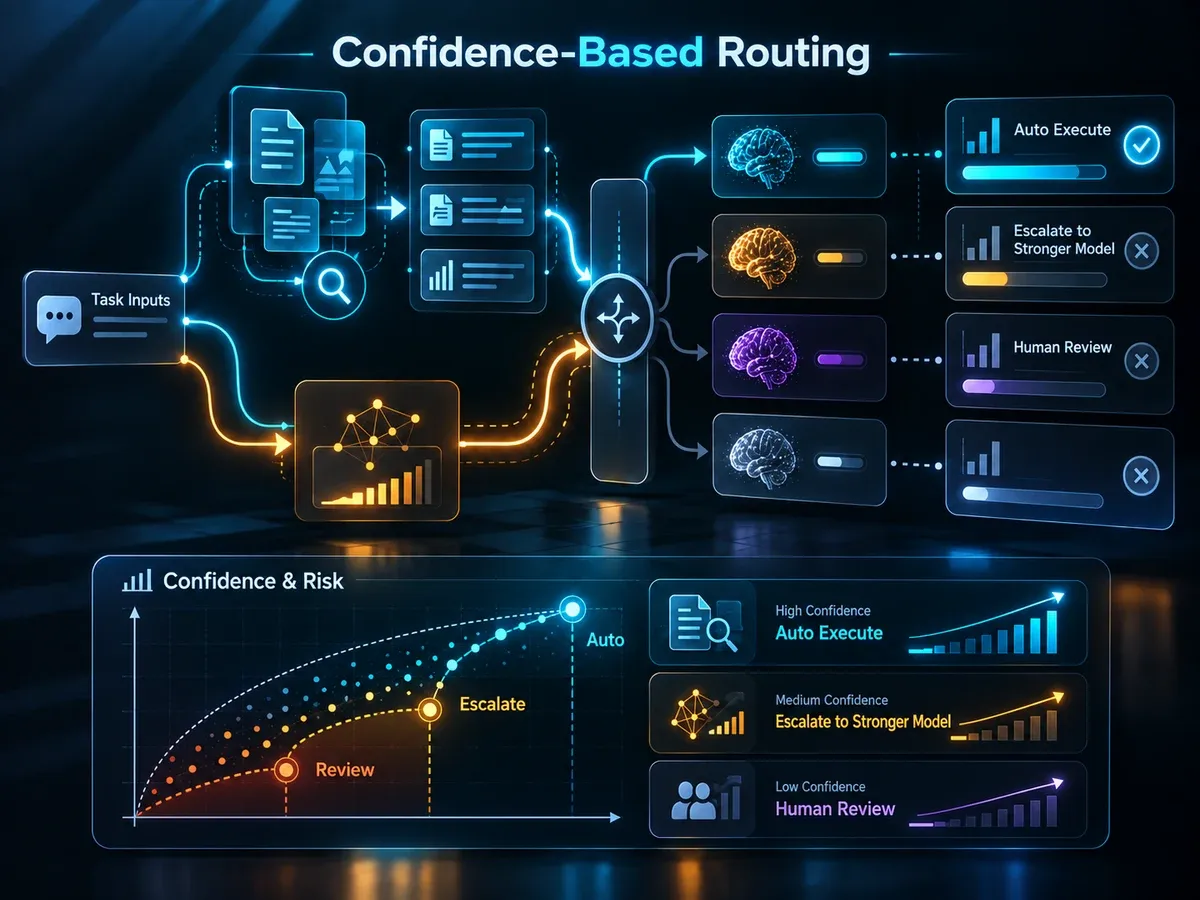
The independent tool-risk benchmark reports Jev ECE in roughly the 0.05–0.07 range on its 60 examples, with errors generally carrying lower confidence than easy correct cases. But the sample is small and most predictions land in a very high-confidence bucket. The author explicitly warns that easy datasets can make calibration look unrealistically clean.
Production thresholds should therefore vary by error cost.
Misrouting an email and authorizing a destructive production command should not share the same threshold.
A useful validation set should include:
- clear cases;
- ambiguous cases;
- adversarial wording;
- boundary inputs;
- short and long state;
- multiple languages;
- historical failures;
- rare high-risk classes.
For a Tool Gate, the most important metric may be false-safe rate: dangerous operations incorrectly classified as safe.
Low per-call price does not automatically mean lower workflow cost
TypeSafe currently lists Jev at $0.042 per million input tokens, with output unmetered.
That creates a real opportunity for high-frequency control-plane calls, but vendor multipliers should not be copied directly into budgets.
The independent tool-risk benchmark reports a much more conservative one-shot comparison than the vendor launch material: roughly 3.25–3.62x lower p50 latency and about 40.6x lower estimated per-call cost than its Claude Sonnet 5 baseline.
The difference in reported multipliers is not necessarily contradictory because the scopes differ. One is vendor-defined System One workflows; the other is single-step classification.
For an agent, the useful cost equation is closer to:
decision calls
+ generation calls
+ tool calls
+ retries
+ fallbacks
+ human review
+ rework caused by bad routing
The future XBSTACK benchmark should therefore track cost per verified task, routing regret, false-safe rate, fallback rate, p50/p95 decision latency, end-to-end task success and manual review rate.
Lack of explanation is both a strength and a limitation
Jev does not generate long explanations. In a control plane that is often useful: smaller responses, no prose parsing, fewer persuasive but unsupported rationales, and a cleaner function-like interface.
Audited systems still need reasons, though.
The safer design is to separate the decision from the evidence and the human explanation:
Jev:
  decision = privileged
  probability = 0.87

Policy / Trace:
  matched_resource = prod-db
  operation = port-forward
  identity_scope = read-only
  policy = human_approval_required

Optional LLM explanation:
  explain the trace to a human reviewer
The authoritative evidence remains the state, policy match, identity scope and trace. A generative model can explain those facts without becoming the source of truth.
This is another reason Jev looks more natural as a control-plane component than as a final business decision-maker.
The three XBSTACK tasks worth testing next
Once TypeSafe API access is available, XBSTACK should avoid a generic clean classification benchmark and focus on three real control-plane tasks.
1. Real agent model routing. Sample actual development and operations requests. Label them as deterministic/no-LLM, cheap-model or strong-model tasks. Compare hard rules, zero-shot classifier, Jev, a cheap LLM and Jev plus retrieval evidence. Then execute the routed task and measure routing regret and cost per successful task, not only label agreement.
2. Tool gating. Reuse real MCP and agent-security scenarios: filesystem read, git status, package installation, production deletion, credential access, outbound upload, database migration and publish/deploy actions. Measure false-safe errors and compare against hard policy.
3. Confidence fallback. Add ambiguity, missing fields, conflicting evidence and adversarial wording. Compare Jev-only, Jev-to-LLM fallback and Jev-to-human fallback. The goal is to keep easy work on the cheap path while escalating uncertain cases.
Only after those tasks produce reproducible logs should this page become an XBSTACK hands-on review.
Final decision: Jev belongs in the evaluation stack, not directly in the authorization chain
As of September 25, 2026, Jev is worth prioritizing for:
- high-frequency model routing;
- agent skill or worker selection;
- tool-call risk classification;
- ticket and event routing;
- candidate scoring;
- low-cost loop evaluation;
- automation with explicit fallback.
It should not directly own:
- authorization and compliance hard policy;
- irreversible production writes;
- payments, deletion or publishing;
- tasks that require long explanations or complex planning;
- mature fixed-label workloads already served by a strong local classifier;
- sensitive workflows that cannot send state to a third-party API.
If a system currently spends frontier-model calls on huge volumes of simple routing, Jev deserves an A/B. If deterministic rules already solve the problem reliably, there is no reason to rebuild the stack for a new model. If the real weakness is missing historical evidence, fix retrieval and evaluation first: current routing evidence already shows that the evidence layer can matter more than a difficulty model.
The current XBSTACK conclusion is therefore:
The most important Jev question is not whether it replaces GPT or Claude. It is whether typed probabilistic decisions deserve to become a first-class primitive in the agent control plane. Public evidence is strong enough to justify testing that architecture, but not strong enough to make Jev the default model router or Tool Gate. A safer starting position is after hard rules and before generative-LLM or human fallback.
FAQ
What is Jev AI?
Jev is TypeSafe AI’s System One Model for typed probabilistic decisions. Applications provide state and predefined questions, then receive Choice, Score or Noul-style outputs with probabilities instead of open-ended text.
How is Jev different from JSON mode or structured output?
JSON mode usually constrains a generative LLM. Jev is designed around finite typed decisions rather than prose generation. The important distinction is the model task, not only the serialization format.
Can Jev be used as an LLM router?
Yes, but it should be treated as one signal. A public routing experiment found that retrieval evidence preserved the main improvement even after the Jev signal was removed, so incremental value needs an ablation test.
Can Jev confidence authorize tool execution?
No. Confidence may help decide when to escalate to a stronger model or human, but resource permissions and consequential actions should remain under independent policy and approval controls.
How much cheaper is Jev than an LLM?
TypeSafe lists $0.042 per million input tokens with output unmetered. One independent 60-case tool-risk benchmark estimated about 40.6x lower per-call cost than its Claude Sonnet 5 baseline. That multiplier is task-specific and should not be generalized.
Has XBSTACK benchmarked Jev directly?
Not yet. This workspace has no TypeSafe API key. All benchmark numbers on this page are explicitly attributed to external reproducible repositories.
Sources
- TypeSafe AI: Introducing System One Models & Jev
- TypeSafe AI API Docs
- TypeSafe AI current pricing / product overview
- Microsoft Agent Framework: Python decision-client / Jev proposal
- Microsoft Agent Framework: .NET decision-model proposal
- Independent agent tool-call risk benchmark
- Independent Jev routing experiment / RouterArena
- Independent Jev vs LLM / BERT / zero-shot NLI benchmark
Continue reading
- AI Agent Production Governance
- AI Agent Deployment: Queues, State, Model Routing and Scale
- AI Agent Tool Authorization and Policy Gate
- Multi-Agent Systems: Supervisors, Workers and Model Routing
Continue from one agent pattern to the complete production system
The AI Agent hub organizes architecture, memory, tool use, evaluation, security, deployment and multi-agent coordination into a single learning path.
More to Explore
Topic hub →AI Engineering Weekly
Production changes, real failures, experiments and new XBSTACK assets.

DISCUSSION
Questions, verification and corrections
Sign in to comment. Every new comment is reviewed before publication; while pending, it is visible only to you and the administrator.