
Xiaobai
Developer · Builder
Building AI engineering systems, developer tools and long-term digital assets at XBSTACK.
About Xiaobai & XBSTACK →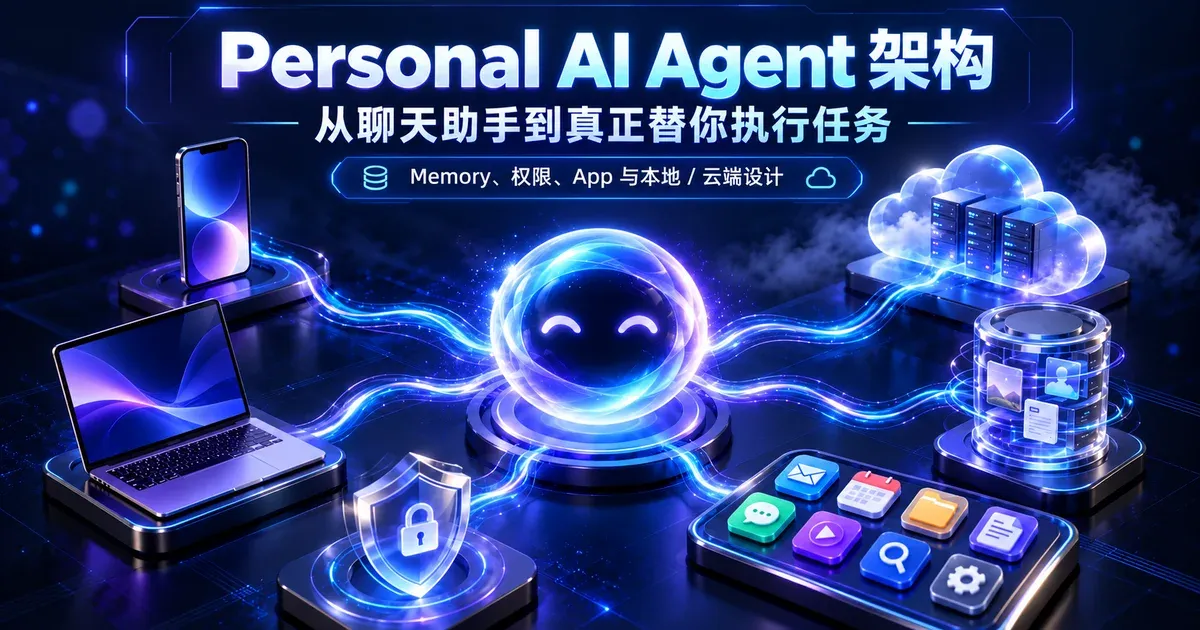
Personal AI Agent Architecture: Memory, Permissions, App Actions and Local-vs-Cloud Design
OpenAI Dot, Meta Muse and Apple Siri AI are pushing personal AI beyond chat toward persistent memory, background work and cross-app actions. This guide defines a production Personal AI Agent architecture across identity, memory, state, RAG, tools, credentials, authorization, approval, local/cloud runtimes and audit, with RecalAI as a first-party local-first reference.
Personal AI Agent Architecture: Memory, Permissions, App Actions and Local-vs-Cloud Design
Short answer: a Personal AI Agent is not simply a better chatbot. It is a durable software actor that understands personal context, keeps governed memory, connects to real tools and continues work inside explicit permission boundaries. The defining architecture is therefore not the model alone. It is the combination of identity, long-term memory, current task state, knowledge retrieval, execution runtimes, app/tool connectors, credentials, authorization, approval, audit and recovery.
September 2026 produced a strong signal that this category is becoming a platform shift rather than a single product launch.
- OpenAI Dot runs on its own cloud computer, learns from feedback over time, connects through a plugin ecosystem spanning more than 4,000 apps, and exposes access, permission, review and approval controls as product primitives.
- Meta Muse explicitly calls itself a Personal AI Agent. It runs inside a dedicated Secure VM, can keep working after the app is closed, can use a browser and connected services, and asks for approval before consequential actions such as sending email or making a purchase.
- Apple Siri AI pushes from the operating-system side with personal context, onscreen awareness and systemwide app actions.
The implementations differ, but the direction is the same: personal AI is moving from “answer what I ask” toward “understand my context and keep helping me complete work within boundaries I control.”
That is a much more durable search and engineering problem than any single SDK regression.
Personal AI Agent vs AI Assistant
The distinction can be compressed into five layers:
| Capability | Typical AI assistant | Personal AI Agent |
|---|---|---|
| Interaction | Current conversation | Cross-session, cross-device, cross-channel |
| Context | Prompt / context window | Personal context + memory + current state |
| Execution | Primarily text output | Apps, APIs, browser, computer, workflows |
| Time | One request at a time | Background work, schedules, event triggers |
| Permission | Feature access | Per-action authorization, approval and audit |
A Personal AI Agent therefore should not be modeled as “a chat with a bigger memory.”
A better system abstraction is:
User
  ↓
Personal Agent Identity
  ↓
Memory + Current State + Knowledge
  ↓
Planner / Reasoner
  ↓
Policy / Authorization / Approval
  ↓
Tools / Apps / Computer
  ↓
Artifacts / External Systems
  ↓
Audit / Recovery / Feedback
Chat, voice, Slack, OS surfaces and wearable devices are simply interfaces into that durable agent.
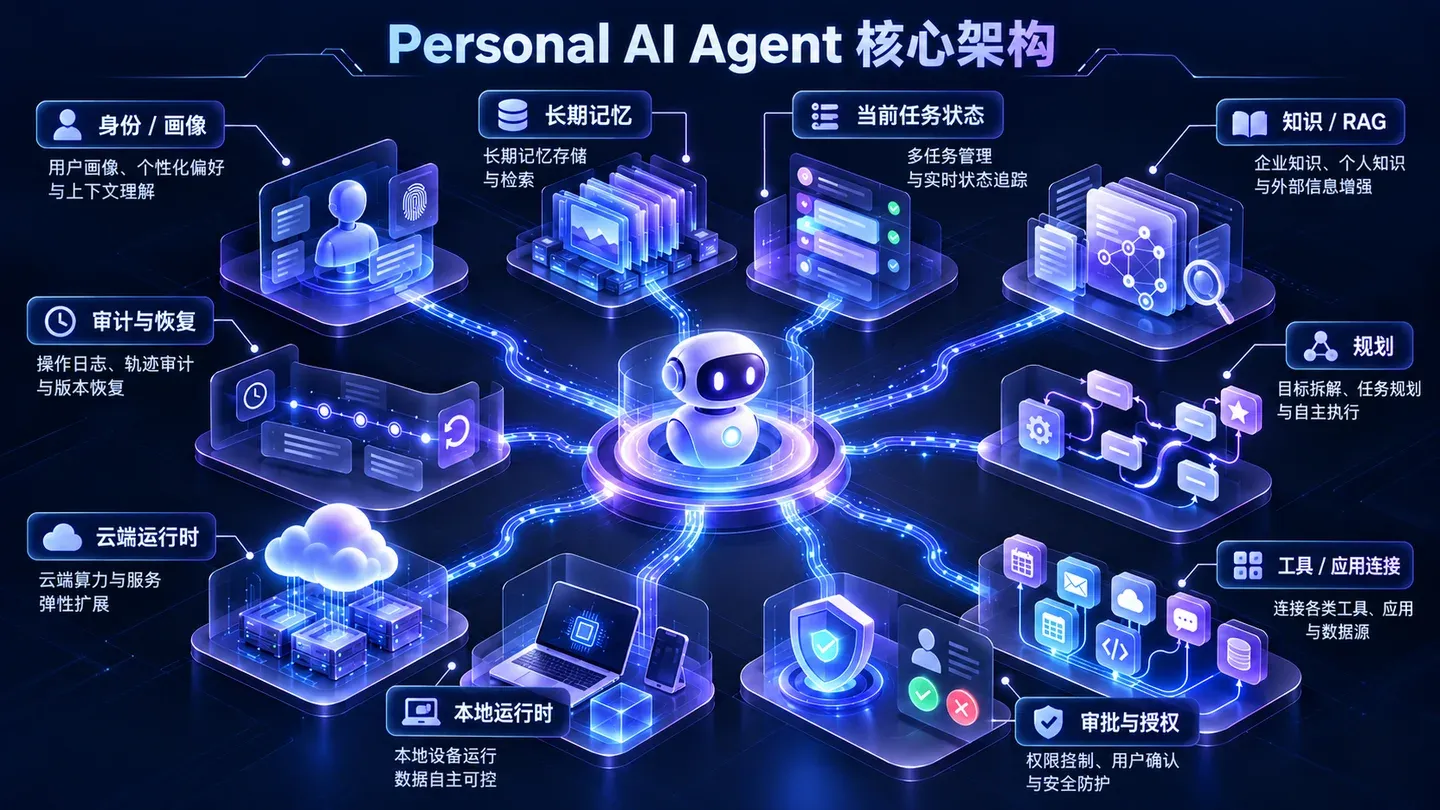
Figure 1: A Personal AI Agent is not a single model. It is a durable execution system combining identity, memory, state, knowledge, planning, tools, runtimes, authorization and audit.
A production Personal AI Agent needs at least nine layers
1. Identity: who is acting, and on whose behalf?
A personal agent is not an anonymous function.
The system should know:
- the current user;
- whether the agent acts for one person, a household or an organization;
- which device/session/workspace is in scope;
- which privileges belong to the agent role;
- which privileges are temporary delegations from the user.
OpenAI already describes Dot as having a separate identity for access and permissions. Microsoft’s September 2026 security update also treats local AI agents and agent traffic as governable security subjects.
The long-term direction looks more like non-human identity plus delegated human authority than “the model has an API key.”
2. Current task state: where is this job right now?
Task state answers questions such as:
- what task is active;
- which step is running;
- which actions have already happened;
- what is waiting for approval;
- what failed and can be retried;
- what deadlines, budgets or dependencies are active.
This should not automatically become long-term memory.
If the user asks an agent to compare hotels and eventually book one, the candidate list, current prices, checkout step and pending approval belong to Task State. Most of that should expire or be archived when the task ends.
3. Long-term memory: what should continue changing future behavior?
Good long-term memory includes:
- stable preferences;
- long-term goals;
- project constraints;
- confirmed decisions;
- recurring work patterns;
- lessons that prevent repeated mistakes.
That is very different from keeping an infinite transcript.
XBSTACK’s AI Agent Memory vs RAG already separates Memory, Session State, Checkpoints and Knowledge Base. A Personal AI Agent makes those boundaries more important because stored personal information can eventually influence real actions.
4. Knowledge / RAG: a personal knowledge base is not the same as memory
Saved PDFs, web pages, archived emails, Word files, slides, OCR from images and project documents belong more naturally in a knowledge system.
They answer:
“What evidence does this task need now?”
They do not automatically answer:
“What should the agent assume as a persistent preference for this user?”
RecalAI is a useful first-party example. Its current ingestion path is:
preserve source
→ OCR / parse
→ normalize
→ chunk
→ FTS for immediate search
→ background embedding / summary / tags / image understanding

query
→ FTS + query embedding
→ chunk-level hybrid retrieval
→ RRF / dedup
→ rerank
→ evidence
→ local or cloud generation
That is a Knowledge + RAG data plane. If RecalAI evolves into a fuller Personal Agent, durable user memory, current task state and account/permission state should still remain separately governed.
5. Planner / Reasoner: the model decides what to propose, not what it is allowed to do
This layer can be one frontier model, a model router, a local classifier, deterministic rules or a dedicated planner.
It can:
- understand goals;
- decompose work;
- select tools;
- identify missing information;
- plan the next step;
- adjust based on feedback.
But one boundary should remain fixed:
A model may propose an action. It should not grant itself permission to execute that action.
That rule applies equally to local and cloud models.
6. App / Tool connectors: cross-app execution is not “click everything”
Marketing often compresses Personal Agents into “AI that can use every app.”
Engineering should prefer more structured execution channels:
- official API;
- OS intent / App Action;
- plugin / MCP / connector;
- controlled workflow;
- browser / computer use;
- visual click automation as the most fragile fallback.
The earlier a channel appears in that list, the easier it is to validate parameters, permissions, results and failure states.
Apple’s systemwide app actions are closer to an OS capability layer. Dot’s plugin ecosystem is a connector layer. Muse’s Secure VM and browser show that remote-computer execution will also be important.
A mature Personal Agent will likely route across several of these channels rather than choosing one.
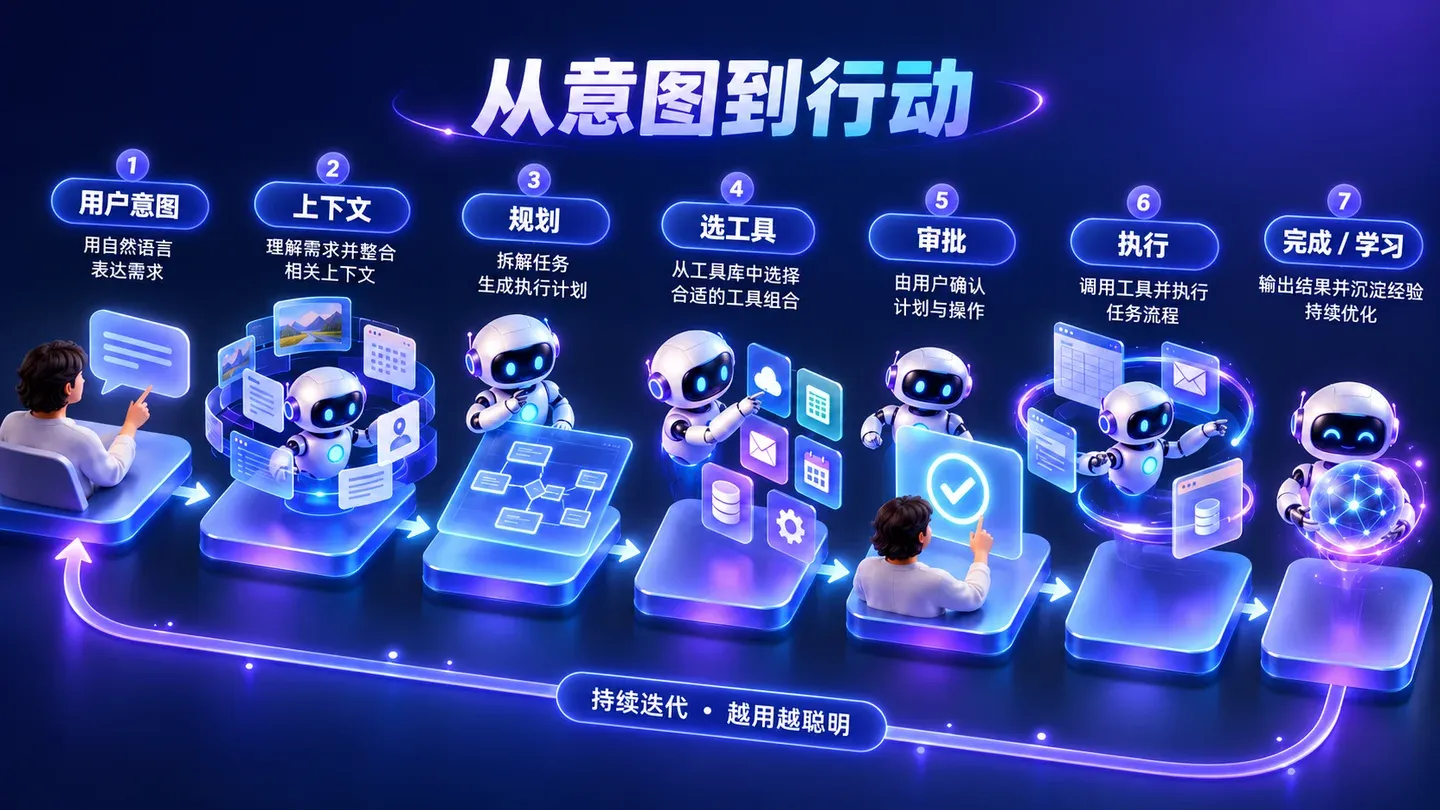
Figure 2: Moving from a user request to a real-world change requires context, planning, tool selection, approval and execution, followed by a feedback and learning loop.
7. Credentials, authorization and approval form the real control plane
Once an app is connected, three separate problems remain.
Credential
“How can the system authenticate to this service?”
Passwords, OAuth tokens, sessions, passkeys and one-time payment tokens are credentials.
They belong in a dedicated secret store or vault, not in normal prompts, logs or long-term memory.
Authorization
“Is this exact action permitted now?”
For example:
agent wants:
send_email(
  to="[email protected]",
  attachment="contract.pdf"
)
The execution layer should re-check:
- who is acting;
- which recipient/resource is involved;
- whether the attachment may leave the boundary;
- the active agent scope;
- whether sending is allowed automatically;
- whether the action crosses an organization or tenant boundary;
- whether the request matches a high-risk policy.
XBSTACK’s AI Agent Tool Authorization / Policy Gate covers that layer directly.
Approval
“Even if policy permits the action, does the user still need to confirm it?”
Purchases, payments, sending messages, deletion, publication and permission changes should be bound to a concrete action and concrete parameters.
Meta Muse and OpenAI Dot both expose the autonomous-versus-approval boundary as part of the product control plane. That is not a UI detail. It is a trust primitive.
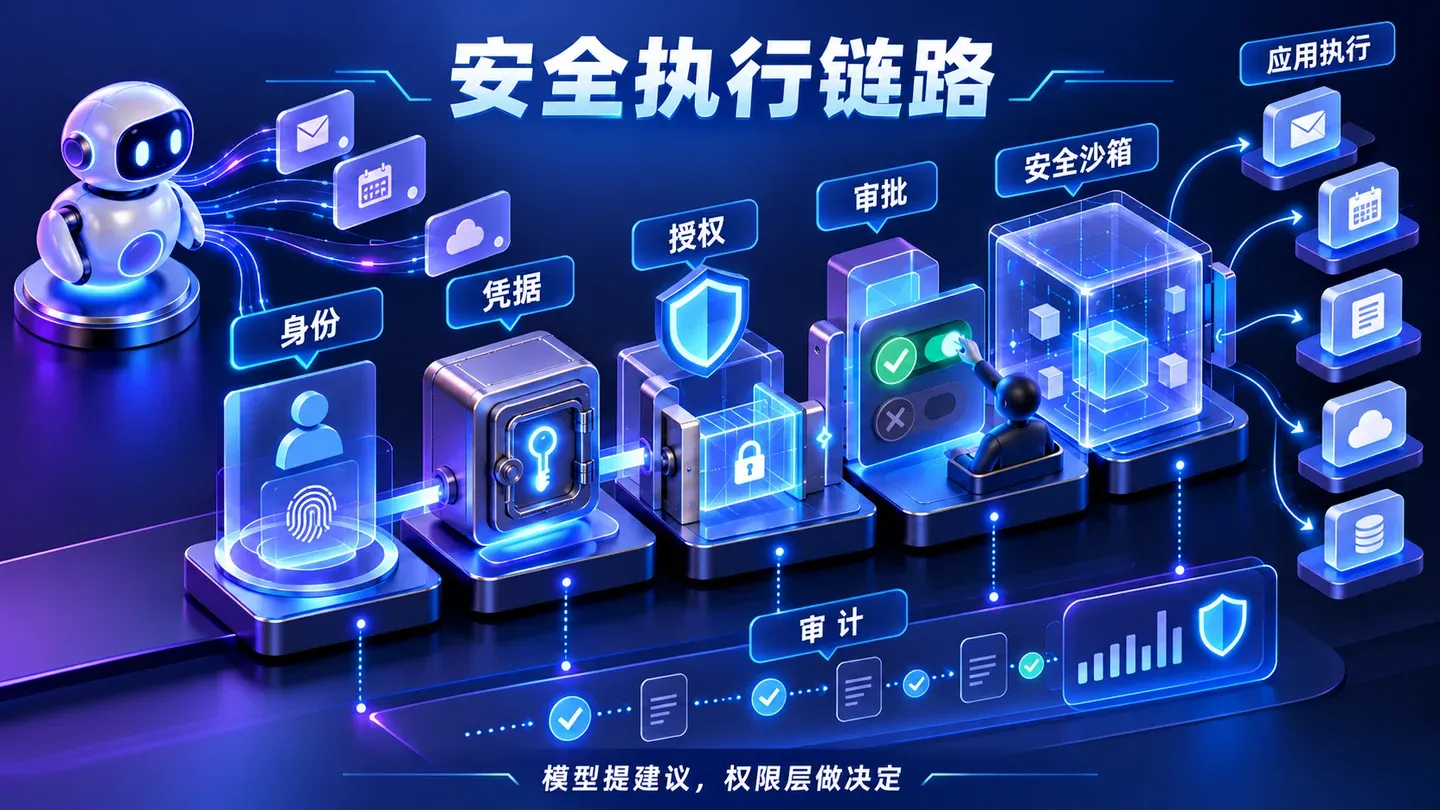
Figure 3: The security boundary should not depend on the model being careful. Identity, credentials, authorization, approval, sandboxing and audit belong outside the model.
8. Local vs cloud runtime: Personal AI is unlikely to be a binary choice
“Personal data is private, therefore the whole agent must run locally” sounds attractive, but phones are not ideal for every long-running or high-compute task.
The opposite extreme—putting everything in the cloud—expands the data boundary around personal knowledge, credentials and durable context.
A hybrid design is usually more practical:
| Layer | Better fit locally | Better fit in cloud |
|---|---|---|
| Private knowledge index | ✓ | Sync only when needed |
| Stable preferences / personal memory | ✓ preferred | Encrypted/controlled sync |
| Lightweight query understanding | ✓ | Optional |
| Deep model reasoning | Device-dependent | ✓ |
| Long-running background work | OS-limited | ✓ |
| Browser / computer use | Limited | ✓ |
| Cross-device continuity | Partial | ✓ |
| Local app / file actions | ✓ | Requires a bridge |
| Credentials | Keychain / local vault | Dedicated secret store |
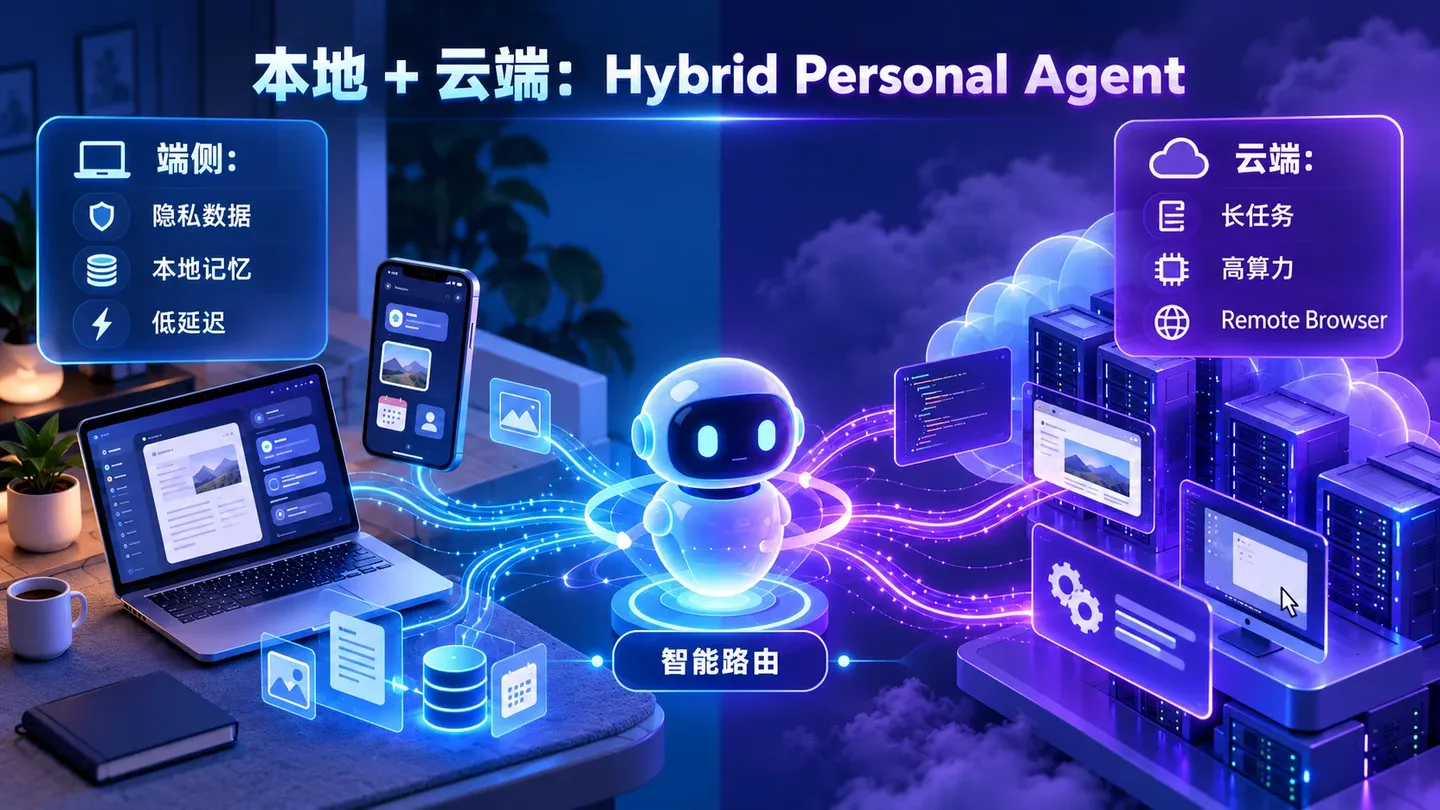
Figure 4: Hybrid does not mean synchronizing everything to the cloud. It routes work by privacy, latency, compute demand, background duration and platform capability.
RecalAI already provides a useful hybrid foundation: local retrieval and local models can work independently, while generation can optionally use a custom cloud API.
That does not mean RecalAI already implements universal autonomous cross-app execution. The stronger architectural lesson is that private data, retrieval and memory boundaries can be stabilized first, then a high-privilege execution layer can be added separately.
9. Audit and recovery: “what did the agent do?” must be reconstructable
Once an agent works in the background, a chat transcript is not enough.
A useful audit record needs to answer:
who
→ requested what
→ agent planned what
→ which evidence was used
→ which policy matched
→ which tool was called
→ with which arguments
→ whether approval was required
→ what actually changed
→ whether it succeeded
→ how to undo / recover
Meta Muse exposes an audit trail. OpenAI Dot exposes activity, permission rules, review and approval controls. Microsoft is extending Zero Trust and data controls to agent traffic.
Observability for Personal Agents therefore grows beyond tokens and latency. It needs to explain why the agent took an action, whose authority it used, and what real system state changed.
For broader controls, continue with AI Agent Security.
Five common architecture mistakes
Treating the full conversation history as memory
Stale facts, temporary numbers and model guesses eventually contaminate future behavior.
Letting the model decide whether it has permission
“the model believes this action is appropriate” is not authorization.
Keeping every connected tool permanently open
A user approving email access today does not mean every future task may read and write every mailbox.
Using browser clicks when a structured interface exists
Prefer an API, intent or connector when one exists. Browser automation should be an execution layer, not the default integration strategy.
Forcing local-only or cloud-only architecture
Production systems need routing based on sensitivity, latency, power, task duration and where the required tools live.
A reference architecture I would use today
                ┌──────────────────────┐
                │ User / Device Identity│
                └──────────┬───────────┘
                           ↓
      ┌──────────────── Personal Context ────────────────┐
      │ Task State │ Long-term Memory │ Knowledge / RAG │
      └───────────────┬─────────────────────────────────┘
                      ↓
              Planner / Reasoner
                      ↓
              Action Proposal
                      ↓
          Policy / Authorization
                ↓           ↓
          Auto Allowed    Approval
                └──────┬──────┘
                       ↓
           Connector / MCP / Intent
             / Browser / Computer
                       ↓
             External Apps / OS
                       ↓
             Audit + Recovery
The runtime is then routed separately:
Sensitive data / local files / low latency
→ Local Runtime

Long-running / high compute / remote browser
→ Cloud Runtime

Mixed task
→ Split execution + minimal necessary context transfer
This is more complex than selecting the strongest model and handing it every tool. But most of the engineering value of a Personal AI Agent now sits outside the model.
Four infrastructure layers worth building for the next 6–24 months
The following is XBSTACK engineering judgment based on current cross-vendor direction, not a promise from any vendor.
Personal Memory Infrastructure
Writing, updating, conflicting, expiring, deleting and syncing long-term personal memory becomes its own subsystem.
Agent Identity and Delegation
Who the agent represents, what authority is delegated, how long that authority lasts and how it is revoked become identity problems rather than simple app settings.
Action / Approval Control Plane
As personal agents connect to more apps, policy, approval and audit become more important—not less important because the model is smarter.
Local-Cloud Personal AI Runtime
Phones, PCs, local NAS devices, cloud computers and SaaS connectors will form one execution environment. Where data lives, where reasoning happens and where actions are committed becomes a core architecture decision.
These are more durable search and product assets than a short-lived SDK bug.
Pre-production checklist
Before shipping a Personal AI Agent, verify that:
- Identity is separate from a session ID.
- Task State, long-term Memory and Knowledge/RAG are separate.
- Memory has provenance, scope, lifecycle, deletion and conflict rules.
- Credentials never enter normal prompts, logs or memory.
- Tool visibility and tool execution permission are separate.
- Consequential actions are re-authorized before execution.
- Approvals are bound to concrete parameters.
- Local/cloud data-transfer boundaries are explicit.
- Browser/computer use runs inside sandbox and network policy.
- Real side effects are fully auditable.
- Long-running tasks support pause, resume, retries and idempotency.
- Users can revoke access, delete memory and stop the agent.
- App/plugin/connector changes trigger regression checks.
Conclusion
OpenAI Dot, Meta Muse and Apple Siri AI matter for more than adding three more AI assistants.
Together they show personal AI moving from a conversation product toward a personal execution system.
A real Personal AI Agent persists, understands personal context, separates memory from current state and knowledge, connects to apps, routes work across local and cloud runtimes, and acts only inside explicit authorization, approval and audit boundaries.
The model still matters. But the questions that increasingly determine whether this system can actually work for a user are:
What should it remember or forget? What may it access or execute? When may it continue autonomously, and when must it return the decision to the user?
Solve those architecture questions first. Model selection, connectors and computer use become much easier to evolve afterward.
Continue from one agent pattern to the complete production system
The AI Agent hub organizes architecture, memory, tool use, evaluation, security, deployment and multi-agent coordination into a single learning path.
More to Explore
Topic hub →AI Engineering Weekly
Production changes, real failures, experiments and new XBSTACK assets.

DISCUSSION
Questions, verification and corrections
Sign in to comment. Every new comment is reviewed before publication; while pending, it is visible only to you and the administrator.