

LFM2.5-24B-A2B on Mac: Memory Requirements, GGUF vs MLX
Can LFM2.5-24B-A2B run locally on your Mac? Compare model file sizes, GGUF and MLX deployment, unified-memory trade-offs, licensing, and an honest testing checklist.
Evidence 4 cited sources
On this page
LFM2.5-24B-A2B deployment note (October 18, 2026): This source-grounded Mac planning guide includes an independently run, read-only memory preflight. XBSTACK has not downloaded or executed the model, so no model throughput, peak inference memory, or benchmark result is claimed.
Short answer: Liquid AI released LFM2.5-24B-A2B on October 13, 2026. It is a mixture-of-experts model with approximately 24 billion parameters in total and approximately 2.45 billion active for each token. That does not make it a 2B-size model in memory. Official MLX quantized checkpoints are listed at roughly 13.6 GB for 4-bit, 16.5 GB for 5-bit, and 25.5 GB for 8-bit. These are model file sizes, not validated peak RAM measurements. A 32 GB Apple Silicon Mac is a reasonable starting point for testing, not a guaranteed minimum specification; 16 GB should not be marketed as a reliable supported tier without a successful controlled run.
What was actually released?
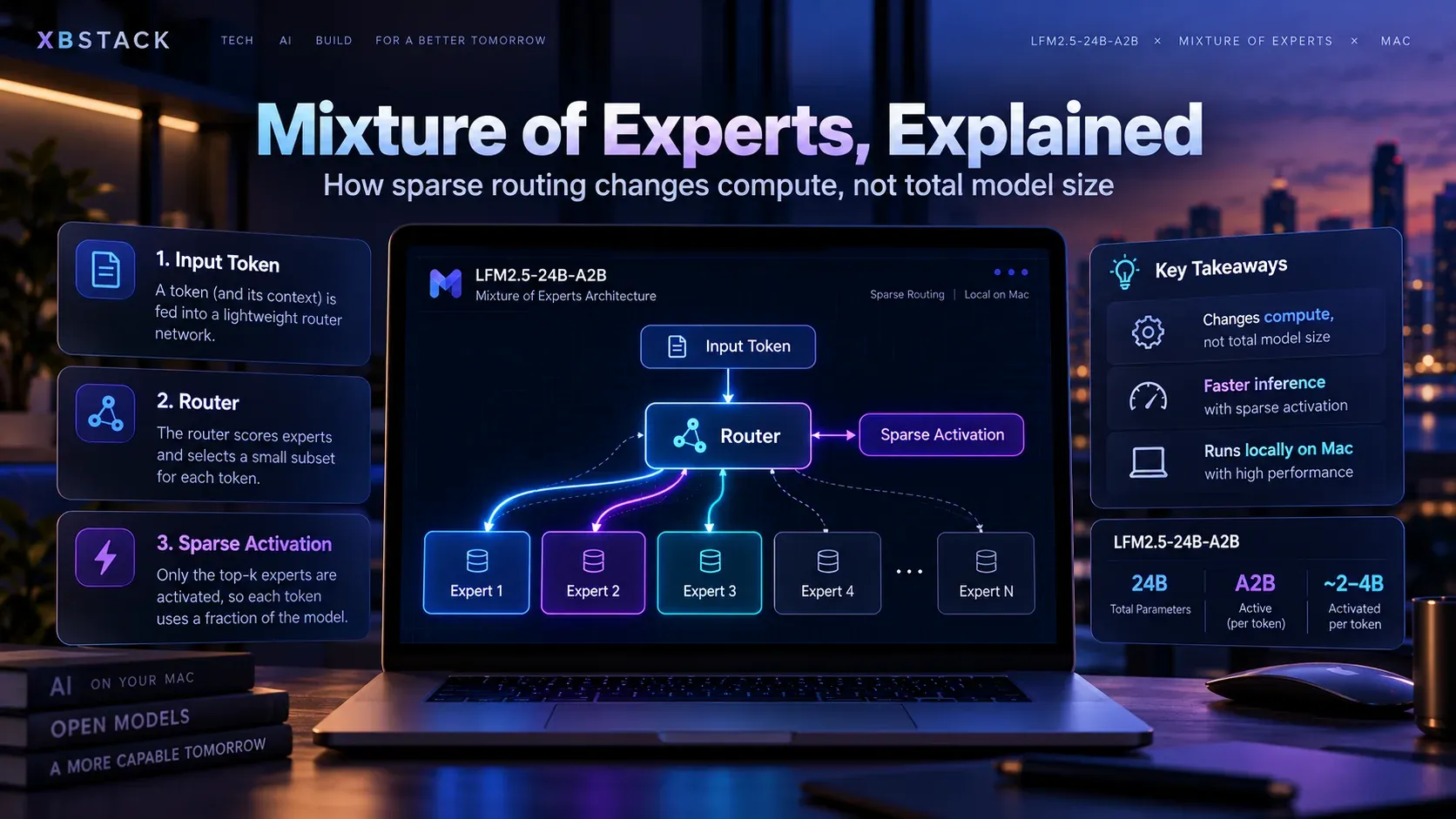
The October 13 Liquid AI announcement presents LFM2.5-24B-A2B as an agent-oriented, post-trained MoE checkpoint. The model card identifies the base and post-trained variants. The architecture uses many experts but activates only a subset per token, reducing active compute without removing the rest of the weights from a typical deployment. The distinction between total weights, active computation, KV cache, and runtime overhead is essential.
Liquid AI reports strong performance on selected tool-use and agent benchmarks and cites generation speed around 184 tokens/s on an M5 Max under its testing conditions. Those are vendor-reported numbers, not independently reproduced measurements by XBSTACK. They must not be compared with an arbitrary Mac or model runtime as though they used a common quantization, prompt length, context window, and sampling configuration.
Original sources:
Mac unified memory: file size is not a minimum specification
| Checkpoint | Model-hosting page size | What the number means |
|---|---|---|
| MLX 4-bit | ~13.6 GB | Quantized model footprint; excludes operating-system, model-runtime, and dynamic context costs |
| MLX 5-bit | ~16.5 GB | Larger weights, but quality differences require task-level testing |
| MLX 8-bit | ~25.5 GB | Considerably more headroom needed for contexts and background applications |
The official hosting-page sizes were reviewed on October 18, 2026. The actual peak process resident size can differ substantially. Context caches, prompt length, parallel requests, memory mapping, GPU allocation policies, and swap pressure all matter.
Practical guidance: On a 16 GB unified-memory Mac, prefer a smaller model unless a specific quantized configuration has been shown to load and complete your workload safely. A 32 GB machine gives more room to start investigating the 4-bit or 5-bit editions, but its success is not guaranteed. Higher-memory Macs are more appropriate candidates when testing larger contexts or running a persistent agent alongside other apps. This is engineering guidance—not a measured compatibility table.
Which route should you pick: GGUF or MLX?
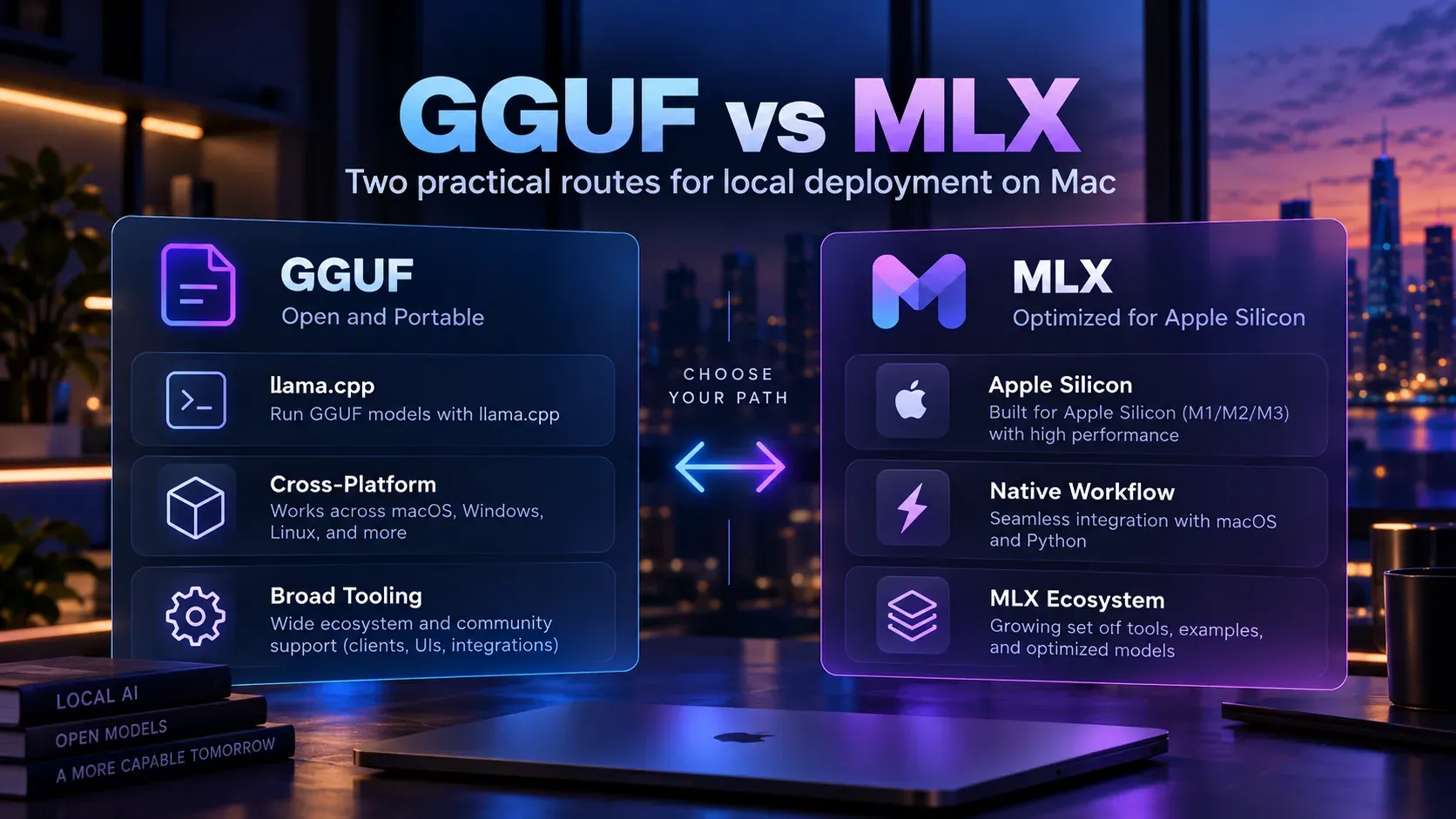
GGUF/llama.cpp is attractive when you want one deployment approach across macOS, Linux, and Windows, or a locally hosted API endpoint. Liquid AI’s official GGUF page documents example commands in the form:
# After installing a compatible llama.cpp build:
llama cli -hf ggml-org/LFM2.5-24B-A2B-GGUF:Q4_K_M

# Start a local service for API-based clients:
llama serve -hf ggml-org/LFM2.5-24B-A2B-GGUF:Q4_K_M
These command forms were sourced from the publisher’s model page. They have not been executed on XBSTACK hardware. Verify that the currently installed llama.cpp supports the LFM2 MoE architecture and its chat template, that sufficient storage is available, and that your runtime uses the intended checkpoint revision.
MLX is a native Apple Silicon route. Use the model publisher’s MLX instructions with compatible MLX/mlx-lm versions; do not assume a downloaded MLX model runs on every older version. A 4-bit variant can be a first test for constrained systems, followed by 5-bit if measurements justify the larger footprint. MLX and GGUF quantization settings are not automatically quality-equivalent.
Run a read-only Mac memory preflight before downloading a model
Unlike a speculative “16 GB minimum” chart, this site provides a small, original, inspectable Python script that reads a Mac’s physical RAM using sysctl hw.memsize and compares it with a publisher-listed quantized artifact size plus a user-adjustable planning reserve. It never downloads or loads model weights. A positive result is only a capacity screen, not proof that the runtime will support the model or that a particular context length will work.
Download the Mac preflight script (plain Python, no external packages).
python3 lfm25-mac-preflight.py --variant mlx-4bit
python3 lfm25-mac-preflight.py --memory-gib 32 --variant mlx-5bit --reserve-gib 8
XBSTACK reproducibility note (2026-10-18): The script ran locally on a Mac whose hw.memsize reports 16 GiB. Using 13.6 GB for the MLX 4-bit artifact and an explicitly assumed, not measured, 6 GiB OS/runtime/cache reserve, it calculated a -2.67 GiB planning margin. This does not show a failed model inference: no model was downloaded or loaded, and it must never be read as a hardware benchmark. A pass on another computer also does not guarantee model load, inference speed, or reliability.
LFM Open License v1.0: commercial-use boundary
The official Liquid AI license allows broad use, modification and redistribution, including commercial use below its annual-revenue threshold; it requires retaining copyright/license notices when redistributing. Under Section 5, entities with annual revenue of USD 10 million or more need a separate commercial license for commercial use. The full current text and any model-specific terms control; this is a source summary, not legal advice.
A reproducible acceptance checklist
Do not declare a winner using a single successful response. Record:
- Environment: Mac model, chip, unified memory, OS version, runtime commit/version, model revision, quantization, and sampling parameters.
- Loading: download size, cold load duration, peak memory, swap usage, and failure/recovery behavior.
- Generation: first-token latency, generated tokens/s, and actual token counts across at least three identical prompts.
- Context scaling: try 4K, 8K, and 16K input sizes progressively; inspect memory, prefill latency, and answer grounding. A published maximum context length is not a universal local deployment guarantee.
- Agent tests: fixed tool schemas, argument validity, tool-selection precision, recovery from tool errors, and duplicate side-effect prevention.
- Sustained workloads: several sequential invocations with memory/timeout monitoring rather than a screenshot of one short output.
A meaningful future XBSTACK review should publish sanitized logs, exact revisions, failing runs, and its own task-level conclusions, and label vendor measurements separately.
Local or hosted inference?
| Decision | Local inference | Hosted inference |
|---|---|---|
| Privacy | May keep prompts on a controlled device | Depends on provider terms and data processing |
| Upfront cost | Requires sufficient hardware and maintenance | Often reduces capital expense but adds API fees |
| Reliability | Your computer controls uptime and updates | Provider handles service infrastructure, with its own availability limits |
| Scaling | Constrained by one device and concurrent memory load | May be easier to scale if a supported API is available |
| Governance | You manage model updates, logs and endpoint security | You manage credentials, vendor choice and contractual controls |
Local does not mean free: electricity, device depreciation, software compatibility, and operational time are real. A hosted model should not be assumed available on an API just because its weights appear on Hugging Face; confirm the specific provider, region, rate limits, pricing and availability.
The Hugging Face model cards identify LFM Open License v1.0 (lfm1.0). Open weights do not automatically mean unrestricted commercial use. Review the full current license before bundling weights in an app, redistributing quantized copies, or operating a commercial service. This guide is not legal advice.
When a smaller model is better
For an iPhone, low-memory laptop, or simple structured-intent classifier, the 24B-total-parameter model may be a poor operational fit even when only a small fraction of parameters are active for each token. Choose based on the actual task rather than peak vendor benchmarks. For personal knowledge retrieval or local RAG, retrieval quality, evidence selection, context budgeting and citation verification remain independent responsibilities; a larger generator does not repair missed retrievals.
Further practical reading
If your goal is a private document assistant rather than a standalone chat model, see the EmbeddingGemma 2 local Mac retrieval experiment to distinguish embedding and retrieval from generation. For the wider architecture behind a device-resident agent, see Personal AI Agent architecture for the division between on-device inference, cloud capabilities, permissions, and persistent memory. The Local AI collection provides a broader route to runtime and on-device model decisions.
Final recommendation
LFM2.5-24B-A2B deserves attention for its MoE design and officially published GGUF/MLX deployment routes. The defensible deployment decision requires a supported runtime, tested quantization, observed peak memory, task accuracy, long-running reliability, and licensing review—not a declaration that “2B active parameters means it fits like a 2B model.”
This article is a source-grounded deployment and selection guide. It is not an XBSTACK real-device benchmark. Before public release, complete the bilingual search-intent and duplication gate, verify the official license terms, test at least one supported startup path, and produce the mandatory independent GPT-generated cover asset.
References
- Liquid AI announcement (Oct 13, 2026): https://www.liquid.ai/blog/lfm2-5-24b-a2b
- Official model card: https://huggingface.co/LiquidAI/LFM2.5-24B-A2B
- Official GGUF: https://huggingface.co/ggml-org/LFM2.5-24B-A2B-GGUF
- MLX 4-bit: https://huggingface.co/LiquidAI/LFM2.5-24B-A2B-MLX-4bit
- MLX 5-bit: https://huggingface.co/LiquidAI/LFM2.5-24B-A2B-MLX-5bit
- MLX 8-bit: https://huggingface.co/LiquidAI/LFM2.5-24B-A2B-MLX-8bit
Next step: continue the Agent system
Full decision path →Choose the next architecture, tool, memory, evaluation, security, or production decision instead of starting over.

DISCUSSION
Questions, verification and corrections
Sign in to comment. Every new comment is reviewed before publication; while pending, it is visible only to you and the administrator.