

Will AI Replace Programmers? The Real Risk Isn't That AI Can Write Code
Will AI replace programmers or frontend developers? Explore 2026 job evidence, productivity, automation, junior hiring and the future of software work.
Evidence 11 cited sources
On this page
Quick answer: AI can automate routine coding and standard-page work and may reduce entry-level hiring, but that does not establish the disappearance of software engineering. Cheaper software may unlock new demand; outcomes also depend on market growth, training, and how productivity gains are shared. We distinguish tasks, occupations, and industries, including the changing role of frontend engineers and the limits of the “silicon-based life” metaphor.
The automobile did replace carriage workers. It also changed the scale of transportation.
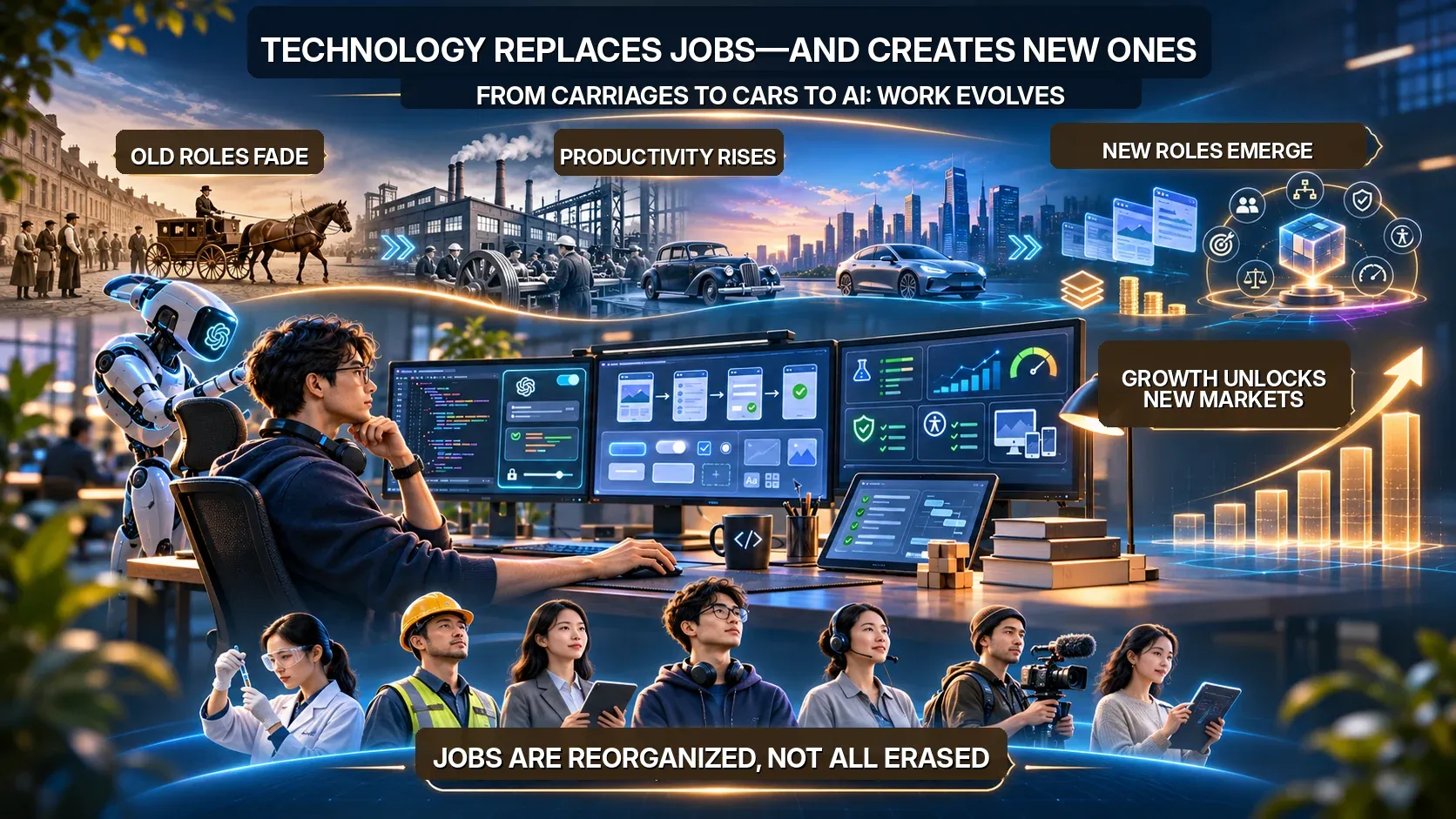
Technology transforms occupational structures as industries change. Illustration, not a historical dataset.
Ask a horse-carriage driver from another century whether automobiles threatened his livelihood. The answer would not be an abstract debate about productivity. His experience with horses, routes, passengers, and repairs was tied to a particular transportation system. As cars spread, many jobs within that system lost economic value.
That is why I would not defend the comforting claim that cars caused no carriage drivers to lose their jobs. They did. The more important point is what happened to the broader market for moving people and goods.
Lower transportation costs enabled longer commutes, wider markets, new supply chains, and whole industries around manufacturing, maintenance, roads, logistics, travel, and insurance. The occupation of carriage driver contracted while transportation became much larger and more complex.
These two facts can both be true: an industry can expand while people who once worked in it experience real losses. Nor does growth guarantee a smooth transition. Someone whose career was built around horses did not automatically become an automotive engineer.
The same distinction matters when people compare artificial intelligence with the internet, mobile commerce, or connected retail. Digital channels challenged many physical stores, while other businesses adapted through delivery, online ordering, inventory systems, and omnichannel operations. Some stores closed; others found new demand. The Internet of Things and e-commerce are not the same technology, and neither has distributed its benefits equally.
History therefore provides a question rather than a guarantee: Will the new work created by a technology be large enough, accessible enough, and valuable enough to offset the work it removes?
Industrial mechanization, electrification, the automobile, the internet, and generative AI are different technologies with different economic consequences. It would be simplistic to claim every technological revolution follows the same employment path. What these transitions reveal is that innovation changes not only the speed of production, but the way production is organized, financed, and rewarded.
We confuse tasks, jobs, and industries
A popular AI demonstration takes a screenshot and produces a functional-looking React interface within minutes. The immediate reaction is predictable: if a model can do that, why employ front-end engineers?
But producing a screenshot-matching page is not the same as delivering a dependable product. The production version may need authentication, permissions, localization, keyboard accessibility, performance under weak networks, race-condition handling, payment idempotency, monitoring, compliance, and ongoing maintenance. It must survive requirements that are missing from the screenshot.
Software engineers deliver working systems under constraints, not merely lines of code. Yet the opposite extreme is equally dangerous. It is no longer credible to describe AI as nothing more than autocomplete. Modern coding agents can inspect repositories, coordinate edits across many files, execute tests, and work through some substantial tasks with relatively limited supervision.
The right unit of analysis is more precise:
- Task: Can AI perform the implementation, review, debugging, or documentation activity?
- Job: How much of a worker’s role consists of those activities, and what remains after automation?
- Industry: If software becomes cheaper, will additional customers and entirely new categories of products emerge?
Evidence at one level does not settle the other two. An impressive coding benchmark can demonstrate technical capability without establishing that an employer will eliminate a position. At the same time, growing demand for software does not prove that every existing programming role is safe.
The labor market evidence is neither a collapse nor a victory lap
The latest US Bureau of Labor Statistics projections distinguish software developers, whose employment is projected to rise by approximately 10% between 2025 and 2035, from computer programmers, projected to decline by approximately 7% over the same period. The detailed projection for web developers is roughly 3.8% growth. These are occupational categories in the United States, not a forecast for China’s front-end labor market, but the divergence is instructive: different kinds of coding-related work can have different trajectories.
A March 2026 working paper by researchers at the US Federal Reserve Board found that employment in coding-intensive occupations had continued to grow after ChatGPT’s introduction, but more slowly than before 2022. Their analysis points to an occupation-specific slowdown that is not fully explained by the industries in which coders work. It does not prove that every missing job was caused by AI, and the paper explicitly discusses methodological limitations.
The sharper warning comes from younger workers. In an August 12, 2026 revision using payroll records for millions of US workers, Stanford Digital Economy Lab researchers found that employment among 22–25-year-olds in highly AI-exposed occupations was about 19% below the trajectory implied by their less-exposed peers. The change appeared largely through reduced hiring, rather than unusually high rates of firing. That figure is not a claim that AI directly laid off 19% of young programmers; it concerns multiple occupations and an estimated relative employment gap. The researchers describe the finding as early, descriptive evidence rather than a causal estimate.
Importantly, the OECD’s 2026 Employment Outlook emphasizes that studies of AI and young workers still reach mixed conclusions. Macroeconomic conditions, financing costs, and sectoral hiring cycles matter too.
These findings are compatible. Software employment can keep growing while opportunities for some new entrants deteriorate. A company may not fire its existing engineers but may choose not to replace two junior vacancies after a team adopts coding agents. From a graduate’s perspective, that hiring decision is not materially less consequential than a layoff elsewhere.
The question has changed from “Will programmers exist?” to “Which people will still be hired, at what level, for which responsibilities?”
Front-end development is a revealing test case
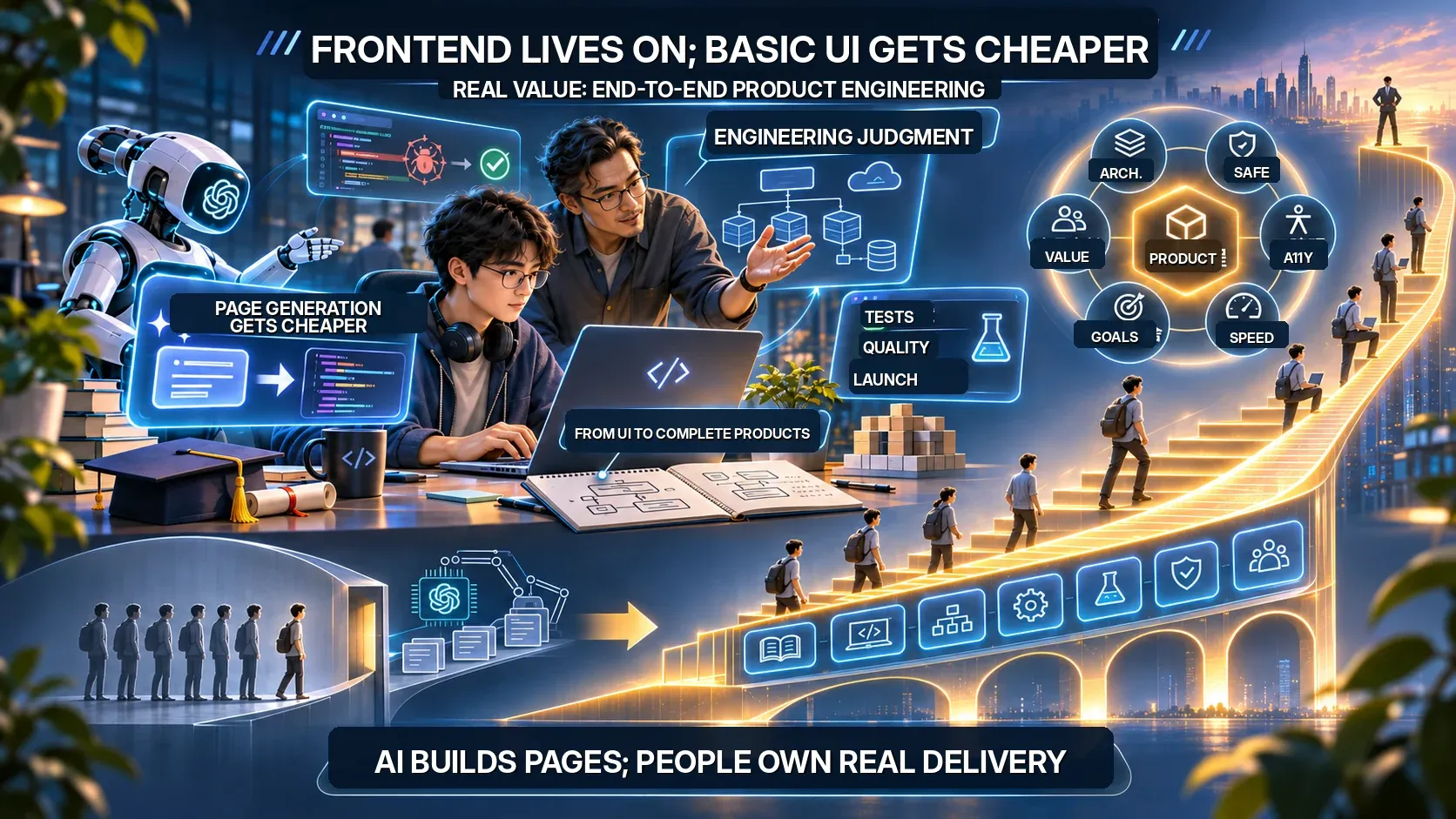
Frontend work increasingly includes product reliability, security, accessibility, and measurable outcomes.
Front-end engineering is particularly exposed because its most visible outputs are easy to demonstrate. Give an agent a design system, an API contract, and a well-specified screen, and it may generate components, styles, forms, and routine state handling quickly.
That matters economically. If an employee’s role is mostly translating mockups into conventional pages, wiring repetitive CRUD interfaces, or adjusting templates, organizations may need fewer hours of that work. Some teams will cut positions. Others will simply hire fewer people when vacancies arise. Saying so is not an attack on front-end engineering; it is an acknowledgement that part of its output is becoming cheaper.
Now consider the checkout experience in a real commerce product. A page that looks perfect on a desktop monitor may perform poorly on a low-memory phone. A retry may duplicate a transaction. A stale session may expose the wrong state. Screen-reader users may get trapped. A loading skeleton may look polished while masking an API that fails under pressure.
These are still front-end problems, but they are product and systems problems rather than isolated markup problems. The engineer’s value lies in making a human workflow reliable: from user intent to API interaction to payment confirmation, across devices and failure conditions.
My prediction is that commodity page assembly loses pricing power while front-end product engineering becomes more integrated with design, back-end contracts, security, performance, and measurement. That does not ensure stable headcount. A stronger engineer using better tools may serve more projects. Dedicated front-end positions may merge with full-stack, design engineering, or AI product roles.
The profession’s boundary will move. People whose skills are limited to that boundary’s old location will face the most pressure.
For React, Vue and admin interfaces, AI-generated UI can be a useful starting point rather than a production-ready deliverable. Payment, identity and personal-data flows still require explicit state models, authorization checks, error recovery, end-to-end testing, performance budgets and rollback procedures. A coding agent can produce changes quickly without automatically gaining release authority or taking responsibility for the outcome.
What must a frontend engineer verify after AI generates React or Vue code?
Consider an online checkout flow. An agent can produce React or Vue components, data fetching and state management quickly, but a page that renders is not yet a product that can safely serve paying customers. The following is a practical release checklist, not the result of a claimed benchmark or measured case study:
- Business logic and state: Test expired sessions, price and inventory changes, network timeouts, retries, duplicate payment clicks, and back navigation; determine where idempotency and rollback are required.
- Security and authorization: Enforce authorization on the server, not merely through hidden UI controls; review access boundaries, XSS, sensitive data, dependencies, and redacted logs.
- Performance and devices: Measure loading, bundle size, interaction responsiveness, and error recovery on representative real devices and constrained networks, not only a fast development laptop.
- Accessibility and localization: Verify keyboard navigation, focus management, semantic markup, screen readers, long translations and responsive layouts.
- Tests and operational ownership: Automate critical user journeys, monitor production failures, prepare a rollback path, and retain traceable review of important AI-generated changes.
AI can help with all five areas, but the acceptance criteria still need to be defined and the outcomes independently verified. Should future systems reliably automate those responsibilities too, employers may need fewer engineers; today’s boundaries are not permanent job guarantees. That is why an impressive page-generation demonstration is not, by itself, an employment forecast for frontend development.
Productivity is only half the employment equation
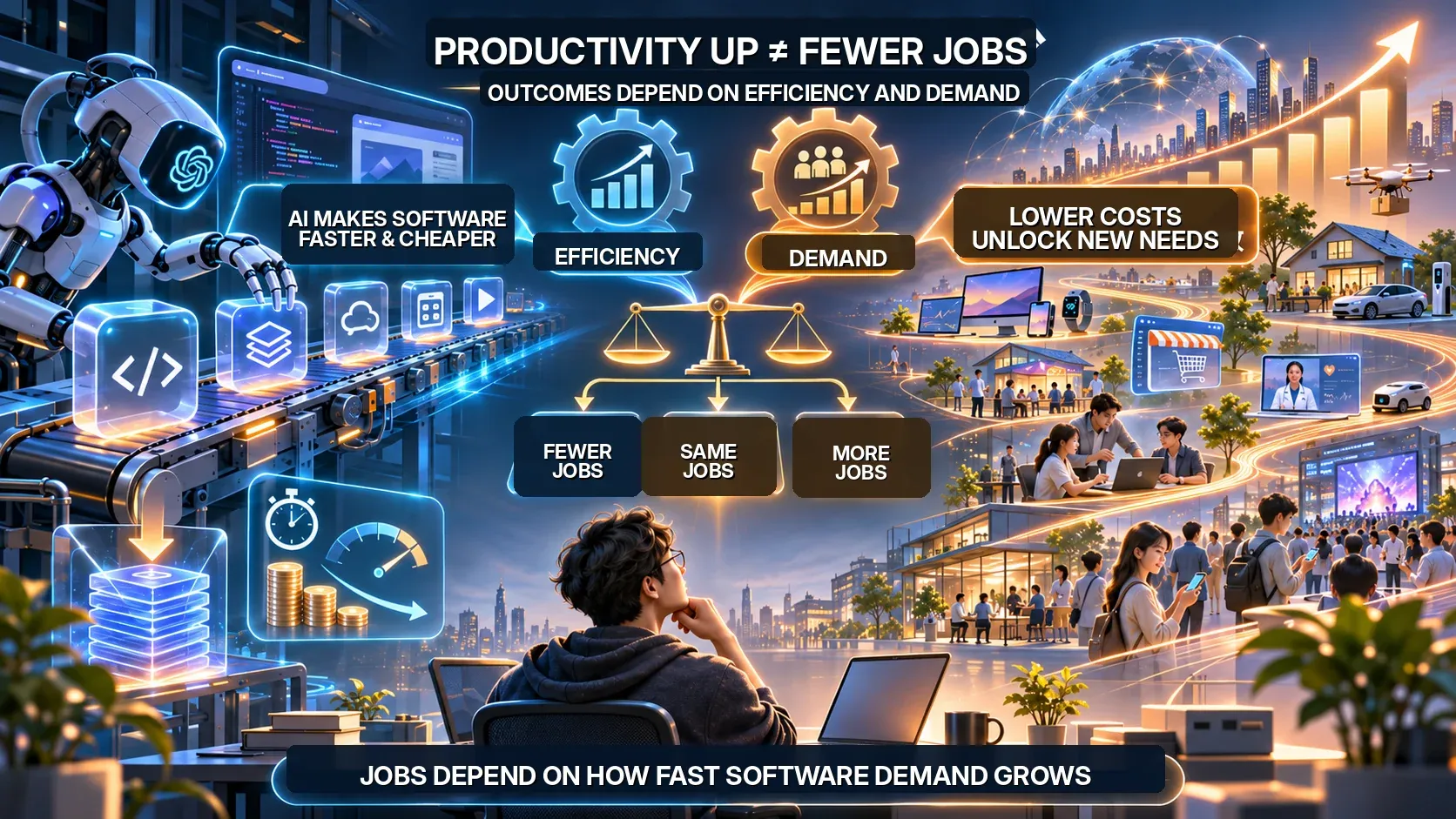
Illustration of how lower costs and increased demand may affect software work; not a labor-market forecast.
Consider a simplified market. Suppose businesses commission 100 software projects a year, each requiring ten engineer-hours of work. That creates 1,000 engineer-hours of demand. AI reduces the effort per project to five hours while preserving quality.
Three different outcomes are possible:
| Annual projects | Hours per project | Total engineer-hours | Change from baseline |
|---|---|---|---|
| 100 | 5 | 500 | –50% |
| 200 | 5 | 1,000 | No change |
| 300 | 5 | 1,500 | +50% |
This is a thought experiment, not a prediction. It demonstrates that labor demand depends on how strongly customers respond when software gets cheaper.
There are credible reasons for demand to grow. Small businesses that could not justify custom tools may now build them. Individuals may create software for niche workflows. Existing organizations may automate neglected processes. AI-enabled products require integration, evaluation, security, governance, and maintenance.
But there are limits. Budgets are finite; customers do not buy twice as much software merely because it costs half as much. New demand might be captured by a handful of extremely productive firms. Productivity benefits may flow disproportionately to platform owners rather than workers.
Economists Daron Acemoglu and Pascual Restrepo describe two opposing forces: automation displaces labor from existing tasks, while the creation of new tasks can restore demand for labor. The net result is not implied by a model’s benchmark score. It emerges through prices, business investment, market structure, institutions, and the creation of work worth doing.
I expect software demand to broaden. I do not claim that this guarantees more software-engineering jobs.
The productivity revolution is also a question about production relations
I think AI deserves to be discussed as a change in productive capacity, not just another office productivity feature. It can lower the cost of building software, change which projects are viable, and allow small teams to do work that previously required substantial budgets. But rising productivity does not mechanically imply more jobs or higher wages.
Imagine a software firm whose existing team can now deliver substantially more work. The firm might expand into new markets, hire and train more employees, lower prices, stop replacing junior departures, or channel the gains primarily to shareholders and AI infrastructure suppliers. The same technical improvement can lead to very different labor outcomes.
This is where relations of production become useful as a lens. Who owns and controls the models, compute, data, and distribution channels? Who sets the terms of employment and assigns responsibility when an agent makes a mistake? Who receives the additional income generated by productivity growth: the worker, the customer, the employer, the platform, or some combination? These are questions of institutions and business choices, not facts predetermined by software benchmarks.
For programmers, the unit being purchased may increasingly be the output of an integrated team of engineers, coding agents, tests, and cloud systems rather than just hours of individual coding. Hiring, junior training, compensation, quality assurance, and accountability may all need to adapt. A productivity revolution without corresponding changes in how work and rewards are organized can produce greater output and greater employment insecurity at the same time.
The displacement-versus-new-tasks framework developed by Acemoglu and Restrepo helps explain why. Automation transfers some tasks away from labor. New tasks can restore demand for labor. Which force dominates depends on demand, investment, competition, and how the benefits of new technology are distributed. It cannot be inferred from how quickly an AI agent finishes a benchmark.
Is AI “silicon-based life”? The metaphor can obscure the labor question
Calling AI “silicon-based life” is rhetorically striking. It evokes an independent digital worker and makes the transformation feel like a competition between two species. But current AI models are not scientifically established as living silicon-based organisms. Biological life, consciousness, and moral agency are separate, unsettled questions, and none is a prerequisite for automation to affect jobs.
Industrial robots altered manufacturing without being alive. Coding agents can reshape the economics of software without being proven conscious. The relevant practical questions are about autonomy, permission, verification, legal responsibility, and ownership of the gains—not whether AI should be called a new form of life. This is a thought-provoking metaphor, not the central search intent of an article about programmers’ employment.
The same mechanism will reshape other industries—but not equally
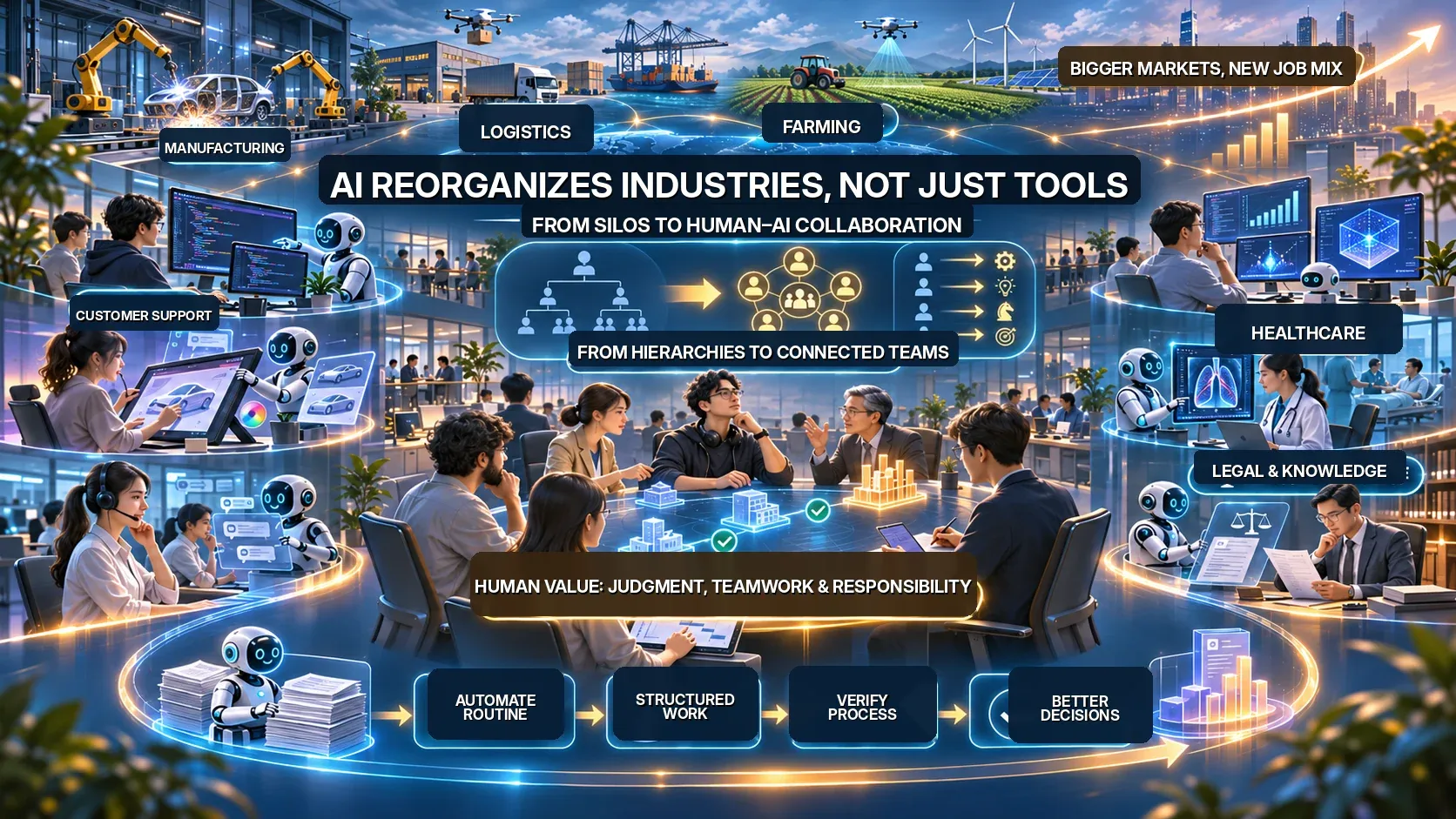
AI changes tasks and coordination across several industries, with uneven effects on jobs.
Customer service already has clear candidates for automation: routine order status requests, basic policy questions, and triage. What remains may involve disputes, complex exceptions, empathy, compliance, and knowledge-base governance. The harder work may become more important, but there is no guarantee that its headcount will offset lost routine positions.
Media, design, and translation face a similar split. Standardized text, simple graphics, and conventional translation face rising supply and pricing pressure. Reporting, verification, editorial judgment, distinctive creative direction, and accountability still matter. The market may nevertheless pay less for some services, even when they are valuable.
In accounting, law, and medicine, AI can accelerate drafting, search, classification, and documentation. Professional liability, regulated decisions, and the costs of error constrain full automation. That does not mean these jobs remain unchanged: their task mixes, staffing models, and training requirements are likely to evolve.
In physical retail and services, software can improve inventory, staffing, logistics, and customer relationships. It cannot fully substitute for physical care, on-site maintenance, real-world delivery, or the experience of a place. Still, businesses that fail to adapt can lose customers.
The International Labour Organization estimated in May 2025 that roughly one in four workers worldwide is in an occupation with some exposure to generative AI. Its central distinction is that exposure does not equal complete replacement: for many occupations, transformation of tasks is more plausible than immediate disappearance. The risks vary sharply by role and context.
The broad vulnerability is not “working at a computer.” It is performing tasks that are repeatable, digitally specified, easy to verify, and inexpensive to get wrong. Even then, business decisions determine whether automation results in layoffs, redeployment, new services, or a mix of all three.
The apprenticeship problem could be more serious than the code-generation problem
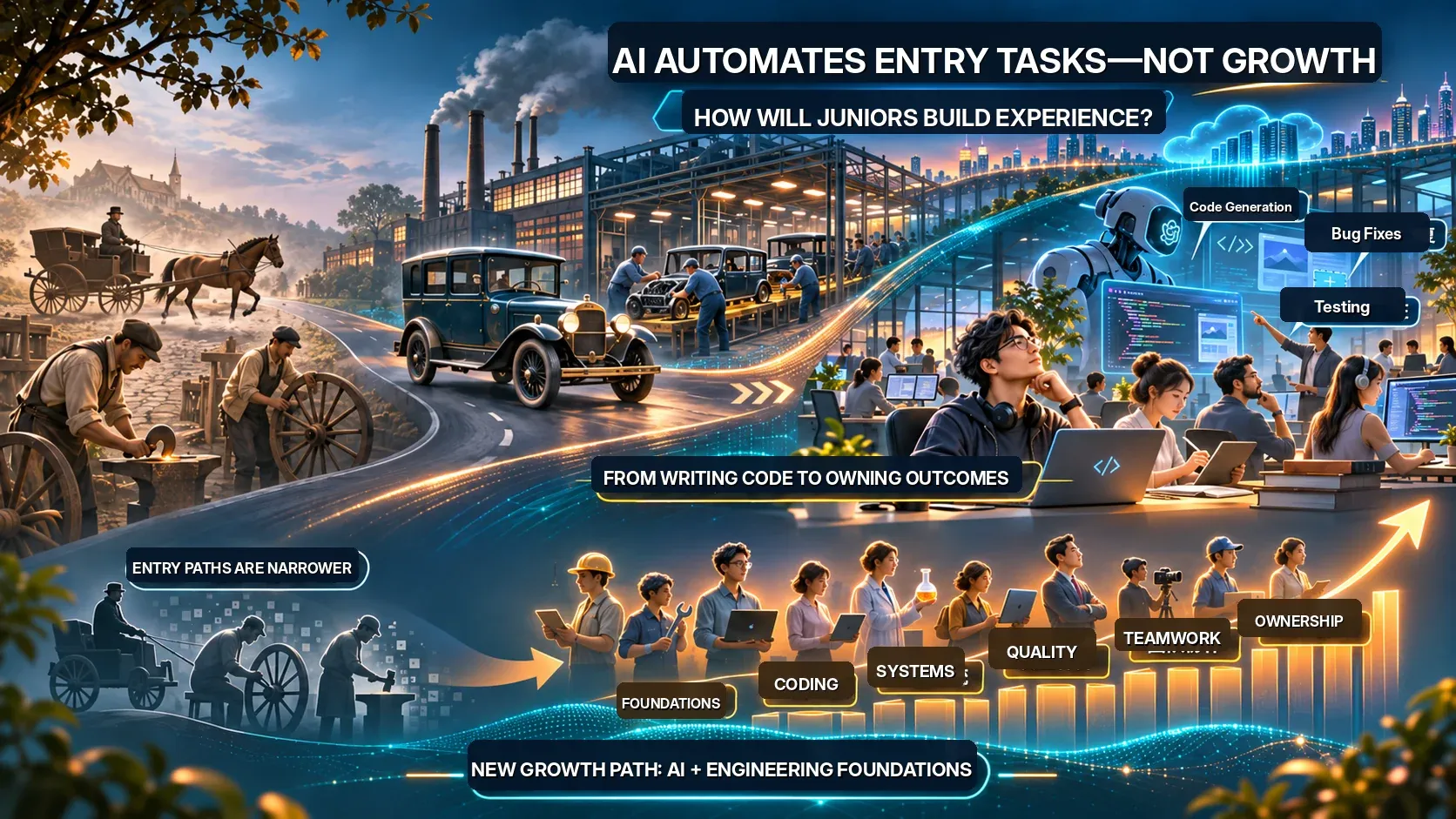
Career progression from routine coding to testing, systems understanding, and responsibility.
A familiar response to the AI labor debate is: “The engineers who understand architecture and business will survive; the ones who only write code will not.”
But where do future senior engineers come from?
Today’s experienced engineers learned through bug fixes, forms, poorly documented APIs, deployment failures, and incremental responsibility. Those tasks were not glamorous. They were training grounds for building judgment about production systems.
If employers automate junior work and reduce entry-level hiring, they may increase output now while undermining their future talent pipeline. A new developer can submit a polished AI-generated pull request without understanding concurrency, transaction consistency, access control, or failure recovery. When the agent is wrong, somebody still needs to diagnose why.
This calls for a different apprenticeship model, not simply the elimination of apprenticeship. Junior engineers should work on real requirements, write acceptance criteria, reproduce failures, explain architecture decisions, review AI changes, and practice controlled deployment and rollback. Teams must reward verified understanding rather than raw code volume.
Not everyone will have equal access to those opportunities. Company training budgets, educational resources, local labor markets, and the ability to endure career transitions all matter. Individual initiative is necessary, but it is not a substitute for institutions that provide pathways into an evolving profession.
What if coding agents become good enough to do almost everything?
A serious argument must confront its strongest counterargument.
METR’s July 2025 randomized study of experienced open-source developers found that using AI tools increased task completion time by about 19% in the tested setting. That result is useful because it challenges the assumption that more generated code always improves the full development process. But it cannot be generalized to every developer, every task, or future tools.
METR itself explained in February 2026 that its follow-up productivity experiment suffered from participation bias: some developers did not want to work without AI, making the estimated effect unreliable. Meanwhile, coding agents have advanced beyond the systems used in the earlier trial.
If future agents reliably handle requirement discovery, architecture, implementation, security review, testing, deployment, and operations, the demand for human engineering labor may decline much further. Human accountability does not logically require the same team size as before.
That possibility is consistent with the broader argument. We should update our beliefs as capabilities and labor evidence change. We should not turn today’s engineering obstacles into a claim of permanent human immunity, any more than we should turn today’s demonstrations into a prediction of an empty profession tomorrow.
A capability forecast is not an employment forecast. Employment also depends on what society chooses to build, who owns the tools, how benefits are shared, and what new tasks appear.
A practical strategy for developers, especially front-end engineers
I would not advise every developer to become a machine-learning researcher, nor would I advise anyone to ignore the tools. The most useful shift is from being paid to produce code toward being trusted to deliver outcomes.
Keep the fundamentals. Networking, databases, data structures, browser behavior, security, concurrency, and performance help you evaluate AI output rather than accept it blindly. For front-end specialists, accessibility, state modeling, production analytics, and the end-to-end behavior of user journeys matter as much as component syntax.
Define problems before generating solutions. A strong specification includes the user, the intended outcome, assumptions, failure modes, data boundaries, tests, rollback conditions, and business metrics. AI can help implement that specification. An engineer must still know when the result is wrong and what to do next.
Expand one layer beyond your existing responsibility. Front-end engineers can learn API contracts, authentication, testing, and deployment. Back-end engineers can develop a deeper understanding of product experience. Everyone working with AI agents should learn tool permissions, evaluation, auditability, and cost controls. The goal is not to become a one-person expert in every discipline. It is to understand the complete flow well enough to make good tradeoffs.
Build evidence of work rather than a collection of generated demos. A deployed project with a clear problem statement, failure analysis, tests, user feedback, and a maintenance history tells employers far more than a repository full of boilerplate.
And keep career flexibility. The fact that a sector might eventually expand offers little immediate protection to someone whose specific job is being reduced today. Learning, savings, professional relationships, and opportunities to gain real-world experience are all forms of resilience.
Final judgment: software may grow; yesterday’s career bargain will not necessarily survive
The automobile did not preserve every carriage job. It expanded transportation while changing who worked in it and what they needed to know.
Digital commerce did not eliminate physical retail. It did eliminate some stores, pressure some business models, and create new kinds of work for others.
AI is likely to reshape software in a comparable, though not identical, way. Routine work becomes cheaper. Some roles contract. New products become economically possible. The industry may continue to grow even as its hiring mix, skill requirements, and distribution of rewards change dramatically.
For employers, the opportunity is not merely to remove headcount from a spreadsheet. It is to build products and services that were previously too costly to attempt. Whether firms pursue that opportunity will help determine how much employment growth offsets automation.
For programmers, especially front-end developers, the better question is not simply, “Will AI write my code?” It is:
When writing code is no longer scarce, what can I understand, decide, build, verify, and take responsibility for that customers will still value?
Technology does not guarantee that every worker benefits. But defending an old job description will not preserve it either. The challenge is to translate improved tools into new demand—and to create realistic paths for people to move with that demand.
FAQ
Will AI cause mass unemployment? Automating coding and other repetitive tasks does not, by itself, prove economy-wide mass unemployment. Demand, new tasks, economic conditions, retraining and how companies use cost savings all affect employment outcomes.
Can AI coding agents replace junior developers? Coding agents can perform boilerplate work, standard UI generation and basic testing, which may reduce demand for some entry-level tasks. Whether this removes junior positions depends on organizational decisions, supervision and training.
Is computer science still worth studying in the AI era? AI-generated code does not make computer science fundamentals irrelevant. Systems thinking, testing, security, architecture, domain understanding and evidence of shipping real products become more important while entry-level hiring remains competitive.
Which jobs are most exposed to generative AI? Standardized and verifiable digital tasks in support, administration, basic content and routine coding are exposed. Occupational exposure is not equivalent to an industry disappearing or workers being laid off.
Does greater AI productivity guarantee more programming jobs? No. Cheaper software may generate additional demand, but some firms may use the same productivity gain to reduce hiring. Market expansion, new tasks, training, and distribution of benefits determine the result.
How could AI change relations of production? It can change who controls the tools and data, how tasks and responsibilities are assigned, and who shares the productivity gains. The direction is not fixed by AI capability alone.
Is AI a form of silicon-based life? There is no established scientific basis for treating current AI models as living silicon-based organisms. The term is a metaphor here, not a biological or employment forecast.
Will AI completely replace software engineers? There is insufficient evidence to conclude that the profession is about to disappear. Some tasks and positions face displacement, while demand for software and engineering responsibilities also changes. Long-term headcount remains uncertain.
Are front-end developers more vulnerable than back-end developers? Template-driven pages, repetitive forms, and conventional CRUD interfaces are highly automatable. That does not prove that all front-end positions face greater risk than all back-end positions. The task mix, reliability requirements, and business context matter more than the label.
Is AI causing fewer entry-level software jobs? Some US research shows slower hiring or weaker relative employment among young workers in AI-exposed occupations. Other studies find mixed or less pronounced effects. It would be inaccurate to attribute every change to AI or extrapolate US estimates directly to China.
Should a junior developer change careers? Not solely because coding agents can write code. First assess the demand for your work, strengthen engineering fundamentals, learn verified AI-assisted workflows, and build evidence that you can ship and maintain real products.
Which industries and jobs might AI replace first? AI most directly affects standardized, repeatable and digitally verifiable work across customer support, administration, basic content production and routine coding. Exposure to these tasks is not evidence that entire industries will disappear.
Sources and limitations
- US Bureau of Labor Statistics — Software Developers, Computer Programmers, and Occupational Projections. Employment projections for the US, not global forecasts.
- Stanford Digital Economy Lab, August 12, 2026 revision: Canaries in the Coal Mine?. The 19% figure is a relative employment trajectory gap, not an AI-caused layoff rate.
- Federal Reserve Board researchers, March 20, 2026: AI and Coder Employment: Compiling the Evidence. Research working paper, not an official policy statement or conclusive causal estimate.
- OECD: Employment Outlook 2026 and Skills in the AI Age.
- International Labour Organization, May 2025: Generative AI and Jobs: A 2025 Update. Exposure is not equivalent to displacement.
- METR: Early-2025 developer productivity randomized study; February 2026 update on experiment design. Findings are sensitive to time, participants, tasks, and tools.
- Acemoglu and Restrepo, 2019: Automation and New Tasks: How Technology Displaces and Reinstates Labor. Economic framework for displacement and reinstatement effects.
The judgments in this essay are interpretations of evidence, not guarantees about anyone’s employment prospects.
Related reading and sections
- AI Agents and the Future of Work: Changing roles and collaboration
- AI for Developer Operations: From code generation to reliable delivery
- Agent Harness vs. Model Upgrades: What changes real task completion?
- Explore more AI engineering and industry analysis
- Browse Insights: Opinions and long-term decisions
Next step: continue the Agent system
Full decision path →Choose the next architecture, tool, memory, evaluation, security, or production decision instead of starting over.

DISCUSSION
Questions, verification and corrections
Sign in to comment. Every new comment is reviewed before publication; while pending, it is visible only to you and the administrator.