

Claude Fable 5.2 API 400 Errors: Debugging Agent History, Tool Calls, Fallback and Real Task Cost
Claude Fable 5.2 upgrade failing with HTTP 400, broken tool use, empty replies or lost reasoning on fallback? Follow a symptom-first troubleshooting workflow with synthetic reproducible fixtures, a compatibility matrix, safe rollouts and a realistic agent-cost decision framework.
Evidence 4 cited sources
On this page
Claude Fable 5.2 API upgrade fails with 400: how to debug the agent, not just the model ID
Imagine a production Coding Agent migrating from Claude Fable 5.1 to Fable 5.2. A fresh request works, but resuming a previously saved session fails. Another workflow returns HTTP 200 after routing to a cheaper model, yet apparently loses information needed for the next step. A third service fails immediately with a 400. Those incidents do not necessarily share a root cause.
This is a synthetic engineering scenario, not an incident observed in an XBSTACK production account. Our goal is to turn Anthropic’s published protocol changes into an actionable incident workflow and an offline diagnostic utility. The provider-specific rules below are sourced from the official migration guide and What’s new. XBSTACK has not called the paid Fable 5.2 API to reproduce any server-side failure.
First classify the symptom instead of guessing the fix
If you searched for “how to fix Claude API 400”, first note that HTTP 400 generally means the submitted request failed input or parameter validation, not that the model service is simply unavailable. It is different from a 429 rate-limit response or a 5xx provider failure. The generic label invalid_request_error does not identify the faulty field by itself: examine the redacted error detail and request shape. When an old conversation stops working after a model change, distinguish a historical message-replay failure from a configuration or tool-routing problem.
Record a redacted HTTP error category, source model, target model, platform, request phase and applicable tool version. Never dump credentials, raw thinking content or private customer prompts into public diagnostics.
| Symptom | First investigative branch | Invalid shortcut |
|---|---|---|
| 400 containing `The block is bound to a different conversation` | Changed historical `system/tools/messages` prefix and preserved thinking replay | Retrying the same body until it passes |
| 400 on the first request containing tools | Forced `tool_choice`, disabled/manual thinking, legacy Computer Use or advisor pairing | Assuming every 400 is new in 5.2 |
| 400 in a ZDR workspace | Workspace retention policy and any express authorization | Treating local-first app storage as provider-side ZDR |
| HTTP 200 after a model fallback, but different state continuity | Thinking-block compatibility and `input_transformations` | Calling a successful response full reasoning preservation |
| `max_tokens` termination with little or no visible text | Adaptive thinking, effort and output budget; content block parsing | Declaring that the model did not generate anything |
| Token pricing fell but the agent costs more | Thinking length, cache, tools, retries and subagent work | Using only the price per million tokens |
Migration origin matters. Fable 5.1 already required always-on adaptive thinking, rejected forced tool choice and had retention restrictions. They are not all new Fable 5.2 regressions. Migrations from older Opus configurations introduce different compatibility risks. Treat that distinction as part of the diagnosis, not a footnote. https://platform.claude.com/docs/en/models/fable-5-2/migration-guide
Incident A: the first turn works; the resumed session gets a thinking signature 400
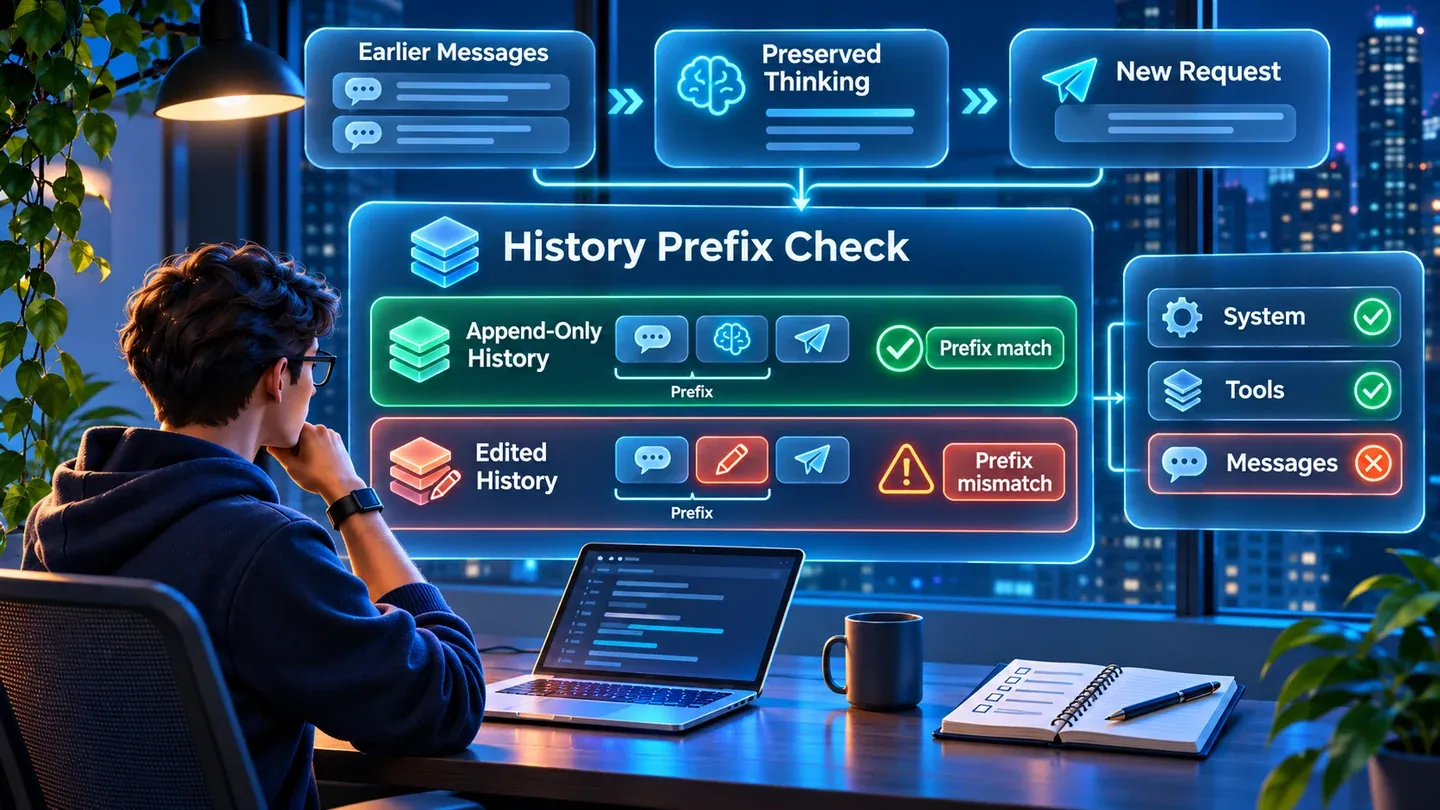
The failure pattern
A common custom-agent pattern is to save a past assistant turn containing both `thinking` and `text` blocks, compact older user turns to save tokens, and replay the original assistant turn on the next request. That changes the historical prefix to which the thinking block was bound.
Here is a synthetic example. The placeholder thinking string is not a real provider-generated or signed block:
```js const before = { system: ‘Use approved tools.’, tools: [{ name: ‘search’, input_schema: { type: ‘object’, properties: {} } }], messages: [ { role: ‘user’, content: ‘Check issue A.’ }, { role: ‘assistant’, content: [ { type: ‘thinking’, thinking: ‘SYNTHETIC_ONLY’ }, { type: ‘text’, text: ‘First diagnosis.’ }, ] }, ], };
const next = structuredClone(before); next.messages[0].content = ‘Summarized context’; // changed earlier prefix next.messages.push({ role: ‘user’, content: ‘Continue.’ }); ```
Fable 5.2 checks that the `system`, `tools` and messages preceding a preserved thinking block have not been edited. Without the relevant drop control, replaying an incompatible block causes a 400. This check applies to all Fable 5.2 accounts; the precise Fable 5.1 behavior depended on account creation time. https://platform.claude.com/docs/en/models/fable-5-2/whats-new-fable-5-2
How to identify the application-side edit
Inspect four boundaries: what the API returned, what the database persisted, how the conversation is reconstructed, and whether a dynamic tool registry rewrites the tools list between turns. Check if empty thinking blocks are discarded, content blocks reordered or older messages rewritten.
In our local repository, the `preflight.mjs` module fingerprints synthetic serialized request snapshots; `diagnose-migration.mjs` labels a change as `PREFIX_MUTATION`.
```js import { auditPrefix } from ’./experiments/claude-fable-5-2-migration/preflight.mjs’; const report = auditPrefix(before, next); console.log(report.changedFields); // [{ code: ‘EARLIER_MESSAGE_CHANGED’, index: 0 }] ```
The offline suite runs with:
```bash node —test experiments/claude-fable-5-2-migration/*.test.mjs ```
On November 10, 2026, we ran 14 synthetic Node tests; all 14 passed. That result only validates our own snapshot comparison and local diagnostic rules. It does not prove a real Claude API 400 or validate Anthropic’s cryptographic signature implementation.
A repair that can be verified
Persist and replay all returned assistant blocks in their original order. Keep `system` and `tools` stable for the session, and only append new messages to the stored conversation. For necessary context trimming, evaluate officially supported server-side compaction and context-editing mechanisms, including platform-specific support.
Anthropic documents a temporary workaround using the `thinking-binding-controls-2026-08-01` beta header plus `thinking.block_binding.prefix_mismatch_behavior: “drop_block”` in supported requests. It discards incompatible blocks rather than repairing the prefix; inspect `input_transformations`. Dropping context can increase subsequent output tokens, so track frequency and cost.
A live acceptance test remains outstanding: verify multi-turn tool-result replay with unchanged history; deliberately edit an early turn to confirm expected error/transformation behavior; and make sure resumption never repeats an already committed external tool side effect.
Incident B: a first-request 400 points to inherited config, not conversation history
A 400 without a replayed thinking block suggests looking at the actual request configuration. This is a more useful scanner than a flat list of product features:
| Component | Which migration raises the risk? | Proposed fix |
|---|---|---|
| `thinking: {type:“disabled”}` or manual `budget_tokens` | Older Opus configurations that allowed disabling or budgeting thinking | Use adaptive thinking and effort; Fable 5.1 already had this restriction |
| Forced `tool_choice` types `any` or `tool` | Older Opus agents that required a particular call | Use `auto` and explicit instructions; validate tool inputs in your app |
| `computer_20251124` | Existing legacy Computer Use workflows | Outside Amazon Bedrock, migrate to `computer_toolset_20260801` and update the entire agent loop |
| Fable 5.2 executor paired with Fable 5.1 advisor | Advisor-beta integrations | Select Fable 5.2 or authorized Mythos 5.2 advisor, starting a new session because tool definitions change |
| Reused `temperature/top_p/top_k` | Copying parameters from other models | Remove unsupported sampling settings according to the target model |
| ZDR-only workspace | Apps with provider-retention constraints | Confirm an eligible 30-day-retention workspace or express Anthropic exception |
An important compound failure: replacing an advisor may edit `tools`. If you then continue a historical session while replaying thinking blocks, the change can independently cause a prefix mismatch. Treat tool definition changes and thinking replay as connected parts of the same migration, rather than repeatedly retrying two 400s. https://platform.claude.com/docs/en/models/fable-5-2/whats-new-fable-5-2
Incident C: run a local migration preflight before sending data to a provider
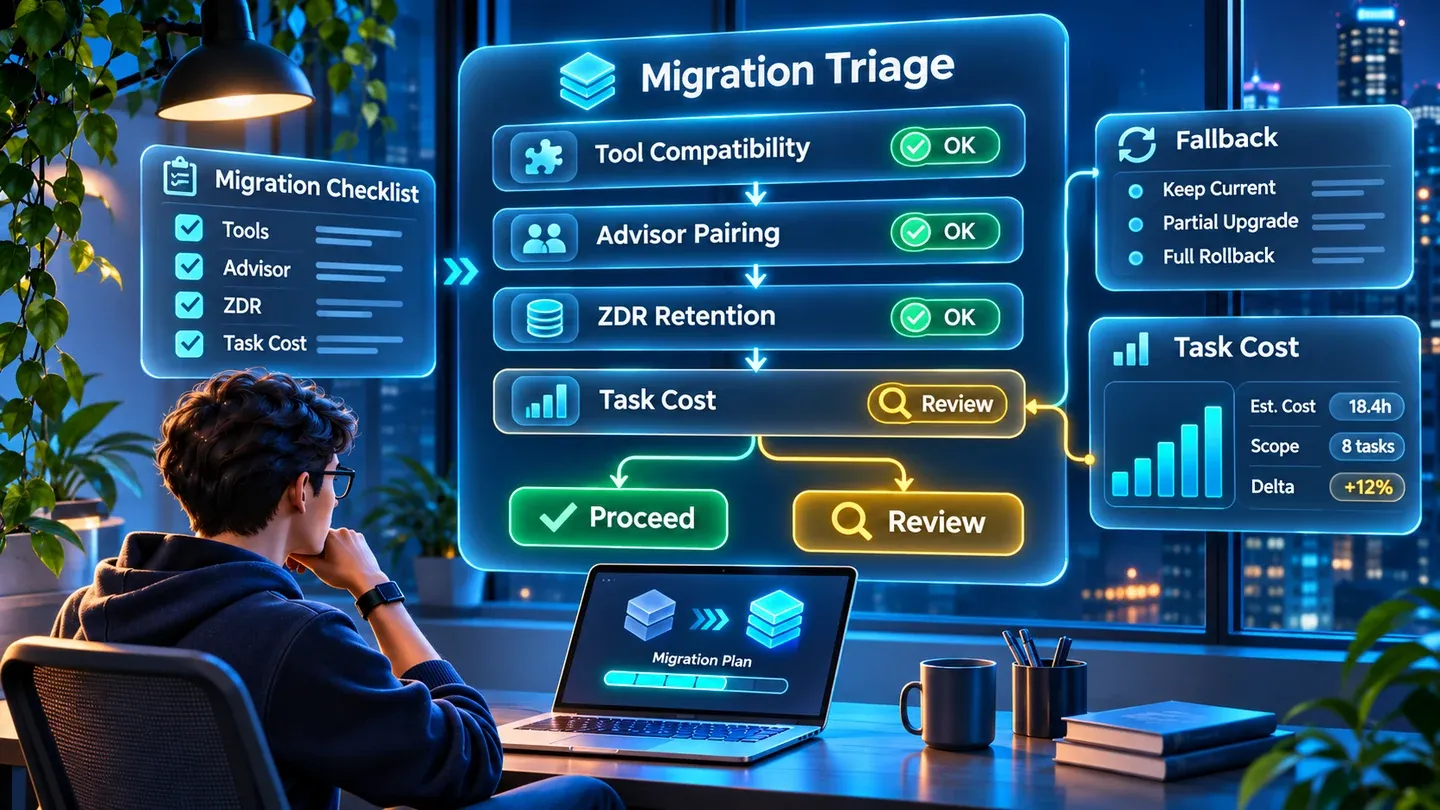
The XBSTACK companion fixture is intentionally offline and designed for synthetic data. It compares API configuration against documented constraints without sending an API request or inspecting a production key.
```js import { diagnoseMigration } from ’./experiments/claude-fable-5-2-migration/diagnose-migration.mjs’;
const report = diagnoseMigration({ sourceModel: ‘claude-fable-5-1’, nextRequest: { system: ‘SYNTHETIC’, messages: [{ role: ‘user’, content: ‘SYNTHETIC’ }], tools: [{ type: ‘computer_20251124’, name: ‘computer’ }], tool_choice: { type: ‘any’ }, }, platform: ‘claude-api’, advisorModel: ‘claude-fable-5-1’, requiresZdr: true, }); console.table(report.findings.map(({code, severity}) => ({code, severity}))); // LEGACY_COMPUTER_TOOL / FORCED_TOOL_CHOICE / ADVISOR_MODEL_INCOMPATIBLE / RETENTION_POLICY_BLOCK ```
The diagnostic returns static findings, not manufactured server exceptions. It marks forced tool choice and retention restrictions as not new to 5.2 when the source model is Fable 5.1. A fallback to an older model is a warning about possible reasoning loss, not an invented 400 failure.
The 14 passing local tests include:
| Offline test family | Local result | What it proves |
|---|---|---|
| Append-only vs mutated historical request prefixes | PASS | Local snapshot edits can be detected |
| Forced tool choice, manual thinking, Computer Use platform exception | PASS | Static classifications follow the documented rules |
| Advisor pairing, ZDR policy and fallback warning severity | PASS | Local blocking and warning levels are distinct |
| Hypothetical public-rate cost and invalid input checks | PASS | Arithmetic is correct for the supplied test cases |
This is the independent engineering contribution of the article—not a claim that Anthropic’s service was independently tested.
Incident D: an HTTP 200 on fallback can still mean dropped reasoning

Moving a complex long-running task from Fable 5.2 to a less expensive model may be sensible. It is not equivalent to copying every type of conversation state.
On supported Claude API and specified Google-managed platforms, Fable 5.2 can consume thinking blocks from various older Claude models. The reverse is restricted: Fable 5.1, Opus 5.5 and other older models cannot consume thinking blocks produced by Fable 5.2. Unsupported blocks are dropped before the target model processes them, while the request can succeed. On supported paths with the documented beta header, the response may expose `input_transformations` entries such as `model_binding_mismatch`.
The failure is not necessarily “the cheaper model became unreliable.” Separate: persisted visible messages and tool results, provider-private reasoning-block compatibility, and your application’s own durable task state.
Our engineering recommendation is to persist task state, evidence references, tool receipts and idempotency keys in an app-owned format. Proprietary thinking blocks should not be the only recovery mechanism across models or accounts.
Incident E: empty replies, stopped generation, or a retention-policy block
No visible text does not necessarily mean no processing. Fable 5.2 always uses adaptive thinking, and the default effort is `high`. `max_tokens` covers thinking plus text, so a low output budget may end with `stop_reason: “max_tokens”` before any `text` block arrives. Read content by `type`; do not assume `content[0].text` always exists.
Retention is a product boundary, not just an API flag. Fable 5.2 normally requires 30-day retention and is unavailable under ZDR unless Anthropic expressly authorizes the exception. The Claude API may reject a workspace that lacks the required retention setting. A local-first application can store all persistent data on-device while still sending optional requests to a remote provider with its own retention policy. Those facts must be communicated separately to the end user. https://platform.claude.com/docs/en/models/fable-5-2/overview
Incident F: a 20% unit-price reduction does not guarantee cheaper completed tasks
As of November 10, 2026, Anthropic lists Fable 5.1 at 50 and Fable 5.2 at 40 per million standard input/output tokens. The same token mix costs 20% less at the new rates, but task-level economics are a different measurement. https://platform.claude.com/docs/en/models/fable-5-2/overview
Consider a deliberately hypothetical run using 500,000 uncached input and 100,000 output tokens, ignoring other charges:
| Model | Hypothetical input cost | Hypothetical output cost | Hypothetical total |
|---|---|---|---|
| Fable 5.1 | $5 | $5 | $10 |
| Fable 5.2 | $4 | $4 | $8 |
We implemented and tested `estimateCost()` against this arithmetic example. No real Anthropic invoice or API task measurement was involved. Production economics also depend on cache reads/writes, tools, retries, external services, subagents and additional thinking.
A useful comparison should ask: What is the dollar cost per successfully completed task, at the same success and safety threshold? Log at least:
```text task_id, model_id, source_model, effort, prompt_version input_tokens, output_tokens, cache_read, cache_write tool_attempts, tool_side_effect_ids, retries, subagent_runs stop_reason, input_transformations, elapsed_ms task_passed, human_fix_minutes, cost_usd ```
Do not label a lower price per token as a measured improvement in your agent’s task completion economics.
A production rollout path with explicit acceptance gates
Gate 0: Provider eligibility and privacy. Validate workspace retention, access permissions, rate limits and budget. Never upload genuine user data merely to test a migration.
Gate 1: Offline preflight. Run the 14-test suite with synthetic fixtures and examine any configuration block. The script covers local logic only.
Gate 2: Real API integration tests (not yet run). In an isolated, authorized, non-sensitive test account, exercise valid and invalid thinking replay; legacy Computer Use; Advisor changes; forced tool choice; small output budget; cross-model fallback. Log redacted HTTP status and provider fields. A 400 reported by official documentation is not an XBSTACK observation until this step actually runs.
Gate 3: Fixed Coding Agent evaluations (not yet run). Include one multi-turn Tool Result recovery, one objectively graded code repair and one interrupted workflow with idempotent resume. Record failures and human intervention, not just completed requests.
Gate 4: Rollout and rollback. Keep older model routes, version tool schemas and advisor configuration in new sessions, and do not assume an older fallback model can read Fable 5.2’s proprietary thinking. Reconcile already executed side effects before retrying.
Passing Node tests alone cannot authorize a production cutover. Privacy, genuine provider integration behavior and per-task cost must all pass.
Should you migrate now?
For routine documentation, lightweight coding and short requests, start with lower-cost baselines such as Opus or Sonnet. For complex migrations, multihour Coding Agents and difficult tool orchestration, Fable 5.2 deserves evaluation—but it still requires evidence that it improves your own workflow.
For a self-managed Fable 5.1 agent, prioritize conversation reconstruction, dynamic tool definitions, Computer Use and Advisor compatibility, privacy and model routing before spending money on capability benchmarks. Avoid changing a stable route merely because a model has a newer version number.
XBSTACK already maintains a Fable 5.1 versus Mythos 5.1 selection guide and an AI SDK 7 production migration study. For durable task-state audits, approvals and rollback controls across agents, see the AI Agent production governance guide. This article targets a different reader task: diagnosing a concrete upgrade failure and deciding whether a safe change is worth shipping.
Primary sources and evidence boundary
- Anthropic migration guide: migration paths, model settings, tools and data-retention requirements.
- What’s new in Fable 5.2: prefix binding, compatibility, platform exceptions.
- Official model overview: model rates, context, output and retention.
- November 9 announcement: release date and vendor positioning.
Exact scope: XBSTACK built and ran 14 local synthetic Node tests. We did not reproduce real Anthropic HTTP 400 responses, measure Fable 5.2 latency, observe a paid account invoice or complete a real-task A/B. Service behavior is attributed to Anthropic; the symptom-first diagnosis, local preflight and acceptance strategy are our independent engineering work.
Continue from one agent pattern to the complete production system
The AI Agent hub organizes architecture, memory, tool use, evaluation, security, deployment and multi-agent coordination into a single learning path.
Next step: continue the Agent system
Full decision path →Choose the next architecture, tool, memory, evaluation, security, or production decision instead of starting over.

DISCUSSION
Questions, verification and corrections
Sign in to comment. Every new comment is reviewed before publication; while pending, it is visible only to you and the administrator.