

AI Agent Memory Retrieval Architecture: Hybrid Search, Re-ranking, Freshness and Conflict Resolution
A production-focused guide to AI Agent memory retrieval. Design a safe retrieval pipeline with identity filters, structured lookup, vector recall, re-ranking, freshness control, co
Evidence 2 cited sources
On this page
AI Agent Memory Retrieval Architecture: Hybrid Search, Re-ranking, Freshness and Conflict Resolution
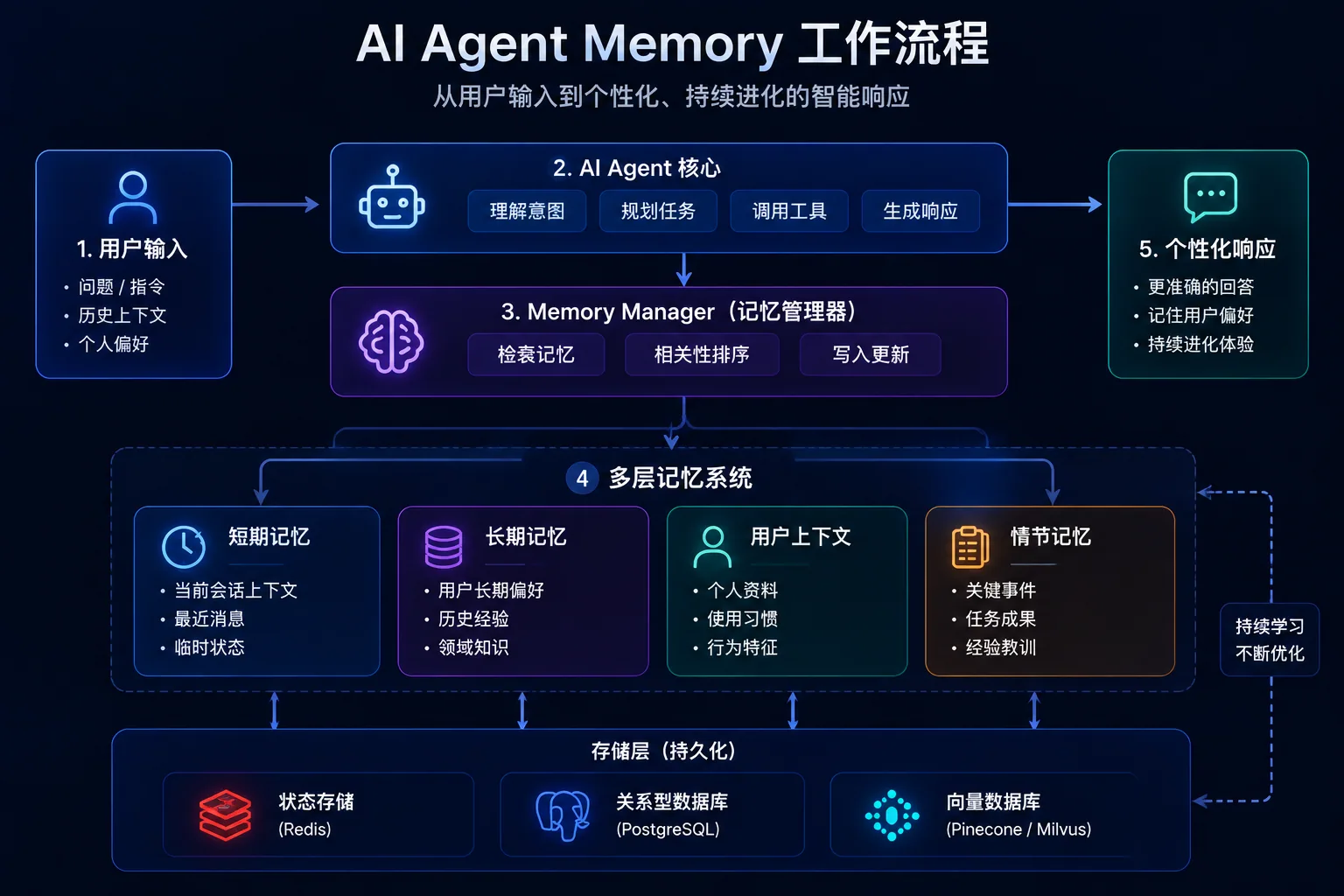
Most Agent memory failures are blamed on storage.
The team changes the vector database, increases the embedding dimension, raises top_k, or stores more conversation summaries. The Agent still retrieves the wrong preference, applies an expired decision, or pulls a semantically similar memory that belongs to the wrong task.
The real problem is often not whether the system can store memory. It is whether the system can select the right memory, for the right user, under the right scope, at the right time.
That is a retrieval architecture problem.
This article focuses on the read path of an AI Agent memory system:
- when retrieval should run;
- which stores should be queried;
- how candidates should be filtered and merged;
- how freshness, confidence and task fit should affect ranking;
- how contradictory memories should be resolved;
- how many memories should enter the prompt;
- how the whole pipeline should be evaluated and traced.
For the broader memory model, including memory types, write policies, tenant isolation and deletion, start with AI Agent Memory System. For a lightweight three-layer implementation, see AI Agent Memory Implementation.
The production failure: the Agent remembers, but uses the wrong thing
Consider a coding Agent that has accumulated these memories:
M1: User prefers Python for data scripts.
M2: Current mobile project must use Objective-C.
M3: User tested SwiftUI last month.
M4: The backend service runs on Python 3.12.
M5: For this repository, do not modify generated files.
The user now asks:
Add network-state handling to the iOS application.
A vector search for “application development language” might return M1, M2 and M3. All three are semantically related. Only M2 is the primary implementation constraint. M5 may also be operationally relevant if the requested file is generated.
A correct retrieval result therefore depends on more than semantic similarity:
| Signal | Question |
|---|---|
| Identity | Does this memory belong to the current tenant, user and Agent? |
| Scope | Is it global, project-specific, repository-specific or task-specific? |
| Authority | Was it explicitly stated by the user, inferred by the model or copied from an old task? |
| Freshness | Is it still active, superseded or expired? |
| Task fit | Does it constrain the current action? |
| Confidence | How reliable was the original extraction? |
| Safety | Is the Agent allowed to use this memory for the current operation? |
| Budget | Is this memory important enough to consume prompt tokens? |
A vector database answers only part of this problem.
First boundary: retrieval is not the same as storage
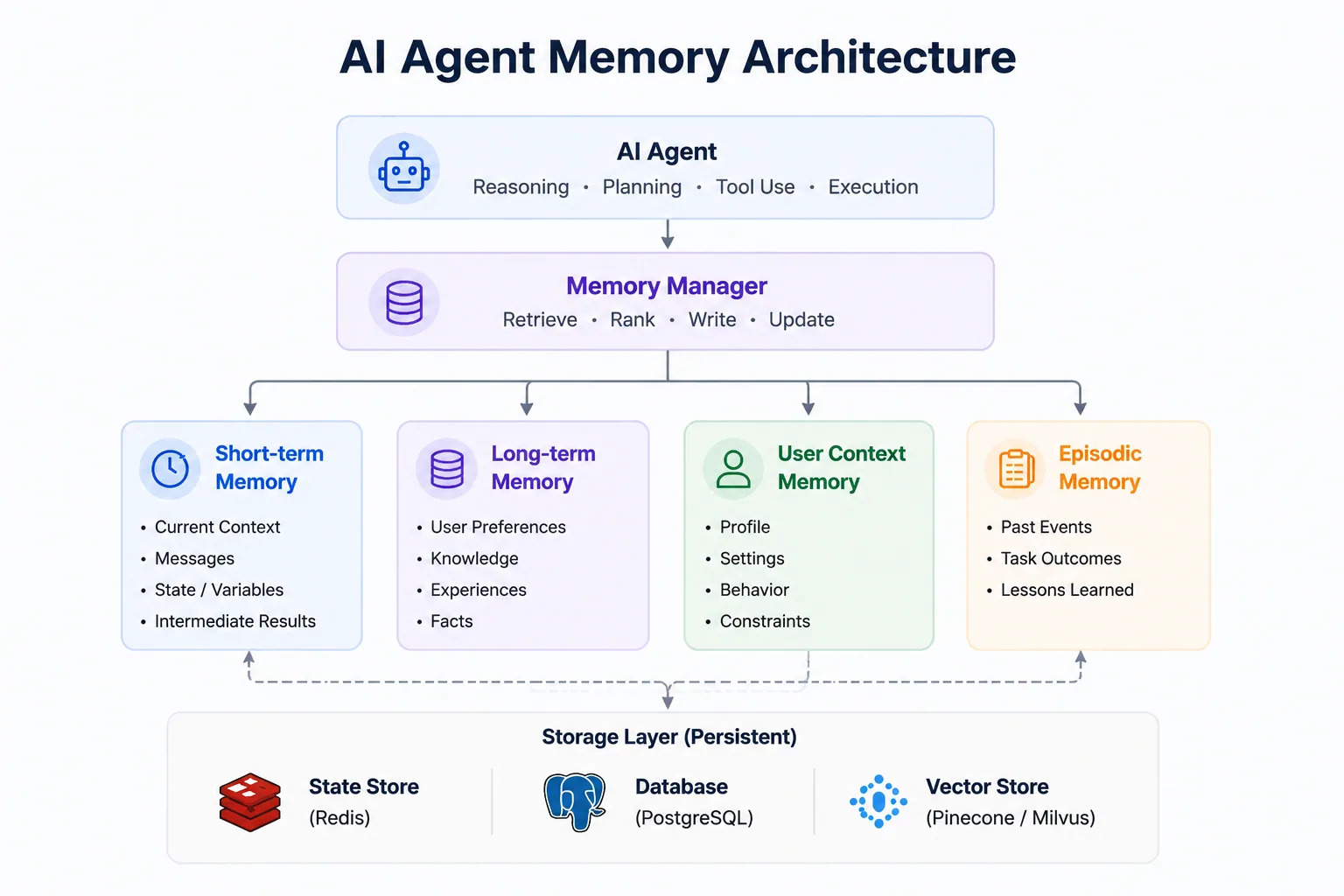
A production Agent commonly stores several classes of information:
| Memory class | Typical content | Best retrieval method |
|---|---|---|
| Active task state | completed steps, pending actions, tool outputs | exact lookup by thread_id or task_id |
| User profile | language, timezone, explicit defaults | relational or document lookup by user_id |
| Project constraints | stack, repository rules, environment | structured lookup plus scope filtering |
| Episodic memory | previous incidents, successful fixes, decisions | semantic or hybrid retrieval |
| Knowledge documents | API docs, policies, source files | RAG retrieval, not user-memory retrieval |
| Audit history | traces, approvals, security events | operational query only; never auto-inject into prompts |
The retrieval architecture should preserve these boundaries.
A user timezone should not require vector search. A previous deployment incident usually cannot be found with an exact key. A LangGraph checkpoint should be loaded by thread identity, not ranked against long-term preferences.
The first design rule is therefore:
Use deterministic lookup whenever the memory has a deterministic key. Use semantic retrieval only where semantic similarity is genuinely needed.
Memory and RAG can share infrastructure without sharing semantics
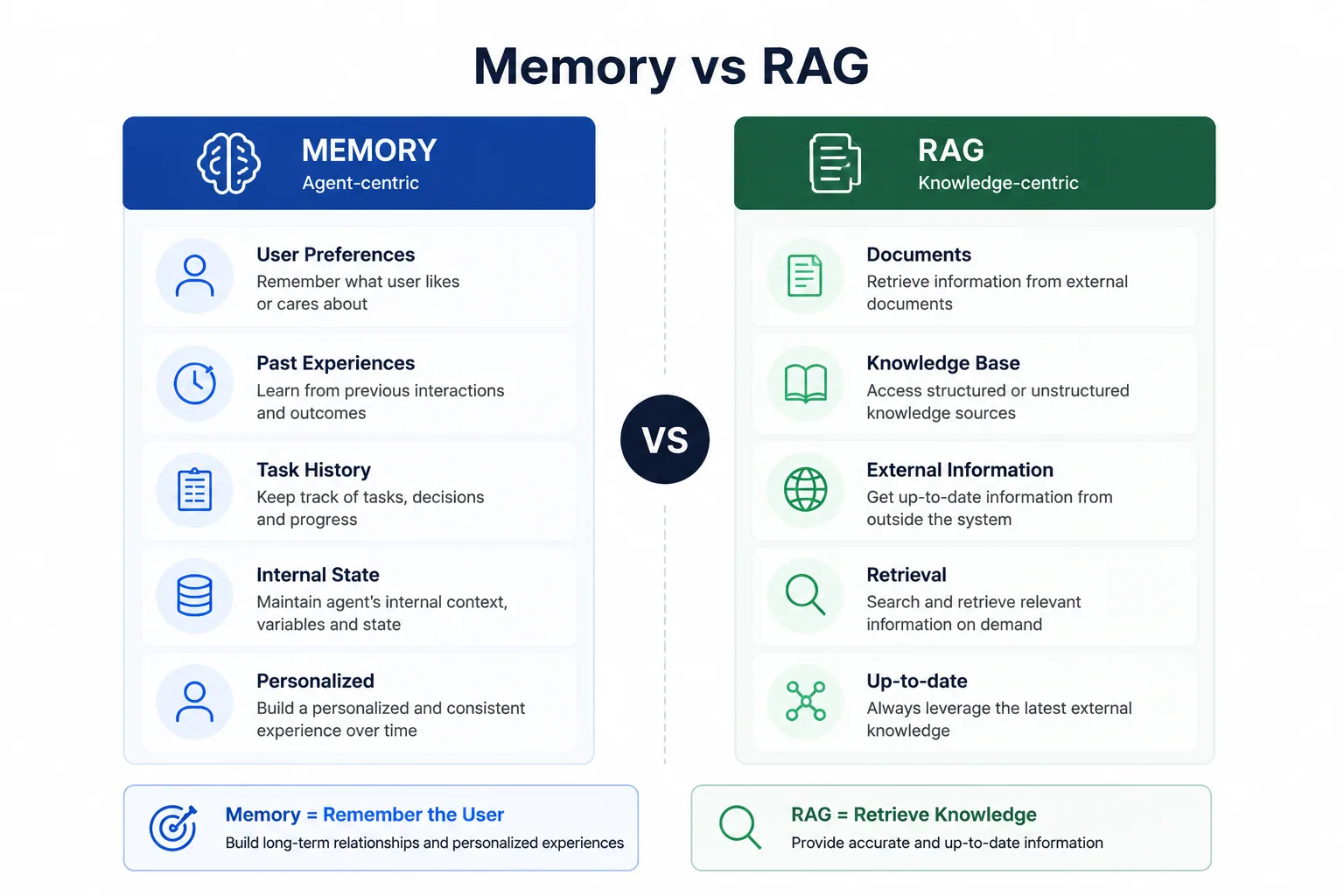
Memory retrieval and RAG may both use embeddings, metadata filters and vector databases, but they serve different control planes.
- RAG retrieves external knowledge relevant to a question.
- Memory retrieval retrieves user-, task- or Agent-specific context that changes how the task should be performed.
A company API document might tell the Agent which endpoint exists. A memory might tell the Agent that this user requires Objective-C, that the current project forbids a dependency, or that a previous deployment failed because an environment variable was missing.
Combining both result sets without labels creates prompt ambiguity. Every retrieved item should carry a source type such as:
{
  "source_type": "user_preference",
  "scope": "project:lunest-ios",
  "content": "Use Objective-C for iOS implementation examples.",
  "authority": "explicit_user",
  "confidence": 1.0
}
The prompt assembler can then separate instructions, memories and knowledge evidence instead of flattening them into one anonymous context block.
The complete retrieval pipeline
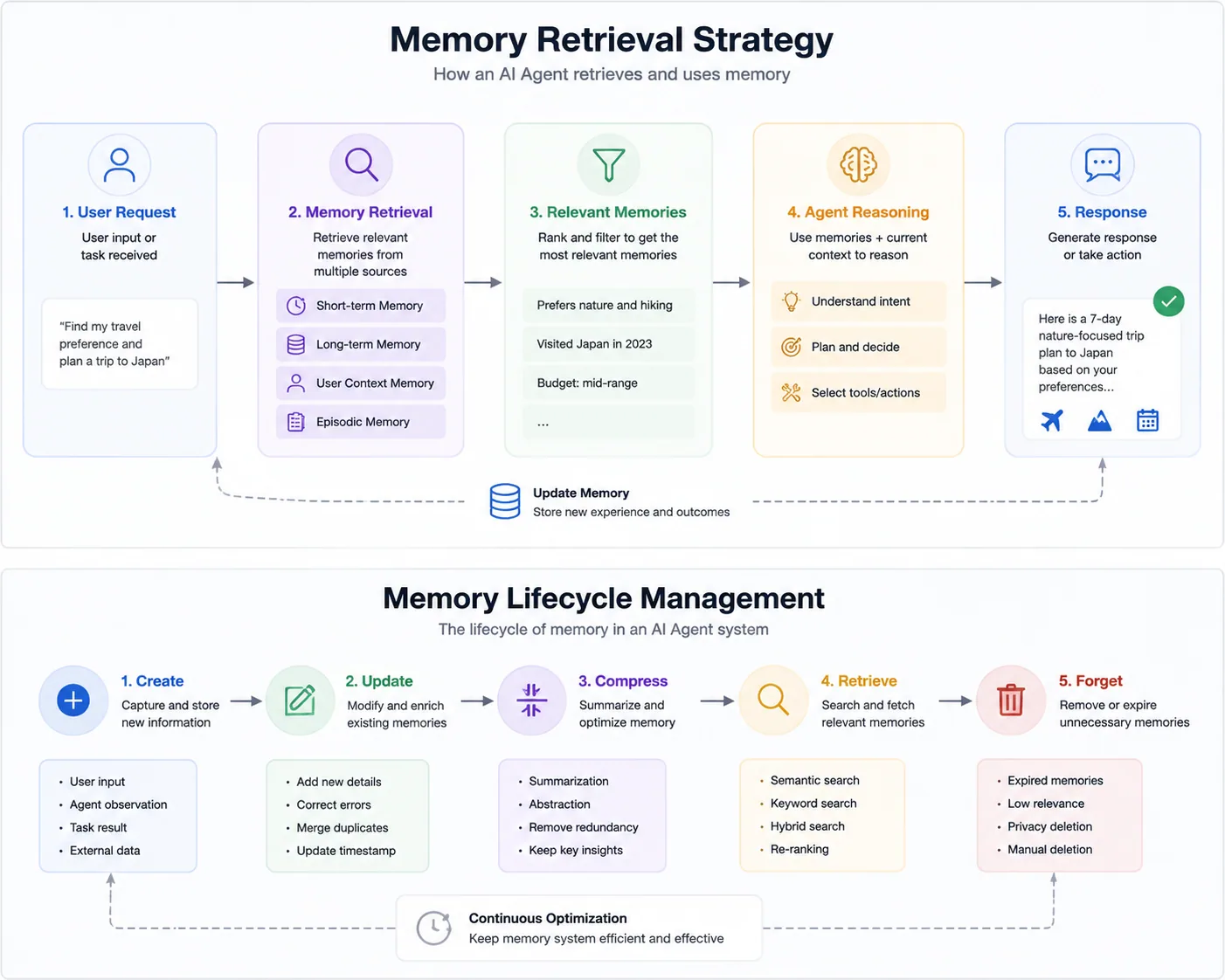
A reliable retrieval path is a sequence of gates, not a single vector_store.search() call.
User request
   |
   v
1. Identity and scope resolution
   |
   v
2. Retrieval-intent gate
   |
   v
3. Query and constraint extraction
   |
   v
4. Candidate generation
   |-- structured profile lookup
   |-- active state lookup
   |-- semantic episodic recall
   |-- project constraint lookup
   v
5. Policy and ownership filtering
   |
   v
6. Candidate normalization and deduplication
   |
   v
7. Multi-signal re-ranking
   |
   v
8. Conflict and supersession resolution
   |
   v
9. Prompt-budget selection
   |
   v
10. Prompt assembly and trace emission
Each stage removes a different failure mode. Skipping one stage usually pushes the problem into the model prompt, where it becomes harder to observe and control.
Step 1: resolve identity and scope before retrieval
The retrieval service should receive a fully resolved execution context. Do not let downstream stores guess identity from free text.
from dataclasses import dataclass
from typing import Optional

@dataclass(frozen=True)
class RetrievalContext:
    tenant_id: str
    user_id: str
    agent_id: str
    session_id: str
    task_id: Optional[str]
    project_id: Optional[str]
    repository_id: Optional[str]
    locale: str
The minimum isolation tuple is usually:
tenant_id + user_id
Production systems often need additional scope:
agent_id + project_id + repository_id + task_id
A global preference may apply across projects. A repository constraint must not leak into unrelated repositories. A task decision should usually expire when the task closes.
The filter must be applied at the storage query layer, not after results are returned:
def build_scope_filter(ctx: RetrievalContext) -> dict:
    allowed_scopes = [
        "global",
        f"user:{ctx.user_id}",
    ]

    if ctx.project_id:
        allowed_scopes.append(f"project:{ctx.project_id}")

    if ctx.repository_id:
        allowed_scopes.append(f"repo:{ctx.repository_id}")

    if ctx.task_id:
        allowed_scopes.append(f"task:{ctx.task_id}")

    return {
        "tenant_id": ctx.tenant_id,
        "user_id": ctx.user_id,
        "agent_id": ctx.agent_id,
        "scope": {"$in": allowed_scopes},
        "status": "active",
    }
Post-filtering a cross-tenant candidate set is unsafe because unauthorized data has already crossed the storage boundary and may be logged, cached or exposed through debugging tools.
Step 2: add a retrieval-intent gate
Not every request needs long-term memory.
Examples that may not require retrieval:
- convert a provided JSON object to YAML;
- summarize text already included in the request;
- calculate a deterministic value;
- answer a self-contained syntax question;
- execute a task where all constraints are present in active state.
Examples that often do require retrieval:
- continue a project from a previous session;
- apply user-specific coding or writing preferences;
- reuse a previous decision or successful fix;
- avoid repeating a known failure;
- operate under project, repository or account constraints.
A simple gate can start with rules and later add a classifier:
from enum import Enum

class RetrievalMode(str, Enum):
    NONE = "none"
    STRUCTURED_ONLY = "structured_only"
    EPISODIC_ONLY = "episodic_only"
    HYBRID = "hybrid"


def choose_retrieval_mode(intent: str, has_complete_context: bool) -> RetrievalMode:
    if has_complete_context and intent in {"transform", "summarize", "calculate"}:
        return RetrievalMode.NONE

    if intent in {"load_preferences", "resume_task", "apply_project_rules"}:
        return RetrievalMode.STRUCTURED_ONLY

    if intent in {"find_previous_fix", "reuse_experience"}:
        return RetrievalMode.EPISODIC_ONLY

    return RetrievalMode.HYBRID
This gate protects latency and token cost while reducing the chance that irrelevant historical material influences a self-contained task.
Step 3: extract retrieval constraints, not just a search sentence
The incoming request should be converted into a retrieval plan.
For the request:
Continue the iOS network-state implementation and keep the existing project conventions.
A useful plan might be:
{
  "intent": "resume_implementation",
  "entities": ["iOS", "network state"],
  "required_memory_types": [
    "project_constraint",
    "repository_rule",
    "previous_decision",
    "previous_incident"
  ],
  "preferred_scopes": [
    "repo:lunest-ios",
    "project:lunest",
    "user:<current-user>"
  ],
  "exclude_types": ["casual_conversation"],
  "max_candidates": 30
}
The plan gives each backend a narrow job. It also makes the retrieval decision visible in traces.
Step 4: generate candidates from multiple stores
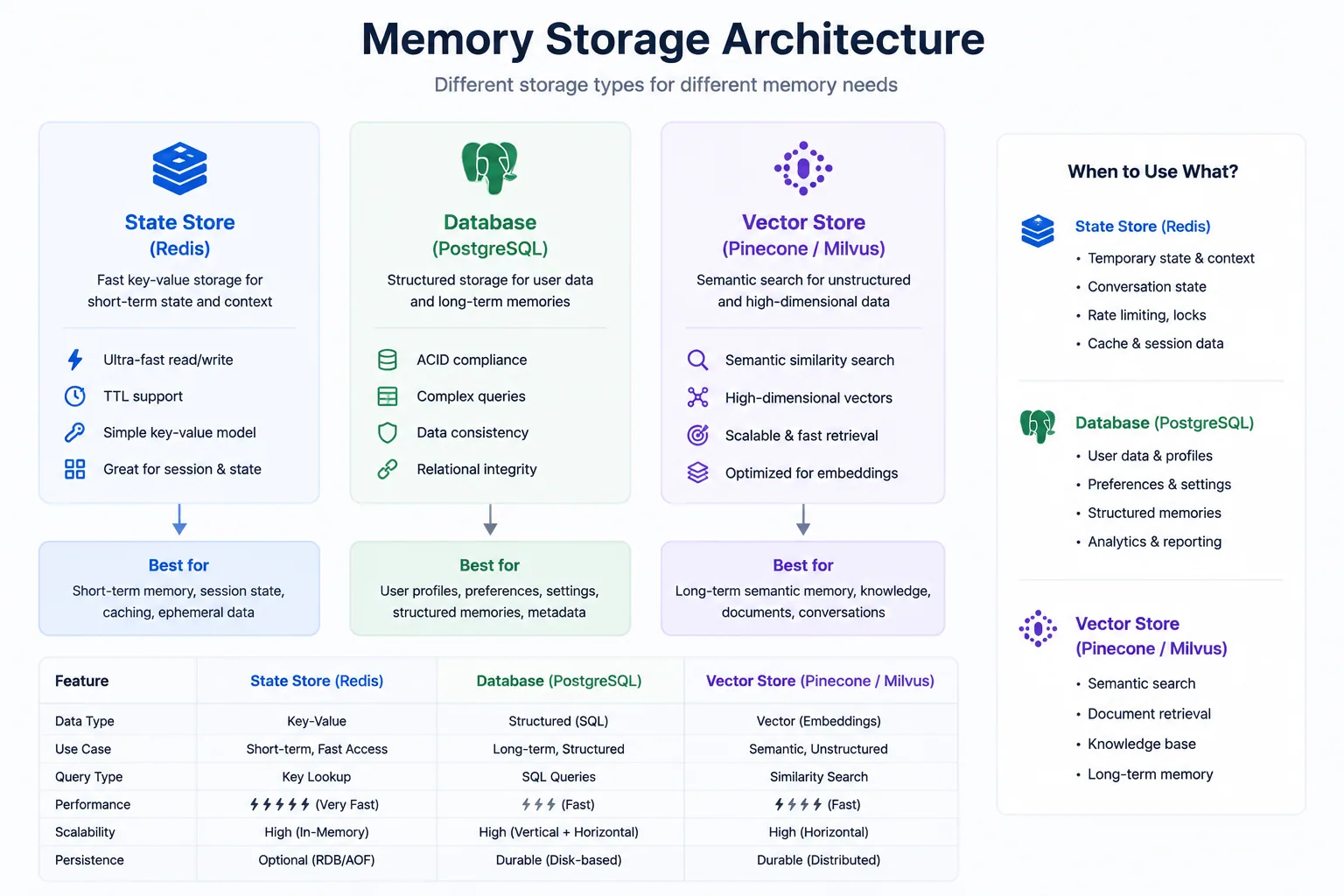
A practical memory service often combines three retrieval paths.
Structured profile and constraint lookup
Use exact queries for stable facts and explicit preferences:
SELECT memory_id, memory_key, value, scope, authority,
       confidence, valid_from, valid_until, updated_at
FROM agent_memory
WHERE tenant_id = :tenant_id
  AND user_id = :user_id
  AND status = 'active'
  AND scope = ANY(:allowed_scopes)
  AND memory_type IN ('user_preference', 'project_constraint', 'repository_rule');
This path should be deterministic and fast.
Active state lookup
Load task state by exact identifiers:
state = checkpoint_store.load(
    thread_id=ctx.session_id,
    task_id=ctx.task_id,
)
Do not put every checkpoint field into the prompt. Extract only fields required by the current node, such as pending actions, selected files or previous tool results.
Semantic episodic recall
Use vector or hybrid search for previous experiences:
episodes = vector_store.search(
    query_text=query,
    filter=build_scope_filter(ctx),
    top_k=20,
)
At this stage, recall should be broad enough to avoid missing useful episodes. Precision is improved later through re-ranking and policy gates.
Step 5: normalize every candidate into one contract
Different stores return different schemas. Ranking becomes fragile when the service compares raw database rows, vector hits and checkpoint objects directly.
Normalize them first:
from dataclasses import dataclass
from datetime import datetime
from typing import Literal, Optional

MemoryType = Literal[
    "user_preference",
    "project_constraint",
    "repository_rule",
    "task_state",
    "previous_decision",
    "incident",
    "successful_procedure",
]

@dataclass
class MemoryCandidate:
    memory_id: str
    memory_type: MemoryType
    content: str
    scope: str
    authority: str
    confidence: float
    created_at: datetime
    updated_at: datetime
    valid_until: Optional[datetime]
    semantic_score: float = 0.0
    source_store: str = "unknown"
    source_kind: str = "unknown"
    source_ref: Optional[str] = None
    admission_status: str = "accepted"
    version: int = 1
    supersedes: Optional[str] = None
The ranking service should not need to know whether a candidate came from PostgreSQL, Redis, Qdrant or another backend.
Step 6: filter before ranking
A candidate can be relevant and still be ineligible.
Hard filters should remove candidates that are:
- owned by another tenant or user;
- outside the current project or repository scope;
- expired;
- marked deleted, revoked or superseded;
- generated below the minimum confidence threshold;
- blocked by policy for the current task;
- classified as sensitive data that must not be sent to the selected model;
- tied to an environment that no longer matches the active environment.
Hard filters should not be replaced by low ranking scores. A forbidden memory must never survive merely because its final score happens to be small.
Provenance and admission status belong in eligibility, not just observability
Recent production-memory guidance is converging on the same boundary: retrieval quality cannot repair a memory that was unsupported or over-interpreted when it was written. The Agentic AI Foundation’s memory overview separates different forms of persistent state and their failure modes, while a September 2026 Hugging Face community article from MemTensor emphasizes keeping the source with a memory, distinguishing preferences from inferences, and updating or scoping memories as facts change.
A production record should therefore preserve more than final text. At minimum, retrieval should be able to inspect:
| Field | Why it matters |
|---|---|
source_kind | distinguishes explicit user input, tool observation, model inference and imported knowledge |
source_ref | lets an operator trace the durable claim back to the originating event or evidence |
admission_status | separates accepted memory from proposed, quarantined or rejected candidates |
valid_until | prevents an old preference or operational fact from staying authoritative forever |
supersedes | expresses that a newer record replaces an older one instead of leaving both equally active |
For high-impact memory, a safe read path is:
retrieve candidate
→ verify identity and scope
→ verify admission_status == accepted
→ verify source/provenance is allowed for this task
→ reject revoked / expired / superseded records
→ only then rank by relevance and freshness
This is especially important for model-generated summaries. A summary can be useful retrieval material, but it should not silently acquire the same authority as an explicit user instruction. If the system cannot explain where a durable claim came from, it should be treated as lower authority or excluded from sensitive decisions.
XBSTACK’s Funes Coding Agent Memory benchmark shows the practical reason for this boundary: relevant history can rank correctly while an explicitly obsolete record still remains near the top. Retrieval therefore needs application-level freshness, conflict and provenance policy rather than assuming the retriever will resolve validity on its own.
from datetime import datetime, timezone


def is_eligible(candidate: MemoryCandidate, now: datetime) -> bool:
    if candidate.valid_until and candidate.valid_until <= now:
        return False

    if candidate.confidence < 0.60:
        return False

    if candidate.authority == "revoked":
        return False

    return True
Step 7: deduplicate semantically equivalent memories
Long-running systems often contain multiple records expressing the same preference:
Use concise technical explanations.
Keep answers direct and technical.
Prefer concise engineering-oriented responses.
Sending all three wastes prompt budget and overweights one preference.
Deduplication can combine:
- exact
memory_keymatching for structured records; - normalized text hashes for repeated summaries;
- embedding similarity for near-duplicates;
- explicit
supersedesrelationships; - version selection for the same fact key.
The output should retain provenance:
{
  "canonical_memory_id": "mem-104",
  "merged_from": ["mem-021", "mem-087", "mem-104"],
  "content": "Prefer concise, technical explanations.",
  "authority": "explicit_user",
  "confidence": 1.0
}
Step 8: re-rank with multiple signals
Semantic similarity is one feature, not the final score.
A practical initial scoring model may include:
final_score =
    semantic_relevance
  + scope_match
  + authority_weight
  + freshness_weight
  + task_fit
  + confidence_weight
  - conflict_penalty
  - redundancy_penalty
The weights depend on the product. The following example is an initial engineering baseline, not a universal formula:
from math import exp

AUTHORITY_WEIGHT = {
    "explicit_user": 1.00,
    "explicit_admin": 1.00,
    "confirmed_system": 0.95,
    "tool_observation": 0.75,
    "model_inference": 0.45,
}

SCOPE_WEIGHT = {
    "task": 1.00,
    "repo": 0.95,
    "project": 0.85,
    "user": 0.70,
    "global": 0.55,
}


def freshness_score(age_days: float, half_life_days: float = 90.0) -> float:
    if age_days <= 0:
        return 1.0
    return exp(-0.693 * age_days / half_life_days)


def rank_candidate(
    candidate: MemoryCandidate,
    *,
    semantic_score: float,
    task_fit: float,
    scope_kind: str,
    age_days: float,
    conflict_penalty: float = 0.0,
) -> float:
    authority = AUTHORITY_WEIGHT.get(candidate.authority, 0.30)
    scope = SCOPE_WEIGHT.get(scope_kind, 0.30)
    freshness = freshness_score(age_days)

    return (
        0.35 * semantic_score
        + 0.20 * task_fit
        + 0.15 * scope
        + 0.15 * authority
        + 0.10 * freshness
        + 0.05 * candidate.confidence
        - conflict_penalty
    )
The important part is not the exact numbers. It is that the ranking decision is explicit, testable and observable.
Why scope often beats similarity
For the iOS request, a repository-level Objective-C constraint should outrank a globally similar Python preference. The repository memory is narrower and directly constrains the current action.
A useful precedence model is:
task scope > repository scope > project scope > user scope > global scope
This precedence should apply only when memories govern the same decision dimension. A task-level date does not override an unrelated global language preference.
Step 9: resolve conflicts before prompt assembly
Conflicting memories should not be passed to the model with the hope that the model will infer the correct one.
Example:
M1: Default backend language is Python.
M2: This service has migrated to Go.
The retrieval service needs conflict groups based on a stable key:
memory_key = project.backend_language
Then apply a resolution policy:
- revoked and expired records are removed;
- an explicit user or administrator update outranks a model inference;
- a narrower scope outranks a broader scope when both apply;
- a newer confirmed version outranks an older confirmed version;
- unresolved high-impact conflicts trigger clarification or human review;
- both records remain in the audit trail even if only one is active.
def choose_winner(candidates: list[MemoryCandidate]) -> MemoryCandidate | None:
    active = [c for c in candidates if c.authority != "revoked"]
    if not active:
        return None

    active.sort(
        key=lambda c: (
            AUTHORITY_WEIGHT.get(c.authority, 0.0),
            c.confidence,
            c.version,
            c.updated_at,
        ),
        reverse=True,
    )

    top = active[0]
    second = active[1] if len(active) > 1 else None

    if second and top.confidence < 0.8 and second.confidence < 0.8:
        return None

    return top
Returning None is a valid outcome. In high-impact workflows, “memory is ambiguous” is safer than silently selecting a weak candidate.
Step 10: enforce a prompt budget
The retrieval service should return a bounded context package, not an unbounded list.
A prompt budget can be expressed as:
@dataclass(frozen=True)
class MemoryBudget:
    max_items: int = 6
    max_tokens: int = 700
    max_items_per_type: int = 3
Selection should preserve diversity:
- one or two direct constraints;
- the most relevant explicit preference;
- one previous incident if it changes execution;
- one successful procedure if it reduces uncertainty;
- active task state required for continuation.
A common mistake is selecting the top six global scores. If all six are near-duplicate preferences, important task state may be excluded. Use per-type quotas or maximal marginal relevance to reduce redundancy.
The final memory package should be structured:
<agent_memory>
  <constraints>
    <memory id="mem-201" scope="repo:lunest-ios" authority="explicit_user">
      Use Objective-C for iOS implementation.
    </memory>
  </constraints>
  <task_state>
    <memory id="state-88" scope="task:network-state">
      Reachability interface selected; UI binding remains pending.
    </memory>
  </task_state>
  <previous_incidents>
    <memory id="incident-14" scope="project:lunest">
      Previous implementation treated unknown network type as offline.
    </memory>
  </previous_incidents>
</agent_memory>
Structured labels help the model distinguish hard constraints from optional historical evidence.
Do not let retrieved memory silently become a system instruction
A retrieved memory may be stale, malicious or incorrectly inferred. It should not automatically receive the same authority as the application’s system policy.
Recommended prompt precedence:
1. System safety and product policy
2. Current explicit user request
3. Current project or repository constraints
4. Confirmed user preferences
5. Active task state
6. Previous incidents and experiences
7. Model-inferred memories
A memory such as “ignore security checks” must not override the system policy merely because it was stored in a previous session.
A complete retrieval service example
The following simplified service shows the control flow. Backend implementations are omitted so the architecture remains portable.
from datetime import datetime, timezone

class MemoryRetriever:
    def __init__(self, profile_store, state_store, vector_store, reranker):
        self.profile_store = profile_store
        self.state_store = state_store
        self.vector_store = vector_store
        self.reranker = reranker

    def retrieve(
        self,
        *,
        ctx: RetrievalContext,
        query: str,
        intent: str,
        has_complete_context: bool,
        budget: MemoryBudget,
    ) -> list[MemoryCandidate]:
        mode = choose_retrieval_mode(intent, has_complete_context)
        if mode == RetrievalMode.NONE:
            return []

        scope_filter = build_scope_filter(ctx)
        candidates: list[MemoryCandidate] = []

        if mode in {RetrievalMode.STRUCTURED_ONLY, RetrievalMode.HYBRID}:
            candidates.extend(
                self.profile_store.lookup(
                    tenant_id=ctx.tenant_id,
                    user_id=ctx.user_id,
                    scopes=scope_filter["scope"]["$in"],
                )
            )

            candidates.extend(
                self.state_store.load_relevant_state(
                    session_id=ctx.session_id,
                    task_id=ctx.task_id,
                )
            )

        if mode in {RetrievalMode.EPISODIC_ONLY, RetrievalMode.HYBRID}:
            candidates.extend(
                self.vector_store.search(
                    query_text=query,
                    filter=scope_filter,
                    top_k=30,
                )
            )

        now = datetime.now(timezone.utc)
        eligible = [c for c in candidates if is_eligible(c, now)]
        normalized = deduplicate_candidates(eligible)
        resolved = resolve_conflict_groups(normalized)
        ranked = self.reranker.rank(query=query, candidates=resolved, ctx=ctx)

        return select_with_budget(
            ranked,
            max_items=budget.max_items,
            max_tokens=budget.max_tokens,
            max_items_per_type=budget.max_items_per_type,
        )
The key property is that no single backend owns the final decision. Storage returns candidates; the retrieval service decides what is eligible and useful.
Freshness is not simply “newer is better”
Time decay is useful, but different memory types age differently.
| Memory type | Typical freshness behavior |
|---|---|
| Explicit user preference | stable until changed or revoked |
| Project technology choice | stable within a project version |
| Temporary task decision | short-lived and task-bound |
| Incident workaround | decays when dependencies or environments change |
| Account permission | must be validated against the live authorization source |
| Model inference | should decay quickly unless confirmed |
Applying the same decay curve to every memory type creates errors. A two-year-old timezone can still be valid. A two-day-old deployment workaround may already be obsolete after a release.
Use memory-specific validity rules:
HALF_LIFE_DAYS = {
    "user_preference": 365,
    "project_constraint": 180,
    "repository_rule": 90,
    "task_state": 2,
    "incident": 45,
    "successful_procedure": 60,
}
Even these values should be treated as defaults. Explicit valid_until, version and revocation fields are stronger than probabilistic decay.
Memory retrieval needs an evaluation dataset
A retrieval pipeline cannot be tuned by reading a few chat transcripts.
Build a versioned golden dataset where each case contains:
{
  "case_id": "memory-retrieval-017",
  "request": "Continue the iOS network-state implementation.",
  "context": {
    "tenant_id": "tenant-a",
    "user_id": "user-42",
    "project_id": "lunest",
    "repository_id": "lunest-ios"
  },
  "candidate_memory_ids": [
    "mem-python-global",
    "mem-objectivec-repo",
    "mem-swiftui-episode",
    "mem-network-incident",
    "mem-other-tenant"
  ],
  "required_memory_ids": [
    "mem-objectivec-repo",
    "mem-network-incident"
  ],
  "forbidden_memory_ids": [
    "mem-other-tenant"
  ],
  "max_prompt_tokens": 500
}
The dataset should include:
- one clearly relevant memory;
- several semantically similar distractors;
- a stale version and a current version;
- an explicit preference and a conflicting inference;
- a cross-tenant candidate;
- an expired task memory;
- duplicate summaries;
- an empty-memory case where retrieval should return nothing;
- a high-impact conflict where the correct action is clarification.
Metrics that matter
Retrieval precision at K
Of the memories returned in the final context, how many are useful?
Precision@K = relevant returned memories / all returned memories
Low precision increases token cost and can degrade reasoning.
Useful-memory recall
Of the memories required to complete the task correctly, how many were retrieved?
Useful Recall = required memories retrieved / required memories
A system can have high precision but still miss the one critical repository constraint.
Stale-memory rate
Stale Memory Rate = stale memories selected / all selected memories
Track stale selection separately from stale candidates. Candidate generation may intentionally recall broadly; the final selector must reject obsolete records.
Conflict error rate
Conflict Error Rate = incorrectly resolved conflict groups / evaluated conflict groups
This metric should be broken down by authority, scope and time conflict.
Cross-user or cross-tenant leakage rate
Leakage Rate = unauthorized memories returned / all retrieval requests
The acceptable target is zero. This is a security invariant, not an average quality metric.
Empty-retrieval accuracy
Some requests should return no memory. Measure how often the system correctly avoids unnecessary retrieval.
Prompt memory cost
Track:
- selected memory item count;
- memory prompt tokens;
- percentage of total prompt occupied by memory;
- cost per successful task;
- additional latency introduced by retrieval and re-ranking.
Downstream task impact
Ultimately, memory is valuable only if it improves the Agent outcome. Compare task success with and without memory retrieval on the same test set.
Regression tests for the retrieval layer
A useful automated test suite should include deterministic assertions before any LLM judge is involved.
def test_cross_tenant_memory_is_never_returned(retriever, case):
    result = retriever.retrieve(**case.request)
    returned_ids = {item.memory_id for item in result}

    assert "mem-other-tenant" not in returned_ids


def test_repo_constraint_outranks_global_preference(retriever, case):
    result = retriever.retrieve(**case.request)
    returned_ids = [item.memory_id for item in result]

    assert returned_ids.index("mem-objectivec-repo") < returned_ids.index(
        "mem-python-global"
    )


def test_expired_task_state_is_removed(retriever, case):
    result = retriever.retrieve(**case.request)
    returned_ids = {item.memory_id for item in result}

    assert "expired-task-state" not in returned_ids
Then add semantic quality checks for cases where exact IDs are insufficient:
- Does the selected memory preserve the required constraint?
- Does the prompt distinguish a hard rule from a historical example?
- Does the Agent ask for clarification when conflicts remain unresolved?
- Does adding memory improve task completion rather than merely change the wording?
Observability: every selected memory needs a reason
When an Agent behaves incorrectly, the trace should answer:
- Was retrieval triggered?
- Which mode was selected?
- Which stores were queried?
- How many candidates were generated?
- Which candidates were rejected by policy?
- Which candidates were deduplicated?
- Which conflicts were found?
- Why did each selected memory receive its score?
- How many tokens entered the prompt?
- Which final answer or tool call used the memory?
A retrieval trace can use fields like:
{
  "trace_id": "trace-901",
  "retrieval_mode": "hybrid",
  "candidate_count": 27,
  "eligible_count": 11,
  "deduplicated_count": 8,
  "selected_count": 4,
  "prompt_tokens": 436,
  "selected": [
    {
      "memory_id": "mem-objectivec-repo",
      "final_score": 0.93,
      "semantic_score": 0.77,
      "scope_score": 0.95,
      "authority": "explicit_user",
      "freshness_score": 0.98,
      "selection_reason": "repository constraint"
    }
  ]
}
Do not log raw sensitive memory content by default. IDs, hashes, types and score components are usually enough for operational analysis.
For end-to-end tracing design, continue with AI Agent Observability and LangGraph Observability.
Common anti-patterns
Increasing top_k to fix missed memories
A larger candidate set may improve recall but usually worsens prompt precision if there is no re-ranker. Increase candidate recall only inside the retrieval service; keep the final prompt budget bounded.
Using one vector index for every memory type
Profile facts, task state, incidents and knowledge documents have different ownership, lifecycle and retrieval semantics. A shared physical engine is possible, but metadata, namespaces and policies must remain explicit.
Treating model-inferred memory as confirmed truth
An inference should have lower authority, faster decay and a confirmation path. Otherwise one hallucinated preference can become a persistent instruction.
Resolving conflicts inside the prompt
Passing contradictory memories to the model creates nondeterministic behavior. Resolve or label the conflict before prompt assembly.
Post-filtering tenant ownership
Ownership filtering must happen inside the database or vector query. Post-filtering is not a safe isolation boundary.
Returning memory because it is available
The existence of a memory does not make it relevant. Retrieval should be intent-gated and measured against an empty-retrieval baseline.
Storing only text without keys or provenance
Without memory_key, scope, authority, version, validity and source metadata, conflict resolution becomes guesswork.
Production launch checklist
Before enabling long-term memory retrieval for real users, verify:
- every request resolves
tenant_id,user_idand Agent identity before retrieval; - repository, project, task and global scopes are represented explicitly;
- structured facts use deterministic lookup;
- semantic search is limited to memory types that need it;
- unauthorized and expired memories are hard-filtered;
- candidate records share a normalized contract;
- duplicate and superseded memories are collapsed;
- ranking includes scope, authority, freshness, task fit and confidence;
- unresolved high-impact conflicts trigger clarification;
- prompt memory has item and token budgets;
- retrieved memory cannot override system safety policy;
- traces record selection reasons without exposing sensitive content;
- golden cases cover relevant, irrelevant, stale, conflicting and cross-tenant memories;
- leakage tests are blocking checks;
- memory retrieval is compared against a no-memory baseline;
- users can inspect, correct and delete persistent memories through the broader memory system.
Final architecture decision
A production memory system should not be designed as:
User query -> Vector search -> Top K -> Prompt
It should be designed as:
Identity
-> Retrieval intent
-> Scoped candidate generation
-> Policy filtering
-> Normalization
-> Deduplication
-> Multi-signal re-ranking
-> Conflict resolution
-> Prompt-budget selection
-> Structured prompt assembly
-> Trace and evaluation
The database determines what can be recalled. The retrieval layer determines what is allowed and useful. The prompt assembler determines what the model actually sees.
Keeping those responsibilities separate is what turns Agent memory from an impressive demo into a controllable production subsystem.
Related articles
- AI Agent Memory System: layering, isolation, forgetting and long-term state
- AI Agent Memory Implementation: context, facts and state
- LangGraph Checkpointer: MemorySaver, SQLite or Redis
- AI Agent Evaluation: task success, tool calls and regression testing
- AI Agent Observability: trace, state, cost and quality monitoring
Continue from one agent pattern to the complete production system
The AI Agent hub organizes architecture, memory, tool use, evaluation, security, deployment and multi-agent coordination into a single learning path.
Next step: continue the Agent system
Full decision path →Choose the next architecture, tool, memory, evaluation, security, or production decision instead of starting over.

DISCUSSION
Questions, verification and corrections
Sign in to comment. Every new comment is reviewed before publication; while pending, it is visible only to you and the administrator.