


Xiaobai
Developer · Builder
Building AI engineering systems, developer tools and long-term digital assets at XBSTACK.
About Xiaobai & XBSTACK →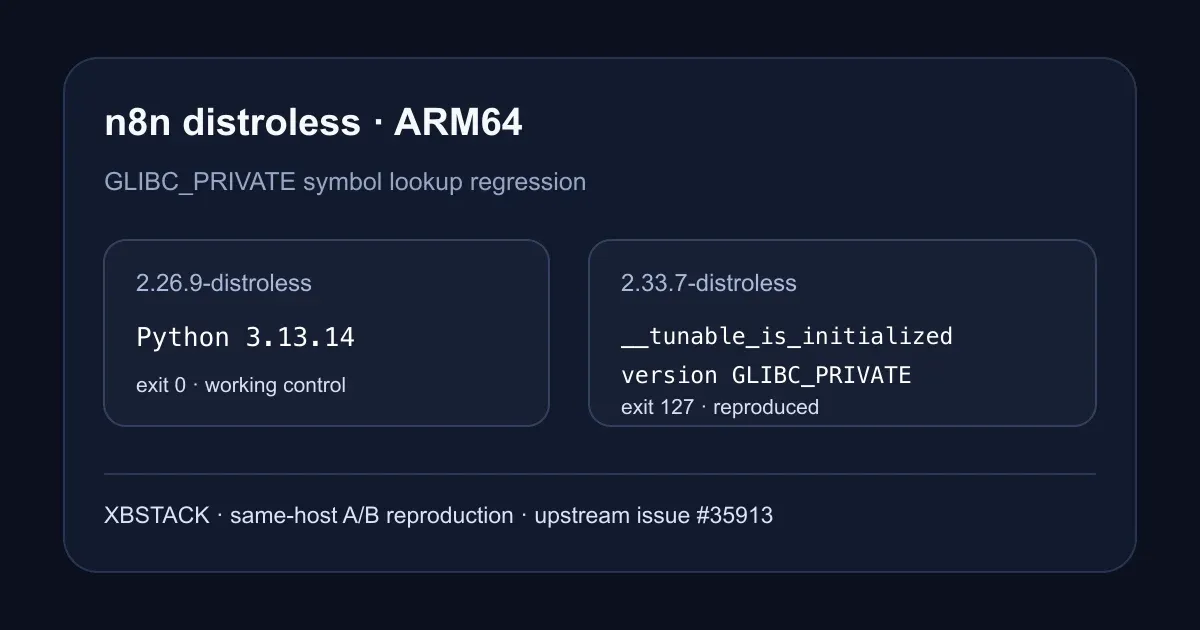
n8n 2.33.7 Distroless ARM64 GLIBC_PRIVATE Error: Reproduction and Workaround
n8n 2.33.7 distroless on ARM64 exits 127 with __tunable_is_initialized / GLIBC_PRIVATE. Compare 2.26.9, the Dockerfile ABI boundary, and a verified rollback workaround.
n8n 2.33.7 Distroless ARM64 GLIBC_PRIVATE Error: Reproduction and Workaround
If you upgrade the n8n distroless task runner to n8nio/runners:2.33.7-distroless, the Python runner can exit on ARM64 before any workflow logic runs. The failure looks like this:
/opt/runners/task-runner-python/.venv/bin/python: symbol lookup error: /lib/aarch64-linux-gnu/libc.so.6: undefined symbol: __tunable_is_initialized, version GLIBC_PRIVATE
I reduced the problem to a direct image test on Apple Silicon with Docker Desktop. No n8n server, database, model provider, or workflow is required. 2.33.7-distroless consistently exits 127; on the same host, changing only the image tag to 2.26.9-distroless prints Python 3.13.14. That means the first troubleshooting target should be the runner image and its runtime ABI, not a Code node, an AI Agent, or a workflow JSON export.
As of September 14, 2026, the official n8n issue #35913 is still open and has been routed to a team. The linked PR #36166 is also still open and proposes moving the Debian-based runner builder stages from bookworm to trixie / Debian 13 so they match the final distroless runtime. That direction matches the glibc mismatch described upstream, but I am not calling it a verified permanent fix because I have not independently rebuilt the full ARM64 runners image with that PR and passed the same regression test.
Do not confuse this with another Task Runner failure class. If there is no GLIBC_PRIVATE / exit 127 and the Code node instead waits roughly 60/66 seconds before reporting Task request timed out / not matched to a runner, the task is timing out while waiting at the broker for a matching runner. See n8n Code Node Task request timed out: Task Runner troubleshooting for that separate reproduction.
Confirm the failure with one command
On an ARM64 Docker host, run the Python entry point directly:
docker run --rm \
  --entrypoint /opt/runners/task-runner-python/.venv/bin/python \
  n8nio/runners:2.33.7-distroless \
  --version
Observed in this reproduction:
exit 127
/opt/runners/task-runner-python/.venv/bin/python: symbol lookup error: /lib/aarch64-linux-gnu/libc.so.6: undefined symbol: __tunable_is_initialized, version GLIBC_PRIVATE
This check intentionally bypasses workflows, credentials, model providers, databases, and the higher-level launcher path. If the Python executable itself cannot start, rebuilding a workflow or changing an AI node is the wrong first move.
Now run the same entry point against the working control on the same machine:
docker run --rm \
  --entrypoint /opt/runners/task-runner-python/.venv/bin/python \
  n8nio/runners:2.26.9-distroless \
  --version
Observed output:
Python 3.13.14
The measured matrix is therefore narrow and useful:
| Image | ARM64 result | Exit |
|---|---|---|
n8nio/runners:2.26.9-distroless | Python 3.13.14 | 0 |
n8nio/runners:2.33.7-distroless | __tunable_is_initialized, version GLIBC_PRIVATE | 127 |
Derived 2.33.7 image replacing only Debian 13 libc.so.6 | same symbol lookup error | 127 |
Those are the three results this page independently verifies. They do not prove that every 2.33.x release, AMD64 image, or non-distroless build has the same failure.
Why the root-cause boundary points to mixed Debian/glibc generations
Before publishing, I re-read the current upstream docker/images/runners/Dockerfile.distroless. The relevant stages are still effectively:
FROM python:${PYTHON_VERSION}-slim-bookworm AS python-runner-builder
...
FROM debian:bookworm-slim AS runtime-prep
...
COPY /lib/*-linux-gnu* /runtime/usr/lib/
COPY /usr/lib/*-linux-gnu* /runtime/usr/lib/
...
FROM gcr.io/distroless/cc-debian13:latest AS runtime
COPY /runtime/ /
Python and some architecture-specific runtime libraries therefore come from a Debian 12/bookworm builder, while the final base is Debian 13 distroless. Issue #35913 describes the same generation boundary and the same GLIBC_PRIVATE lookup failure.
GLIBC_PRIVATE is also a strong clue: it is not a public stable ABI contract intended for mixing unrelated glibc builds. If a process loads an incompatible set of loader, libc, or related system libraries, it can fail during process startup before Python code executes.
The evidence boundary still matters. This reproduction proves that the published 2.33.7 image fails on the tested ARM64 host and that the Dockerfile mixes Debian generations across build/runtime boundaries. It does not independently prove that one specific copied library is the only root cause.
Replacing only libc.so.6 did not fix it
Because the error names libc.so.6, the obvious temptation is to copy Debian 13’s libc back into the image. I tested that as a narrow diagnostic control: derive from the broken 2.33.7-distroless image, copy Debian 13 libc.so.6 from gcr.io/distroless/cc-debian13, then rerun the exact same Python --version check.
The result did not change:
exit 127
undefined symbol: __tunable_is_initialized, version GLIBC_PRIVATE
That is useful negative evidence. It rules out a simplistic one-file patch as a verified repair. The runtime ABI needs to be treated as a coherent set rather than replacing whichever .so appears in the first error message. Without a full rebuilt image, I am not going to guess which additional loader or system-library files must be aligned.
The complete experiment, logs, machine-readable results, and version matrix are public here:
GitHub: xbstack/n8n-distroless-arm64-glibc-repro
Verified temporary recovery: roll back the runner image
In this ARM64 environment, the only short-term option that has passed the exact same entry-point test is:
n8nio/runners:2.26.9-distroless
If the symbol lookup error appeared only after a runner-image upgrade, a controlled rollback is a reasonable recovery candidate after you back up configuration, verify version-specific feature requirements, and rerun your own workflows.
The trade-off is important: 2.26.9 is older. Pinning it can mean missing later features, bug fixes, or security updates. Treat this as a temporary service-recovery workaround, not a long-term version policy. If your deployment requires functionality introduced after 2.26.9, the rollback may not be acceptable.
What would count as a verified permanent fix?
The upstream issue points toward aligning the Python builder and final distroless runtime on the same Debian generation—for example, moving the Python builder away from slim-bookworm toward a Debian 13-aligned base, or using a final runtime that matches the Debian 12 builder.
That direction is consistent with the ABI evidence, but plausible is not the same as verified. For XBSTACK to mark a permanent fix as tested, I want at least this regression set:
- rebuild the ARM64 runners image from current n8n source, rather than replacing one or two files in the published image;
- rerun the same Python
--versioncommand and see exit 127 become exit 0; - verify
task-runner-launchercan start the Python runner; - confirm the JavaScript runner does not gain a new dynamic-library regression;
- execute at least one real Code/Python workflow end to end;
- map the passing build to an upstream PR or released version.
Until those checks pass, this page calls Debian-generation alignment an upstream fix direction, not a one-line confirmed solution.
Production troubleshooting order
If you are seeing this exact error, use this order:
- run the direct Python entry-point command to see whether the image itself already fails;
- record
uname -mand Docker Server architecture and confirm whether the host is ARM64; - record the exact runner tag instead of saying only “latest”;
- run a known-good image on the same host to separate image regression from host configuration;
- if you need to restore service quickly, evaluate a rollback to a version you have tested instead of copying glibc files by hand;
- follow issue #35913 for a PR/release and rerun the same minimal command before upgrading again.
Do not automatically apply this conclusion if your error occurs in the main n8n server, on AMD64, in a non-distroless runner, or with a different symbol string. Similar libc.so.6 errors can have different causes.
Upstream status and update boundary
As of publication on August 11, 2026:
- n8n issue #35913: Open;
- XBSTACK ARM64 reproduction of the published 2.33.7 image: complete;
- same-host 2.26.9 working control: complete;
- Debian 13
libc.so.6single-file replacement: confirmed insufficient; - full Debian-aligned runners rebuild: not yet completed;
- official fixed release: not yet verified in this environment.
If n8n merges a fix or publishes a new runner image, I will rerun the same ARM64 entry-point regression before changing this page from “reproduction + workaround” to “permanent fix verified.”
Related n8n troubleshooting
- Self-hosted n8n: Docker, VPS, and NAS production baseline
- n8n Baserow parameter dependency regression
- n8n AI workflow error handling, retries, and cost monitoring
- n8n Code node Task request timed out: Task Runner matching diagnosis
- n8n AI Agent not calling Tools
Continue through the production automation path
The workflow hub connects self-hosting, queue mode, webhooks, retries, observability and n8n implementation cases into one production-oriented learning path.
More to Explore
Topic hub →AI Engineering Weekly
Production changes, real failures, experiments and new XBSTACK assets.

DISCUSSION
Questions, verification and corrections
Sign in to comment. Every new comment is reviewed before publication; while pending, it is visible only to you and the administrator.