
Start on the device
Retrieval, indexing and local AI are designed to stay on-device whenever the selected feature supports it.
Recalia
Local AI Personal Memory
Turn your files into AI memory that stays under your control.
Import knowledge, search it and ask questions against your own library. Recalia starts local-first so personal knowledge can become searchable, understandable and traceable back to source material.
No unverified rating, download count, user count or store link is displayed before public release.
Retrieval, indexing and local AI are designed to stay on-device whenever the selected feature supports it.
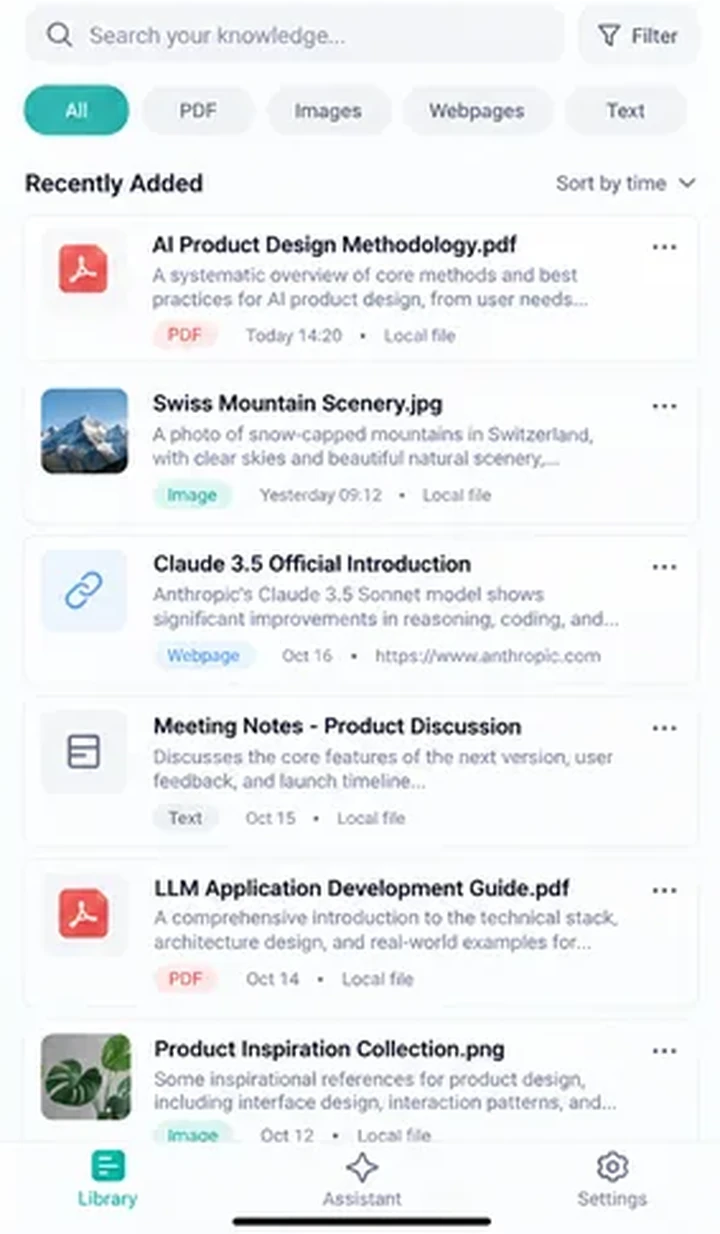
PDFs, Word files, presentations, images and text become one searchable personal library.
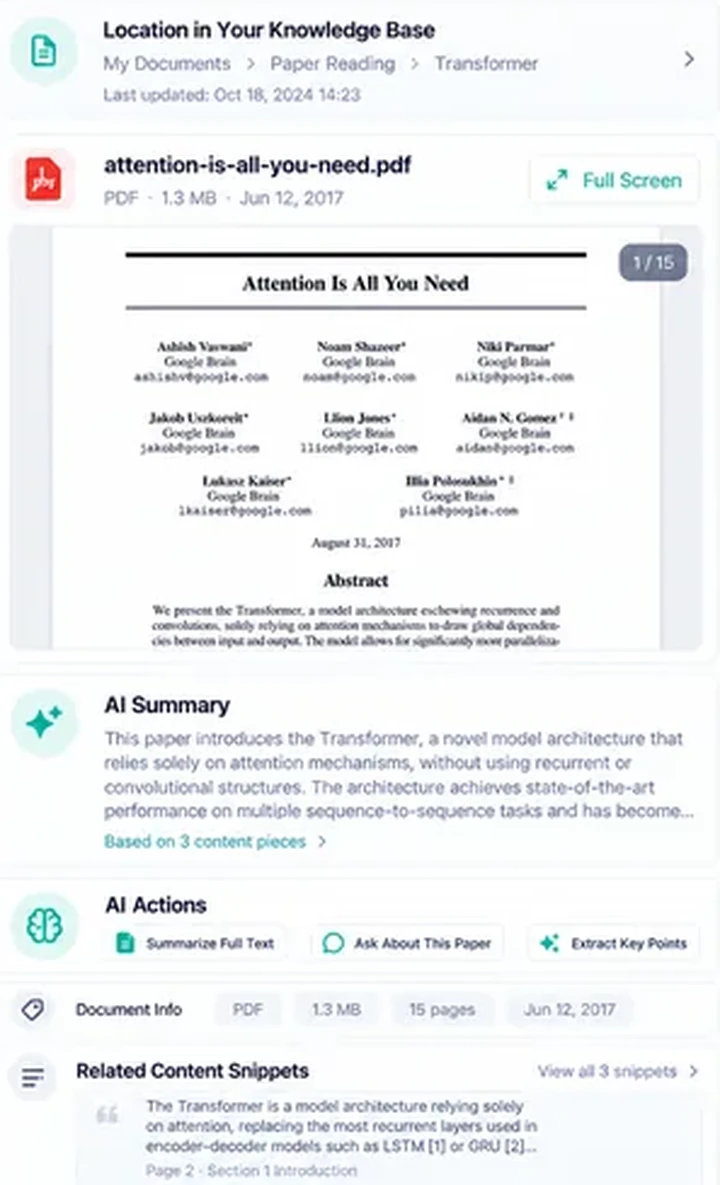
Search and assistant flows keep source evidence visible so you can verify the original material.
Local models, connected models and custom APIs are separate choices rather than hidden network behavior.
From files to memory
Recalia does not require every AI enrichment step to finish before search becomes available. Parsing and full-text indexing make knowledge useful first; embeddings, summaries and tags can improve it in the background.
Bring PDFs, Word files, presentations, images and text into your library.
Parsing and full-text indexing make content searchable before every background AI task is complete.
Embeddings, summaries, tags and image understanding can be added incrementally.
Hybrid retrieval selects evidence before a local or user-selected model generates an answer.
Product preview
These images show the current Recalia product direction. They are interface previews rather than final store screenshots, and release builds may still change.
Keep documents, images, web content and notes in one searchable personal library.
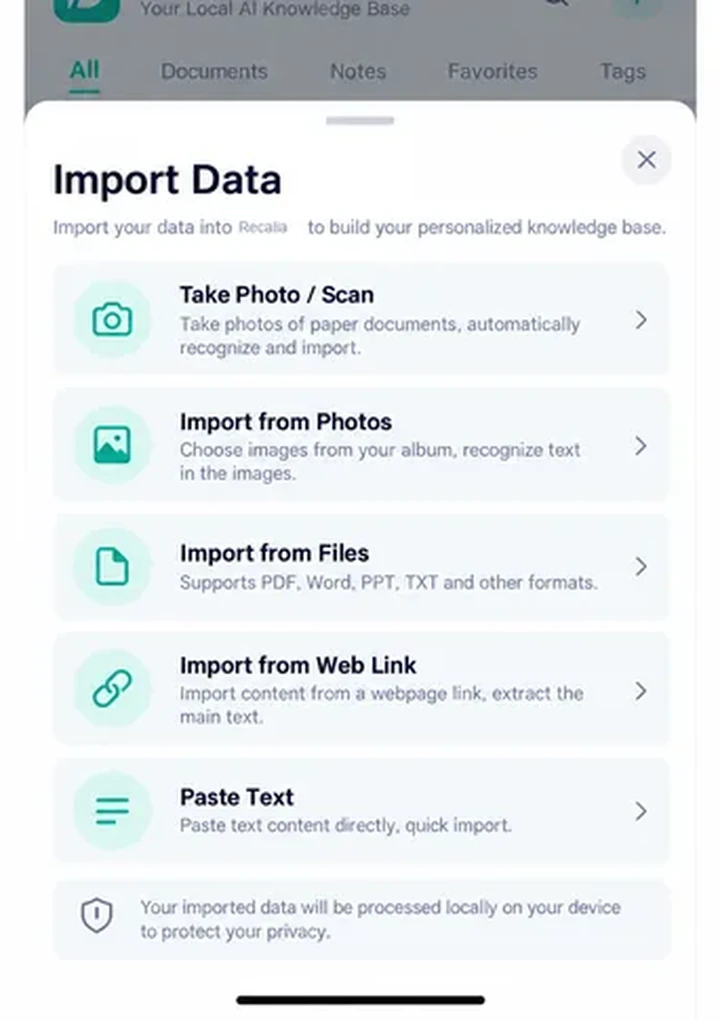
Bring in files, photos, web links and pasted text through clear import paths.
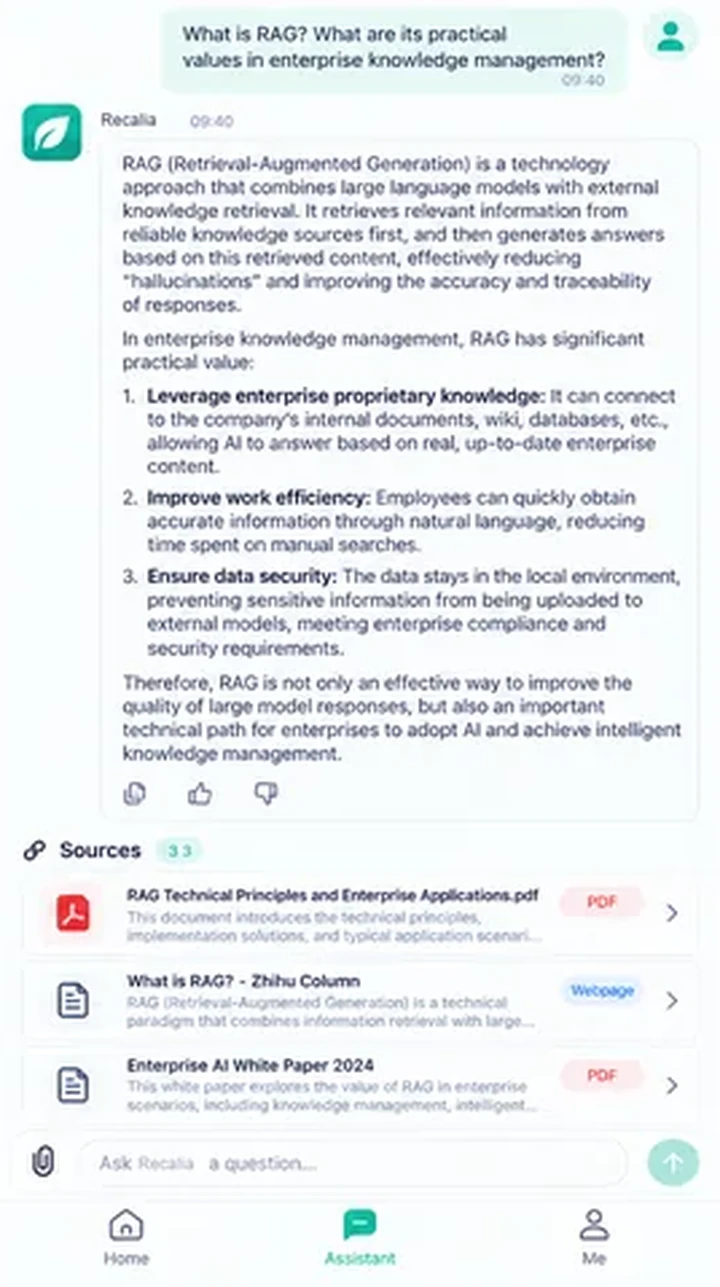
Keep evidence visible so answers can be checked against the original source.
Open the original document and return to the exact context behind a result.
Built around your knowledge
Search, question answering, long-term knowledge and local AI are designed as one connected workflow rather than separate features.
Full-text and semantic retrieval work together to find real matching passages, including across languages.
The assistant retrieves evidence from the selected document scope or your broader library before generating an answer.
Summaries, tags, conversations and knowledge scope remain available so later search and follow-up questions feel more natural.
Local models stay device-first when supported; connected models and custom APIs have separate, explicit data boundaries.
You choose where AI runs
Recalia does not treat “using AI” as automatically sending your library to the cloud. Local models, third-party providers and custom APIs are different data paths that should be selected explicitly by the user.
Prefer an on-device model selected for the current hardware when supported.
Use a third-party model only when the user explicitly selects that provider and its corresponding data boundary.
Support user-configured model services and API keys while keeping local and network calls clearly separated.
Adaptive local AI
Phones, tablets and desktops have different memory, thermal and sustained-performance limits. Recalia adapts its local runtime instead of forcing the same model everywhere.
Prioritize memory, latency and heat.
Use stronger local capability when the hardware allows.
Use more memory and sustained compute for heavier tasks.
Launching soon
Recalia is preparing its first public releases. Real store links will be added here when public downloads are available.
Product status last updated: 2026-09-17
Email and platform details are used only for Recalia testing and important release updates.
Email, name, platform and use-case details are used only for Recalia testing eligibility and important release updates.
FAQ
Not yet. Recalia is preparing its first public releases. There is currently no public App Store, Google Play, Mac App Store or Microsoft Store download. Real store links will be added here after release.
The product is local-first, but different features have different data boundaries. Local retrieval and local models are designed to remain device-side when supported. If you explicitly enable sync, a third-party AI provider or a custom API, the related data flow will be disclosed in the feature and privacy policy.
The current product direction covers PDFs, Word documents, presentations, images and text. Exact formats, size limits and platform differences will be documented for release builds.
No. Recalia is designed to adapt the local model and runtime strategy to memory, thermal limits and platform capability so phones, tablets and desktops can balance speed, heat, memory use and answer quality.