

Kimi K3 Test: Coding Ability, Kimi Code, 1M Context, and Real Project Results
Kimi K3 coding test on a real Astro project: cross-file analysis, code review, self-correction, Kimi Code, k3-256k, 1M context access, membership, and cache-switching boundaries.
On this page
Direct answer: in this Kimi K3 test on a real Astro project, Kimi K3 correctly traced cross-file relationships, caught routing and migration risks, and reversed its first remediation after receiving stronger evidence. Use it for investigation, code review, and migration-risk analysis—not as a replacement for local builds, diffs, security checks, or production approval.
Evidence note: Both K3 web-Chat rounds and the repository verification are complete. The conclusions below come from the real response text and repository code. The six images visualize verified findings; they are not raw Kimi screenshots and do not prove command execution.
August 14, 2026 update: k3-256k, 1M context, and Kimi Code 0.31
This update does not change the original 89/100 test result, but it does change how developers should choose the K3 model ID, context window, and Kimi Code workflow today.
First separate a July historical event from current product configuration. K3 did temporarily pause new consumer subscriptions after launch demand exceeded forecasts, which explains the capacity pressure at the time. This article no longer treats that pause as a real-time statement about August availability; current model and membership limits should come from Kimi Code’s live configuration pages.
Kimi Code now exposes both k3 and the newer k3-256k. Moderato and higher can call both; k3-256k is fixed at 256K, while k3 reaches up to 1M only for Allegretto and higher. Kimi positions k3-256k as the more quota-efficient everyday choice for workloads that fit within 256K and says it consumes about half the quota of k3 (1M). “Can I use K3?” and “Do I need 1M K3?” are therefore different decisions.
Kimi Code itself has moved beyond the 0.28 state recorded in the earlier article. Version 0.29 added Markdown-defined custom agents, SYSTEM.md, and global tool switches; 0.30 added a customizable status line and immediate quota-exhaustion errors; 0.31 allows plugins to contribute custom agents and system prompts and adds an experimental /secondary_model path. These changes do not raise the score of the original web-Chat test, but they expand what the local coding product can orchestrate around long-running and multi-agent work.
Cache behavior also needs a more precise rule. Moving to a different model can invalidate the previous cache. If a k3 1M session is already above 256K, Kimi recommends compacting before switching down to k3-256k. In the other direction, the current documentation says switching from k3-256k to k3 1M does not affect the cache. Check current context length and whether the old session is still valuable before treating a usage spike as a model-price problem.
The practical recommendation is now: prefer k3-256k when the task fits inside 256K; use k3 1M only when the repository or document really needs the larger window; keep local builds, diffs, security checks, and production approval outside the model’s first recommendation.
Conclusion first: K3 understood the cross-file relationships, but its first final decision was not safe to adopt
I did not buy a Kimi Code subscription, and I did not infer coding quality from an official benchmark. I opened a new Kimi web-Chat session, selected K3 with Max reasoning, and uploaded a sanitized evidence pack containing five groups of real files from XBSTACK.
The task came from a live Astro content-architecture problem rather than a synthetic demo.
In the first round, K3 accurately explained why the content audit flagged the target article. It understood that Astro Content Collection ownership is determined by the file’s physical directory, and it identified that moving the article from Lens to AI would break the existing /en/life/self-hosted-ai-workflow-infrastructure/ page unless the migration explicitly handled the old URL. The first round scored 86/100.
The failure came at the decision stage. K3 recommended a file-specific exception in the audit script. Local verification showed that the Medium warning did not block builds or publishing, and that the article was genuinely included in an English Life page positioned around outdoor routes, gear, and field notes. The exception would not fix the classification problem; it would only silence the warning.
After receiving four additional repository facts, K3 withdrew that recommendation and advised keeping the valid Medium warning until a complete migration could be implemented. The second round scored 92/100.
The final score is 89/100.
- K3 is useful for real project investigation, code review, and migration-risk inventories;
- it can connect implicit relationships across several files;
- its first final engineering decision may still optimize for the wrong objective;
- production changes still require full-repository verification and local checks.
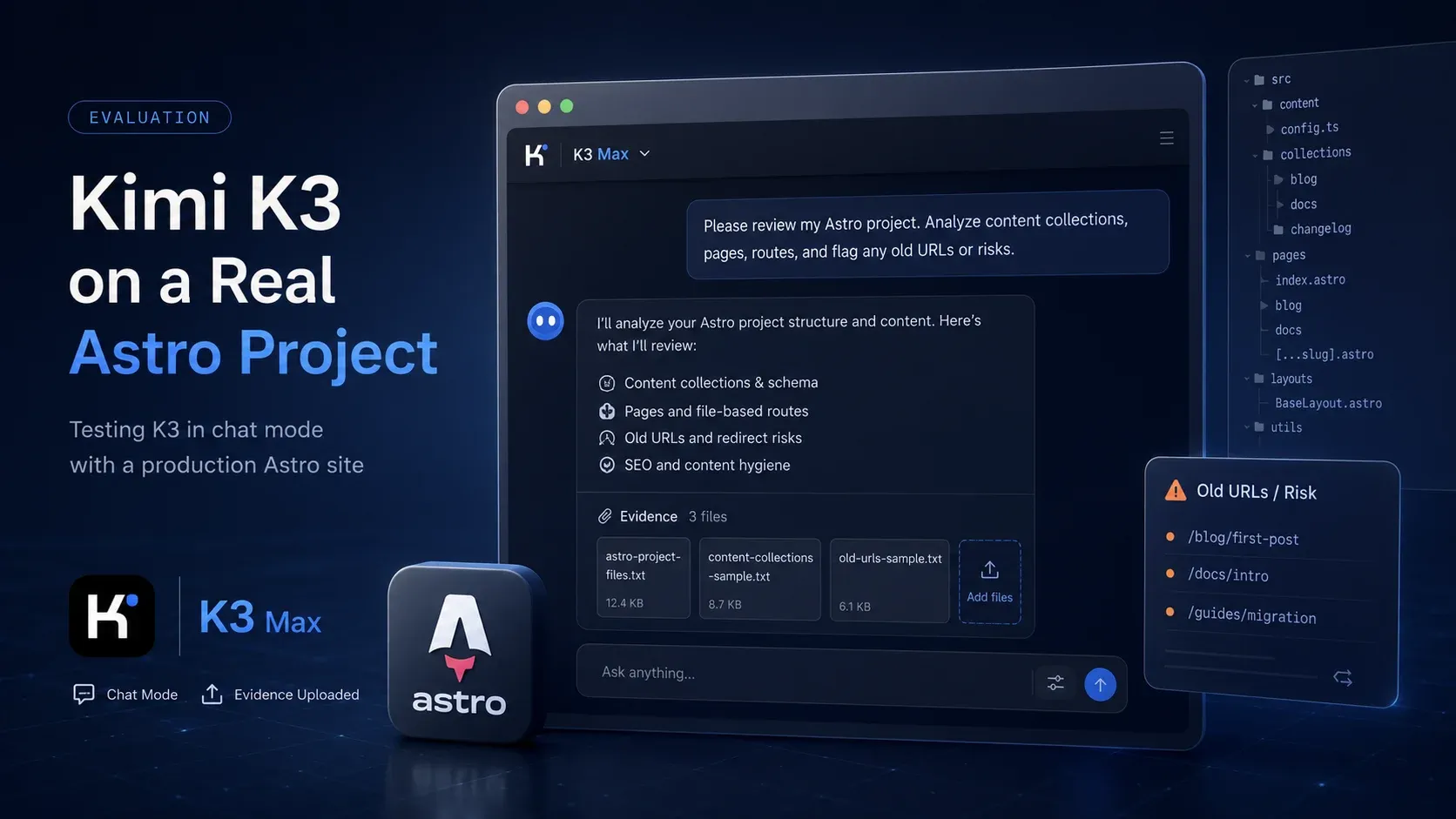
Figure 1. An explanatory cover based on K3 Max, a real Astro project, cross-file analysis, and legacy URL risk. The interface elements are illustrative.
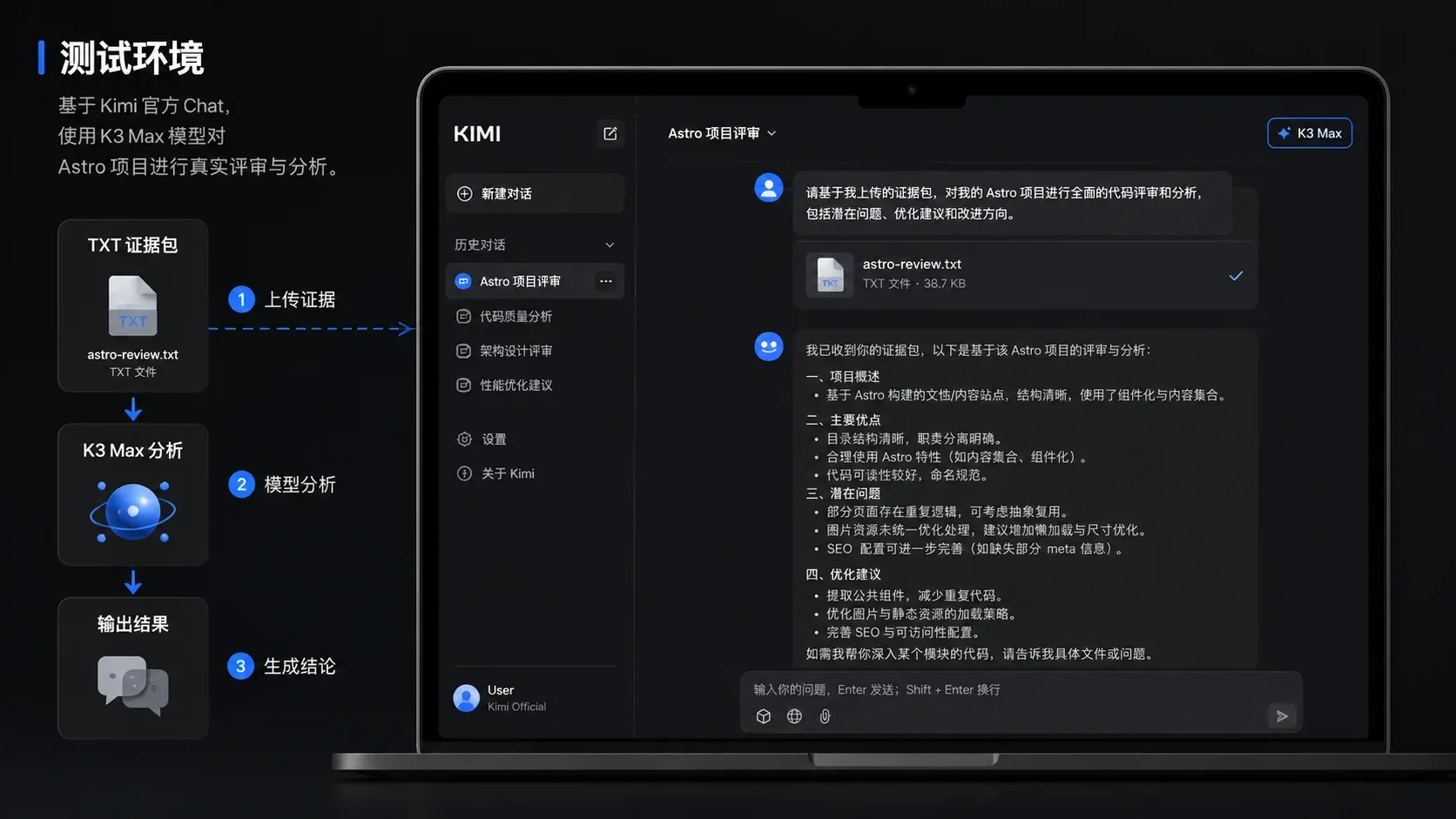
Figure 2. The actual test used Kimi web Chat with K3 Max and one sanitized TXT file containing five groups of real project evidence.
Test task and boundaries
The test answered one question:
Can Kimi K3 use a limited but real set of repository evidence to diagnose an Astro content-architecture problem and then correct its own engineering plan when challenged?
The real baseline was:
npm run content:audit

Scanned 414 files.
High: 0
Medium: 1
The only warning was:
MEDIUM / misplaced_lens_tech
src/content/lens/en/self-hosted-ai-workflow-infrastructure.md

Technical content is stored in the Lens Collection and may pollute the outdoor channel.
I extracted and sanitized five evidence groups:
- the relevant audit rule;
- the Lens and AI Collection definitions;
- the affected English infrastructure article;
src/pages/en/life/[...slug].astro;src/pages/en/ai/[...slug].astro.
Because the test used web Chat rather than Kimi Code, K3 had no local file permissions and could not run npm, Git, or Astro commands.
Test record
| Item | Setting |
|---|---|
| Test date | July 18, 2026 |
| Entry point | Kimi web Chat |
| Model and reasoning level | K3 · Max |
| Input | One sanitized TXT file with five groups of real code |
| Main calls | One investigation round and one adversarial review round |
| Additional cash outlay | $0 |
| Local repository and command access | None |
| Output | Two complete responses, local verification, and a scoring record |
The web interface did not expose token usage or per-call cost, and the session was not independently timed. This article does not invent a precise cost or latency figure.
Core prompt constraints
Use only the uploaded real code evidence. Do not browse the web and do not assume
implementations that were not provided.

Do not claim that you executed npm, Astro, Git, or a build.

Explain why the audit rule matched. Decide whether this is a false positive,
a classification error, or historical architecture debt.

Analyze what happens to the legacy /en/life/ URL, Canonical URL, translations,
and list-page inclusion if the article moves to the AI Collection.

Compare changing the audit, changing Frontmatter only, moving the file,
and adding a precise exception. If evidence is missing, do not force a full Diff.
The first-round failure is meaningful because K3 respected these explicit restrictions but still selected the wrong engineering objective.
Why I used web Chat instead of Kimi Code
My original plan was to let Kimi Code CLI enter an isolated worktree, inspect the repository, edit files, and run validation. Kimi Code 0.27.0 installed successfully, and device authorization completed, but the model endpoint could not verify the required membership benefit. The CLI never obtained a usable K3 model.
That is a product-access boundary, not evidence that K3 failed at coding.
I therefore changed the claim:
- this is not a Kimi Code autonomous modification-and-build test;
- it is a K3 web-Chat real project code-review test;
- local commands and final repository facts were verified separately.
First round: how K3 understood the problem
The audit reports misplaced_lens_tech only when four conditions are all true:
- the file path is inside
src/content/lens/; - the file is not skipped as a draft or unpublished translation;
- the title, category, hub, or first 1,200 body characters match technical keywords;
- the same sample does not match outdoor keywords.
K3 mapped every condition to the target article. It also judged that the issue looked like historical architecture debt because the route, Canonical URL, translation key, and translation links had all been built around /en/life/.
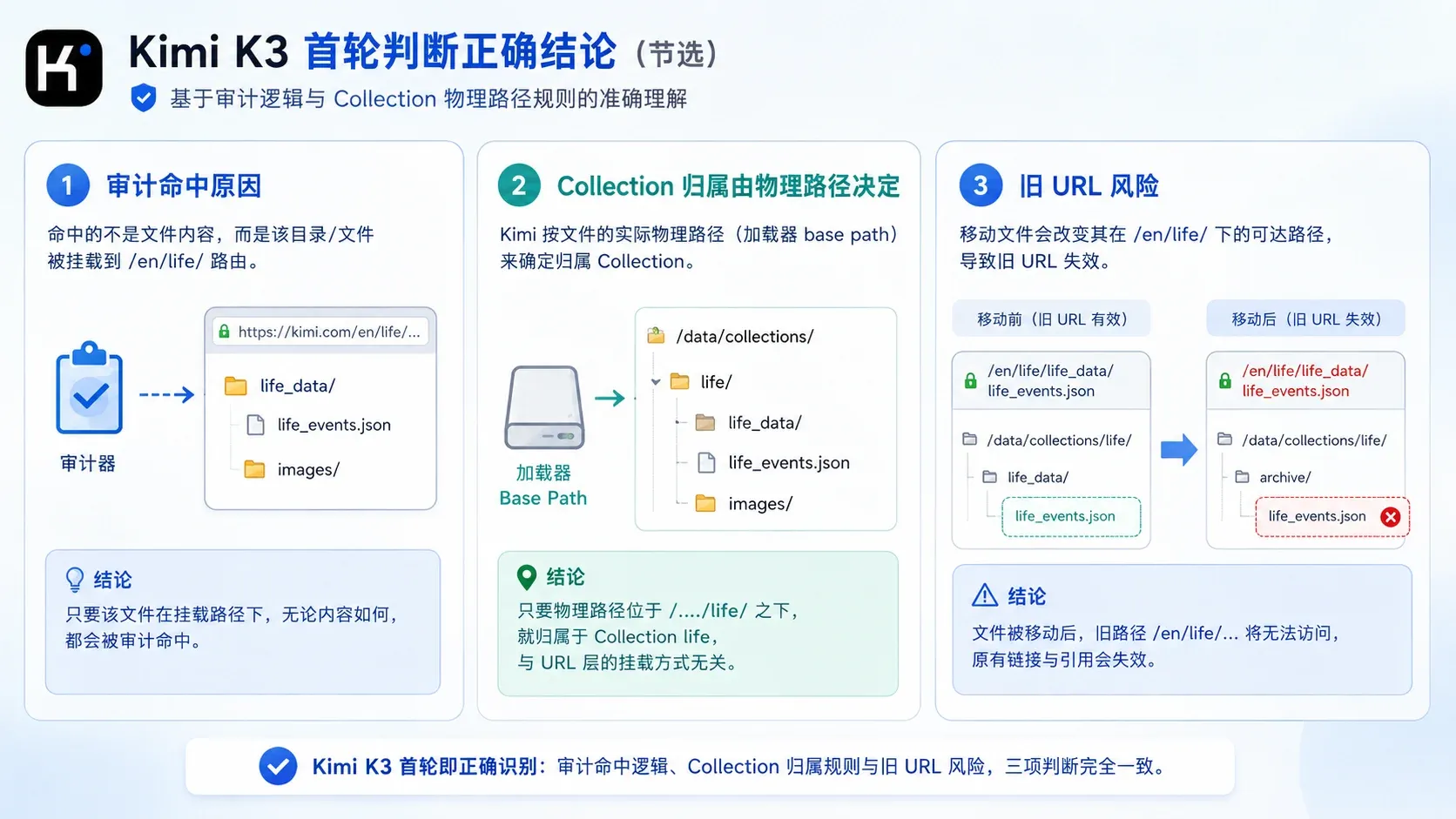
Figure 3. K3 correctly identified the audit conditions, the physical-directory rule for Collection ownership, and the legacy URL risk.
The strongest part: Frontmatter could not preserve the old URL
K3 correctly identified that:
- Collection ownership is determined by each loader’s physical
basedirectory; - changing
category,section, orhubdoes not move an entry between Collections; /en/life/[...slug].astroqueries onlygetCollection('lens');- the Life route derives the slug from
entry.id, not the Frontmatterroutefield; - after the file moves to
src/content/ai/en/, the old Life route can no longer retrieve it; /en/ai/[...slug].astrousesrouteonly when it begins with/en/ai/;- keeping
route: /en/life/...after the move can leave the old Canonical pointing to a missing page.
This is cross-file relationship analysis, not single-file autocomplete.
First failure: the analysis was strong, but the final recommendation hid a valid warning
K3 compared four approaches:
- change the audit script;
- change only the article Frontmatter;
- move the article to the AI Collection;
- keep the article in place and add a precise audit exception.
It correctly rejected the Frontmatter-only approach and acknowledged that moving the file was the long-term fix. But because the first evidence pack did not include the full redirect, list-page, and translation implementation, K3 recommended option four as the short-term choice.
The proposal sounded disciplined: add one documented exception, preserve the old URL for now, and schedule the migration as a separate task.
That recommendation was not actually safe.
I returned to the repository and found two decisive facts.
First, the English Life list queries published Lens entries directly:
const entries = await getCollection(
  'lens',
  ({ data }) =>
    !data.draft &&
    data.lang === 'en' &&
    data.indexing !== 'noindex' &&
    data.translationStatus !== 'machine' &&
    data.hub !== 'reading'
);
The infrastructure article passes every condition. The classification problem is not theoretical; the article is eligible for an English page positioned around outdoor routes, gear, and field notes.
Second, the content-audit script fails only for High-severity issues:
if ((severity.high || 0) > 0) process.exitCode = 1;
The baseline is High 0 and Medium 1. The warning does not block the build or release. There was no CI emergency that justified silencing it.
The actual effect of the proposed exception would have been:
The article remains in the wrong Collection
+ the English Life list continues to include it
+ the only automated reminder disappears
That is not a minimal safe fix. It trades a quieter report for less visibility into unresolved architecture debt.
The recommendation is especially risky because it is persuasive. It satisfies three intuitive goals: small change, no immediate URL break, and a clean audit report. A developer unfamiliar with the repository could accept it without noticing that the model never checked whether the warning blocked deployment or whether the wrong listing was already happening.
A well-argued plan with the wrong objective can be more dangerous than an obvious syntax error.
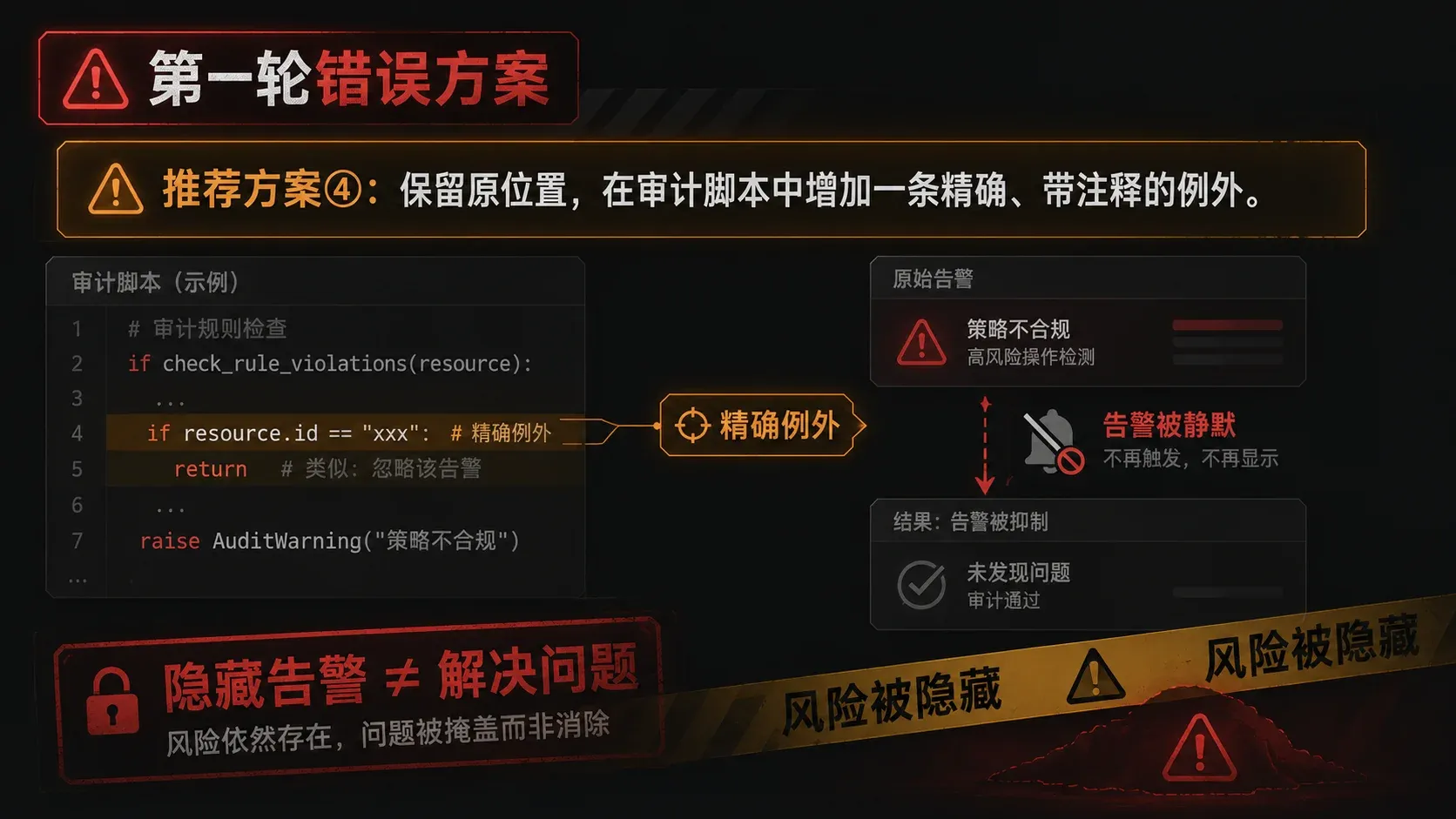
Figure 4. The failure was not a syntax mistake. K3 proposed silencing a valid warning. The code shown in the illustration explains the risk mechanism and is not a patch generated by K3.
Second round: could K3 overturn its own plan after receiving new evidence?
I did not simply tell K3 the answer. I supplied four facts verified from the real repository:
- the uploaded evidence already included
baseContent, with route, Canonical, and translation fields; - the English Life list genuinely includes the article;
- Medium severity does not block builds or releases;
- the project already has a static 301 redirect mechanism.
I then asked K3 to audit its previous reasoning.
Its response was explicit:
The foundation for recommending option four no longer exists. I formally withdraw it.
K3 separated two decisions that had previously been bundled together:
- postpone the migration: accept the debt but keep the warning and tracking signal;
- change the audit so it stops reporting: leave the problem in place and remove the record of it.
The revised short-term plan was zero code changes: do not change the article, audit rule, or redirects; keep the Medium warning visible while collecting the remaining migration evidence.
The revised long-term plan was to move the English article to the AI Collection, update the new route and Canonical URL, add a 301 for the old path, inspect the Chinese counterpart and translation mapping, update internal links, and verify list pages, sitemap output, and hreflang relationships.
K3 also declined to generate a complete Diff while the Chinese article, internal-link inventory, and translation-consumer logic were still incomplete. It did not present guesses as an executable patch.
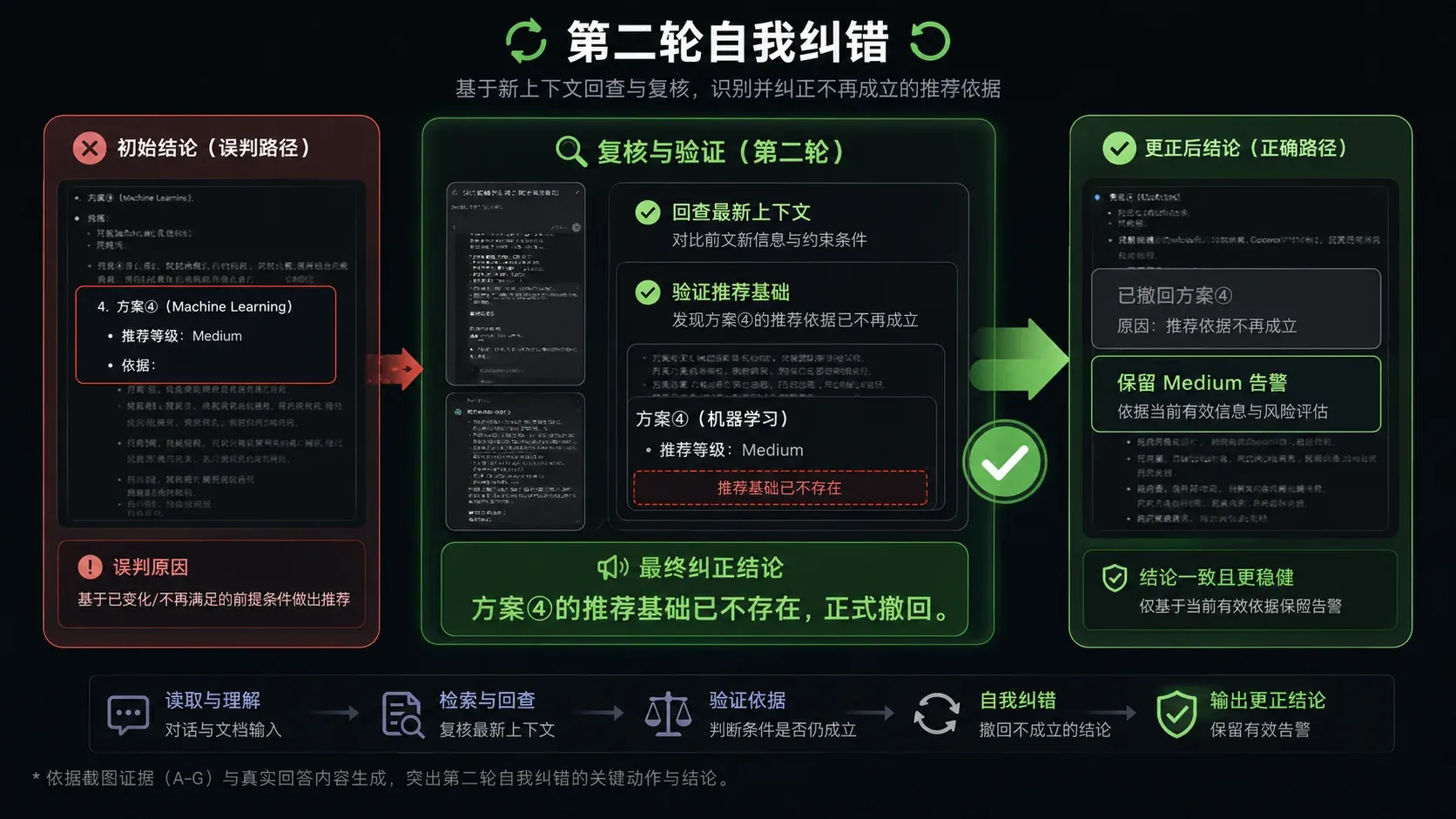
Figure 5. After receiving evidence about the list page, exit code, schema, and redirects, K3 withdrew the audit-exception recommendation.
Two-round comparison
| Dimension | First round | Second round |
|---|---|---|
| Root cause | Correctly identified architecture debt | Retained |
| Collection ownership | Physical directory determines Collection | Retained |
| Legacy URL risk | Correctly identified loss of the Life entry | Added _redirects as a viable migration mechanism |
| Medium severity | Exit-code impact was not checked | Confirmed that it does not block release |
| Short-term plan | Add a file-specific audit exception | Withdraw the exception and keep the warning |
| Long-term plan | Treat migration as a later task | Move file, add 301, update Canonical, translations, and links |
| Full Diff | Not produced | Correctly refused while evidence remained incomplete |
| Human assessment | Strong mechanism analysis, risky final choice | Successful correction, with some defensive wording |
How the human verification was performed
The response was not scored by how authoritative it sounded. I returned to the repository and looked for code that could confirm or falsify each claim.
I read the English Life listing logic to determine whether the infrastructure article was genuinely included. I inspected the audit exit code to determine whether Medium severity blocked publishing. I checked public/_redirects and the Astro configuration to verify whether a 301 migration mechanism existed. Finally, I reopened the uploaded TXT file to confirm whether baseContent had already been present.
I separated findings into three classes:
- facts directly proven by code;
- inferences supported by the available evidence;
- unresolved questions that required additional files.
For example, “the Life route queries only Lens” is a direct fact. “This is historical architecture debt” is a strong inference. “How the Chinese article should migrate” remained unresolved until the Chinese content and translation tooling were inspected.
This is also why web Chat cannot replace a local Agent. K3 can produce a strong investigation path, but it cannot see an unuploaded list page, exit-code logic, redirects file, or full internal-link graph. A reliable workflow lets the model expose its assumptions, verifies them locally, and then returns the counter-evidence for a second review.
Why the second round was not perfect
The correction was directionally strong, but two details still mattered.
First, K3 did not fully acknowledge that it had missed evidence already present in the uploaded baseContent definition. The TXT file explicitly included these fields:
canonical
route
indexing
lang
translationKey
translations
translationStatus
translationSource
translationSourceHash
It described the issue as the evidence not having reached “its side,” even though the TXT file contained the definition.
Second, it described the zero-change short-term plan as “zero risk.” A more precise statement is: the risk of introducing a new code change is close to zero, but the existing channel pollution and architecture debt remain.
These issues do not invalidate the revised plan. They show that a model can correct a conclusion without always giving an accurate account of why the first conclusion failed.
The second round scored 92/100.
Scoring: where the 89 points came from
| Dimension | First round | Second round | Assessment |
|---|---|---|---|
| Audit-trigger explanation | 15/15 | 15/15 | Accurate condition mapping |
| Collection and Frontmatter | 14/15 | 15/15 | Correct main conclusion; first-round schema miss |
| Legacy URL and route risk | 20/20 | 20/20 | Strongest dimension |
| Architecture judgment | 13/15 | 15/15 | Real list pollution confirmed after new evidence |
| Evidence discipline | 9/10 | 10/10 | No fabricated command execution |
| Engineering decision quality | 7/15 | 14/15 | First-round exception was a poor choice |
| Self-correction | — | 8/10 | Plan withdrawn; error attribution remained defensive |
| Output completeness | 5/5 | 5/5 | Structured investigation and action list |
First round: 86/100. Second round: 92/100. Combined score: 89/100.
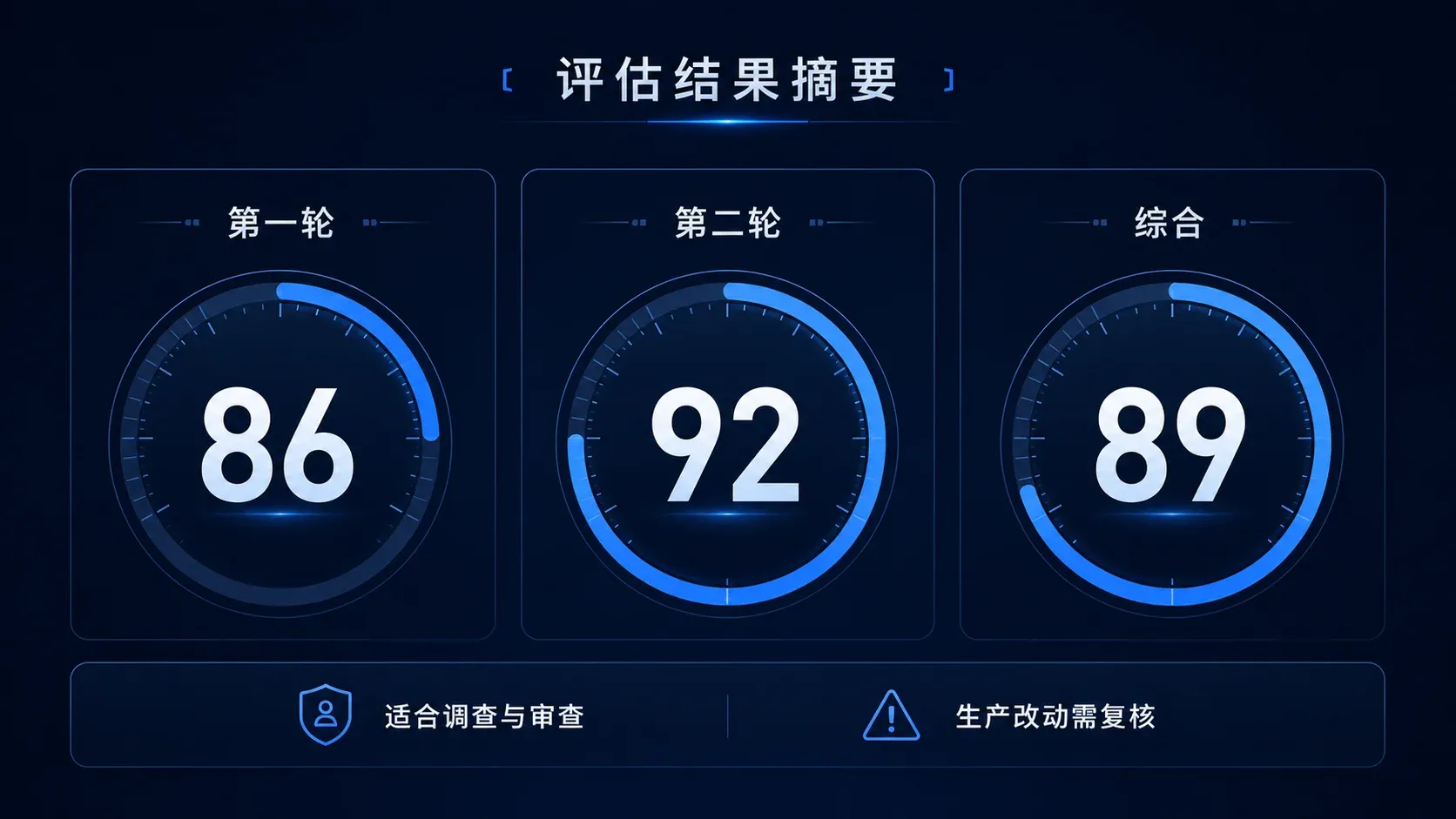
Figure 6. These scores apply only to this Astro code-review task. They are not an official benchmark and should not be compared directly with unrelated model scores.
Which official capabilities matched the experience, and which were not tested
Kimi positions K3 for Chat and Agent tasks, with Low, High, and Max reasoning levels in the web product. Kimi Code documentation describes a CLI that can read code, edit files, and execute commands, with access tied to product permissions.
Capabilities consistent with this test:
- handling a relatively long multi-file evidence pack;
- connecting audit logic, Collection ownership, routes, and Canonical URLs;
- comparing remediation options under explicit constraints;
- performing an adversarial review and withdrawing a prior recommendation.
Not tested:
- direct access to the complete repository;
- Kimi Code file editing;
- npm, Git, or build execution by K3;
- the one-million-token context limit;
- HighSpeed variants;
- API token usage or per-call price;
- repeated-run consistency;
- same-prompt comparisons with other models.
The defensible conclusion is narrower than “K3 can autonomously complete a real engineering task”:
K3 can perform useful engineering investigation and code review, but final modifications still require local tools, complete evidence, and human acceptance testing.
Who should use it, and who should not
K3 web Chat is useful for:
- selecting 5–15 key repository files and investigating a root cause;
- reviewing whether a migration may break routes, Canonical URLs, or translations;
- conducting an adversarial review of an existing remediation plan;
- obtaining technical analysis before paying for a local Coding Agent product;
- acting as a second code reviewer rather than the final approver.
It is not a substitute when you need:
- automatic traversal of the full repository;
- direct editing, testing, building, or committing;
- validation of runtime behavior;
- unsupervised handling of production URLs, redirects, credentials, or data;
- reliable reconstruction of an entire implementation from a single error log.
I would make one follow-up mandatory:
Strictly challenge your previous plan. Identify at least one omission and separate:

1. facts directly proven by the supplied code;
2. reasonable inferences from the current evidence;
3. unknowns that still require local verification.

If evidence is insufficient, do not generate a full Diff and do not claim that any
command has been executed.
In this test, that follow-up materially changed the engineering plan.
Final decision: use it for investigation, not as an independent production approver
K3’s strongest capability in this task was cross-file relationship analysis. It was not misled by category: gear, and it did not assume that Frontmatter could change Collection ownership. It connected the separate Life and AI routes to their Collections and correctly identified the legacy URL risk.
Its most dangerous failure was selecting a local patch that appeared conservative because it avoided an immediate migration. But conservative does not automatically mean correct. Hiding a valid Medium warning would not reduce the existing channel pollution; it would reduce the visibility of the problem.
The positive result is that K3 accepted counter-evidence and withdrew the plan. The limitation is that the user must know which evidence to collect and which assumptions to challenge.
My usage policy is therefore:
- root-cause investigation, cross-file review, and migration-risk inventory: recommended;
- final Diff, build conclusions, and production migration decisions: require human and local-tool verification;
- first answer: treat it as a candidate plan;
- evidence-backed adversarial review: make it mandatory;
- autonomous editing and command execution: use a Coding Agent surface with explicit local permissions.
Final score: 89/100. K3 is already a valuable engineering reviewer, but it is not a system that should independently approve production changes.
More to Explore
- GPT5.6 Real-World Test: Projects, Content Creation, and Data Analysis
- Claude Sonnet 5 Real-World Test: Fixing an Oversized Astro Bundle
- ChatGPT Chat vs Work: What’s the Difference, and When Should You Use Codex?
- AI Tools Lab: real-project tests of AI models and tools
Official resources
Next step: continue the Agent system
Full decision path →Choose the next architecture, tool, memory, evaluation, security, or production decision instead of starting over.

DISCUSSION
Questions, verification and corrections
Sign in to comment. Every new comment is reviewed before publication; while pending, it is visible only to you and the administrator.