

OpenAI Is Testing Outcome-Based Pricing: Why AI Agents May Move Beyond Token Billing
OpenAI CFO Sarah Friar says the company is experimenting with business-outcome pricing in enterprise AI. This analysis combines OpenAI, Intercom, Salesforce, AWS and Stripe evidence to explain how AI agent pricing may move from token/usage economics toward tasks, verified outcomes, ROI and model-routing decisions.
Evidence 7 cited sources
On this page
OpenAI Outcome-Based Pricing is pushing AI agent economics beyond a single question—how much does one million tokens cost? As agents begin completing real work, token usage remains an important cost metric, but verified outcomes, task success and ROI become more meaningful measures of customer value.
Developers compare GPT, Claude and Gemini by input, cached-input and output rates. AI SaaS teams then calculate cost per request, monthly spend per user, cache savings and whether simpler traffic can be routed to a cheaper model. That is rational because tokens are still one of the cleanest units for measuring model consumption.
But the commercial logic starts to break when AI stops merely answering questions and starts doing work.
On September 9, 2026, Reuters reported that OpenAI CFO Sarah Friar said the company is pushing enterprise AI into specialized domains including chip design, life sciences and financial services, while experimenting with pricing based on business outcomes rather than use. Friar also said enterprise revenue grew 32% from June to July, ahead of roughly 20% growth in overall annualized revenue over the same period.
That does not mean OpenAI is about to stop selling tokens. OpenAI’s current Enterprise token-based rate card still prices supported usage by input, cached-input and output tokens, and the API remains usage-based.
The more important signal is that the industry is being forced to answer a harder question: should customers pay for how much AI consumed, or for whether the AI actually got the job done?
My view is that this is one of the most important business-model shifts of the agent era.
Selling tokens means selling compute. Selling outcomes means selling responsibility.
Once a vendor sells responsibility, model quality, evaluation, tool reliability, recovery, human review and billing logic all become part of the same economic system.
OpenAI signaled this direction months before the September comments
The September remarks matter more when read alongside OpenAI’s own January strategy.
On January 18, Sarah Friar wrote in A business that scales with the value of intelligence that OpenAI’s business already spanned consumer subscriptions, workplace subscriptions and usage-based APIs. She then described a future in which intelligence used in scientific research, drug discovery, energy systems and financial modeling could support new commercial structures including licensing, IP agreements and outcome-based pricing.
In January, outcome-based pricing was described as an emerging economic model. By September, Friar was discussing experiments with business-outcome pricing in enterprise deployments.
That is not proof of a complete pricing transition. It is evidence that outcome pricing has moved from strategic thesis to active enterprise experimentation.
The timing also matters. Enterprise buyers are under increasing pressure to justify AI spending in conventional financial terms. For example, telling a finance team how many billions of tokens were consumed in a month says little about business value. Reporting how many support issues an agent actually resolved and how much it reduced human escalation is far more meaningful.
Likewise, reporting how many tokens a coding agent consumed is not a business result. Reporting how many mergeable patches it delivered, and how many passed the required tests and were accepted, is much closer.
The more capable agents become, the more obvious the gap between model consumption and customer value becomes.

Tokens are a cost unit, not a value unit
Token pricing works naturally at the infrastructure layer. Cloud computing has long charged for CPU, storage and bandwidth because customers are explicitly buying infrastructure resources. LLM APIs inherited a similar model: process more tokens, pay more.
Agents change the abstraction. A support agent is valuable because it resolves an issue, not because it generates text. A finance agent is valuable because it reconciles an invoice correctly, not because it reads a long PDF. A coding agent is valuable because it produces usable software, not because it performs many model calls.
That difference can completely change unit economics.
Imagine two agents handling the same task:
| Metric | Agent A | Agent B |
|---|---|---|
| AI cost per task | USD 0.03 | USD 0.12 |
| Task success rate | 45% | 96% |
| Cost for 100 tasks | USD 3 | USD 12 |
| Successful tasks | 45 | 96 |
| AI cost per success | USD 0.067 | USD 0.125 |
At first glance Agent A still looks cheaper. But suppose each failed task requires one dollar of human rework. Agent A creates roughly USD 55 of additional labor cost, while Agent B creates only about USD 4.
The useful metric is therefore not model price alone:
Cost per Verified Outcome
= (Model Cost
 + Tool Cost
 + Infrastructure Cost
 + Retry Cost
 + Failed-run Cost
 + Human Review / Rework Cost)
÷ Verified Successful Outcomes
This is where AI FinOps needs to evolve.
The first phase focused on:
Token Cost
→ Cache Hit Rate
→ Cost per Request
→ Provider Spend
The next phase needs to connect cost to effectiveness:
Agent Cost
→ Task Success Rate
→ Cost per Verified Outcome
→ Business Value
→ ROI
→ Model Routing
A cheap model does not automatically produce a cheap outcome. An expensive model does not automatically produce strong ROI. The economic target is the total cost required to produce one verified result.
This is already a real market, not just an OpenAI theory
OpenAI is not the first company to experiment with value-aligned AI pricing. What makes the new signal interesting is that several agent vendors are converging on units that sit closer to work completed than to compute consumed.
Intercom’s Fin AI Agent now bills by outcome. Its billing model defines outcomes such as Resolution, Procedure handoff, Disqualification and Qualification. A conversation can contain multiple AI actions, but the commercial event is the defined outcome rather than every model invocation.
That distinction matters because “outcome” has moved from marketing language into actual billing logic.
Salesforce’s Agentforce pricing illustrates a different intermediate layer. Agentforce supports multiple models including user licensing, conversations and Flex Credits that meter Actions. An action is still not the same as a final business result, but it is a much more work-oriented unit than a raw token.
AWS also treats outcome-based pricing as a distinct part of agentic AI economics, emphasizing measurable results and the transfer of more execution risk from buyer to provider.
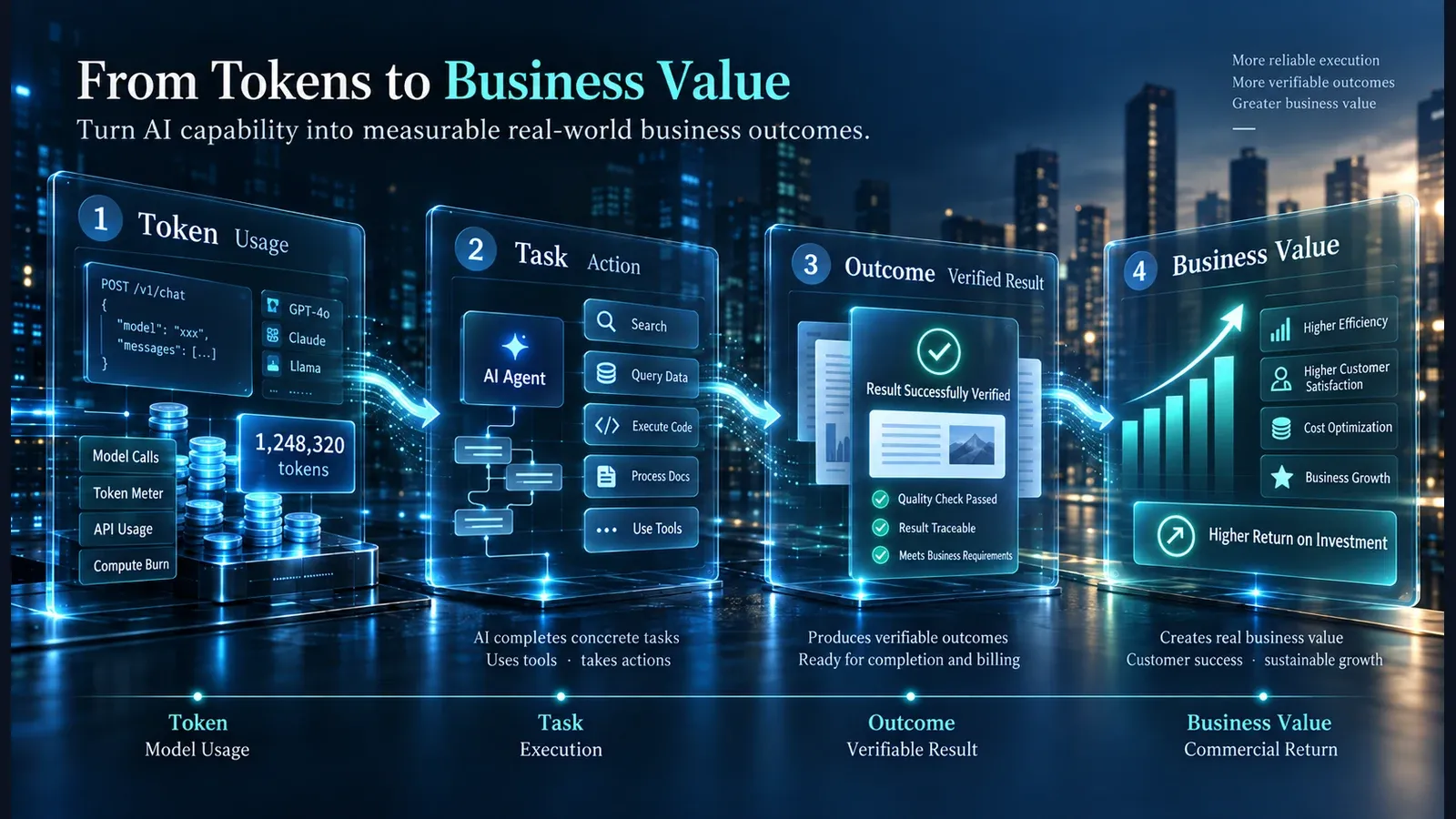
The market therefore appears to be building a pricing ladder rather than jumping directly from tokens to revenue sharing:
Token
↓
Request / Credit
↓
Conversation
↓
Action / Task
↓
Verified Outcome
↓
Business Value / Revenue Share
Each layer is closer to what the customer actually values. Each layer also shifts more risk to the vendor.
The hardest problem is not pricing. It is defining success
Outcome pricing sounds simple until a contract needs to answer, “what exactly counts as an outcome?”
Customer support is relatively measurable. A case can be considered resolved when a customer confirms resolution or when no additional help is requested within a defined window. That is why support has become one of the earliest categories where outcome pricing works.
Sales is harder. If an agent qualifies a lead and the prospect signs a contract three months later, how much of that revenue belongs to the agent? What if a salesperson followed up 17 times? What if the customer would have converted anyway?
Coding agents create another attribution problem. Is success a pull request, a green test suite, a merged patch, or seven production days without a regression?
Outcome pricing therefore requires an Outcome Verification Layer that most early AI products do not yet have.
It needs to determine:
Did the task start?
→ What did the agent actually do?
→ Did it meet the pre-agreed success criteria?
→ Is human confirmation required?
→ Can the result be reopened or reversed during a validation window?
→ Was the outcome caused by the agent, a human or an external event?
→ Is the event billable?
This turns evaluation into more than an engineering benchmark.
Agent evaluation can become part of the billing system.
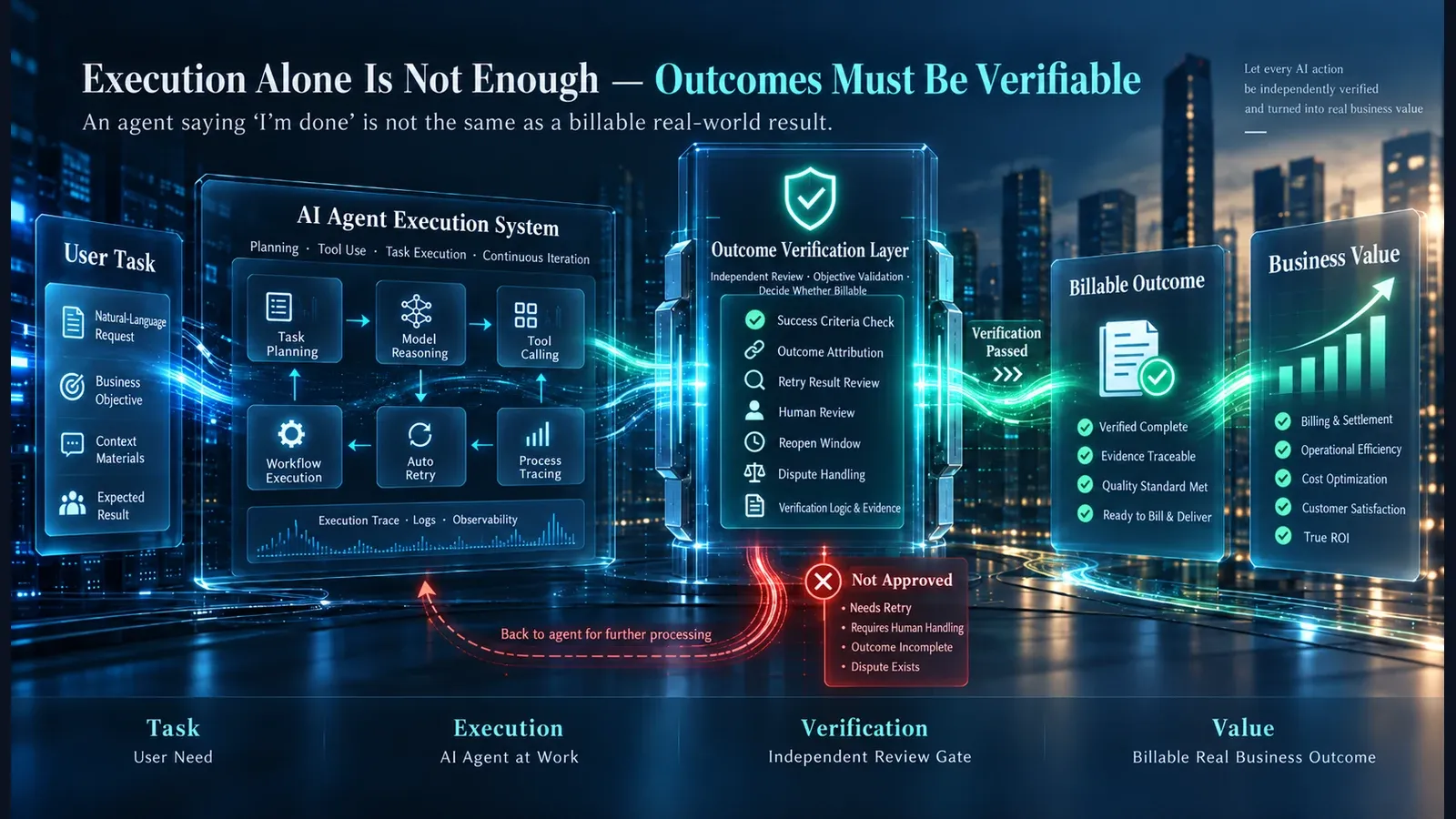
That is one of the most important consequences of outcome-based pricing and one that many teams are still underestimating.
Outcome pricing turns failed tasks into a margin problem
Usage pricing is comfortable for a provider because model cost is usually billable even when a task is unsuccessful. The tokens were consumed, so the usage event still exists.
Outcome pricing can reverse that relationship.
If a contract says the customer pays only for a successful resolution, an agent might make 20 model calls, eight searches and six tool calls, then escalate to a human. The customer may owe nothing for that outcome, but the vendor has still paid for the entire run.
The competitive question changes from “who has the cheapest model?” to:
Who can reliably produce the result at the lowest total cost?
That brings a different metric set directly into gross margin:
Task Success Rate
First-pass Success Rate
Retry Rate
Escalation Rate
Human Review Rate
Failed-task Cost
Cost per Verified Outcome
Outcome Reopen / Reversal Rate
Gross Margin per Outcome
A five-point success-rate gap that once looked like a product-quality issue can become a direct profit difference when revenue is recognized only on successful outcomes.
Model routing must change as well. A simple rule like this is not enough:
Easy task → cheapest model
Hard task → strongest model
The more useful optimization objective is:
Choose the model / workflow that minimizes
Expected Cost per Verified Outcome
A more expensive model can have better unit economics if it materially reduces retries, tool errors and human rework.
Independent developers should define one billable outcome before designing a complex revenue-share model
Outcome pricing can be especially tempting for independent developers because it sounds like a stronger sales pitch: “pay only when it works.” But that promise transfers operational risk to the builder, and small teams have less room to absorb unpredictable long-tail cost.
The better first step is to define a Billable Outcome with four properties:
- Clear boundary: the start and end events are identifiable.
- Verifiable: success is not merely “the user felt more productive.”
- Strong attribution: the agent materially controls the result.
- Positive unit economics: customer value is comfortably above delivery cost.
For example:
| Product | Better outcome | Weak outcome |
|---|---|---|
| Support agent | Ticket resolved and not reopened for 72 hours | “Answered a message” |
| Invoice agent | Extracted fields pass rules and are accepted by the finance system | “Parsed a PDF” |
| Coding agent | Patch passes required tests and is accepted by a reviewer | “Generated code” |
| Data agent | Output passes constraints and enters a downstream workflow | “Ran a SQL query” |
| Sales agent | Lead meets a predefined qualification standard | “Sent an email” |
A hybrid commercial model is often safer than jumping directly to pure outcome pricing:
Base subscription
+ Included usage
+ Verified-outcome charges
+ Premium model / high-cost task surcharge
This keeps pricing aligned with value while preventing every model-cost spike and hard-tail task from landing on the vendor’s balance sheet.
Stripe’s discussion with Intercom’s pricing team makes a similar point: as AI agents increasingly promise completed work rather than software access, pure usage-based pricing has a growing disconnect from customer value, making outcome and hybrid models more attractive. See the Stripe case study.
The next phase of AI FinOps is not just reducing tokens. It is proving ROI
Outcome pricing does not make token economics disappear. It makes internal cost accounting more important.
If customers stop paying for failed token consumption, the vendor needs much better internal instrumentation. The customer-facing unit may be:
Resolved Ticket
Approved Invoice
Accepted Patch
Qualified Lead
Completed Research Task
The internal cost ledger must still decompose:
Model Cost
Tool/API Cost
Vector / Storage Cost
Retry Cost
Human Review Cost
Failure Cost
Infrastructure Cost
Those costs then need to connect to the business chain:
Agent Cost
→ Task
→ Verification
→ Outcome
→ Business Value
→ Revenue
→ Gross Margin / ROI
Once that data exists, model routing becomes an economic decision rather than a benchmark decision.
The useful questions are no longer “which model is cheapest per million tokens?” They become:
Which model resolves one eligible support case at the lowest total cost?
Which coding model costs more per call but has a materially higher merge success rate?
Which tasks should never use the strongest model, and which tasks have such high failure/rework cost that the stronger model is cheaper in practice?
The full loop is:
Agent Cost → Task Success Rate → Business Outcome → ROI → Automated Model Routing.
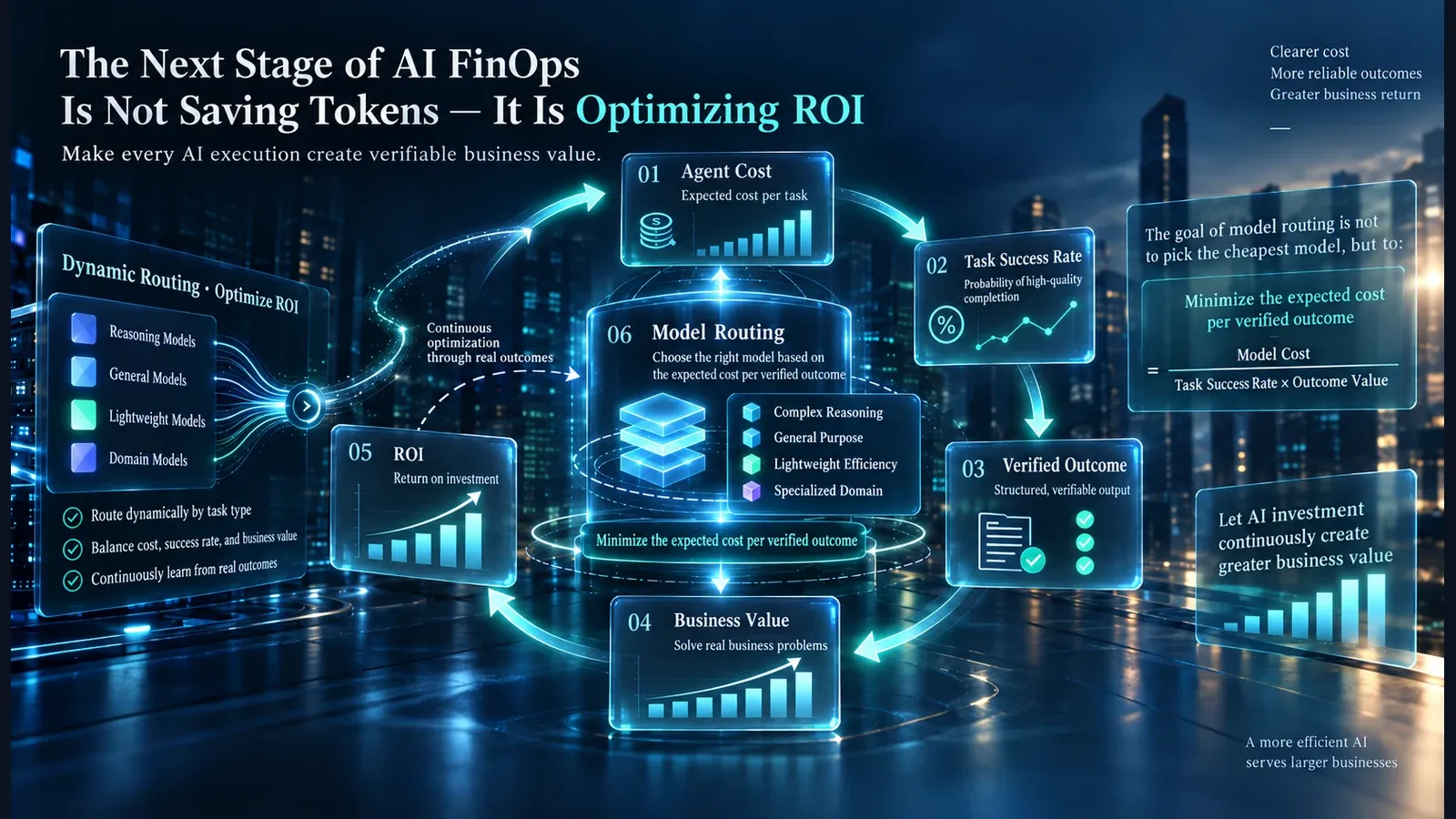
That is not architecture for architecture’s sake. It is the point where every model-selection decision can be tied to whether an outcome is actually profitable.
Token pricing is not going away
The easiest mistake is to turn this trend into “token pricing is dead.” I do not think that is what the evidence supports.
Tokens remain an excellent infrastructure accounting unit. APIs, developer platforms, model providers and workloads without standardized business outcomes still benefit from a transparent usage meter.
What is more likely is a layered pricing stack:
Bottom: Token / Compute Economics
Middle: Task / Agent Economics
Top: Outcome / Business Economics
At the model layer, tokens can remain the meter. Inside the agent platform, model calls, tools, retries and human work become Task Cost. At the customer layer, selected workflows can then be sold as Actions, Resolutions, Verified Outcomes or a share of business value.
These layers are additive, not mutually exclusive.
The most accurate reading of OpenAI’s latest signal is therefore not “OpenAI has stopped selling tokens.” It is that as AI moves into enterprise production, even a frontier-model company has to answer the most traditional commercial question in software:
What measurable value did the customer actually receive?
This is where agent commercialization really starts
The AI industry has spent two years obsessing over benchmarks, context windows, parameters and token prices. Those numbers remain important, but they increasingly resemble engine specifications.
A business does not pay because an engine reached a certain RPM. It pays because the truck delivered the cargo.
Agents are moving toward the same logic.
When AI only chats, it is natural to sell access and usage. When AI performs support, finance, engineering, sales, research and professional workflows, enterprise buyers start asking tougher questions: What is the success rate? How much labor was removed? Who absorbs failure cost? Why should we pay for 30 internal reasoning loops when the task still failed?
Once those questions enter procurement, the basis of competition changes.
That is why the most important part of OpenAI’s outcome-pricing signal is not another pricing acronym. It is the deeper shift underneath it:
AI is moving from selling access to intelligence toward accepting responsibility for what that intelligence delivers.
If that trend continues, the most valuable AI products may not be the ones with the lowest token price, the largest model or the smoothest chat experience. They may be the products that can define a valuable outcome, deliver it reliably, prove that it happened and still make money on each successful result.
For an independent developer, that leads to a much better question than “which model API is cheapest?”
What job does my AI actually finish for the customer, and what is that verified result worth?
Related XBSTACK guides
- AI Agent SaaS Architecture: Multi-Tenancy, Billing, Queues and Cost Control
- What Is Context Engineering? Reducing AI Agent Context Cost
- AI Agent Evaluation: Measuring Whether an Agent Actually Completes the Task
- AI Agent Observability: Tracing What Happened During an Agent Run
- AI Agent Architecture: From Model Calls to Production Systems
Sources
- OpenAI, A business that scales with the value of intelligence, January 18, 2026: https://openai.com/index/a-business-that-scales-with-the-value-of-intelligence/
- Reuters, OpenAI offers AI for chip design, touts cost advantage over open-source, CFO says, September 9, 2026: https://www.reuters.com/world/china/openai-offers-ai-chip-design-touts-cost-advantage-over-open-source-cfo-says-2026-09-09/
- OpenAI Help Center, ChatGPT Rate Card (Enterprise token-based pricing): https://help.openai.com/en/articles/20001415-chatgpt-rate-card-enterprise-token-based-pricing
- Intercom, Fin AI Agent outcomes: https://www.intercom.com/help/en/articles/8205718-fin-ai-agent-outcomes
- Salesforce, Agentforce Pricing: https://www.salesforce.com/agentforce/pricing/
- AWS Prescriptive Guidance, Outcome-based pricing: https://docs.aws.amazon.com/prescriptive-guidance/latest/agentic-ai-economics/outcome-pricing.html
- Stripe, Intercom on the evolution of value-based pricing for AI agents like Fin: https://stripe.com/customers/intercom-pricing
Continue from one agent pattern to the complete production system
The AI Agent hub organizes architecture, memory, tool use, evaluation, security, deployment and multi-agent coordination into a single learning path.
Next step: continue the Agent system
Full decision path →Choose the next architecture, tool, memory, evaluation, security, or production decision instead of starting over.

DISCUSSION
Questions, verification and corrections
Sign in to comment. Every new comment is reviewed before publication; while pending, it is visible only to you and the administrator.