

1,449 Sessions, 84 Engaged Sessions: What Does a Personal Website Actually Gain?
Why website visits do not prove reader growth: XBSTACK examines GA4 engaged sessions, Direct and referral attribution, Search Console and return-visit signals using its own November 2026 data.
Evidence 3 cited sources
On this page
High website traffic does not necessarily mean strong engagement or a growing readership. On November 20, 2026, I opened the XBSTACK analytics database to review the week. Two numbers deserved a longer look than the familiar session total:
November 12–18: 1,449 GA4 sessions, but only 84 engaged sessions.
For the common question, “Why is my website traffic high but engagement low?”, my first answer is not to call the visits bots or declare that the site has only 84 genuine readers. Check the GA4 engaged-session definition, traffic-source attribution, the landing pages that brought visitors in, and the next actions they actually took. Search Console impressions and GA4 sessions also cover different stages of discovery, often over different date ranges.
There is a tempting headline hidden in that contrast: a site with plenty of passersby and very few readers. It is also a misleading conclusion. A session is not a person. An engaged session is not a verified reader. The gap between those numbers raises a more useful question for someone building a personal website: what can I actually measure about a relationship between a piece of work and the person it might help?
First, the numbers do not measure the same thing
Google Analytics 4 records sessions, which are periods of user activity. One person can generate more than one session, and aggregate session counts alone cannot establish whether every visit comes from a unique human.
An engaged session satisfies one or more configured conditions. Under Google’s official explanation, this generally includes an activity-duration threshold (often ten seconds by default), a key event, or at least two page or screen views. The threshold can be configured. An engineer who finds a precise answer in eight seconds might not qualify, while a long-open page is not proof of trust.
The XBSTACK database currently reports:
| November 12–18, 2026 | Observed GA4 total |
|---|---|
| Sessions | 1,449 |
| Engaged sessions | 84 |
| Engaged sessions / sessions, calculated | Approximately 5.8% |
| Direct sessions | 1,084 |
| Engaged Direct sessions | 26 |
| CSDN referral sessions | 79 |
| Engaged CSDN referral sessions | 3 |
| Zhihu referral sessions | 18 |
| Engaged Zhihu referral sessions | 1 |
Source: XBSTACK’s own GA4 daily and channel summaries, last complete day November 18. The ratio is 84 divided by 1,449. It is not a human-share estimate, read-completion rate, or bot percentage. The totals are aggregate site observations, not individual visitor records.
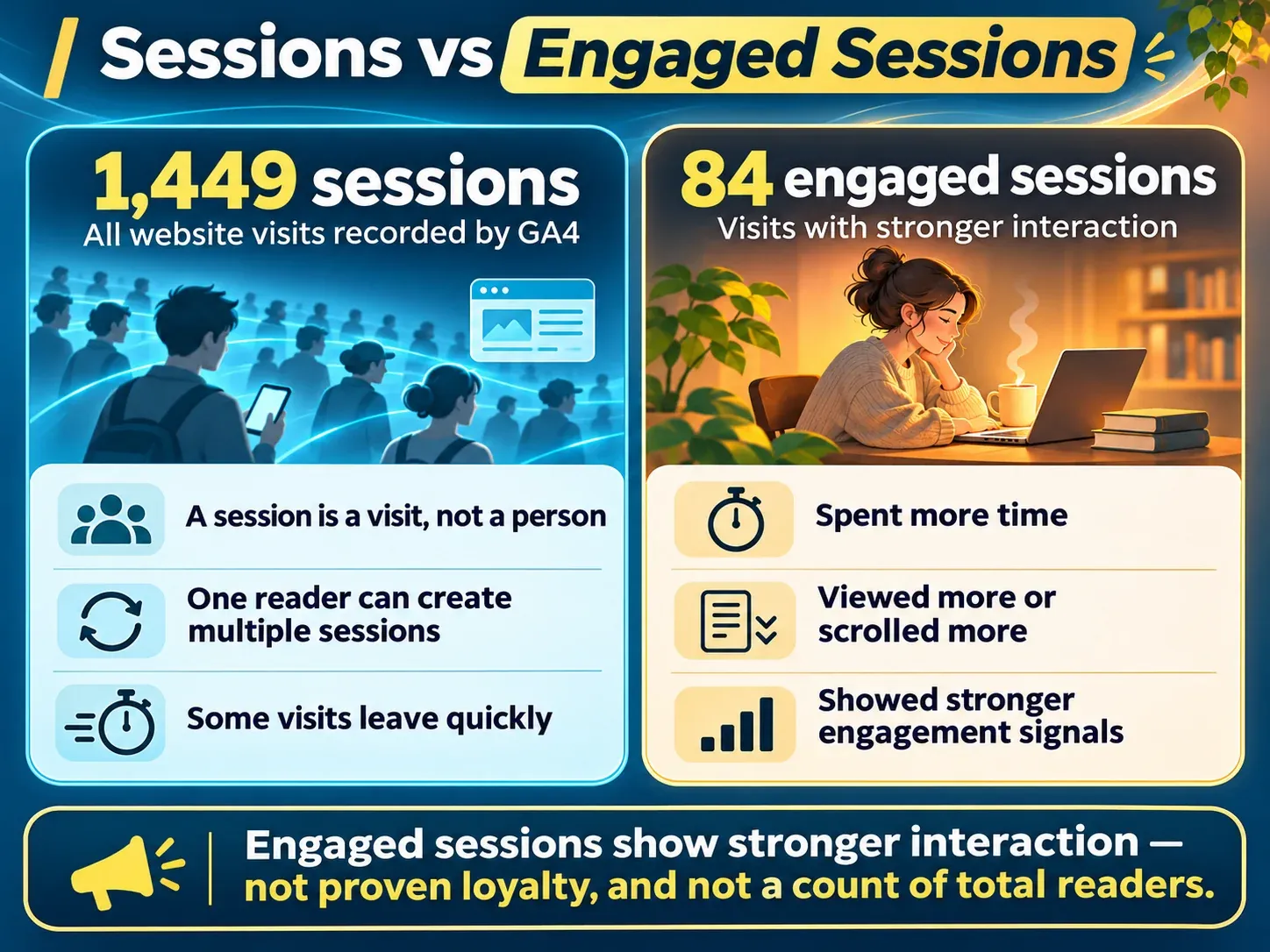
Illustration, not a live analytics screenshot. GA4 counts an engaged session when it meets the configured engagement-time threshold, records a key event, or has at least two page/screen views; scrolling alone does not automatically qualify. The figures come from the table above, not from the illustration.
The table is useful precisely because it tells me what not to infer.
Direct is not shorthand for a loyal audience
Direct accounts for 1,084 of the sessions in that period. I could pretend those visitors typed xbstack.com from memory. But Google describes Direct as a traffic-source category used when there is no clearly identifiable referral source. Bookmarks and typed URLs are possible, but so are visits whose attribution is unavailable.
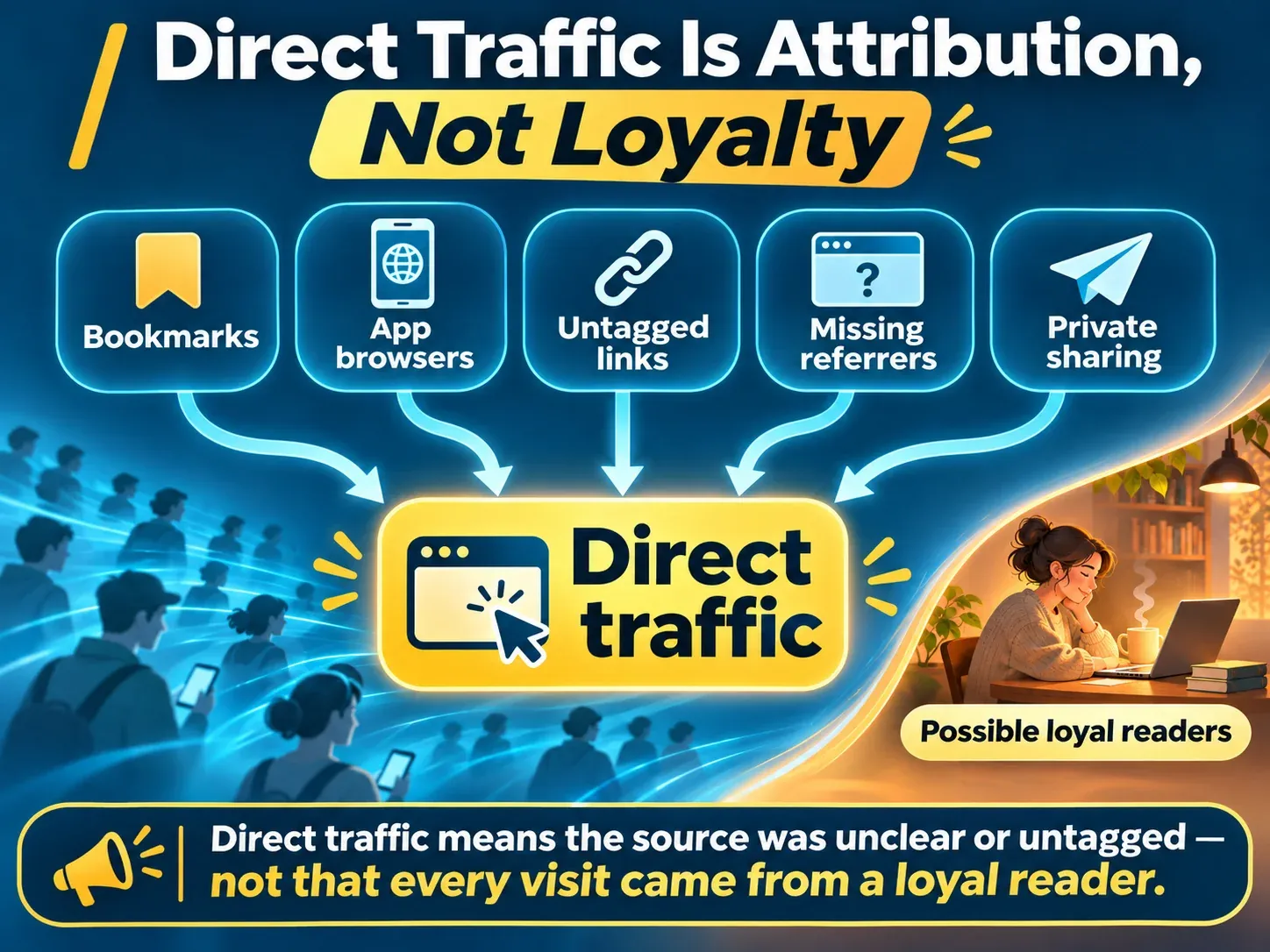
Conceptual attribution paths: these sources can end up classified as Direct when referral information is missing; they are not invariably classified as Direct, nor are they a count of loyal people.
This distinction matters to a site that distributes writing across technical communities and social platforms. Links can pass through in-app browsers, redirects and other intermediaries. Some arrive without the original context. If the analytics report cannot identify a source, it does not suddenly identify a loyal person.
The opposite claim would be careless too: I have no basis to call all Direct traffic bots. I would need independent evidence about actual requests, events and sources before drawing that conclusion.
Even referral traffic needs context. CSDN contributed 79 sessions and three engaged sessions. That does not establish the platform is useless; someone can read a useful answer and leave quickly. Juejin’s sample is smaller still, so the engaged-session proportion can swing dramatically with only a handful of events. A source becomes meaningful when I understand which problem it sent a reader to, rather than just seeing a domain name in a channel table.
Search Console is a different view of a different step
XBSTACK’s Search Console data currently ends November 16, two days earlier than the GA4 window above. It records 33 impressions and zero clicks over its latest complete seven days; the preceding seven days recorded 238 impressions and two clicks.
It would be easy to label that a collapse in search demand. However, some of the site’s visible queries are site: diagnostic searches rather than ordinary reader questions. And the reporting window is not the same as the GA4 one. As Google explains when comparing Search Console with Analytics, one system observes search-result visibility and clicks; the other records on-site activity. They cannot be combined into a conversion funnel by casually dividing one total by another.
I therefore want to separate actual problem queries from diagnostic checks before deciding a title needs rewriting. The useful sequence is: What did someone search for? Which result did they see? Which page did they reach? What could they reasonably do next?
A personal website should not turn every visit into a fictional user
For a programmer or independent developer running a personal site, more visits do not by themselves establish growth in a lasting audience. Here “independent website” means a self-published content site like XBSTACK, where the question is reading and return visits—not an e-commerce store’s order conversion rate.
Running an independent technical and editorial site makes measurement attractive. There are countable articles, release commits, impressions, redirects, referral posts, tools, views and events. Each is real in its own way. Each can also become a stand-in for progress when the underlying task is harder to evaluate.
XBSTACK is meant to hold more than a list of technical answers. It brings together engineering notes, product experiments, reading, investing and observations about ordinary life. A developer might land here to fix an MCP transport error; another reader may arrive through an essay about money or independent work. I want the site to give both people a coherent reason to explore. That does not mean inserting the same promotional block into every article. It means linking genuinely related questions and allowing the author’s work to speak for itself.
I cannot yet prove that people are returning for that broader relationship. Aggregate session counts do not give me that evidence. Newsletter opt-ins, meaningful next-page journeys and repeated legitimate tool use could become stronger signals, but only when the events are implemented, consented to, validated and deduplicated. None is a magic definition of loyalty.
Three small tests worth more than another traffic headline
First, change titles only when a real query and page justify it. Use Search Console’s actual query-page-country-device observations; remove site: and other monitoring queries from audience-demand conclusions. A page with zero clicks and no meaningful queries does not automatically have a headline problem.
Second, make the next reading step specific. After an MCP security guide, a reader may want the MCP topic hub; someone studying a local AI product may continue to the personal AI architecture discussion. Readers of this essay can browse Horizon for more work and life decisions. These are editorially plausible paths, not established evidence that anyone has clicked them.
Third, stop treating publishing operations as audience outcomes. A GitHub reply is not a new reader. A successful deployment is not a Google crawl. A submitted sitemap is not an indexed article. A visit from a platform is not necessarily a person who stayed. Each part needs its own evidence and date.
I want to review the following 7–14 days with these distinctions intact, rather than discovering another attractive total and inventing a story around it.

The four steps describe what an independent publisher would need to measure. They are a proposed reader journey, not a claim that XBSTACK has already observed repeat visitors or proven loyalty.
Traffic matters, but it is the beginning
I still care about search visibility and referral traffic. A website that nobody can find has limited opportunity to help anyone. Yet the distance between 1,449 sessions and 84 engaged sessions is a reminder that being visited is not the same as having built a lasting audience.
The long-term work is less glamorous: write something genuinely useful, give the reader a sensible next step, earn the right to be remembered, and measure only what the available systems can actually support.
When I reopen the report, the question I want to ask is not merely, “Did traffic go up?” It is: Did more people find a specific answer here—and did the site give them a credible reason to read further or return?
This is a public editorial reflection on aggregated XBSTACK operational data. It does not identify any visitor, assert a bot fraction, or claim a proven increase in loyal readers.
Next step: test the next assumption
Full decision path →Continue with the decision framework, evidence, or review that changes the next action.

DISCUSSION
Questions, verification and corrections
Sign in to comment. Every new comment is reviewed before publication; while pending, it is visible only to you and the administrator.