

Why Did the Great Depression Deepen After the 1929 Crash? Reading Friedman and Schwartz
Why did the Great Depression deepen after 1929? A reading of Friedman and Schwartz on bank runs, the money stock, gold-standard constraints, Fed policy and credit.
Evidence 7 cited sources
On this page
Why Did the Great Depression Deepen After the 1929 Crash? Reading Friedman and Schwartz
The stock-market crash of October 1929 is often treated as the defining event of the Great Depression. It is an easy story to remember: prices collapsed, investors panicked, businesses cut spending, and the economy fell apart. But Milton Friedman and Anna J. Schwartz ask a more difficult question in A Monetary History of the United States, 1867–1960: why did the downturn keep deepening instead of following the pattern of a severe but recoverable recession? Their answer directs attention away from stock prices alone and toward the banking system, the shrinking stock of money, and the Federal Reserve’s failure to prevent a monetary collapse.
This note focuses on Chapter 7, “The Great Contraction, 1929–33,” rather than pretending to summarize the entire book. The original 1963 volume traces changes in the U.S. money stock from the post-Civil War period to 1960 and examines how monetary developments interacted with economic activity. The Great Contraction chapter is a concentrated historical case study. Its lasting value is not the slogan that “money matters,” but the mechanism through which a banking panic can turn an economic downturn into a much deeper contraction.
The crash did not immediately become a banking panic

One detail in Friedman and Schwartz’s account is easy to miss: the October 1929 stock-market crash did not immediately trigger a generalized loss of confidence in commercial banks. The authors describe its direct financial effects as largely confined to the securities market. Depositors did not immediately begin withdrawing funds because they feared their banks would fail. Economic activity had already begun weakening, and the crash intensified uncertainty, but it cannot by itself explain the later collapse in the money stock.
The character of the contraction changed in the autumn of 1930, when waves of bank failures began. Friedman and Schwartz record that 256 banks suspended operations in November 1930, with about 370 million in deposits in December. On December 11, the Bank of United States—a commercial bank, not the U.S. central bank—closed. Its name had led many people at home and abroad to assume that it had some official standing, so its failure dealt a particularly damaging blow to confidence.
At that point, the crisis was no longer simply about investors losing money in the stock market. Depositors tried to convert bank deposits into currency. Banks, seeking to protect their own liquidity, held more reserves and reduced lending. Deposits and credit that had supported ordinary transactions began to contract. The financial system was no longer merely suffering from the recession; it was transmitting an additional shock to households and businesses.
Why a shrinking money stock can deepen a downturn
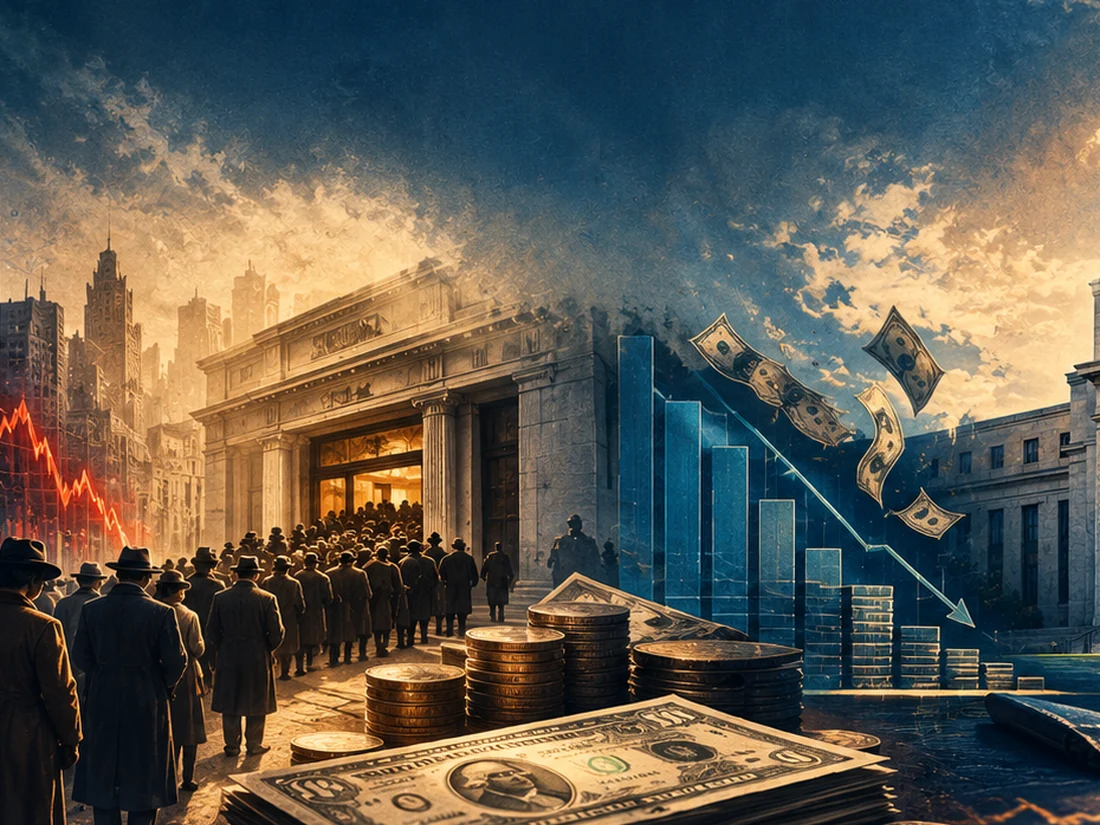
Friedman and Schwartz’s central contribution is to connect bank failures with changes in the money stock. By their historical measure, the U.S. money stock fell by more than one-third between the cyclical peak in August 1929 and the trough in March 1933. More than one-fifth of commercial banks suspended operations because of financial difficulties; those institutions had held nearly one-tenth of commercial-bank deposits at the beginning of the contraction. The authors also report that money income fell by about 53 percent and real income by about 36 percent over the four-year period. At the trough, roughly one person was unemployed for every three employed. These are the historical national-income and monetary measures used in the book; they should not be casually relabeled as modern GDP or today’s M1 series.
The mechanism can be understood as a feedback loop. Depositors withdraw cash because they fear for their savings. Banks respond by holding more reserves and making fewer loans. The money stock and the availability of credit contract. Nominal income and prices fall, while existing debt obligations do not automatically shrink at the same rate. Borrowers come under greater pressure, defaults rise, and the quality of bank assets deteriorates. That in turn makes depositors and lenders more cautious. A local liquidity shock can therefore spread through bank networks, credit relationships, and expectations.
Two concepts need to be kept separate. A liquidity problem occurs when an institution cannot meet payments as they fall due, even if its longer-term assets may be worth more than its liabilities. A solvency problem exists when the value of assets or future cash flows is insufficient to cover obligations. A bank run can expose a liquidity mismatch; it can also accelerate the failure of an institution whose assets are already impaired. Treating every bank failure as a run on a fundamentally sound bank—or treating every run as proof that the bank was already insolvent—misses the distinction.
Why did the Federal Reserve fail to stop the contraction?

Friedman and Schwartz do not explain the Federal Reserve’s failure simply by saying that it lacked tools. In their account, the System already had powers to provide liquidity and conduct open-market operations. The problem was that policy doctrine, institutional structure, and disagreements among decision-makers prevented those tools from being used with sufficient force and consistency.
One influential view was the Real Bills Doctrine. In simplified terms, some policymakers believed central-bank credit should expand with the demand for commercial transactions and contract when economic activity weakened. Others held more liquidationist views, believing that allowing weak financial institutions to fail would help cleanse the system. Both approaches underestimated the contagious nature of bank runs. When depositors cannot tell whether a bank is temporarily short of cash or fundamentally insolvent, fear can spread beyond the original institution.
The international gold standard added another constraint. After Britain left gold in September 1931, concern about the dollar’s convertibility increased pressure on U.S. gold reserves. The Federal Reserve raised discount rates to respond to the external drain, but did not offset the domestic banking pressure with sufficiently forceful open-market purchases. The policy problem was not simply whether to lower one interest rate. It involved competing pressures from gold reserves, international capital flows, bank runs, and domestic credit conditions.
In the spring and summer of 1932, the Fed purchased roughly $1 billion in government securities. Bank failures temporarily slowed, and economic activity showed signs of improvement. But the policy was not sustained; banking stress returned, and the crisis culminated in the nationwide banking holiday of March 1933. Friedman and Schwartz’s counterfactual is that earlier and more persistent action could have prevented the monetary system from collapsing. They do not need to claim that such action would have eliminated every cause of the downturn. Their narrower point is that the contraction could have been much less severe.
The opening of Chapter 7 in the 1965 standalone edition states: “The monetary system collapsed, but it clearly need not have done so.” The sentence is not a claim that central banks can abolish recessions. It is a claim about institutional responsibility: the actions—and inactions—of a central bank can determine how far an initial shock is amplified.
What later research adds—and challenges
It would be too simple to read the book as proving that the Federal Reserve alone caused the Great Depression. Peter Temin emphasized consumption and export shocks, arguing that declines in economic activity could themselves reduce money demand and influence the money stock; he did not treat an autonomous collapse in investment as the central explanation for this period. In her 1987 retrospective, Anna Schwartz responded that the relationship between money and income was not a one-way causal story. Economic activity can affect money, while monetary disturbances can also affect economic activity. The question is whether the monetary influence is large enough to matter materially.
Ben Bernanke’s 1983 research added another mechanism. Bank failures did not matter only because they reduced the money stock. Banks and other financial intermediaries gather information, screen borrowers, and maintain lending relationships. When those institutions fail, households, farmers, and small firms may face higher borrowing costs and less access to credit even if they still want to borrow. This “credit-intermediation channel” helps explain why a financial crisis can depress real activity for an extended period. It complements the monetary account rather than simply replacing it.
Other work challenges the estimated size of particular channels. In a 2001 general-equilibrium study, Harold Cole and Lee Ohanian argued that, under their model assumptions, the loss of banking-intermediation capital caused by bank closures could account for less than one percent of the output decline. That result does not disprove the historical fall in the money stock or settle the role of Federal Reserve policy. It challenges how much of the overall output collapse can be attributed to one specific banking-intermediation mechanism. The answer depends partly on assumptions about alternative sources of finance and the way the value of banking services is measured.
The more defensible conclusion is therefore not that “money explains everything,” nor that money was merely a passive reflection of falling output. The initial downturn, bank panics, monetary contraction, damaged credit intermediation, gold-standard constraints, and policy delays interacted. No single variable explains the entire sequence.
What can investors and business operators take from the book?
The practical lesson is not a trading rule such as “sell when money growth slows” or “buy when the central bank expands its balance sheet.” It is a warning against treating one macroeconomic indicator as a complete description of financing conditions. A lower policy rate does not guarantee that every company can obtain a loan. An increase in central-bank liquidity does not guarantee that credit reaches small businesses, households, or productive investment projects. Credit spreads, bank risk appetite, collateral values, maturity structures, and operating cash flow all influence whether monetary policy reaches the real economy.
For company analysis, four questions are useful. How much cash is available relative to short-term obligations? What debt maturities are concentrated in the next twelve months? Does the business depend excessively on one bank, one market, or one form of collateral? Can operating cash flow sustain essential spending if external financing becomes harder to obtain? For financial institutions, the analysis should also include deposit composition, asset-liability maturity mismatches, loan quality, liquidity reserves, and dependence on wholesale funding.
I would keep macro analysis and company analysis in separate records. At the macro level, track money, credit, real interest rates, and bank lending conditions. At the company level, examine cash flow, debt maturities, financing costs, and solvency. Then test whether there is evidence of a transmission mechanism between the two. It is also important to write down what evidence would change the original view, rather than collecting only facts that confirm it. This is a proposed research discipline, not a tested investment strategy or a forecast for any market.
The question worth keeping
The Great Contraction is best understood not as a single bad event, but as a system with transmission channels. The stock-market crash was a shock; bank panics amplified it; monetary and credit contraction became feedback mechanisms; and the Federal Reserve’s institutional structure and policy beliefs influenced whether the system could correct course. Separating these stages helps avoid explaining everything with the phrase “market panic,” and it also prevents us from assuming that a rate cut automatically means financing conditions have improved.
The book’s most useful lesson is not that money determines everything. It is a stricter way of asking questions: Where did the flow of funds stop? Were banks managing risk or amplifying it? Did the central bank have the tools to respond, was it willing to use them, and could its structure support coordinated action? Did policy actually reach businesses and households? When those questions remain unanswered, a broad macroeconomic label should not be turned into an investment conclusion.
Reading is not about finding one explanation that is always right. It is about making the next judgment easier to test against evidence.
For context, compare this chapter with the first reading on the 1867 U.S. money-stock series and the reading on The Great Game and financial-market narratives.
A related question is why macroeconomic growth and ordinary financing conditions can diverge; see why GDP growth can feel different from household income and spending.
Edition, sources, and scope
This note focuses on Chapter 7, “The Great Contraction, 1929–33,” in Milton Friedman and Anna J. Schwartz’s A Monetary History of the United States, 1867–1960 (Princeton University Press, 1963), and cross-checks the authors’ 1965 standalone edition and the NBER chapter text. The short quotation above is from page 111 of the 1965 standalone edition; pagination differs across editions. The discussion of credit intermediation and model-based estimates comes from later research and should not be attributed to the original authors.
- Friedman & Schwartz, A Monetary History of the United States, 1867–1960 (NBER book record)
- Friedman & Schwartz, The Great Contraction, 1929–33 (NBER book record and contents)
- The Great Contraction, original chapter excerpt (Princeton University Press PDF)
- Why Was Monetary Policy So Inept? (Friedman & Schwartz, 1965, Chapter 7)
- Anna J. Schwartz, Understanding 1929–1933 (1987)
- Ben S. Bernanke, Nonmonetary Effects of the Financial Crisis in the Propagation of the Great Depression (1983)
- Cole & Ohanian, Re-Examining the Contributions of Money and Banking Shocks to the U.S. Great Depression (2001)
- Federal Reserve History, The Great Depression
- Federal Reserve History, Banking Panics of 1931–33
Next step: test the next assumption
Full decision path →Continue with the decision framework, evidence, or review that changes the next action.

DISCUSSION
Questions, verification and corrections
Sign in to comment. Every new comment is reviewed before publication; while pending, it is visible only to you and the administrator.