

Why More Website Articles Still Bring No Traffic: A Real 592-URL Audit
Why can a personal website publish hundreds of pages without meaningful organic traffic? This XBSTACK field audit examines 592 sitemap URLs, six orphaned routes, crawl and index evidence, and a real Cloudflare release.
Evidence 5 cited sources
On this page
Why More Website Articles Still Bring No Traffic: A Real 592-URL Audit
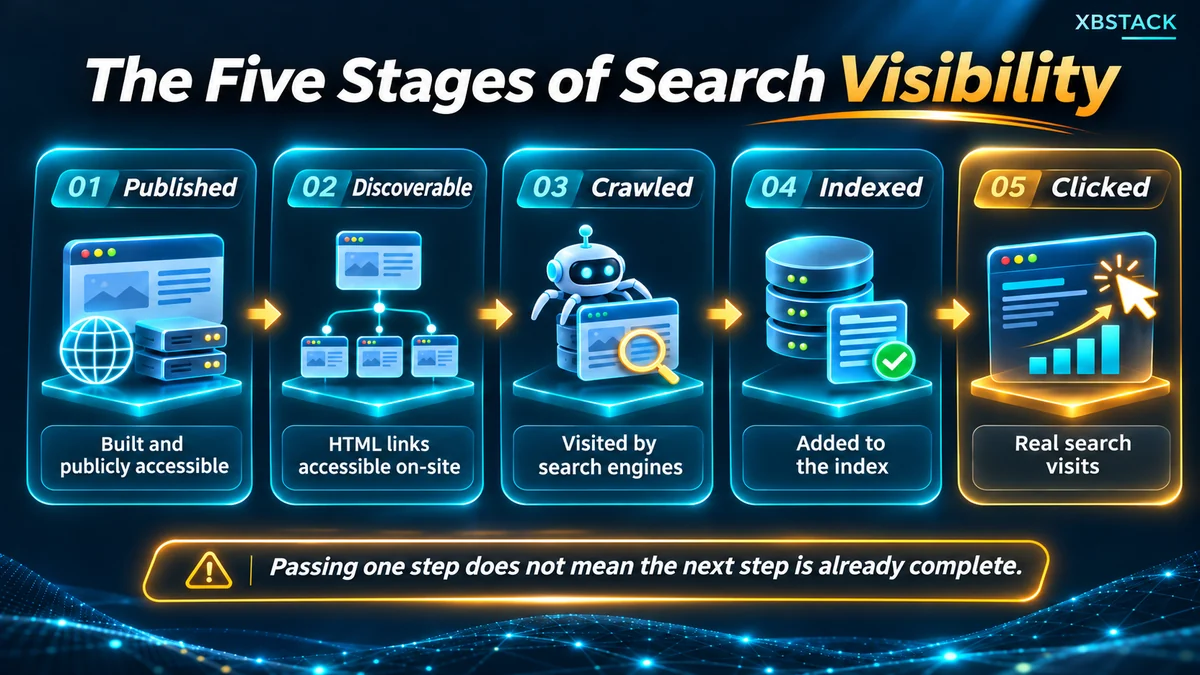
You publish another article, then another. You add topic pages, tools and product pages. The sitemap keeps growing, but organic traffic barely moves. The easy response is to write more, rewrite headlines, or resubmit the sitemap. Yet having a live URL, making it discoverable from your website, getting it crawled, earning indexation and attracting a search click are five different outcomes.
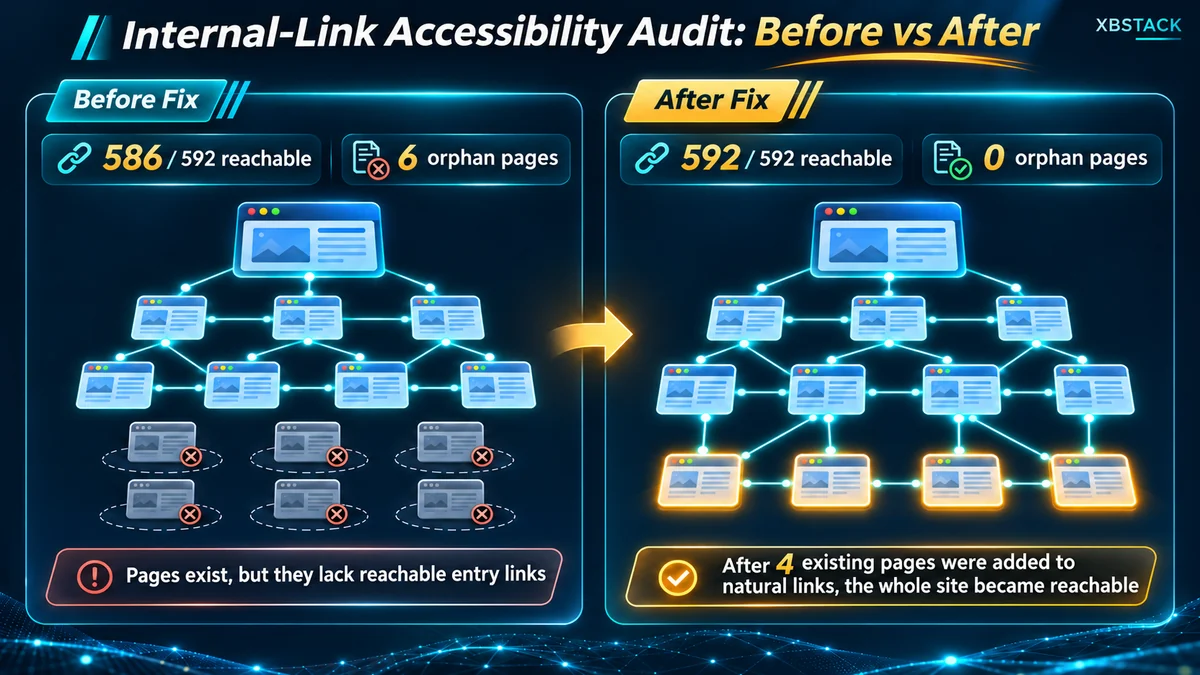
I ran into that distinction while maintaining XBSTACK on November 11, 2026. Its published sitemap contained 592 URLs. The first site-wide audit of ordinary rendered HTML links found that only 586 of those routes could be reached starting at the Chinese and English homepages. Six existing pages had no reachable inbound link path. Their HTML files were present, and the sitemap listed them; they were simply disconnected from the normal internal discovery graph. After targeted repairs, the same type of check passed at 592 of 592.
This is not a promise that Google suddenly indexed all 592 pages. It is a reproducible account of what was wrong, how I inspected the static output, what changed in four existing pages, and what the evidence cannot prove. The earlier 160-post content quality journal discusses why content volume is not an editorial strategy. This article has a narrower technical task: verify the sitemap-to-HTML discovery chain without mistaking deployment evidence for search growth.
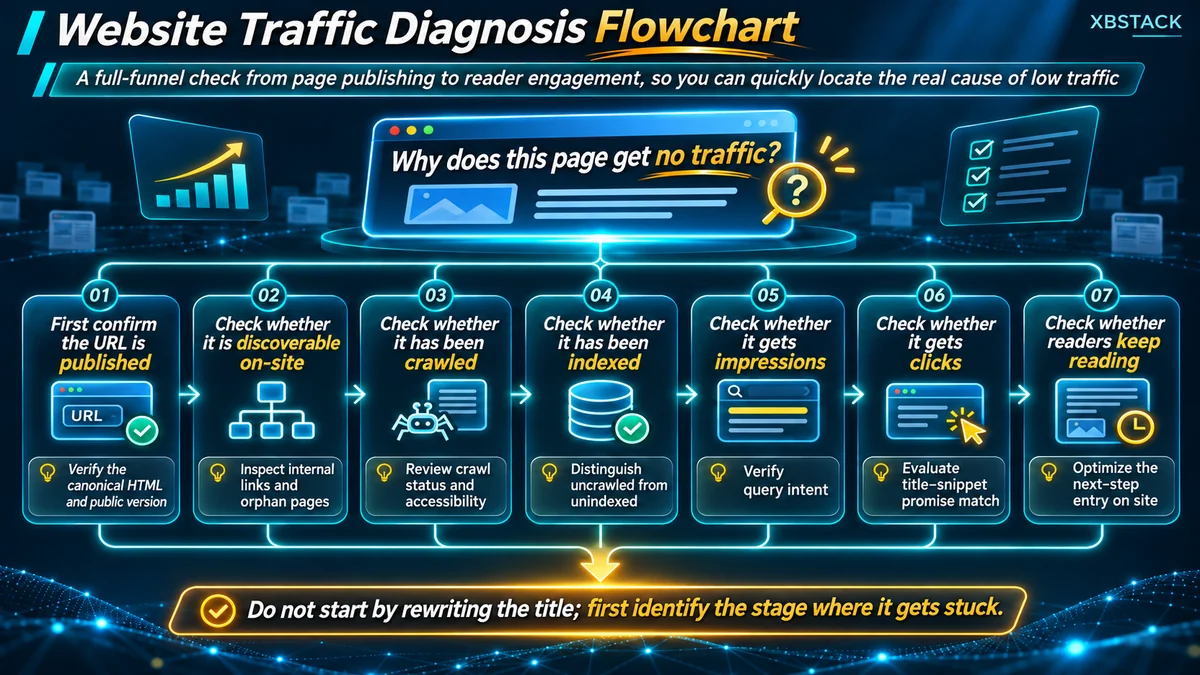
First, separate five very different “no traffic” problems
| What you observe | First evidence to inspect | What not to do immediately |
|---|---|---|
| A URL is live but not linked from the site | Built HTML, homepage and topic-page anchors | Mass-rewrite titles |
| The sitemap includes a URL but Google has not crawled it | URL Inspection, crawl access, robots and actual links | Resubmit unchanged XML several times daily |
| Google crawled a page but did not index it | Canonical, distinctive content, duplicates, status | Assume every exclusion is a crawl-budget problem |
| A page gets impressions but no clicks | Query intent, SERP snippet, headline and page promise | Change the slug from a tiny sample |
| A page gets clicks but readers do not continue | Whether the task is answered and meaningful next links exist | Treat all GA4 sessions as valuable organic visitors |
Google’s own sitemap guidance makes the essential point: XML sitemaps help search engines discover URLs, but do not guarantee crawling or indexing. You need to know which layer your site has actually failed before choosing a repair.
The real baseline: 592 sitemap entries, 586 reachable, six orphaned
| Measurement | Before link repair, Nov 11 | After link repair |
|---|---|---|
| Production sitemap URLs | 592 | 592 |
| Sitemap URLs reachable through homepage-seeded HTML links | 586 | 592 |
| Historical orphan routes | 6 | 0 |
| Missing HTML for sitemap entries | 0 | 0 |
| Existing HTML pages actually edited in the release | — | 4 |
592 URLs are not 592 blog posts. The XML list includes articles, hubs, tools, products and other public routes. “Reachable” also means something precise here: there is a traversable path through the site’s static HTML anchor graph. It does not mean that a real Googlebot request, indexing decision or search impression was observed.
The six disconnected routes were:
/guides/— the Chinese learning-path collection;/en/guides/— the English learning-path collection;/guides/ai-agents/— a legacy Agent study path;/guides/self-hosted/— the historical self-hosting learning path;/lens/— a previous Lens index;/zh-tw/products/lunest/— the Traditional Chinese Lunest product introduction.
None of these six was evidence of a missing HTML file or an HTTP 404. Each had an actual route and sitemap record. The problem was the absence of a viable internal link path from the starting pages. That is why this incident differs from the site’s earlier 404 and external-link investigation, linked in the further-reading section below.
Reproduction: compare sitemap XML against rendered HTML links
I did not estimate site size using a site: search, nor did I assume that a Markdown link in a source file necessarily appears in the published page. The actual repository audit lives at:
scripts/audit-discovery-coverage.py
From the repository root, the read-only audit of the published static tree is:
python3 scripts/audit-discovery-coverage.py \
  --root deploy \
  --baseline deploy \
  --report reports/search-notification/discovery-coverage-latest.json
Before a new release, --root instead refers to the freshly frozen, immutable static snapshot, while --baseline remains the previously published deploy tree. This distinction matters: scanning dist while a concurrent build is still writing files can produce a misleading partial graph.
The script performs five separate checks:
- Sitemap inventory. Read each
<loc>fromsitemap-0.xmland reject a duplicate, malformed or foreign-domain URL. - File existence. Resolve the route to its emitted
index.html, distinguishing missing files from valid but unlinked pages. - Actual HTML graph. Seed a breadth-first search (BFS) at
/and/en/. Parse ordinary HTML anchor elements with a realhrefattribute and normalize same-origin relative URLs, and exclude irrelevant fragments, mail links and nofollow paths. - Reachability and inbound edges. Compare
sitemap URL set − BFS visited set, then inspect missing inbound paths. Against the previous release, distinguish genuinely new orphans, previously reachable pages losing a route, and legacy orphan debt. - Pre-release decisions. Fail the release if a sitemap HTML target disappeared, a newly published URL is orphaned, or a previously reachable URL becomes undiscoverable. Report known historic orphans separately rather than deleting URLs to make a dashboard green.
This is a static HTML graph test, not a simulation of all Googlebot rendering or an external crawl. It cannot establish page relevance, link quality, dynamic JavaScript navigation, backlinks, ranking or real indexing eligibility. It deliberately tests the basic path Google recommends: crawlable anchor links with an actual href.
Why four contextual edits solved six route gaps
It would have been easy to put six URLs into the main navigation and force the audit to pass. But navigation should represent reader tasks, not a machine-coverage target. Instead I placed relevant links in four already published HTML pages:
| Edited page | Reader path restored |
|---|---|
| Chinese Builder Log | /guides/, /guides/ai-agents/, /guides/self-hosted/ |
| English Builder Log | /en/guides/ |
| Life field notes | /lens/ |
| Lunest product page | /zh-tw/products/lunest/ |
The main navigation, six legacy URLs and their canonical addresses stayed unchanged. Four human-readable body edits brought all six older destinations back into the link graph. The resulting report showed 592/592 reachable, zero no-inbound sitemap routes and zero missing HTML targets.
This distinction is editorial as much as technical: an inbound link must make sense to someone reading the surrounding paragraph. A set of unrelated, hidden “SEO links” might increase an internal metric while degrading the site. The reason to restore each link was that the destination could answer the reader’s next plausible question.
A successful Git push is not a verified Cloudflare release
There is another common trap in small publishing workflows: assuming that git push means the current HTML is now live everywhere. In practice, the pipeline includes a successful static build, an immutable artifact, the public Git update, platform deployment and CDN propagation.
For this scoped repair I used an independent public-version checker:
python3 scripts/verify-public-deployment.py \
  --before 06d356fea4044e39c34c4e97a6c43fa8765c62bd \
  --after c2bf06bc17e45c6705b89926e3eef5b603d66d8f
The actual November 11 release receipt reported four changed routes verified, 11 public pages checked, all 592 sitemap entries matching, and PASS. It compared the expected public HTML content fingerprints, canonical information and sitemap to the live site. A bare HTTP 200 would not have been sufficient, because a CDN might still serve an older valid page.
The publication tool only notified search services after the live-version check passed. For these four changed URLs, IndexNow accepted four (HTTP 200) and the Google Sitemap submission succeeded. This is evidence of successful notification, not proof that Bing or Google subsequently crawled these pages.
A different denominator: 591 Google-inspected URLs, 404 indexed
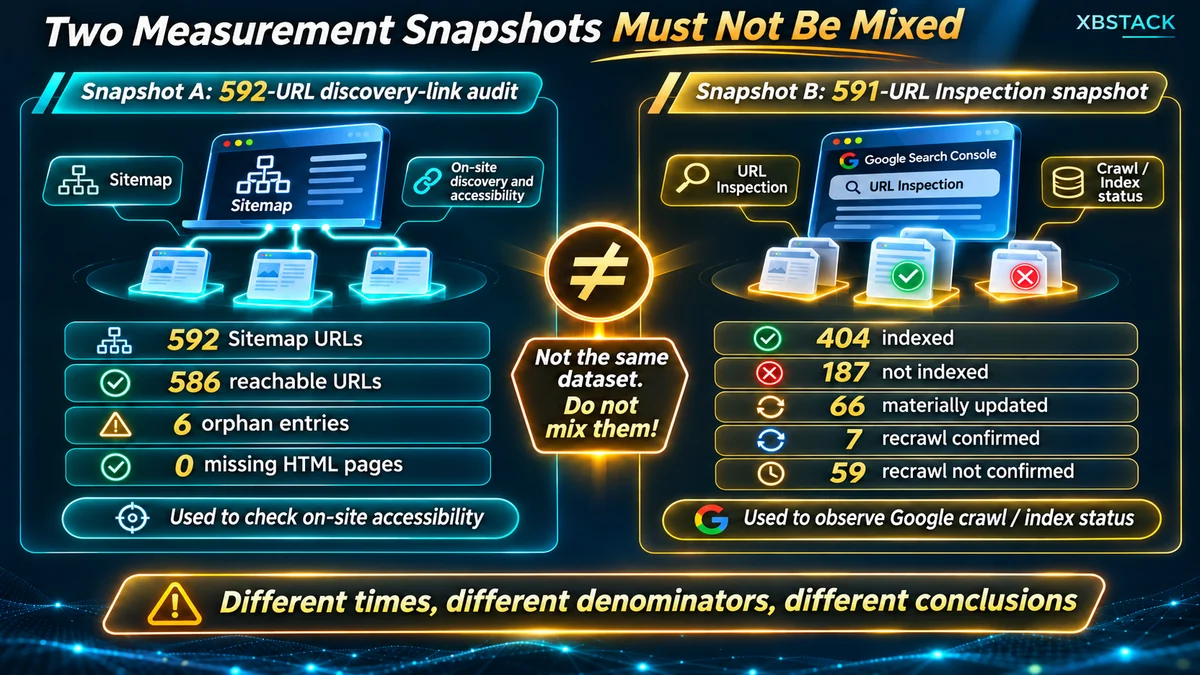
An earlier separate Google Search Console URL Inspection snapshot on the same day covered the previous 591-URL sitemap inventory:
| Inspection measurement | Result |
|---|---|
| URLs inspected | 591 |
| Confirmed indexed | 404 |
| Confirmed unindexed | 187 |
| URLs with genuine content-update evidence | 66 |
| Confirmed recrawled after that update | 7 |
| No confirmed post-update recrawl | 59 |
It would be incorrect to report “404 of 592 were indexed.” These are two different historical snapshots and different denominators. It would also be incorrect to attribute all 187 unindexed URLs to the six orphan routes. The unindexed records covered different situations, including discovered but not crawled, crawled but not indexed, and URLs not known to Google at that inspection point.
For an engineer diagnosing those states, the next action depends on the evidence:
- Discovered – currently not indexed: check real HTML paths, access restrictions, response health and distinct page purpose. Do not leap directly to “we need more crawl budget.”
- Crawled – currently not indexed: review the canonical, duplicate task intent, content originality and whether the rendered page gives a useful answer.
- Updated but not confirmed recrawled: check that the page really changed, that the
lastmodrecord reflects a dated substantive edit, and that the monitoring window has elapsed. Do not create freshness signals from unchanged pages. - Impressions but no clicks: inspect real query intent, sample size and SERP promises before editing the title or changing the route.
URL Inspection’s lastCrawlTime is the last known crawl timestamp, not a real-time Googlebot access log; the Google crawling and indexing FAQ explains related status limitations. Google’s crawl-troubleshooting documentation explicitly separates crawl and indexing concerns and cautions against expecting immediate recrawls from every sitemap update.
Why I did not mass-rewrite the old headlines
Another XBSTACK observation illustrates how easily metrics can be misread. In a complete GSC query-analysis window ending on November 7, an AI financial-report guide had 48 impressions, an average position of about 7.92 and zero clicks. Yet the same report supplied no usable matching queries. That is not enough evidence to say the headline is weak, or to predict a lift from rewriting it.
I would rather learn the concrete task that produced the impressions and compare the actual answer with what the searcher expected. The separate Search Console CTR field note covers the search-result headline and snippet problem; this page focuses on what is verifiably reachable before a search engine decides to rank it.
A practical audit checklist for another personal site
You do not need a new paid SEO platform to start:
- Count URLs precisely. Save the sitemap and its timestamp; separate articles, category hubs, tools and products. Do not mix inventories from different releases.
- Count real rendered entry paths. Traverse the Chinese/English homepage HTML graph, compare it to the sitemap, and distinguish missing HTML from missing inbound anchors or incorrect legacy routes.
- Repair meaningful next steps. Add relevant links within articles, learning paths and product descriptions rather than bloating sitewide menus.
- Verify a deployed version. Compare real page content, canonical tags and the sitemap with the intended immutable release, rather than trusting only the build or Git push.
- Measure search stages independently. Review URL discovery, confirmed crawls, indexation, GSC impressions, qualified search clicks and eventually reader return. Record dates and denominators at every stage.
The verified fix here was narrow and useful: six existing pages had HTML and sitemap entries but no normal internal path from the selected homepage seeds. Repairing that gap removed one preventable source of discovery debt. It did not create evidence of increased Google indexation or organic sessions, and it did not make every page automatically valuable to readers.
My longer-term reason for maintaining XBSTACK is not a counter that rises every day. It is a collection of trustworthy answers, tools, real product decisions and field notes that a visitor can still navigate years from now. A reproducible audit—and a clear statement of what it does not prove—is part of earning that trust.
Sources and further reading
- The 160-post Builder Log and content audit — the earlier editorial organization problem, rather than a duplicate of today’s graph test.
- Web Builder Log hub — ongoing Astro, Cloudflare, publishing and search operations.
- Search Console impressions without clicks — distinct CTR and intent troubleshooting.
- The external-link 404 incident — actual broken URLs, not valid orphan HTML pages.
- Google’s XML sitemap guidance, crawlable link practices and crawl diagnosis.
Evidence date: November 11, 2026. The 592-URL rendered-link audit, earlier 591-URL URL Inspection snapshot, four-page Cloudflare release and IndexNow acknowledgements are separate observations, not a real-time indexation total. Images are GPT-created conceptual illustrations, not screenshots of a Google dashboard.
Next step: continue the Agent system
Full decision path →Choose the next architecture, tool, memory, evaluation, security, or production decision instead of starting over.

DISCUSSION
Questions, verification and corrections
Sign in to comment. Every new comment is reviewed before publication; while pending, it is visible only to you and the administrator.