

What Is Pydantic Pax? Comparing Codex, Claude Code and the Future of Agent Harnesses
What is Pydantic Pax? Compare seven coding tools, pinned source, eight-model SWE81 data, measured offline Code Mode behavior, installation and security.
Evidence 40 cited sources
On this page
What Is Pydantic Pax? Comparing Codex, Claude Code and the Future of Agent Harnesses
On November 25, 2026, Pydantic introduced Pax and the public beta of its AI Harness. Pax is a terminal coding assistant built on a composable harness SDK, not a new foundation model. The release separates model choice, execution capabilities, workspace and interface, offering developers another approach alongside Codex and Claude Code.
By November 27, XBSTACK had inspected three pinned distributions, recomputed the published eight-model SWE81 results and completed an isolated installation, CLI startup check and 60 timed offline harness runs on an M1 Pro. The synthetic dependent tool-chain experiment found that Code Mode reduced elapsed time with substantial injected request delays but increased overhead without those delays. No hosted commercial model was called; the experiment does not establish superior coding performance. The important question raised by this release is whether different execution frameworks can deliver better outcomes, lower costs and verifiable security boundaries with the same model.
Pax is worth evaluating, but the evidence does not yet justify replacing Codex or Claude Code across an established workflow. The more consequential proposition is an execution SDK that applications can assemble independently of the terminal interface. This article uses public documentation and research available on November 27. It includes isolated installation, CLI startup and measured offline Harness behavior, but not an independently executed commercial-model benchmark.
If you are choosing an AI coding assistant, separate three questions: Pax is a multi-model terminal tool, not a new foundation model; open-source software does not make inference free; our M1 Pro measurements validate installation, CLI startup and a fixed synthetic tool chain, not superiority on real coding tasks. The sections below explain installation, selection, measured overhead and safety boundaries.
Related research: AI tooling and evaluation research.
1. What Pydantic released
Pydantic is well known for Python data validation. That heritage is relevant to agents because plausible model outputs still need to become valid application inputs, although it does not establish superior coding quality.
Pax is distributed as pydantic-ai-pax. The PyPI 0.75.0 release records a November 25 release date, MIT licensing and a Python 3.11 minimum. This is the pinned release reference for this article, not a claim that it is the latest version. Open-source licensing does not make model calls or hosted execution free. Four layers are worth separating:
| Layer | Responsibility | Adoption question |
|---|---|---|
| Pydantic AI | Agent loop, models, tools and structured output | Do we need an agent inside an application? |
| Harness SDK | Reusable execution components | Which components fit the workflow? |
| Coder | Bundled coding capability | Can we reuse an existing coding workflow? |
| Pax | Terminal experience and plugins | Should this be our interactive entry point? |
The Harness documentation and Coder reference explain how applications can reuse the components independently. The terminal is not a mandatory dependency of a custom coding agent.
This separation is useful, but interchangeable interfaces do not guarantee identical behavior. Changing a model or workspace can alter security, output handling and recovery.
Pydantic’s commercial position
It would be misleading to treat Pax as the auxiliary client of a foundation-model vendor. Pydantic’s company announcement established the open-source project as a foundation for the business. The subsequent Logfire launch and Series A announcement expanded that foundation into observability. Its current enterprise offering distinguishes the open-source framework from commercial support, observability and gateway services; the Gateway integration announcement documents the consolidation of one of those services.
The original validation library addressed a relatively deterministic problem: turning unchecked data into values an application could depend on. An agent adds a more difficult category of inputs. Its tool arguments, execution results and accumulated task state may have valid schemas while still describing an unauthorized or incorrect action. Validation is necessary but insufficient. A correctly typed deletion request can still address the wrong object, and a well-formed completion report can describe tests that never ran.
Pydantic’s plausible advantage is the ability to connect these concerns across the developer workflow, not an assumption that a validation-library maintainer automatically builds a superior coding agent. A terminal product exposes the behavior of the framework to users. The framework can become a point of integration for tracing, evaluation, model access and commercial assistance. That is an interpretation of the published product portfolio, not an assertion about private revenue or customer conversion.
There is a tension in this strategy. A freely available terminal can broaden developer adoption, but developers may use it without purchasing any service. Commercial integration can improve convenience, while excessive coupling would undermine the attraction of independent components. Useful signals are adoption of the SDK outside Pax, stable public interfaces, and whether commercial services offer measurable value without forcing a change of execution environment. Downloads or social-media mentions alone cannot answer those questions.
2. Inspecting the actual distributions: three pinned wheels
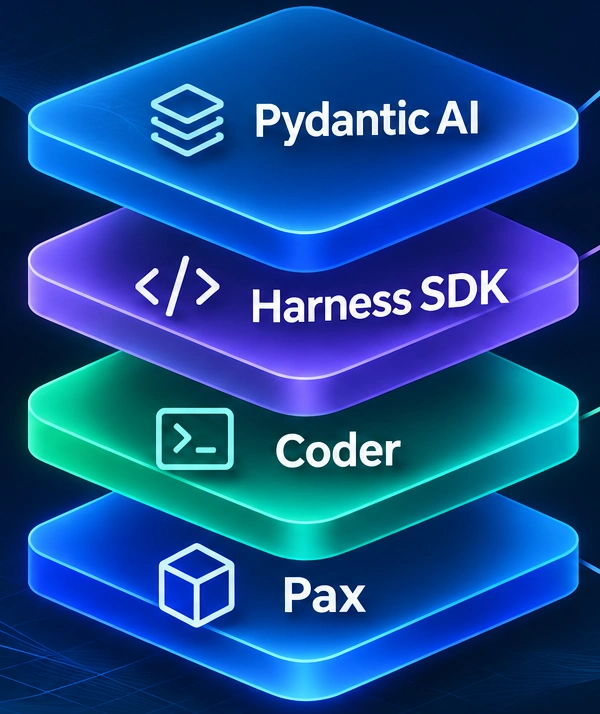
GPT explanatory illustration, cropped to the four component names. Read top to bottom as the framework-to-terminal sequence, not a guarantee of production readiness or execution safety. See the preceding table for each layer’s responsibility.
XBSTACK independently retrieved three release artifacts, verified SHA-256 digests and parsed their Python abstract syntax trees. The procedure read ZIP entries and package metadata without installing, importing or executing downloaded code during the static phase; a separate isolated runtime test follows in section 13.
| Distribution | Pinned version | Python files | Dependency relationship |
|---|---|---|---|
| pydantic-ai-pax | 0.75.0 | 255 | Harness 0.75.0, core 2.75.0 |
| pydantic-ai-harness | 0.75.0 | 441 | pydantic-ai-slim 2.75.0 |
| pydantic-ai-slim | 2.75.0 | 483 | Core; no dependency on the other two |
See the release metadata for Pax, Harness and Core. The file counts are a description of artifacts, not a measure of code quality, maturity or performance. Exact dependency pins also show why modularity does not imply arbitrary version compatibility.
| Layer | Observed source path or symbol | What the observation supports |
|---|---|---|
| Console | pydantic_ai_pax.main:main | Both console aliases share an entry point |
| Coding plugin | builtin_plugins/coder.py, CoderPlugin | Terminal integration is organized through a plugin |
| SDK coding | pydantic_ai_harness/coder/_capability.py, Coder | The SDK component is separate from the interface |
| Plugin API | plugins/init.py, Plugin, PluginHost | Explicit host and plugin abstractions |
| Permissions | runtime/permissions.py, ApprovalHandler, session_permissions | Permission handling is distinct from default behavior |
| Code mode | code_mode capability, toolset, streaming and speculation modules | Multiple implementation concerns |
| Context | compaction summarization, clearing and deduplication modules | More than a single text truncation function |
| State | step_persistence store/recovery; core ModelFallback | Separate persistence and model-selection mechanisms |
These observations establish that the pinned distributions contain the named structures. They do not show that every branch works, every capability is enabled by default or the product enforces all advertised security properties. A source symbol is evidence of implementation structure, not a successful runtime trace. The source checks and original results are now available in the pinned GitHub evidence directory.
The Capabilities reference and on-demand capabilities explain the composition contract. In engineering terms, deferred capabilities may reduce the number of tool definitions and instructions the model receives upfront. The cost is another lifecycle: discovering, activating, configuring and potentially unloading behavior. If tool output reduction conflicts with a requirement to cite exact source material, the composition must resolve that tension explicitly. A component’s security and resource assumptions must also survive the combination. This is a practical test of modularity: can teams change one behavior without silently changing the contract of another?
3. Pax versus Codex and Claude Code
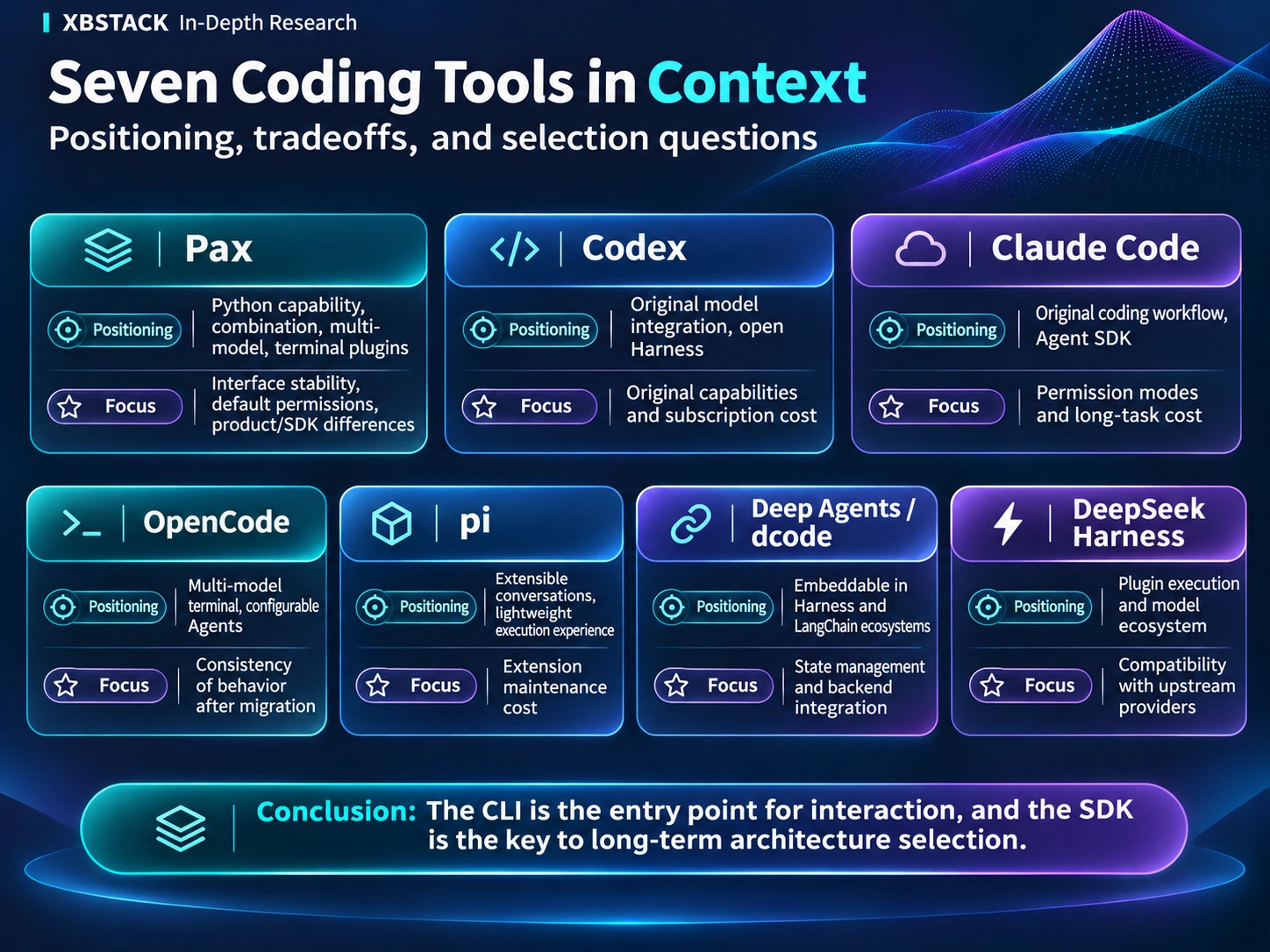
GPT explanatory illustration; factual and experimental claims are grounded in the article and underlying records.
A feature checklist alone obscures the architectural question.
| Dimension | Pax | Codex | Claude Code |
|---|---|---|---|
| Entry point | Terminal and Python components | CLI, app and integrations | CLI, app and Agent SDK |
| Model orientation | Multiple providers | Primarily OpenAI | Primarily Claude |
| Extension path | Composable capabilities and plugins | Open harness, SDK and App Server | Agent SDK, tools, hooks and skills |
| Local security | No additional sandbox or per-action approval by default | Sandbox and approval controls available | Tool permissions and configurable Bash sandbox |
| Maturity | Beta | Established developer platform | Established developer platform |
OpenAI’s Codex platform architecture already exposes its open harness through developer interfaces. Anthropic’s Agent SDK provides programmatic integration, approvals and tool controls. Pax is not the first extensible coding agent. Its distinction is making model choice and capability composition central.
A developer may prioritize familiar defaults and tight model integration. A team embedding agents may instead prioritize ownership of the work environment, authorization, task state and acceptance. These are different decisions, not necessarily competing products.
Seven products, different forms of control
Pax’s novelty becomes clearer when we expand the comparison beyond the native coding products. OpenCode agents document configurable agents and their permissions. The pi SDK offers a programmatic session abstraction. Deep Agents offers a reusable harness alongside its terminal coding product. DeepSeek Harness also emphasizes an extensible plugin architecture. None of these facts establishes a market-share ranking.
| Product | Distinguishing orientation | Important adoption question |
|---|---|---|
| Codex | Native model integration and an open harness | Which native features and subscription economics survive a switch? |
| Claude Code | Integrated coding workflow and Agent SDK | How do permissions, native tools and long tasks behave? |
| Pax | Python capability composition, terminal plugins and model choice | How stable are the 0.x interfaces, defaults and product-specific features? |
| OpenCode | Multi-model terminal and configurable agents | Do provider adapters and migrated configurations preserve behavior? |
| pi | Extensible sessions and a compact execution experience | What maintenance effort will custom extensions require? |
| Deep Agents / dcode | Embeddable harness and LangChain/LangGraph ecosystem | How does it integrate with existing state and execution backends? |
| DeepSeek Harness | Plugin-based execution and model ecosystem | What is verified about compatibility and cross-provider behavior? |
These are migration questions, not a list of established product defects. We did not run seven products in the same environment and do not assign subjective scores for usability or security. DeepSeek Harness is not a column in Pydantic’s published SWE81 matrix; missing benchmark data must not be interpreted as poor performance.
There is also a category distinction: a CLI competes for interactive work, while a library competes for architectural integration. Teams may retain Codex for daily repository work while using Pydantic AI or Deep Agents for a separate business application. They may also incorporate only one capability into an existing runtime. Forcing every candidate into a single replacement decision hides this flexibility.
The important competitive test for Pax is whether the modular architecture lowers the integration burden. If switching models requires redesigning every tool schema, approval policy, historical message representation and stopping rule, provider choice is only an adapter-level feature. Conversely, a single-model workflow that has stable task contracts and strong operational controls may be more economical. Technical openness and practical substitutability should be measured separately.
4. Model choice and migration do not eliminate lock-in
The Pax documentation describes importing Codex and Claude Code conversations using the corresponding resume options. Project instructions and skills also have supported discovery paths. Plugins can connect MCP tools and Logfire tracing or disable the coding capability. Select capabilities according to the task rather than enabling all of them.
There are three forms of portability: configuration, conversation history, and actual execution state. The third is the difficult one. A transcript can be reconstructed while its pending actions, approvals and external effects remain unresolved. Model-specific context behavior and native tools can also differ.
Before migrating, preserve the worktree and reconcile unfinished operations. For an agent that deploys software or updates a database, this is the unknown-outcome problem discussed in LangGraph failure recovery. A missing response does not prove that an operation never occurred.
5. Context, memory and model fallback are not one mechanism
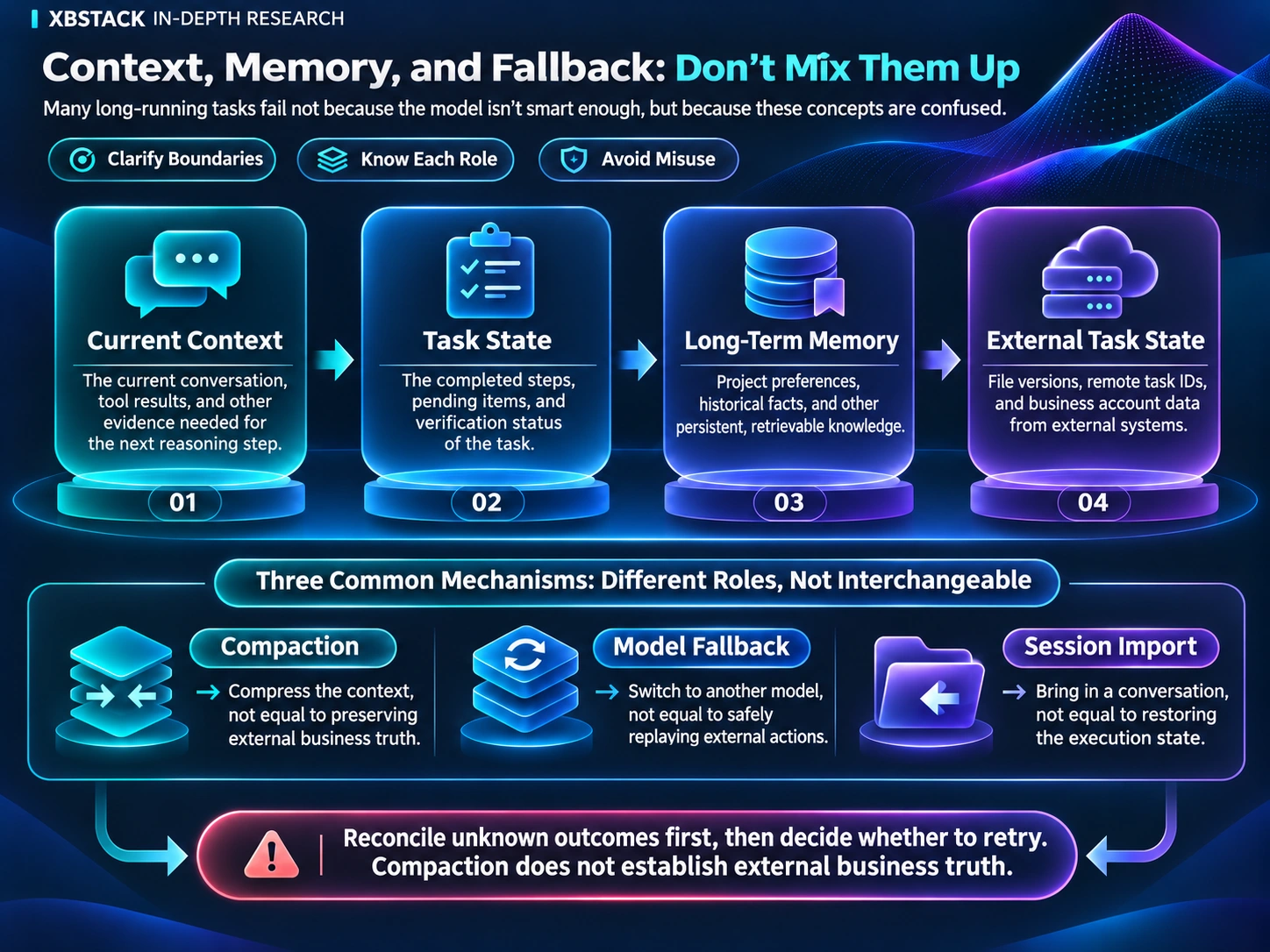
GPT explanatory illustration; reconcile unknown external outcomes before retrying.
A common model interface addresses the beginning of a run. Long-running work also requires an understanding of what the system remembers and what it can verify. The separate documentation for Compaction, Tool Output Limits and Memory illustrates distinct concerns.
| State | Purpose | Consequence of losing it |
|---|---|---|
| Current context | Evidence and messages needed by the next request | Incorrect inference or repeated reading |
| Task progress | Verified steps and unfinished requirements | Repeated or omitted work |
| Persistent knowledge | Project facts and relevant preferences | Stale or untrusted information influences future runs |
| External truth | File versions, operation identities and business records | Duplicate effects, incorrect rollback or false completion |
Only the first category should depend entirely on prompt compaction. If a long tool result can be retrieved again, reducing it may be a sensible trade. Compressing a user’s authorization or a failed test into an ambiguous statement is different. A summary is not an independent record that a test passed or a transaction was committed.
Consider a coding task interrupted overnight. A migration script was written during the first session. In the morning, another developer changed the file. Resuming a conversation containing yesterday’s summary cannot establish today’s state. The restored agent needs the current worktree, a reliable baseline, an independent list of outstanding requirements and evidence of previous effects. The same holds when a conversation moves between clients. Successful transcript import is a much narrower outcome than successful workflow migration.
The Model Fallback capability addresses model-request failures and responses that cannot be accepted under the configured policy. It must not be confused with replaying a business action. If a provider fails while selecting a next step, a compatible fallback may continue inference. If a previous tool already initiated an external operation and its result is unknown, switching models is not permission to initiate it again. Organization safety rules and overall task budgets should carry across the fallback; model selection must not become a way to evade applicable restrictions.
Subagents add another boundary. Delegation can parallelize separable work, but each child must operate within a defined scope and report verifiable results. A parent’s job is to distinguish an ordinary child failure, user cancellation, an inference problem and an ambiguous external outcome. Concurrency without explicit ownership makes it harder to reconcile state. The evaluation should therefore test not only whether delegation produces a correct final answer, but also whether it duplicates work, consumes unexpected resources or fails to propagate cancellation.
6. What the official benchmark means
Selected same-model Harness-Bench SWE81 results from Pydantic’s November announcement:
| Model | Harness | Score | Mean task cost |
|---|---|---|---|
| GPT-6.2 Sol | Pax | 64.7 | USD 9.21 |
| GPT-6.2 Sol | Codex | 60.1 | USD 21.05 |
| Claude Opus 5.5 | Pax | 61.2 | USD 24.61 |
| Claude Opus 5.5 | Claude Code | 60.4 | USD 25.10 |
Source: Pydantic’s announcement and original methodology.
The reported Sol cost reduction is approximately 56.2%, with a 4.6-point score difference. In the Opus comparison, the corresponding differences are approximately 2.0% and 0.8 points. The two configurations therefore do not support a universal claim that Pax halves coding costs.
The publisher identifies single runs, relaxed scoring for Sol and Opus, and max autonomy for Pax’s Sol configuration. Under the original grader, Sol scores are 51.0 and 49.8. That smaller difference shows why the scoring rule matters.
Among the four systems evaluated across all eight models, average scores span 57.3 to 58.5; Pax leads OpenCode by 0.3 points, while pi is cheaper on average. The figures are too limited to establish a stable overall ranking. The reported expenses are task-run averages, not subscription fees or complete project costs.
Independent research, Harness or Model?, reports same-model comparisons whose principal average contrasts were not statistically resolved. It is not a Pax replication. It is a useful warning against generalizing from a narrow benchmark.
The engineering metric that matters is cost per independently accepted task: total model, execution and human rework expenditure divided by the number of valid accepted tasks. If none pass, the metric is undefined. Correctness and authorization must both hold.
Our existing model versus harness guide addresses broader failure diagnosis. This article instead focuses on the specific decision to adopt Pax or its SDK.
7. The complete eight-model matrix
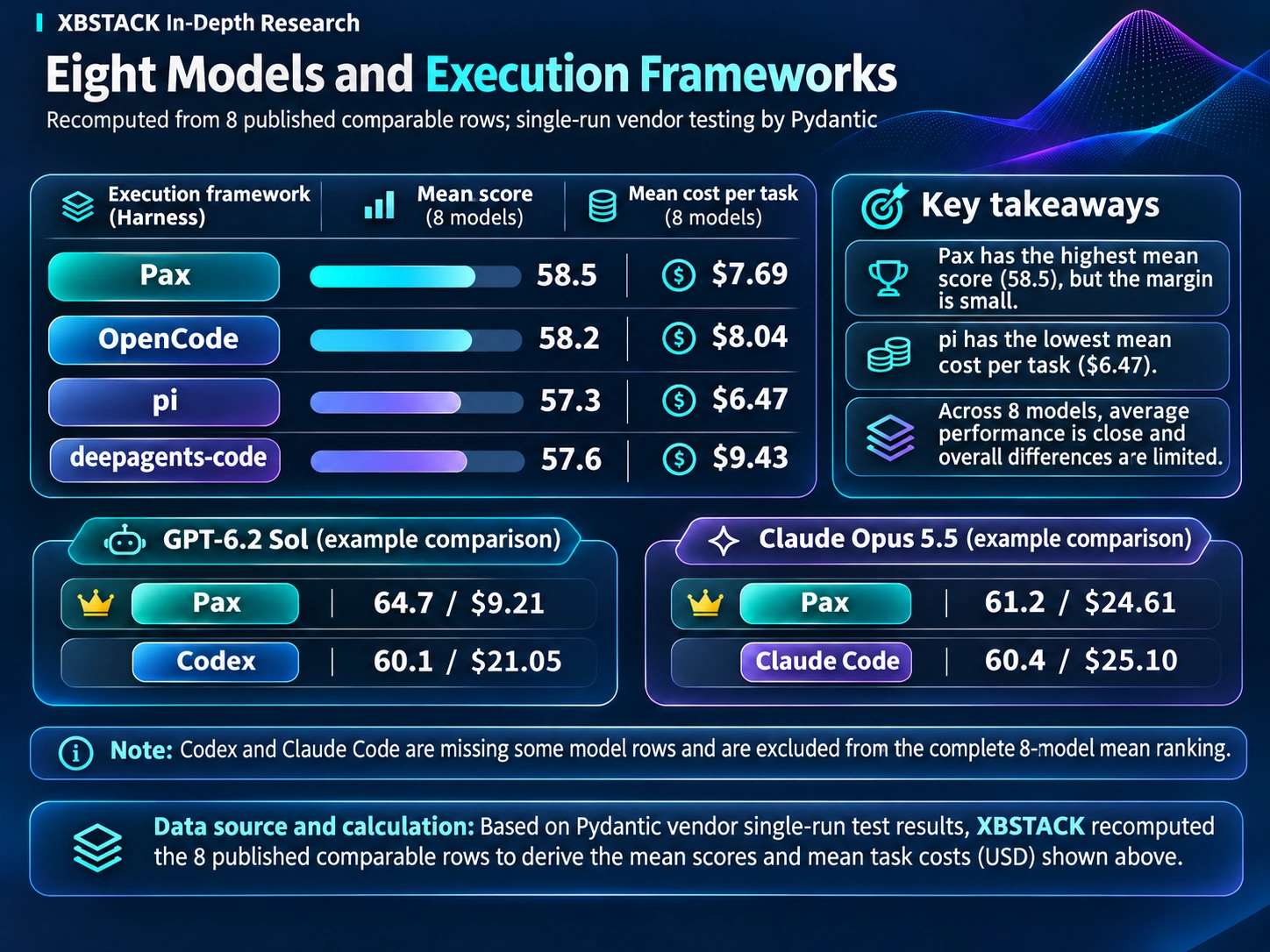
GPT explanatory illustration; eight-model means recomputed from Pydantic single-run vendor data, not an independent model benchmark. Flagship examples compare only the two listed tools; see the scoring caveats in the text.
Recomputing the eight displayed rows gives mean task costs of USD 7.69 for Pax, 8.04 for OpenCode, 6.47 for pi, and 9.43 for deepagents-code (rounded from displayed cells). Codex and Claude Code lack some model rows and are not directly comparable as complete eight-model averages.
Selecting only the two flagship comparisons would introduce selection bias. The following numerical data are from Pydantic’s November 25 publication. A dash means the cell was not reported, not zero performance or lack of product support.
| Model | Pax | OpenCode | pi | deepagents-code | Codex | Claude Code |
|---|---|---|---|---|---|---|
| GPT-6 Luna | 55.1 | 57.2 | 53.3 | 55.1 | 56.0 | — |
| GPT-6.1 Terra | 54.1 | 54.7 | 57.2 | 51.4 | 54.2 | — |
| Claude Haiku 5.5 | 56.0 | 55.5 | 52.9 | 59.1 | — | 56.5 |
| Claude Sonnet 5.5 | 58.4 | 60.8 | 57.9 | 57.7 | — | 56.9 |
| MiniMax M3.1 Flash | 54.7 | 50.8 | 52.3 | 50.7 | 54.7 | 38.6 |
| Kimi K3.1 Pro | 63.7 | 64.3 | 59.1 | 61.5 | 61.8 | 62.9 |
| GPT-6.2 Sol | 64.7 | 61.0 | 64.8 | 61.7 | 60.1 | — |
| Claude Opus 5.5 | 61.2 | 61.4 | 61.1 | 63.3 | — | 60.4 |
Mean task-run cost, in USD:
| Model | Pax | OpenCode | pi | deepagents-code | Codex | Claude Code |
|---|---|---|---|---|---|---|
| GPT-6 Luna | 0.77 | 0.69 | 0.57 | 1.08 | 1.04 | — |
| GPT-6.1 Terra | 4.97 | 5.41 | 3.97 | 13.79 | 6.36 | — |
| Claude Haiku 5.5 | 1.46 | 1.50 | 1.20 | 1.34 | — | 1.37 |
| Claude Sonnet 5.5 | 7.90 | 7.43 | 6.54 | 7.90 | — | 6.86 |
| MiniMax M3.1 Flash | 1.67 | 2.94 | 1.40 | 2.92 | 1.85 | 2.95 |
| Kimi K3.1 Pro | 10.92 | 9.81 | 9.44 | 11.88 | 14.42 | 11.40 |
| GPT-6.2 Sol | 9.21 | 9.17 | 7.69 | 12.98 | 21.05 | — |
| Claude Opus 5.5 | 24.61 | 27.33 | 20.96 | 23.51 | — | 25.10 |
The original report specifies a score averaged over graded tasks and cost averaged over all 81 tasks. OpenAI and Anthropic costs use token list prices; MiniMax and Kimi costs use OpenRouter billed amounts. Dividing cost by score gives a cost per score point, not necessarily the cost of one successfully solved task. These denominators must remain explicit.
We also computed a Pareto comparison using the reported cells. A configuration dominates another when it scores at least as highly, costs no more, and strictly improves at least one of the two dimensions. The frontier consists of configurations for which no other reported combination satisfies that definition.
| Model | Highest score | Lowest mean expense | Observed frontier |
|---|---|---|---|
| GPT-6 Luna | OpenCode | pi | OpenCode, pi |
| GPT-6.1 Terra | pi | pi | pi |
| Claude Haiku 5.5 | deepagents-code | pi | pi, deepagents-code |
| Claude Sonnet 5.5 | OpenCode | pi | OpenCode, pi |
| MiniMax M3.1 Flash | Pax and Codex (tie) | pi | Pax, pi |
| Kimi K3.1 Pro | OpenCode | pi | OpenCode, pi |
| GPT-6.2 Sol | pi | pi | pi |
| Claude Opus 5.5 | deepagents-code | pi | pi, deepagents-code |
This is an independent arithmetic analysis of the publisher’s table, not an independent benchmark run. In these rounded single-run figures, pi is the least expensive in all eight rows. Pax lies on the specified frontier in the MiniMax row alone. This does not negate Pax’s highest mean score among the four complete harnesses: a relatively consistent set of second-place results can win an average without leading individual comparisons.
Nor does the analysis establish which tool has the lowest real cost. A different task mix can change the weights. Latency, security, human intervention, infrastructure and rework are not represented. Missing raw task-level observations prevent uncertainty estimates. An organization that values the ability to reuse SDK components might prefer Pax even if a cheaper configuration exists in this narrow table.
Scoring sensitivity also matters. The Sol gap changes from 1.2 points under the original grader to 4.6 after the rescore; the Opus gap moves in the other direction, from 1.4 to 0.8. The separate GPT-6.1 Sol comparison reports a different 29% cost reduction. Mixing that result with the GPT-6.2 Sol comparison would be a methodological error.
How to build a credible coding-agent evaluation
The Harness-Bench project describes multiple realistic task families and task-specific evaluation. Pydantic’s current results are an illustrative matrix, not the complete repeat-run methodology. Without per-task outputs, we cannot construct honest confidence intervals or infer binary pass rates from aggregate scores.
The earlier Harness or Model? preprint provides a useful counterweight. Its two principal paired comparisons had intervals covering zero; the effect varied across repository and contest tasks. The authors themselves note the need to replicate a post-hoc partition. This is not an evaluation of Pax. It explains why a small overall lead should not be treated as a stable causal result for a new product.
A defensible organization-level test has two tracks. In track A, hold the model, repository, task, reasoning budget, access, time cap and evaluator as constant as feasible. This approximates a controlled harness comparison. In track B, allow each system to use its normal recommended configuration. This better represents the actual adoption experience. Declare the two tracks before running them; there is no need to force their rankings to agree.
Record the repository revision, exact model identity, tool version, environment digest, access restrictions, budget, output, changed files, termination reason and test results. Use repeated paired tasks and report uncertainty on paired differences. Keep unsuccessful attempts; never permit the agent under test to rewrite its own evaluator. A task can have a passing patch at the time limit, or a confident completion message without a passing patch. The two cases belong to different failure classes. Anthropic’s agent evaluation research offers a complementary distinction between execution traces and evaluated outcomes.
Rather than spending heavily to duplicate a vendor leaderboard immediately, this research produced a compact audit of three fixed wheel artifacts and the public data. Twelve checks passed: eight distribution and source-structure checks, three quantitative checks and one explicitly hypothetical cost illustration. These are not twelve successful runs of Pax.
8. Code mode and execution overhead
Tool-heavy agents can spend repeated model round trips on intermediate results that never needed to enter the conversation. Pydantic’s code mode uses Monty’s restricted Python environment to coordinate tool operations and return selected results. This may reduce coordination overhead.
A repository search and related file reads can be grouped into controlled inspection. Editing a file or initiating an external write changes the risk category. Interpreter restrictions do not secure a tool with excessive authority.
Measure model calls, input size, caching, execution time, tool results, acceptance outcomes and policy violations. A cheaper run is not necessarily more efficient if essential tests or approvals were skipped.
9. Workspace abstraction and execution boundaries
Pydantic’s workspace documentation describes a common interface for files and commands. It offers a way to change execution environments while keeping application tools conceptually similar. This separation reduces environment-specific integration work but does not, by itself, create isolation.
If a custom tool accesses the host directly instead of using the workspace contract, selecting a sandbox may not constrain that tool. Data synchronization is another issue: even an isolated environment can receive unnecessary files, local modifications or configurations. An adoption checklist should specify writable and read-only locations, allowed network access, the execution identity, which inputs are synchronized, and what happens when the workspace is discarded. Remote execution also needs a clear data retention and deletion policy.
Some of the remote providers described in the release route authenticated repository requests through a proxy rather than placing the corresponding authentication material inside the sandbox. This reduces one exposure path; it does not prove least privilege. The proxy’s authorization scope, auditability and revocation behavior still matter.
Streaming and speculation introduce an additional distinction. A static read may be safe to start ahead of the final tool request, while a state-changing action must wait for complete, validated arguments and authorization. Even a nominally read-only external query may disclose data, consume quota or observe a different state when run early. Reusing a result from before a file was modified can make later reasoning incorrect. Measuring seconds saved without examining stale reads, abandoned calls and rework would reward latency rather than reliable delivery.
10. Security and durability are separate questions
The default local Pax configuration does not introduce additional isolation or approval prompts. Open source does not establish safe operation. Pydantic’s permissions reference distinguishes matching command patterns from a real isolation boundary.
Likewise, the presence of configurable security features in Codex and Claude Code does not prove that every tool or configuration is protected.
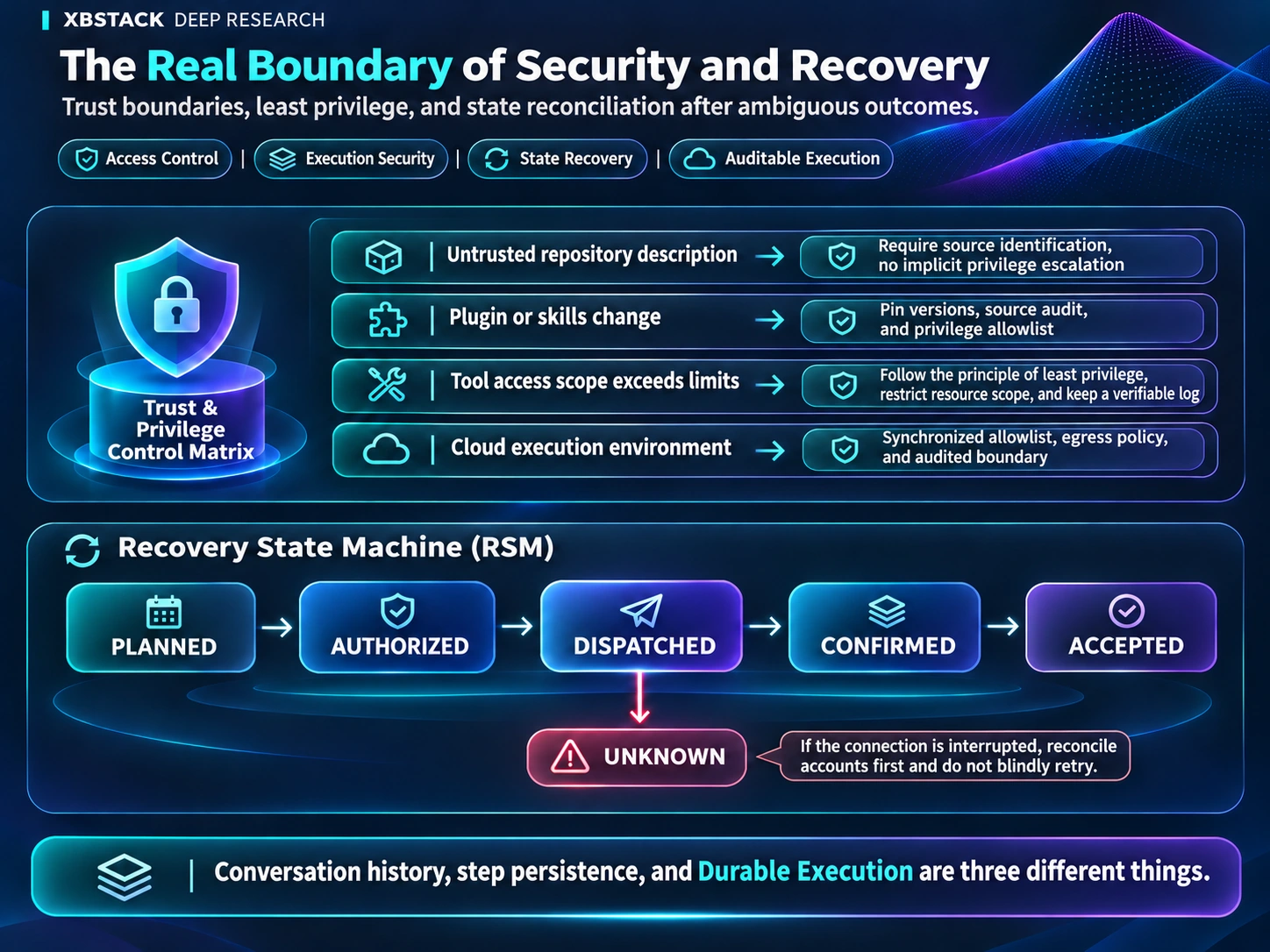
Start with a disposable repository and restricted access. Treat plugins, repository instructions and MCP responses as untrusted inputs, not sources of permission. Require separate review before external effects. Related XBSTACK resources include MCP tool poisoning and agent security.
Pydantic also distinguished SDK durability from Pax’s current capabilities in its announcement. Saving conversation history does not establish crash-safe recovery. A reliable task system needs persistent operation identities, reconciliation of uncertain effects and appropriate renewed authorization.
Trusting data is not the same as authorizing actions
The v2.75.0 release notes document a compatibility change relevant to repository context, skills and memory: lower-authority workspace content should not automatically become higher-authority instructions. This is a concrete prompt-injection boundary.
An agent working on someone else’s repository may legitimately read project documentation, dependency descriptions and examples. Those materials can explain the task, but they cannot establish new authority over the host or external systems. Folder trust, permission to use tools and approval for a particular consequential action are three different decisions. Even if the model recognizes the provenance of a message, the application must independently enforce its tool policy.
The public security advisories provide a way to monitor affected versions and repairs. Their existence should not be used as a simple ranking of product safety, and a new release is not proof that every issue has been resolved. Open source makes inspection possible; operational safety requires evidence from the configuration in use.
| Scenario | Appropriate control | Required evidence |
|---|---|---|
| Untrusted repository instructions | Provenance and non-escalation of authority | Host denies unauthorized actions |
| Changed plugin or skill | Pinned reviewed origin and version | Loaded components and permissions |
| Tool accesses an unrelated resource | Narrow identity and resource scope | Actual refusal of protected access |
| Unnecessary data enters a sandbox | Synchronization allowlist and egress policy | Observable transfer and access boundaries |
| Delegated work | Scoped authorization and budget | No unintended child effects |
| Interrupted action | Durable identity and reconciliation | Verified external state |
This is a proposed control matrix, not a statement that Pax passed these scenarios. It is especially important to keep the distinction when a product exposes both local and hosted environments.
The Pax user guide describes automatic loading of project environment configuration, repository trust and local session storage. Marking a folder untrusted does not by itself prevent file access or execution; it changes how repository material is presented to the model. Test in an empty disposable directory first, inspect the loaded components and data destinations, and verify organizational data-handling requirements before opening a production repository. Local execution does not mean inference data remains local.
The Coder documentation also separates autonomy guidance from enforced permissions. Asking the model to plan first is not a tool-level denial of writes, and requesting task completion is not blanket permission for external effects. An assessment must inspect actual accepted and rejected calls. Recheck authorization when a task is interrupted, resumed or delegated.
11. Conversation recovery, step persistence and durable execution
GPT explanatory illustration; factual and experimental claims are grounded in the article and underlying records.
The Step Persistence documentation describes recovery boundaries at stored steps, while Durable Execution covers execution engines. A stored conversation supports reconstructing context. A checkpoint can recover progress at a defined boundary. A durable engine may recover interrupted operations. None by itself proves that a remote service performed an action exactly once.
A useful business state machine is PLANNED, AUTHORIZED, DISPATCHED, CONFIRMED and ACCEPTED. When a connection fails after dispatch, record UNKNOWN and reconcile against the external system. A retry should occur only after the state and authorization justify it. This is independent of which model or interface continues the work.
For a software release, successful compilation, committed source, initiated deployment, public version verification and final acceptance are separate milestones. A timeout after deployment starts does not prove the public version stayed unchanged. On restart, the agent must inspect the actual release and its receipts rather than blindly repeat the entire process. The distinction is particularly relevant because the launch announcement excludes durable execution from Pax at that time, even while the SDK supports it for applications. Choosing a terminal client does not automatically produce a business execution platform.
12. How to evaluate Pax
The official documentation offers temporary execution through uvx and persistent installation through uv. Check the package version, provenance and command path first; macOS has an unrelated system utility with the same short name. Our subsequent pinned installation and CLI startup are documented in section 13.
Keep the established coding workflow while testing alternatives in isolation. Teams building Python-based agents may benefit from evaluating the SDK independently of the terminal.
Four initial task families can help:
| Proposed test | Acceptance criterion |
|---|---|
| Repository question answering | Verifiable references; no unwanted edits |
| Small bug fix | Correct patch; independent tests pass |
| Approval-sensitive action | No unapproved external effect |
| Interrupted run | Consistent state; no duplicate operation or false completion |
Control repository revision, model, reasoning configuration, budget, authorization and environment. Repeat runs, retain failures and grade independently. Offline fixtures can demonstrate control behavior, not establish comparative coding intelligence.
These tests are proposals, not completed experiments.
13. Independent evidence and a staged adoption plan
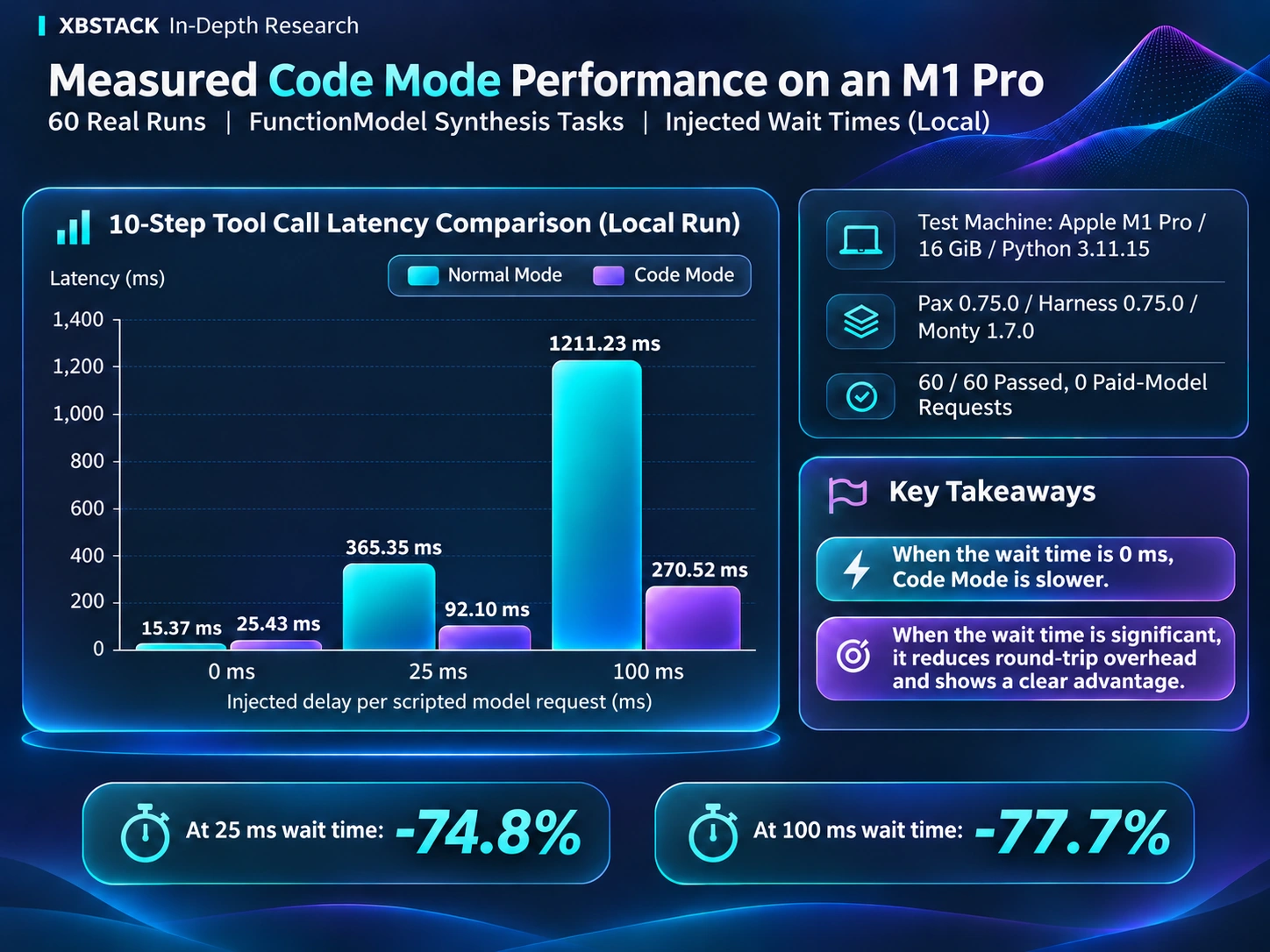
GPT explanatory illustration; medians of total elapsed time for the ten-step synthetic chain, five measurements per condition. The horizontal axis is injected delay per scripted model request; no hosted model inference.
The initial static audit ran without installing or importing downloaded packages; the second phase used a disposable installation for actual runtime tests. The first attempt encountered a TLS handshake error. A second run using the local Python 3.11 environment passed while preserving certificate validation. Docker was not available on the local machine, so we did not run the third-party agent in the website workspace. This limitation concerns our test environment, not a claim that Pax fails to run.
| Check family | Count | Result | What it establishes |
|---|---|---|---|
| Release integrity, dependencies, entry points and source structure | 8 | 8/8 | Inspectable implementation evidence |
| Eight-model matrix, frontier and sensitivity | 3 | 3/3 | Reproducible arithmetic |
| Hypothetical rework-cost inversion | 1 | 1/1 | Direct model expense is not total validated-task cost |
| Pinned Pax installation and CLI startup | 2 | Passed | Package installation and help command |
| Harness scripted-model timing runs | 60 | 60/60 | Real local runtime, not model inference |
| Commercial-model coding and independent SWE81 | 0 | Not run | No independent model ranking |
The illustrative cost case assumes A spends ten arbitrary units directly and fifty on rework, with six accepted tasks. B spends twenty directly and ten on rework, with eight accepted tasks. The effective costs are ten and 3.75 per accepted task. These are invented scenario inputs, not measurements or actual product prices. They demonstrate why a cheaper inference run might still be a worse organizational decision.
XBSTACK runtime measurement: Code Mode on an M1 Pro
On November 27, 2026, XBSTACK used an Apple M1 Pro with ten CPU cores, 16 GiB unified memory, macOS 27.0.1 arm64, Python 3.11.15, Pax 0.75.0, Harness 0.75.0, Core 2.75.0 and Monty 1.7.0. The disposable environment accepted wheel dependencies only. The host sandbox denied home-directory reads and limited writes to the temporary directory; during runtime it denied networking, and a local socket bind was rejected. The temporary environment was removed. The Pax CLI help command returned exit code zero. This verifies startup, not an interactive coding session.
The timing test executed the installed Pydantic AI, CodeMode and Monty using the documented FunctionModel testing interface with provider requests disabled. Native mode emitted one predetermined tool call per scripted model request. Code Mode ran a loop in one run_code request, passing each increment result to the next step; a scripted completion response followed. Assertions verified the tool-call sequence, count and completion marker. Each configuration had one warm-up and five timed repetitions, for 12 configurations, 60 timed runs and 12 warm-ups. Fixed delays were artificially injected into each model response, not measured API latency or inference speed.
| Tool steps | Injected delay per request | Native median (ms) | Code Mode median (ms) | Scripted requests (native/code) |
|---|---|---|---|---|
| 3 | 0 ms | 6.76 | 22.44 | 4 / 2 |
| 10 | 0 ms | 15.37 | 25.43 | 11 / 2 |
| 3 | 25 ms | 131.35 | 81.67 | 4 / 2 |
| 10 | 25 ms | 365.35 | 92.10 | 11 / 2 |
| 3 | 100 ms | 436.72 | 270.19 | 4 / 2 |
| 10 | 100 ms | 1211.23 | 270.52 | 11 / 2 |
All 60 timed runs satisfied the fixture assertions. At ten steps, median elapsed time decreased by about 74.8% with 25 ms injected delays and 77.7% with 100 ms delays. With zero injected delay, Code Mode was slower. These are measured runtime timings for a scripted fixture, not GPT, Claude, Kimi or MiniMax inference timings. Native mode deliberately uses one request per step; real models can batch independent calls, so the results cannot be generalized to all tasks. Peak RSS was about 186.6 MiB (195690496 bytes) for the experimental Python process alone, excluding aggregate child-process memory and not representing a full interactive Pax session. The first Code Mode attempt failed because the test omitted await; the fixture was corrected before measuring the reported run. The original timing records and reproduction scripts are public; follow the README isolation and dependency constraints when rerunning them.
For context, Pydantic’s separate 5,276-run Code Mode study used eight actual models across five small applications and deterministic graders. It reported clear reductions in long-task cost and elapsed time, with overhead on some small tasks. Its earlier package versions, eager execution configuration and task set differ from ours; the benchmark code was not public, and it is not an independent Pax replication. The publisher also observed that real models can batch calls, suggesting that reduced context volume matters as well as round-trip count. Our fixture establishes a narrower mechanism: fewer scripted requests can reduce elapsed time for a prescribed dependent sequence with meaningful request wait. It does not establish the probability of generating a correct sequence.
Eight-model budget scenario and hardware boundaries
The SWE81 models were evaluated through the publisher’s model services; server GPU, memory, scheduling and batching details are not fully disclosed. It would be incorrect to claim that these eight models ran on our M1 Pro or invent hardware-specific token throughput and time to first token. Instead, assume the same model service, task mix and mean task-run cost reported in section 7, with 100 attempted tasks and no added retries, human labor or infrastructure. Multiplying each reported mean by 100 yields an illustrative budget, not a price quotation, bill or new benchmark.
| Hosted model | Pax (100 tasks, USD) | pi (100 tasks, USD) | Reported native-client comparator (USD) |
|---|---|---|---|
| GPT-6 Luna | 77 | 57 | Codex 104 |
| GPT-6.1 Terra | 497 | 397 | Codex 636 |
| Claude Haiku 5.5 | 146 | 120 | Claude Code 137 |
| Claude Sonnet 5.5 | 790 | 654 | Claude Code 686 |
| MiniMax M3.1 Flash | 167 | 140 | Codex 185; Claude Code 295 |
| Kimi K3.1 Pro | 1092 | 944 | Codex 1442; Claude Code 1140 |
| GPT-6.2 Sol | 921 | 769 | Codex 2105 |
| Claude Opus 5.5 | 2461 | 2096 | Claude Code 2510 |
This inherits the publisher’s cost conventions. Different subscriptions, caches, routes and task distributions can produce different prices and outcomes. One hundred attempted tasks do not mean one hundred successful tasks. Distinguish the following hardware scenarios:
| Hardware | Suitable evaluation | Evidence |
|---|---|---|
| M1 Pro, 16 GiB | Local harness orchestration, hosted-model client and offline mock | Our 60 timed tool-chain runs; no hosted inference |
| Hypothetical x86-64 development machine, 32 GiB | Equivalent hosted client and isolated test environment | Not measured; M1 timing and RSS do not transfer |
| Hypothetical workstation, 24 GiB GPU and 64 GiB RAM | Self-hosting obtainable weights, quantization and context tests | Not measured; unavailable weights cannot be assumed deployable |
For a dense model, the theoretical storage floor for 4-bit weights is parameter count multiplied by 0.5 byte: approximately 3.5 GB at 7B, 7 GB at 14B, 16 GB at 32B and 35 GB at 70B. Quantization metadata, KV cache, activation and runtime allocations, concurrency and OS headroom must be added. For mixture-of-experts architectures, active parameter count is not the total resident weight count. These are theoretical capacity figures, not measured memory or throughput, and do not assert parameter sizes for the eight hosted models. Real hardware-specific results require authorized model weights or endpoints and a controlled, documented runtime benchmark.
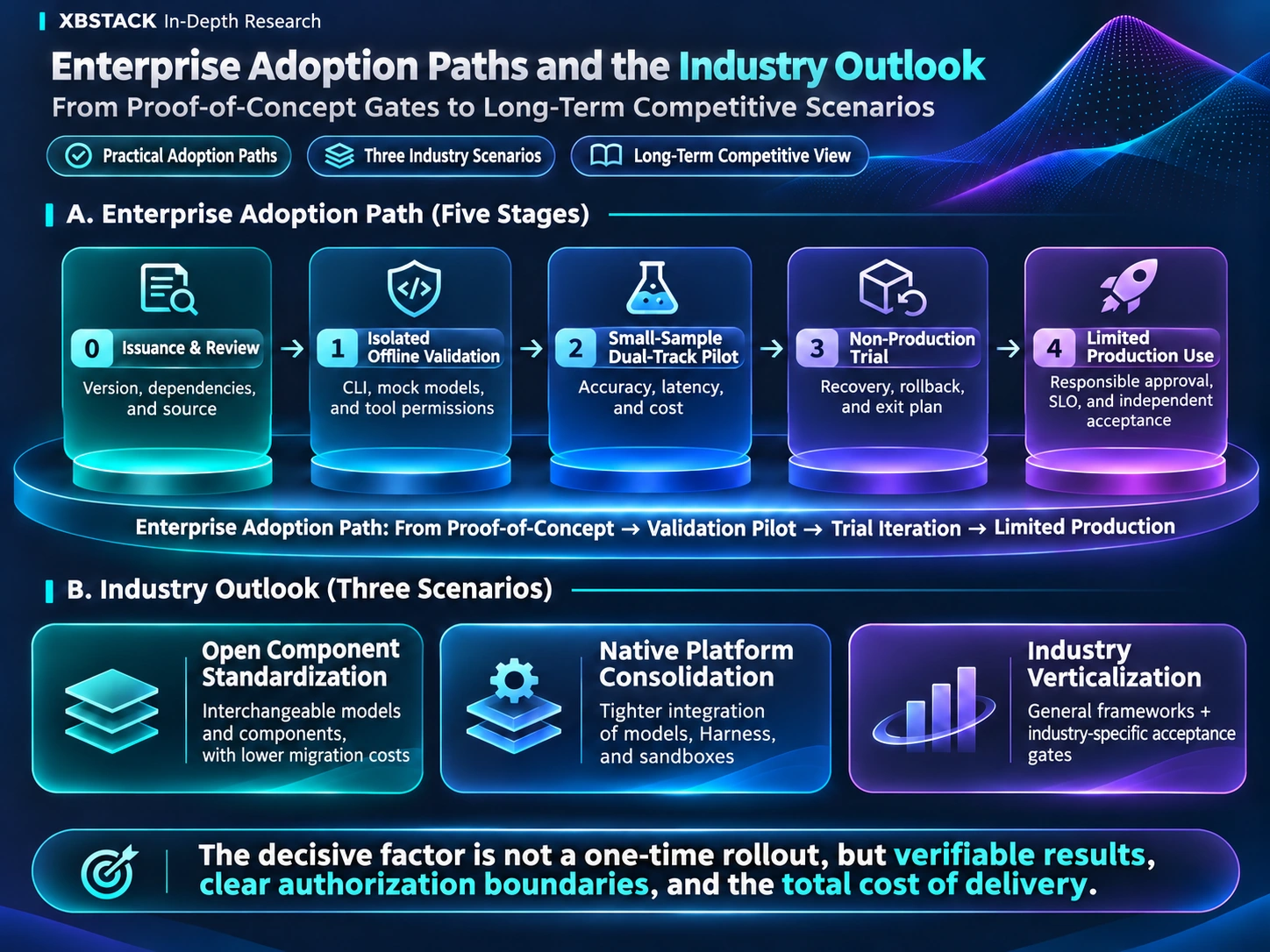
For enterprise adoption, move through explicit evidence gates.
| Stage | Minimum evidence | Stop condition |
|---|---|---|
| 0. Artifact review | Pinned versions, dependencies and declared capabilities | Unexplained provenance or compatibility |
| 1. Isolated offline test | CLI, mock model and tool-permission checks | Unexpected filesystem or network access |
| 2. Paired pilot | Repeated task outcomes, costs and latency | Critical regression or unauthorized effect |
| 3. Non-production integration | Recovery, logs, rollback and exit strategy | Ambiguous external effects cannot be reconciled |
| 4. Limited production use | Owner authorization, service objectives and independent acceptance | Governance or privacy requirements cannot be met |
This study reaches stage 0 and partially covers stage 1: CLI startup, scripted models and tool-chain execution passed. Further work must cover repository reads and edits, refusal of out-of-scope requests, compaction, transcript import, model fallback, interrupted steps and reconciliation. Retain machine-readable inputs and outputs rather than replacing unexecuted tests with confidence statements. Where an actual model is required, set an explicit budget and test in a non-production workspace.
There is also a migration cost not visible in the benchmark. A team must translate project instructions, plugin policy, conversation retention, provider configuration and organizational approvals. It must retrain developers and maintain integrations after API changes. On the other hand, a well-separated task contract can reduce future switching costs. Estimate the total cost of transition and of operating both systems during a pilot before counting theoretical savings.
14. Is the harness an AI operating system?
Calling the harness an operating system is an appealing analogy with important limits. An operating system offers relatively deterministic primitives for processes, memory, files and scheduling. An agent harness coordinates probabilistic model behavior with real execution. Similar coordination responsibilities do not imply kernel-level isolation, transactional guarantees or deterministic correctness.
A more precise analogy is a combination of application runtime and business middleware. The model proposes an action; the runtime provides execution and resources; the business system retains the authoritative record and policy. Middleware can remove duplicated engineering work, but an agent runtime must handle uncertainty about intent, changing model behavior and finite context.
One useful design separates three planes. The data plane carries model requests, tool results and application data. The control plane handles authorization, scheduling, budgets, tool selection and cancellation. The evidence plane records state changes, provenance, independent evaluation and rollback. A platform earns infrastructure status when these planes can be integrated and replaced without silently weakening their guarantees, not simply when it has the most extensions.
This direction is not exclusive to Pydantic. OpenAI’s harness engineering case emphasizes repositories that agents can inspect and independently validate. Anthropic’s long-running harness research emphasizes structured planning, generation and evaluation. Its Managed Agents architecture distinguishes sessions, harnesses and sandboxes. Native model vendors are investing in the same execution layer.
There are competing possibilities. As model interfaces become more interchangeable, open components may give adopters more choice. As models specialize in native tools and training-time environments, model-runtime coupling may instead become more valuable. The question is not answered by token prices alone. Measure the cost of preserving task semantics, authorization, state and acceptance when components change.
15. The future of agent harnesses
The launch offers evidence of an architectural direction, not a guaranteed market outcome.
First, model selection and execution tooling may become more separable. Better interoperability could encourage competition on accepted-task costs and reliability. Native platforms retain advantages in provider-specific features, infrastructure and product experience.
Second, reusable execution components may become more important to application frameworks. Workspaces, state management, authorization and observability could become replaceable infrastructure. Maintaining compatible abstractions across changing providers will also cost engineering effort. The announced 1.0 plan is not an achieved stability guarantee.
Third, applications may retain more control over authorization and acceptance instead of treating the model’s success statement as sufficient evidence. The valuable outcome is permitted, independently verified work.
In the next one to four weeks, watch API stability, permission behavior, complete benchmark methodology and independent reruns. Over six to twenty-four months, look for evidence that teams can migrate across models without losing state or authorization and sustain lower costs per accepted task. If interfaces remain unstable, safety controls are hard to deploy, or native platforms match the flexibility with stronger integration, Pax’s differentiation could diminish.
16. Commercial competition and three falsifiable scenarios
GPT explanatory illustration; factual and experimental claims are grounded in the article and underlying records.
Pydantic can attract teams seeking independently assembled execution infrastructure; OpenAI and Anthropic benefit from integration among models, native tools, applications and developer distribution. Open-model suppliers may benefit when a common client makes model-specific advantages easier to access. None of these observations establishes a winner.
| Scenario | Possible outcome | Evidence to monitor |
|---|---|---|
| Open components standardize | Teams combine models and capabilities across products | Task state and policy move across implementations without regression |
| Native platforms integrate more tightly | Models and harnesses improve together | Persistent native advantages on controlled and realistic evaluations |
| Vertical specialization | Generic runtimes support application-specific governance | Domain-specific recovery and acceptance replace a universal leaderboard |
Over three to six months, look for actual delivery of the 1.0 compatibility policy, raw benchmark methodology and repeated trials, product-level durable execution, and improved permission defaults. Treat dates and feature announcements as hypotheses until releases and evidence exist. Over one to two years, measure integration effort, portable contracts, developer throughput, rework and costs on stable task suites. Further out, evidence and acceptance may become an important part of execution infrastructure. Yet native platforms may reproduce equivalent component interfaces while providing stronger integrated economics, limiting independent SDK differentiation.
Individuals do not need to predict the final market winner. Store the code, tests, requirements and task state in systems that remain under their control rather than binding all assets to a chat transcript. Teams can replace one layer at a time and evaluate the resulting behavior. Organizations should define approval responsibilities and verifiable completion independently of whichever model produces an answer. That is a useful architectural decision whether Pax eventually leads the market or remains a specialized alternative.
Conclusion
Pax is an interesting terminal coding agent and an example of a composable execution architecture. Early evidence supports competitiveness in specific configurations, not general superiority over Codex or Claude Code.
The better selection criterion is whether the system produces independently verifiable results within real operating boundaries. Preserve proven workflows and evaluate alternatives against actual tasks before switching.
Research cutoff: November 27, 2026. Forecasts are conditional engineering judgments. XBSTACK completed isolated Pax installation and CLI startup and measured the installed Harness with a scripted model; no paid model calls, penetration tests or independent vendor benchmark reruns were performed. This is architecture research with limited local runtime evidence, not a full coding-performance review.
Continue from one agent pattern to the complete production system
The AI Agent hub organizes architecture, memory, tool use, evaluation, security, deployment and multi-agent coordination into a single learning path.
Next step: continue the Agent system
Full decision path →Choose the next architecture, tool, memory, evaluation, security, or production decision instead of starting over.

DISCUSSION
Questions, verification and corrections
Sign in to comment. Every new comment is reviewed before publication; while pending, it is visible only to you and the administrator.