
From Voice Chat to AI Personal Assistants: Qwen-Audio-Live and the Architecture of Interactive AI
An engineering analysis of interactive AI and AI personal assistants through Qwen-Audio-Live: continuous speech, async task delegation, interruption, privacy and reliable delivery, with twelve offline tests of local state.
Evidence 11 cited sources
On this page
An AI personal assistant that can retrieve information and execute authorized tasks while speaking is no longer simply a chatbot with a microphone. A user can revise a request while a search is running, ask an unrelated question, or interrupt an answer. Whether the system understands the difference between “wait,” “stop speaking,” and “cancel the task” is central to reliable interaction.
The architectural shift is from isolated requests toward continuous interaction alongside asynchronous execution. Conversation responsiveness, task completion and result delivery have separate timelines. Success in one cannot establish success in another.
Alibaba Cloud’s November 23, 2026 update to its Qwen-Audio-Live WebSocket documentation provides a concrete case: a live speech frontend can coordinate with backend models or application-owned tasks. Public interfaces from Gemini Live, LiveKit and GPT-Live address related coordination needs, although their models and runtime contracts are not interchangeable.
This article studies real-time voice agents as one form of interactive AI: speech, task delegation, cancellation semantics and reliable delivery. Two local experiments containing twelve passing tests examine specific engineering invariants. The evidence is protocol documentation and an offline reference implementation, not a benchmark of hosted models, audio quality, latency or price.
1. From conversational AI to continuous task collaboration
Interactive artificial intelligence encompasses more than conversational AI and voice interfaces. An AI assistant may simply answer questions or, with permission, read a calendar, search a knowledge base or delegate work. Tool use and controlled execution introduce agent behavior; natural speech alone does not confer autonomy or authority.
A conventional AI voice conversation pipeline chains automatic speech recognition (ASR), large language model (LLM) inference, tool calls and text-to-speech (TTS). Its modular components can still be valuable for replacement, observability and privacy controls. Native speech-to-speech models may remove some explicit intermediate conversion steps, but cannot eliminate business-tool latency or transaction boundaries. One architecture is not universally superior to the other. For device-specific ASR, TTS and fallback constraints, see the engineering analysis of offline speech; the focus here is the relationship between conversation and task lifetime.
Full duplex addresses media exchange and interaction timing. Asynchronous tool calling addresses long-running work without blocking the conversational frontend. Reliable delivery addresses cancellation, duplication, recovery and result relevance. Even an end-to-end speech-to-speech model needs application-level semantics for the latter two.
Streaming audio input and output introduce timing boundaries absent from ordinary text exchanges. Voice activity detection (VAD) concerns speech activity; turn detection concerns when the system should take its turn. An interruption, a brief acknowledgment and background noise need not represent the same conversational intent. For example, the OpenAI Realtime API guide describes voice activity detection separately from real-time tool use. Low-latency voice interaction requires coordination of audio, turn-taking and playback, but detecting speech does not automatically revoke authorization for background work.
| Layer | Responsibility | Does not establish |
|---|---|---|
| Voice frontend | Audio input, response, interruption | Business task completion |
| Task executor | Retrieval, tools, computation, task state | User heard the result |
| Delivery layer | Correlation, acknowledgment, replay policy | Exactly-once external effects |
Consider a user who requests a document search and then asks what day it is. The second conversational turn should not have to wait for the document search. If they change their mind, the system must determine whether to cancel the work, suppress a result, or retain it for later. Speech interruption is not necessarily a request to abandon all active tasks.
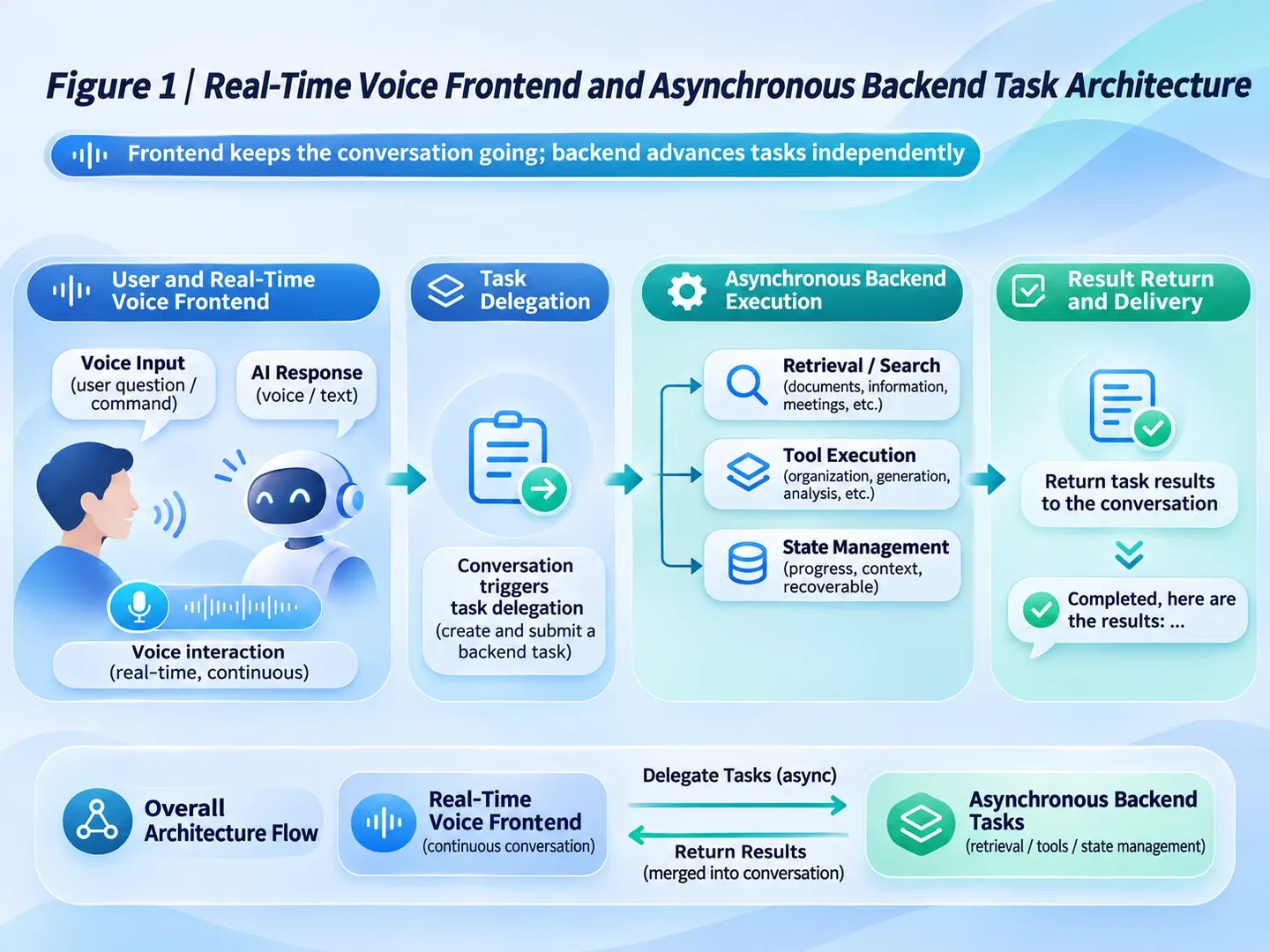
Figure 1 | Reference architecture separating continuous conversation from background work. Progress and completion require actual executor state. GPT-generated concept diagram, not a live provider API screenshot.
2. What Qwen-Audio-Live reveals about task delegation
The WebSocket access documentation identifies the connection service with qwen-audio-3.1-live. This is distinct from the voice frontend model configured in the session. Check the workspace-supported frontend and turn detection settings for full-duplex operation rather than assuming the connection identifier is the frontend model.
In Client mode, the application owns delegated task execution and correlates the result with the task identifier. In Responses mode, the platform coordinates the configured backend model. Neither mode establishes application authorization, resource scope, identity or consent for outbound data.
| Documented event | Purpose | Application concern |
|---|---|---|
session.update | Session configuration | Service, frontend and delegation mode |
session.delegation.created | Delegated task | Trusted session, duplicate detection and authorization |
session.commentary.append | Session-level task information | Correlate with delegation_id |
response.event | Backend Responses events | Generation status, not playback completion |
session.event / session.item.create | Frontend function calls and results | Use call_id, not the delegation identifier |
session.output_audio.delta | Audio output chunks | Separate playback and interruption state |
See server events and client events for the current wire contracts. A delegation can include a task summary and a context snapshot, which may be incomplete or truncated. A natural-language summary is not a permission token, and it may omit information needed for execution.
The distinction is ownership of execution, not a ranking of capability. Application-owned delegation preserves control over business rules, local resources and permissions but requires scheduling, persistence and failure recovery. Platform-coordinated delegation can transfer some backend inference coordination while leaving business authorization, data handling and outcome verification unresolved. Suitability depends on task boundaries, deployment constraints and the provider contract.
Documented events describe possible interactions, not verified production reliability. No hosted API integration was tested here, so the comparison establishes neither response speed nor completion or interruption accuracy.
3. Interruption, cancellation and delivery are separate state spaces
A local task record should include a trusted principal, session, delegation identifier, state, authorization reference, result version and delivery status. Deduplicate a task durably before authorizing execution.
Multi-turn conversations also require a distinction between conversation context and task context. A user may change a date, target document or filter while retrieval is underway. An older result must remain associated with the original intent and result version. If the new conditions invalidate it, the application should cancel or mark it stale according to policy, rather than insert it unconditionally into a new answer. This is an application-level consistency problem for an AI agent engaged in continuous human–AI interaction, not a reason to repeat function calling every time a user speaks.
An extended production state machine would include pending, running, completed, cancelled, failed and unknown. Delivery can separately track pending, sent and acknowledged. The actual playback position requires its own observation.
Four invariants matter:
- Speech barge-in, or interrupting audio, is not automatically cancelling a task. Only explicit cancellation or applicable policy should change task state. Already completed effects must remain recorded.
- Task completion is not result delivery. An executor returning does not mean a model spoke the result or a user heard it.
- Duplicate delegation and duplicate result events are separate failure modes. A stable business key should prevent unnecessary repeat execution.
- An unknown outcome is not failure. Reconcile consequential operations such as booking, deletion or payment with authoritative business records before retrying. Our fixture permits only synthetic read-only lookups.
A conceptual adapter might look like this. It is pseudocode, not a runnable Qwen wire request:
async def on_delegation(connection, event):
    principal = authenticated_principal(connection)
    task_id = event["delegation_id"]
    intent = validate_and_authorize(principal, event)
    key = (principal.id, connection.session_id, task_id)
    if ledger.accept(key, intent.operation):
        queue_authorized_job(key, intent)
    # return to the audio/event loop immediately
The worker persists its result first; a separate delivery loop decides whether and when to return the appropriate content. Do not trust a client-provided owner string as identity. Use bounded queues, deadlines and appropriate scheduling for blocking I/O or CPU work. The pseudocode names application contracts, not functions implemented by the provider.
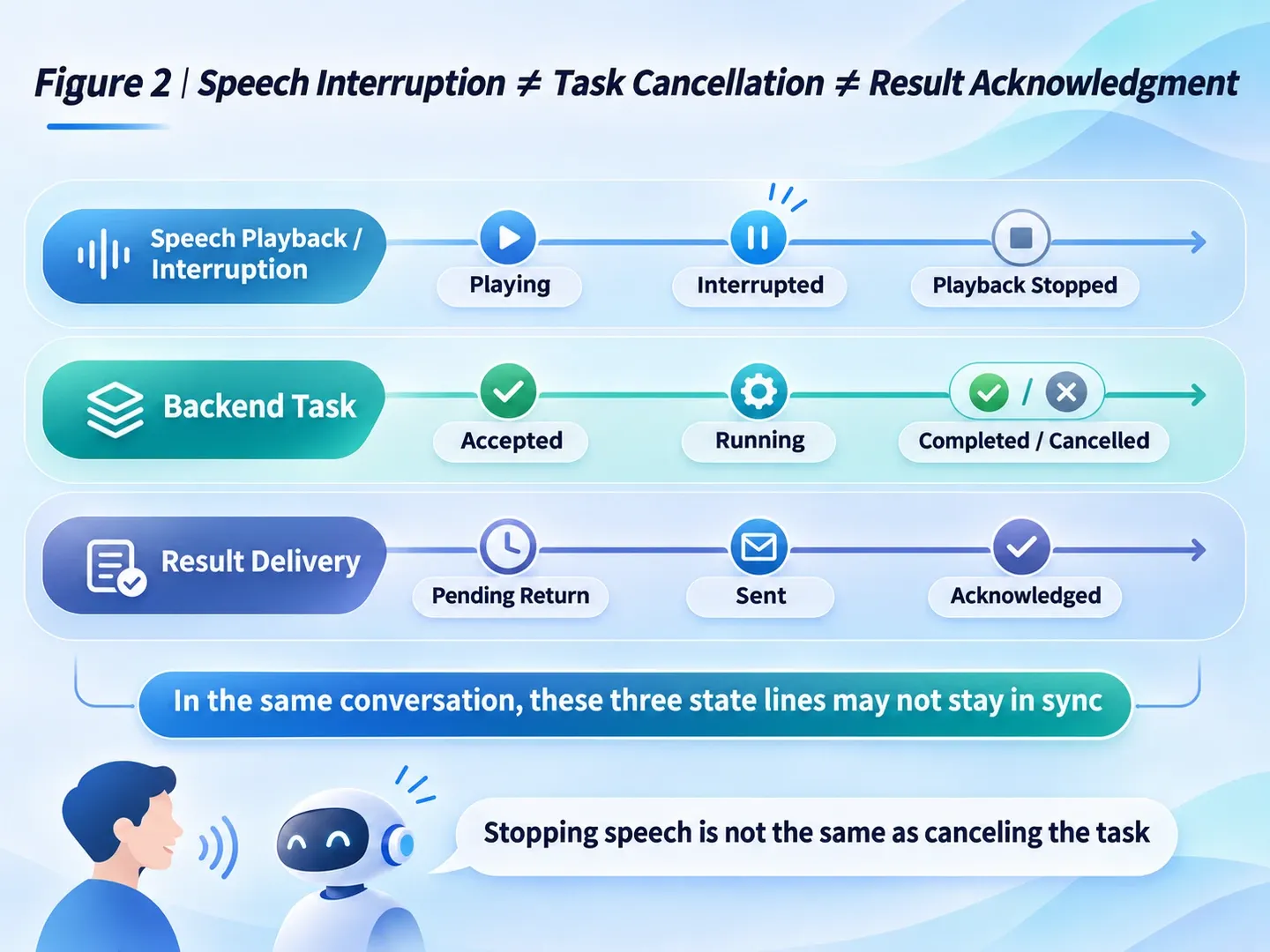
Figure 2 | Independent state lanes. Cancelled work may produce no deliverable business result, and a delivery acknowledgment does not prove that a user heard the audio. GPT-generated conceptual diagram, not measured timing.
4. Experiment A: six in-memory state-machine tests
On November 25, XBSTACK ran lab.py on Darwin / Python 3.10.2. An asyncio.Event deliberately holds a worker until the test permits it to proceed. There is no network, random timing, microphone or paid API.
| Scenario | Observed result |
|---|---|
| Foreground event while worker waits | Passed |
| Duplicate delegation and result | Rejected |
| Worker returns after cancellation | No local outbox entry |
| Same delegation ID in two sessions | Separate records |
| Non-allowlisted tool | Rejected |
| Unguarded versus guarded result relay | 2 versus 1 synthetic output messages |
All six tests passed. The comparison is a count of locally generated messages, not a network duplicate rate. The foreground test demonstrates cooperative scheduling in the fixture; it does not prove real audio latency or nonblocking behavior for arbitrary synchronous or CPU-bound work.
python3 experiments/voice-agent-async-task-20261125/lab.py
5. Experiment B: a SQLite task ledger and transactional outbox
The in-memory adapter loses all state on exit. Our second fixture stores tasks and result outbox entries in the same SQLite database. Completing a task and inserting the result happen in one transaction, with a unique composite key for owner, session and delegation.
UPDATE task
SET state = 'completed'
WHERE owner = ? AND session = ? AND delegation = ?
  AND state = 'pending';
-- Insert the outbox record in the same transaction
-- only if exactly one row changed.
Both tables enforce uniqueness. An exception after the state update but before the outbox insert rolls back the transaction. Reopening a database tests durable state across connection close/reopen; this is not an abrupt process-kill or power-loss test.
Actual environment: Darwin, Python 3.10.2, SQLite 3.35.5. Six of six tests passed.
| Test | Observed result |
|---|---|
| Reopen and accept the same task again | Duplicate rejected |
| Exception between state update and outbox insert | Transaction rolled back; completion can be retried |
| Reopen with unacknowledged result | Still available |
| Reopen after acknowledgment | No pending delivery |
| Persist cancellation, owner isolation and allowlist | Passed |
| Two database connections sequentially complete one task | Only one completion succeeds |
python3 experiments/voice-agent-async-task-20261125/durable_lab.py
The two suites passed twelve tests using synthetic identities and lookup results. The database fixture establishes specific local uniqueness and transaction invariants, not an exactly-once network guarantee.
Suppose a message is sent, the connection fails, and no acknowledgment arrives. A pending outbox record may be replayed after reconnect. Without receiver-side deduplication or an appropriate provider contract, the user may hear the same result again. WebSocket reconnection and result replay must be distinguished from duplicate tool execution: recovering an unacknowledged message does not authorize repeating an already completed business operation. A production system also needs authenticated session binding, result freshness, worker claims and leases, restart behavior, and business-level idempotency. This fixture has no process-kill test, concurrent stress test or real external effect. The broader AI agent deployment analysis of queues and checkpoints examines durable workers and recovery in a more general setting.
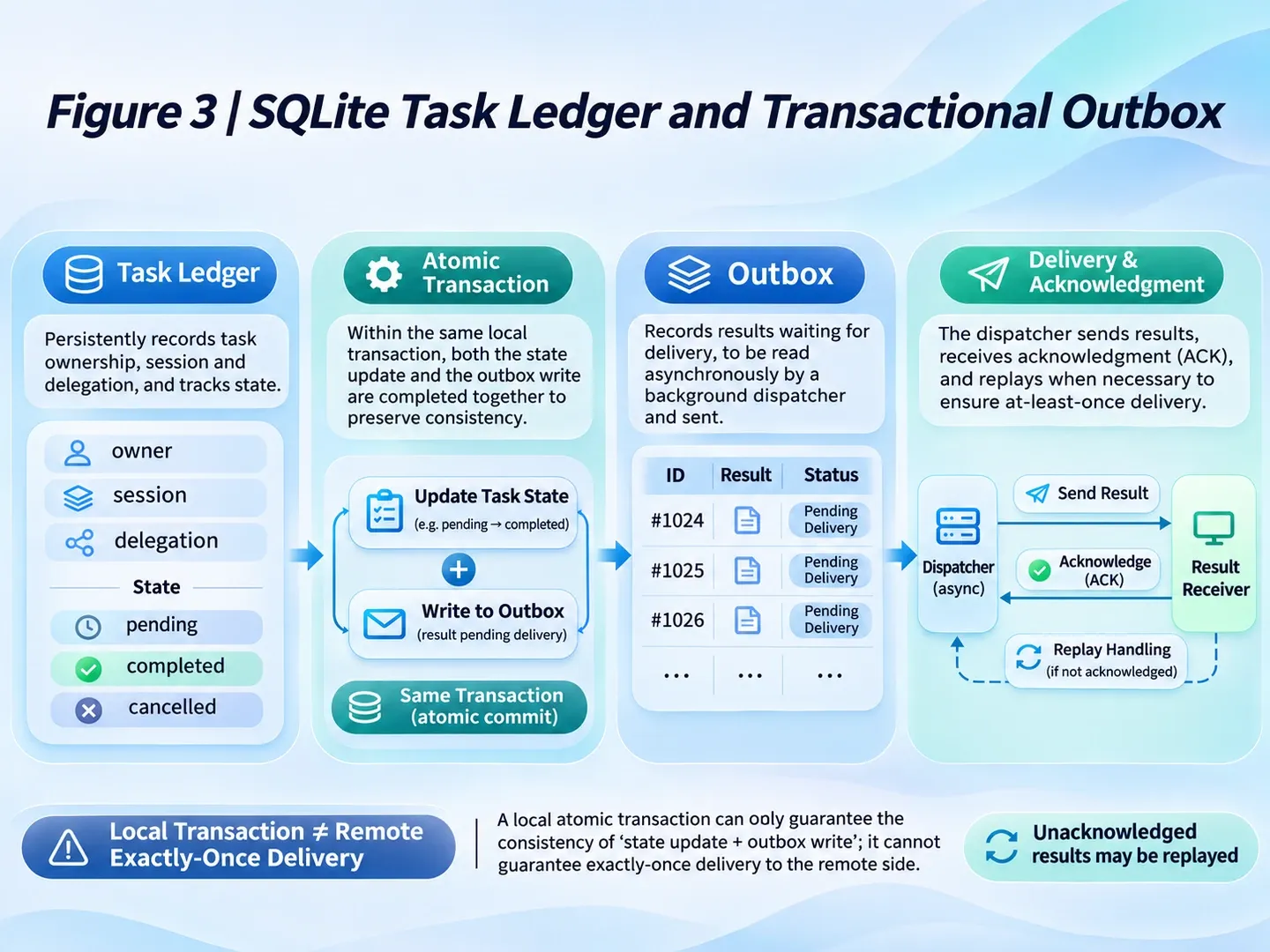
Figure 3 | Reference ledger and transactional outbox. At-least-once delivery in the diagram is a design objective conditional on durable retries, a recoverable receiver and eventual connectivity, not a network guarantee established by this experiment. Actual remote delivery and receiver deduplication remain unverified.
6. Compare the runtime problem across ecosystems
LiveKit async tools provide background execution and progress updates. Its tool definition guide discusses tool lifetime and interruption. Developers have reported lost results and duplicate execution in issue #3702, and an unanswered delegated call stalling a session in issue #7679. These are upstream reports, not XBSTACK reproductions of those SDKs or evidence that current releases remain affected.
Gemini Live asynchronous function calling distinguishes nonblocking lookup behavior from operations that warrant more careful sequencing. GPT-Live’s guide also describes delegated backend execution. These separate ecosystems establish that the design problem survives a single vendor release. Event models, media contracts, tool result delivery, cost and supported capabilities still require independent adapters.
| Approach | Suitable task | Application responsibility |
|---|---|---|
| Qwen Client delegation | Application-owned retrieval/tools | Authorization, durable task and delivery records |
| Qwen Responses delegation | Platform-coordinated backend | Business tool scopes and verified outcomes |
| Gemini Live nonblocking tools | Queries while continuing dialogue | Results, cancellation and sequencing |
| LiveKit async tools | Custom voice runtime / provider integration | Session lifecycle and external effects |
This is a documentation-based design comparison, not a ranking of speed or quality.
7. Personal AI assistants: permission, privacy and bounded autonomy
An assistant that can affect personal data and business state differs from a generic conversational interface. Reading versus modifying a calendar, searching versus sending email, and retrieving versus deleting a file may be requested in the same conversation, but require different authority and produce different effects.
Continuous interaction makes authorization more granular. A grant valid at task creation may be revoked before execution. Identity, session, intent, tool and resource scope should be bound to verifiable application authority. Consequential actions require authorization checks at execution and explicit confirmation where appropriate. A model-generated plan or task summary is not an authorization credential. The related per-call AI agent tool authorization and policy gate analysis explains identity, scope and execution approval.
Microphone permission is not consent to upload private recordings, documents or retrieval context. Local retrieval-augmented generation (RAG), hosted models and hybrid architectures can divide responsibilities, but outbound data should be restricted to explicitly authorized, necessary information under a reviewed provider policy. Retaining an evidence version or reference also prevents an outdated result from being presented as a current fact. A bring-your-own-key (BYOK) configuration does not by itself establish local-only data processing; see local AI and BYOK data boundaries.
Proactive collaboration means advancing authorized work under the current conversation and task context, not unrestricted autonomy. Task progress should reflect executor state rather than the language model’s conversational guess about completion. An interactive AI assistant should make pending, completed and confirmation-required work distinguishable and support revocation of future authority. Our fixture uses synthetic read-only tools; personal data, device integration and consequential actions were not tested.
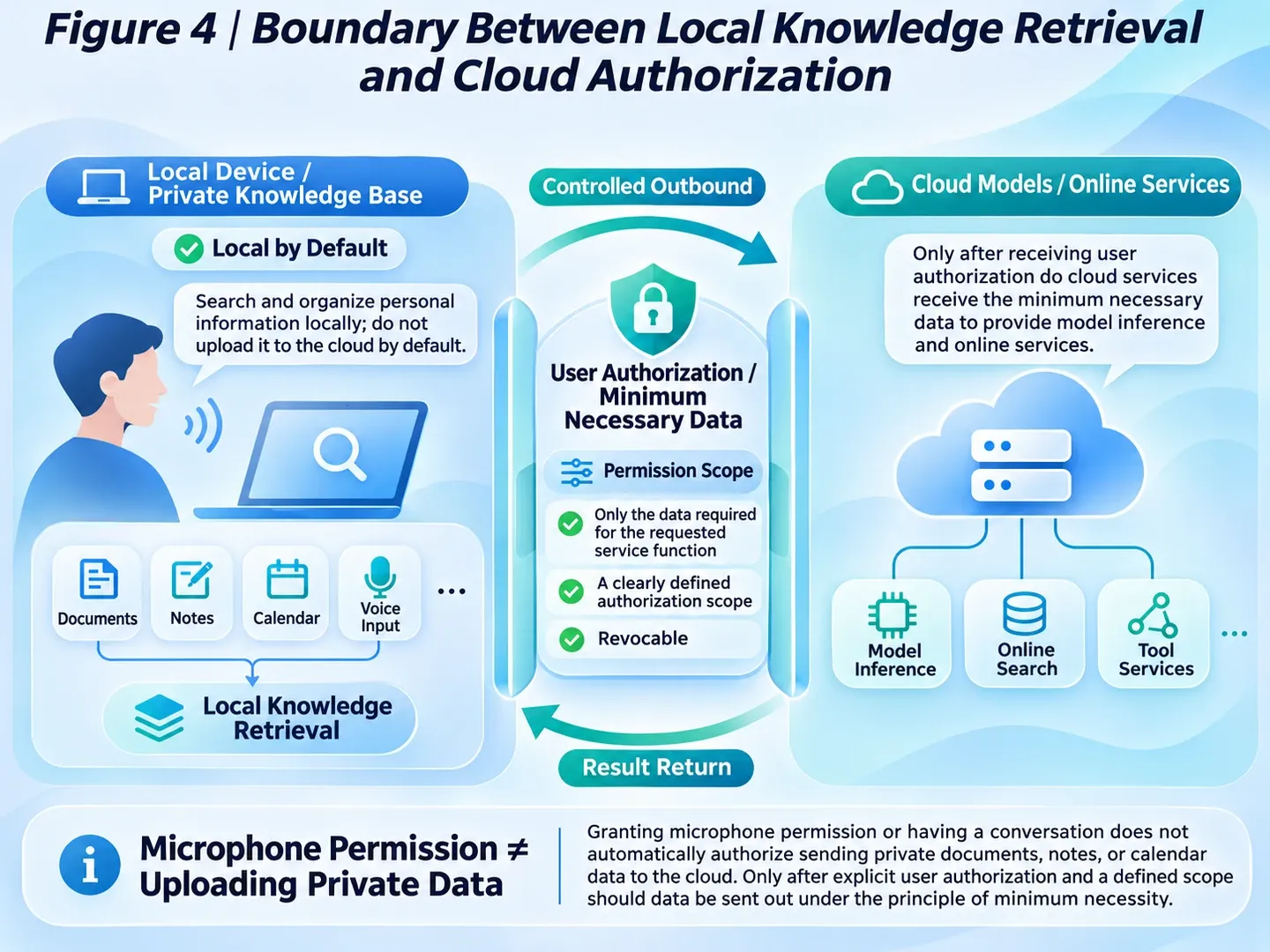
Figure 4 | Proposed local-first and authorized disclosure architecture. Local by default is a design choice, not evidence of the defaults of any provider or existing application. GPT-generated concept diagram.
8. Evaluating interactive AI beyond first-response latency
First-audio latency alone cannot establish the quality of a real-time AI assistant. Audio arrival, audible response, backend completion and result delivery are different events. An assistant that speaks sooner can still duplicate an action, lose a result or use stale context.
A useful evaluation separates the following dimensions. These are proposed measures, not observed performance scores.
| Dimension | Observable metrics or failure modes |
|---|---|
| Interaction | Time to audible response, residual playback after interruption, false-interruption rate |
| Execution | Authorized-task completion, incorrect cancellation, duplicate execution, unknown outcomes |
| Delivery | Missing acknowledgments, duplicate replay, stale results, delivery latency |
| Safety and control | Unauthorized tools, execution after revocation, unauthorized data disclosure |
| Economics | Cost per successfully completed task rather than per request alone |
A provider evaluation would require an authorized sandbox with recorded SDK and model versions, regions, audio conditions, workloads and event logs. Actual WebSocket reconnection, noisy and intentional speech interruptions, permission revocation, business idempotency and cost are outside the current offline evidence.
The public interfaces and developer reports suggest a possible direction: further separation of real-time multimodal interaction from backend agent orchestration. This is a conditional interpretation, not a confirmed forecast. A provider with explicit replay, idempotency and reliable session contracts could reduce the application-owned ledger’s scope. Conversely, growing tool authority, personal data and long-running work could increase the need for application-level controls. Future event traces, successful-task outcomes and measured costs would test that interpretation.
Conclusion
As voice chat evolves toward personal AI assistants, the engineering problem expands from producing a useful answer to reliably completing authorized work during continuous interaction. Qwen-Audio-Live makes that architectural distinction concrete, but the transferable challenge is separating conversation, execution and delivery state.
The two offline experiments establish specific local invariants for task records, atomic result persistence and cancellation boundaries. They establish neither real audio performance nor exactly-once remote delivery, and do not demonstrate production readiness for any vendor. For interactive AI, the ability to accommodate natural interruptions while preserving traceable, consistent and controllable authorized work is a more consequential research target than conversational naturalness alone.
Further reading and topic hub
This article belongs to the AI Agent engineering and runtime hub. To move from continuous voice interaction into broader agent design, follow these resources.
- AI Agent vs AI Assistant: distinguish conversational interfaces from controlled task execution.
- AI Agent Architecture: extend the voice frontend into the broader tool, memory, runtime and business-system architecture.
- AI Agent Workflow Control: examine multi-step state, checkpoints and interruption recovery.
Sources and reproduction
- Alibaba Cloud Qwen-Audio-Live WebSocket access, updated November 23, 2026.
- Server events and client events.
- Qwen-Audio-Agent Technical Report, vendor research rather than an independent local reproduction.
- LiveKit async tools, function tools, issue #3702 and issue #7679.
- Gemini Live asynchronous function calling, GPT-Live guide and OpenAI Realtime API guide (comparative concepts for turn detection, voice activity and real-time tools; not Qwen’s wire contract).
- XBSTACK public GitHub reproduction and run instructions:
lab.py,durable_lab.py, 12/12 passing local synthetic tests with JSON receipts; no actual audio, vendor API or exactly-once network delivery validation.
Continue from one agent pattern to the complete production system
The AI Agent hub organizes architecture, memory, tool use, evaluation, security, deployment and multi-agent coordination into a single learning path.
Next step: continue the Agent system
Full decision path →Choose the next architecture, tool, memory, evaluation, security, or production decision instead of starting over.

DISCUSSION
Questions, verification and corrections
Sign in to comment. Every new comment is reviewed before publication; while pending, it is visible only to you and the administrator.