

LangGraph aupdate_state 'Ambiguous update': Why Async Fails When update_state Works
LangGraph 1.2.11 repro: sync update_state works, but async aupdate_state raises Ambiguous update after a START seed. See the cause and tested explicit as_node workaround.
Evidence 4 cited sources
On this page
LangGraph aupdate_state “Ambiguous update”: Why Async Fails When update_state Works
If you seed a LangGraph thread with as_node=START and then call aupdate_state(config, values) without another as_node, langgraph 1.2.11 can raise:
langgraph.errors.InvalidUpdateError: Ambiguous update, specify as_node
I reproduced upstream issue #8714 on August 26, 2026 with Python 3.12.13, langgraph 1.2.11, langgraph-checkpoint 4.2.0, and a fresh InMemorySaver. The result is specific and repeatable: the second synchronous update_state succeeds, while the equivalent second asynchronous aupdate_state fails. In this pre-node initialization case, making the second async update explicit with as_node=START succeeds and leaves the same final ['seed', 'again'] state as the sync control.
The fastest containment is therefore not to delete checkpoints or rebuild the thread. Determine which node should own the external update and pass that as_node explicitly. START is verified for the exact case tested here—two input-boundary updates before any real graph node has run. It is not a universal value for later workflow updates.
1. Minimal reproduction: sync passes, async fails
The graph is intentionally small: START -> a -> b -> END. State key x uses a list-add reducer. A new thread is first seeded from START with ['seed'].
Synchronous control:
app.update_state(config, {"x": ["seed"]}, as_node=START)
config = app.update_state(config, {"x": ["again"]})
print(app.get_state(config).values["x"])
Local output:
sync implicit update: ok
sync state: ['seed', 'again']
Now change only the API to the async equivalent:
await app.aupdate_state(config, {"x": ["seed"]}, as_node=START)
await app.aupdate_state(config, {"x": ["again"]})
The second call raises:
langgraph.errors.InvalidUpdateError: Ambiguous update, specify as_node
The runnable experiment is stored at:
experiments/langgraph-aupdate-state-ambiguous-update-repro/
repro/repro.py preserves the failing path, fixed/workaround.py contains the tested containment, and logs/ stores sanitized real output without local absolute paths.
2. Affected version: the current 1.2.11 release reproduces it
Upstream issue #8714 was opened on August 25, 2026 with Python 3.12.3, langgraph 1.2.11, langgraph-checkpoint 4.2.0, and Linux.
Before testing, I checked the package index instead of assuming the report was already stale. On August 26, pip index versions langgraph returned:
INSTALLED: 1.2.11
LATEST:    1.2.11
I then reproduced the same failure with the same LangGraph versions on macOS arm64 and Python 3.12.13. That does not prove every platform is affected, but it rules out a simple Linux-only explanation.
There is no basis yet for writing “fixed in version X.” The issue remains open and there is no released fix identified by upstream.
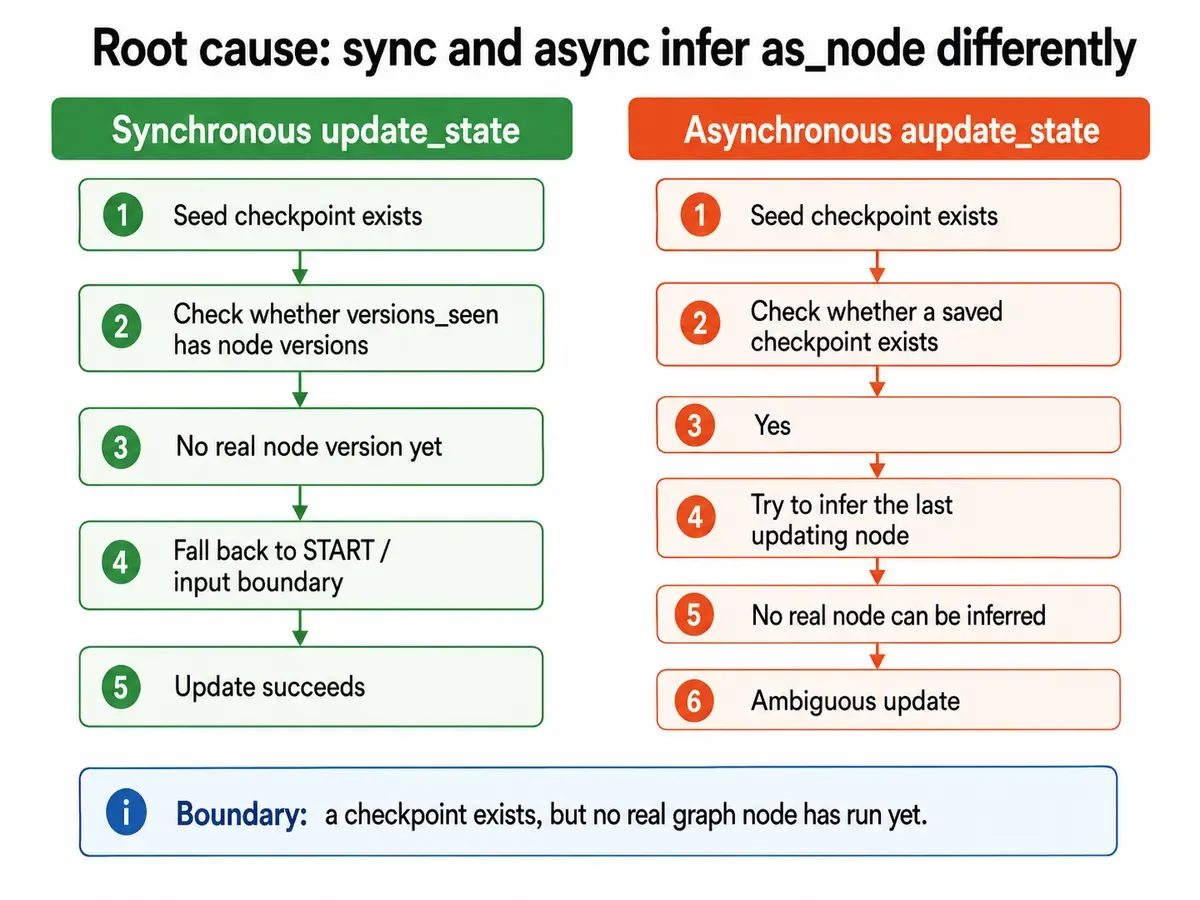
3. Root cause: node inference diverges between sync and async
The official LangGraph reference describes update_state and aupdate_state with the same conceptual contract: values are applied as if they came from as_node, and when as_node is omitted the graph may infer the last node that updated state when that inference is not ambiguous.
Issue #8714 exposes a narrow intermediate state:
- a checkpoint already exists;
- that checkpoint was created by a seed update using
as_node=START; - no real graph node such as
aorbhas run yet; - therefore the checkpoint exists while
versions_seendoes not contain a real node version that can act as the last updater.
Inspecting the installed 1.2.11 source shows different fallback tests. Simplified, they are:
sync:  no node version seen -> fall back to input / START
async: no saved checkpoint -> fall back to input / START
After the seed, a saved checkpoint exists but no real node version exists. The sync path still takes the input fallback. The async path skips it, searches for a last real node, finds none, and ends at InvalidUpdateError("Ambiguous update, specify as_node").
That is why the message can sound like multiple nodes are competing even though this reproduction has the opposite condition: there is no real node available to infer.
4. Tested containment: pass the correct as_node explicitly
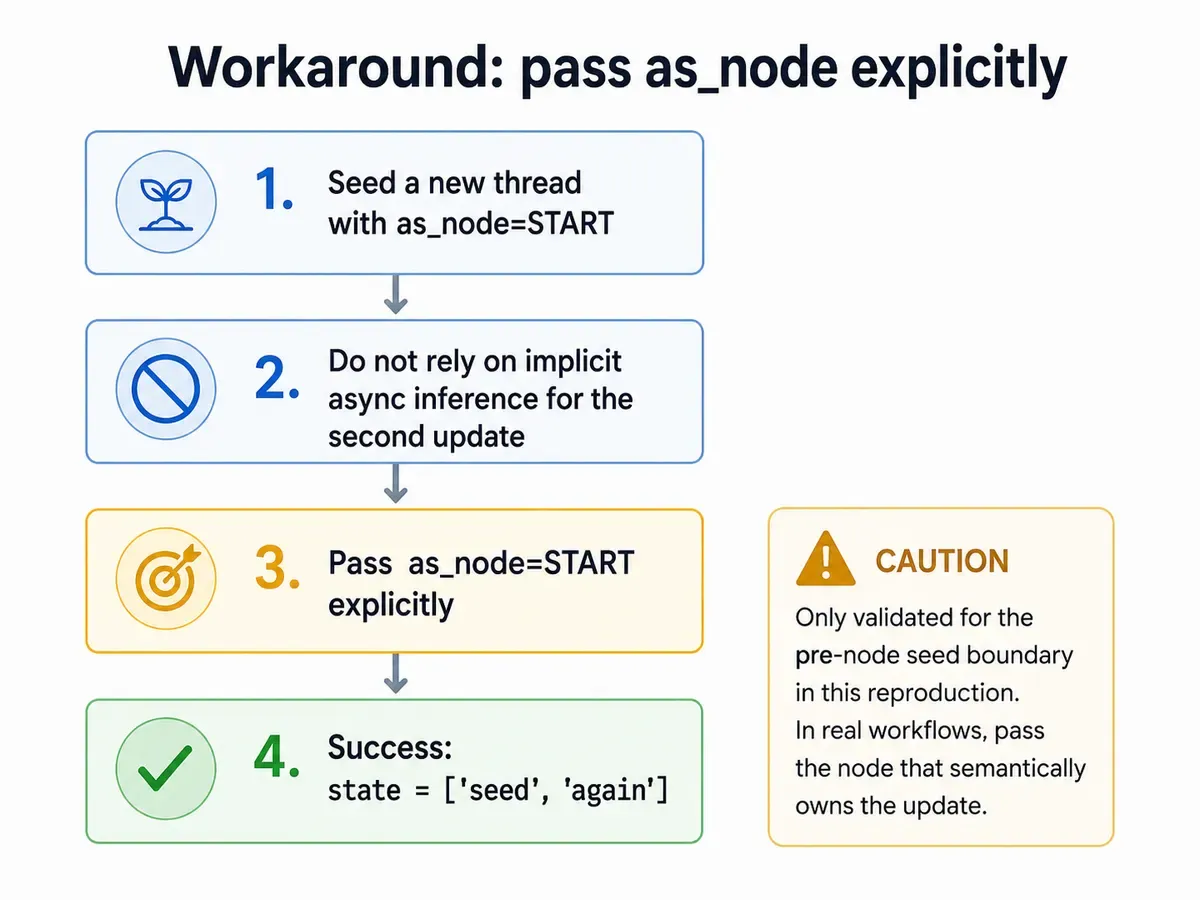
For the exact pre-node input-boundary sequence, make the second update explicit:
await app.aupdate_state(config, {"x": ["seed"]}, as_node=START)
config = await app.aupdate_state(
    config,
    {"x": ["again"]},
    as_node=START,
)
Verified output:
async explicit as_node=START: ok
async state: ['seed', 'again']
This matches the synchronous control, so START is a valid containment for the tested state lifecycle.
Do not mechanically change every aupdate_state call to as_node=START. as_node is not an error-suppression flag; it tells LangGraph where the external update sits in graph semantics. If an approval backend is applying a state change that semantically belongs to review, or a compensation service is writing as compensate, pass that actual node instead.
5. Why deleting the checkpoint is the wrong workaround
The reproduction uses a new InMemorySaver and a new thread_id. There is no database migration, stale Redis data, SQLite corruption, or concurrent worker.
Deleting the checkpoint may appear to help because the async path can re-enter its “no saved checkpoint” branch. But it also destroys durable state that the application intentionally created. In production, that is data loss used as a workaround for inference behavior.
A safer sequence is:
- confirm the thread is in the seeded-but-no-node-run boundary;
- decide which node owns the update;
- pass that
as_nodeexplicitly; - keep a regression test for the thread lifecycle;
- rerun the same matrix when upstream publishes a candidate fix before removing the explicit parameter.
6. How to tell whether your Ambiguous update is issue #8714
Check four conditions:
- you are calling Python LangGraph
aupdate_state; - the same values and thread succeed through synchronous
update_state; - the thread already received an explicit
as_node=STARTor equivalent input-boundary seed; - real graph nodes have not yet produced node versions that can be inferred as the last updater.
If those conditions do not hold, do not automatically label your error issue #8714. After parallel nodes have actually run, Ambiguous update may be legitimate: LangGraph really cannot know which node an external write should be attributed to. In that case explicit as_node is part of the correct API contract, not a bug workaround.
7. Regression matrix for the eventual upstream fix
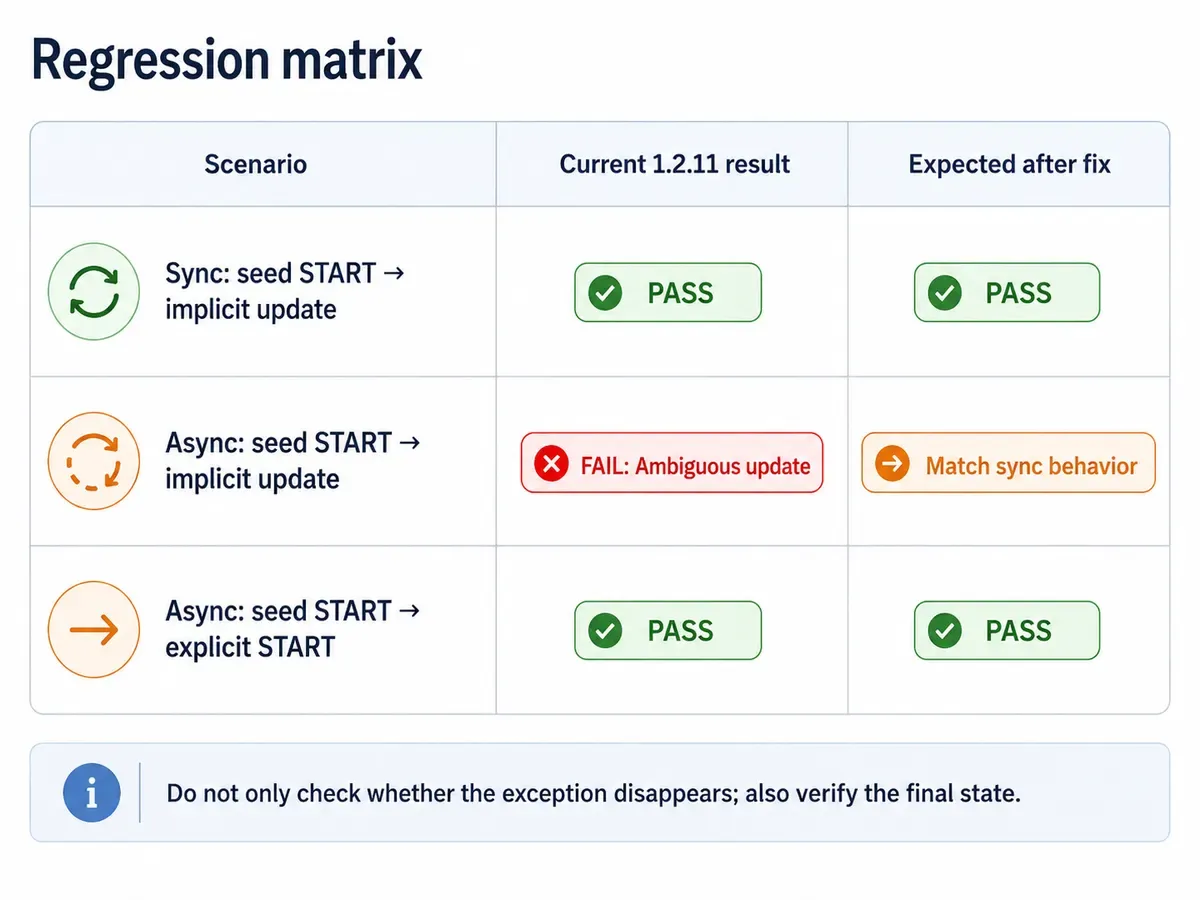
Do not upgrade and check only whether the exception disappears. Keep three controls:
| Scenario | 1.2.11 now | Expected after fix |
|---|---|---|
| Sync: seed START -> implicit update | PASS | PASS |
| Async: seed START -> implicit update | FAIL | Match sync behavior |
| Async: seed START -> explicit START | PASS | PASS |
Also assert the final state, not just the absence of an exception. This experiment uses ['seed', 'again'] as the minimum state invariant. A future change that stops raising but attributes the update to the wrong graph position would still fail the semantic regression test.
8. How this differs from Checkpointer and thread_id failures
This bug reproduces with InMemorySaver, so changing to SQLite, Redis, or Postgres is not the first response.
If your state disappears between requests, crosses users, or resumes from the wrong checkpoint, you are dealing with a different persistence or identity problem. Continue with LangGraph Checkpointer: Memory, SQLite, and Redis and LangGraph thread_id / session_id state isolation.
If the problem is pausing a graph for human approval and resuming after a decision, see LangGraph Human-in-the-Loop Approval. These topics all involve state, but their failure boundaries are different.
9. Current decision
As of August 26, 2026, the evidence supports these conclusions:
- upstream issue #8714 documents a mismatch between
update_stateandaupdate_stateafter a seeded checkpoint; - XBSTACK reproduced it on a second operating system with the same package versions;
- 1.2.11 is still the latest release visible through pip;
- installed source shows different sync/async fallback conditions for node inference;
- explicit
as_node=STARTrestores the synchronous result in the exact tested pre-node case; - there is no released upstream fix yet, so the explicit parameter remains a scoped workaround.
If your production Agent lets a web backend, approval service, or queue worker modify LangGraph state outside normal node execution, treat “which graph node owns this write?” as an explicit state contract. Depending entirely on automatic as_node inference creates an avoidable ambiguity boundary even after issue #8714 is fixed.
FAQ
Is every Ambiguous update, specify as_node error a LangGraph bug?
No. Parallel nodes, external state mutation, or multiple equally recent updater candidates can create real ambiguity. This page verifies only the issue #8714 boundary where a checkpoint exists, no real node version exists, sync inference succeeds, and async inference fails.
Will as_node=START affect later graph execution?
It can, because it changes how the update is attributed in graph state. It is correct in this test because both updates happen before real graph nodes execute. Do not copy it into later workflow stages without checking the intended node semantics.
Should I downgrade LangGraph?
There is no evidence here that an older version is the right long-term answer. Pin the current dependency, pass the correct explicit as_node, keep the regression test, and track the upstream issue and release notes.
Where is the minimal reproduction?
Inside this project: experiments/langgraph-aupdate-state-ambiguous-update-repro/. It contains the failing script, tested workaround, sanitized logs, and version matrix.
Related reading
- LangGraph Production Guides
- LangGraph Checkpointer: Memory, SQLite, and Redis
- LangGraph Human-in-the-Loop Approval
- LangGraph Agent Error Recovery, Timeout, and Retry
Continue through the production LangGraph learning path
The LangGraph hub organizes state isolation, checkpointing, human approval, retries, observability, supervisors, subgraphs and memory into one reviewable path.
Next step: make state and recovery explicit
Full decision path →Move from the current symptom to the next state, checkpoint, resume, or failure-recovery boundary.

DISCUSSION
Questions, verification and corrections
Sign in to comment. Every new comment is reviewed before publication; while pending, it is visible only to you and the administrator.