


Xiaobai
Developer · Builder
Building AI engineering systems, developer tools and long-term digital assets at XBSTACK.
About Xiaobai & XBSTACK →
Google ADK delete_session() Does Not Delete Long-Term Memory: 2.8.0/2.9.0 Reproduction
Why does Google ADK delete_session() remove the Session while data copied with add_session_to_memory() remains searchable? This offline reproduction covers 2.8.0 and 2.9.0, the API boundary, and production deletion design.
If you are implementing user-data deletion in Google ADK, there is an easy boundary to miss: delete_session() deletes a Session. It does not necessarily delete long-term data that was already copied into a MemoryService.
I reproduced that behavior locally on both google-adk==2.8.0 and 2.9.0. After deleting the Session, get_session() confirmed that it was gone, but the same unique marker that had been copied with add_session_to_memory() was still returned by search_memory().
This is not a stale model response or a remote cache. The reproduction makes no external model call. The retained content is the exact Session event that was explicitly copied into InMemoryMemoryService before the Session was deleted.
The short answer
The test matrix is intentionally small:
- Python 3.11+
google-adk==2.8.0google-adk==2.9.0InMemorySessionServiceInMemoryMemoryService- unique marker:
blue-orchid-260915 - fully offline, with no Gemini, OpenAI, or Vertex AI call
Both versions produced the same result:
| Version | Session after delete_session() | Memory found before delete | Memory found after delete | Callable BaseMemoryService delete method |
|---|---|---|---|---|
| 2.8.0 | deleted | yes | yes | 0 |
| 2.9.0 | deleted | yes | yes | 0 |
That means this call cannot be treated as proof that all user data associated with the Session has been deleted:
await session_service.delete_session(
    app_name=app_name,
    user_id=user_id,
    session_id=session_id,
)
It proves only that the Session layer completed its deletion. Long-term Memory, Artifacts, external vector stores, and application databases need their own deletion path and their own post-delete verification.
How I reproduced it
The reproduction keeps the path minimal. First, it creates a Session and appends a user event containing one unique marker:
Remember this marker: blue-orchid-260915
Next, it copies the Session into long-term Memory:
await memory_service.add_session_to_memory(session)
A call to search_memory() confirms that the marker is present before deletion. The script then calls delete_session() and checks get_session() to verify that the Session itself no longer exists.
Finally, it searches Memory again.
The important fields from both runs are equivalent to:
{
  "session_exists_after_delete": false,
  "memory_found_before_delete": true,
  "memory_found_after_delete": true,
  "base_memory_delete_methods": []
}
The complete minimal reproduction lives in the XBSTACK experiment asset with version-specific JSON logs. The evidence is not that one internal object happened to look unusual. Three assertions hold at the same time: the Session is gone, Memory existed before deletion, and the copied Memory still exists afterward.
Why this happens: Session and Memory have separate lifecycles
The key operation is add_session_to_memory().
Once an application gives Session content to a MemoryService, long-term Memory is no longer merely a view over the original Session. It has been copied into a separate persistence surface. Deleting the source Session therefore has no reason to erase the copy unless an explicit cascade has been implemented.
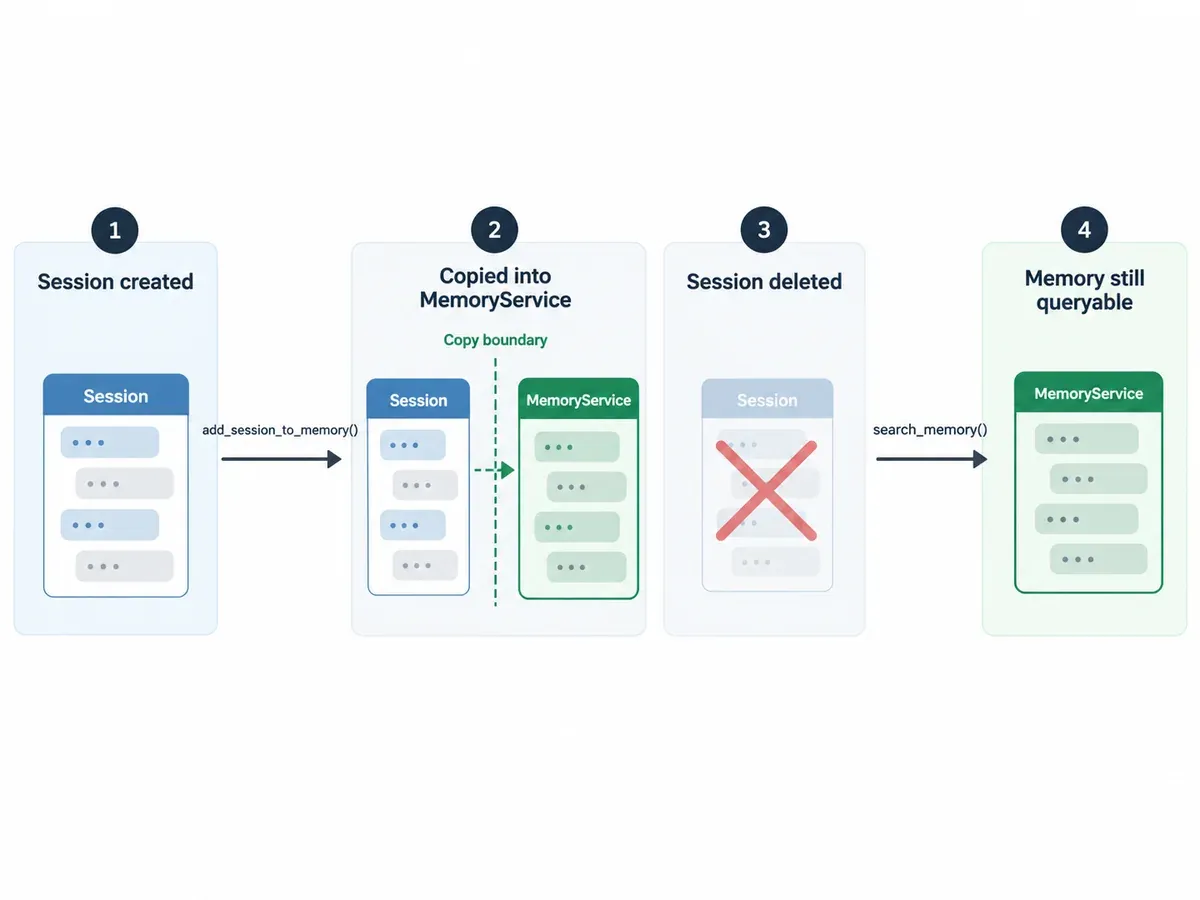
The public service surface reinforces that separation. In both 2.8.0 and 2.9.0, SessionService has a delete_session() operation, while the runtime inspection in this test found no callable delete* method on BaseMemoryService.
This is the same product-level gap described by upstream issue #6949: applications may have deletion paths for Sessions and Artifacts while still lacking a backend-independent Memory deletion API.
For a broader architecture view of long-term Agent Memory, user isolation, and forgetting mechanisms, see AI Agent Memory System. The important distinction here is narrower: a Memory lifecycle cannot be inferred from a Session lifecycle.
Why the issue resurfaced now
This boundary is not entirely new, but it became current again in September 2026.
Upstream issue #6949, opened on August 30, points out that BaseMemoryService has no deletion operation analogous to Session and Artifact deletion. On September 13, issue #7110 restated the problem as a concrete failure shape: copy a Session into Memory, delete the Session, and the long-term Memory remains.
Those issues are external problem evidence. The conclusion in this article does not rely only on their text: XBSTACK reran the behavior locally against both 2.8.0 and 2.9.0.
Why this matters for account deletion and privacy controls
If Memory is only a disposable developer aid, the problem may stay invisible for a while. It becomes a production concern as soon as the product offers operations such as:
- delete one conversation;
- clear chat history;
- clear AI memory;
- close an account;
- export and delete user data;
- enforce enterprise retention rules;
- remove a departed user from a multi-tenant workspace.
The dangerous implementation is a UI that calls delete_session() and immediately tells the user that the data has been deleted. At least for the in-memory implementation reproduced here, that statement would be false for the Memory layer.
A safer design is an explicit deletion ledger:
| Persistence surface | Deletion operation | Post-delete verification |
|---|---|---|
| Session | delete_session() | get_session() returns no Session |
| Long-term Memory | backend-specific deletion | search_memory() no longer returns the user’s marker or id |
| Artifacts | ArtifactService deletion | read returns not found |
| External vector store | delete by user/tenant/id | query returns zero matches |
| Application database | transaction / soft-delete / hard-delete policy | business query verifies final state |
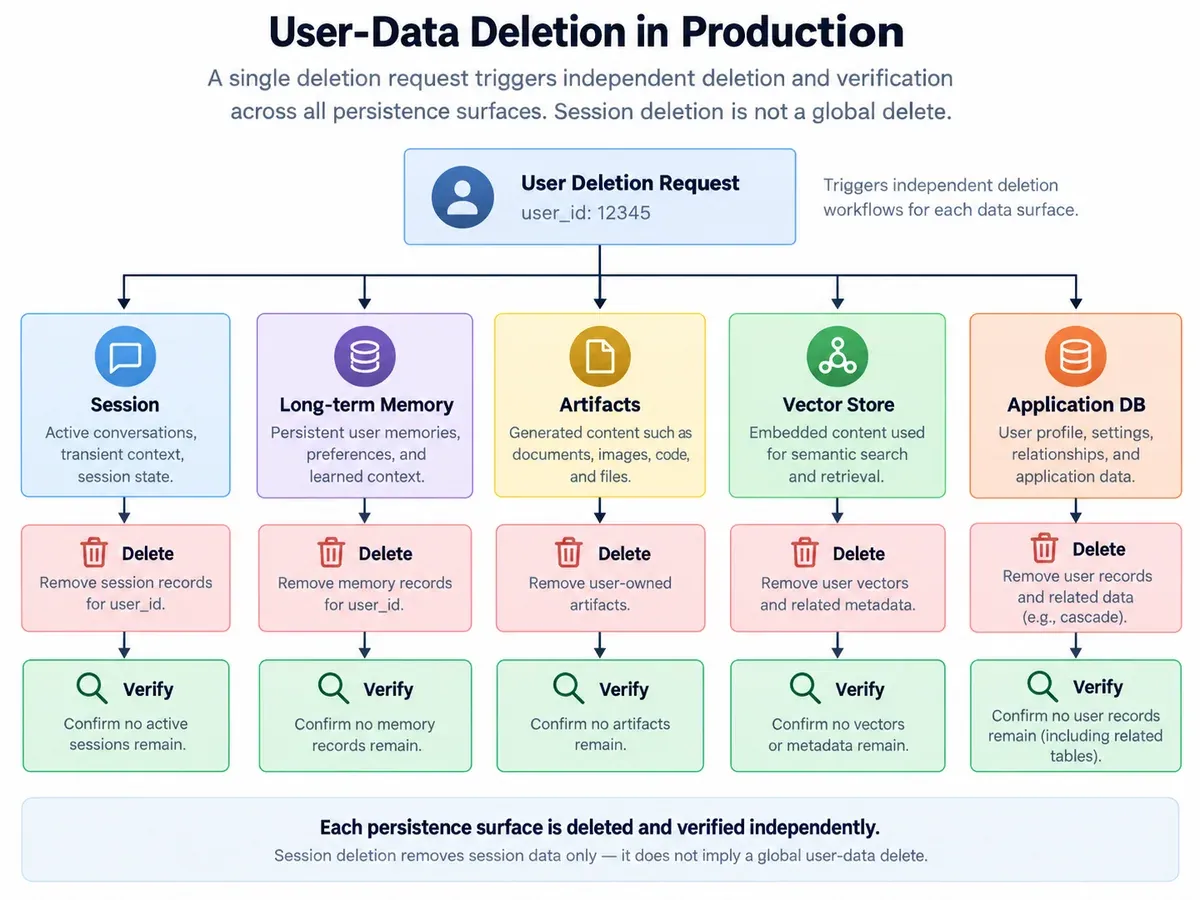
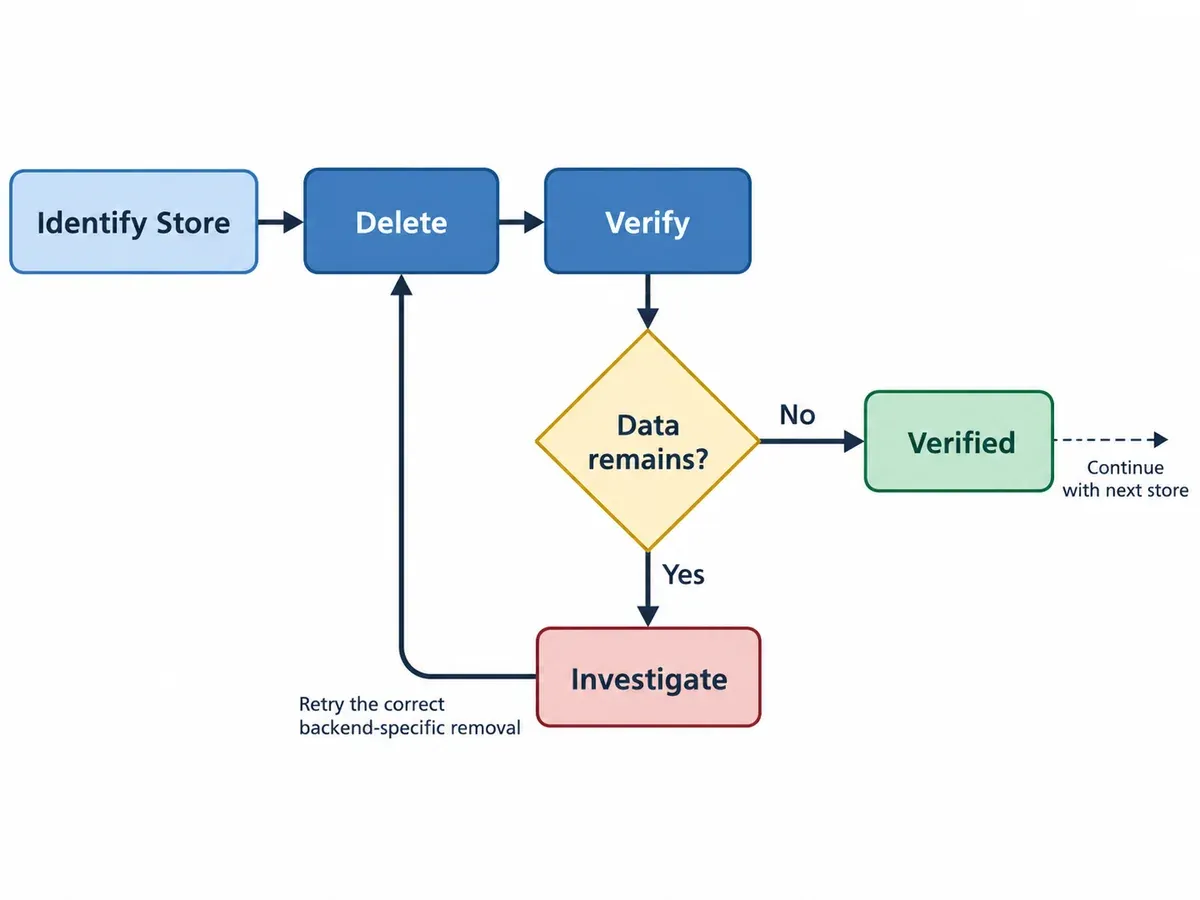
Deletion and verification belong together. Sending a delete request without a read-back or query verification is not enough to prove the final data state.
What can you do now?
The answer is not to call delete_session() twice. It depends on the Memory backend you actually use.
For a custom MemoryService, design a concrete deletion key in the backing store, such as user_id + memory_id, a tenant namespace, or another index that can reliably remove all long-term data for one user. The deletion should also be auditable.
For a managed Memory backend, check whether that backend exposes its own deletion API and use it directly. Do not wait for SessionService to cascade unless the backend contract explicitly guarantees that behavior.
If the chosen MemoryService has no deletion capability at all while your product promises user-data deletion, the safest engineering decision is simple: do not ingest data that must later be deletable into that backend, or choose a backend with verifiable deletion.
This is also the kind of production criterion that belongs in an Agent framework comparison. XBSTACK’s AI Agent framework comparison already treats resume, state persistence, and idempotency as operational concerns; Memory deletion should be evaluated the same way rather than as a feature checkbox.
Do not overgeneralize this into “Google ADK cannot delete data”
That would go beyond the evidence.
I did not test VertexAiMemoryBankService, and I did not provision managed infrastructure. Different MemoryService implementations may expose backend-specific deletion capabilities even though BaseMemoryService does not provide one common interface in the versions tested here.
The reproduction also does not prove that future versions will behave the same way. The 2.8.0/2.9.0 version matrix exists so that each future ADK upgrade can be retested. If a public delete API is added, or an explicit cascade contract appears, the current assertions should fail and this page should be updated.
Do not mix this with Google ADK resume bugs
XBSTACK already has a separate Google ADK state_delta and A2A resume reproduction. That page covers state updates during resumable Runner.run_async() calls and an A2A human-approval message-conversion boundary.
The search intent here is different:
- the state-delta page answers “why was my state not persisted when I resumed an Agent?”;
- this page answers “why is long-term Memory still present after I deleted the Session?”
They belong to the same Google ADK production cluster, but they require different reproductions and different production fixes.
Production recommendation
If your application already uses Google ADK long-term Memory, make three changes.
First, remove delete_session() from any implementation that labels it as a complete user-data deletion operation. Treat it as Session deletion only.
Second, add an independent deletion path and post-delete verification for the actual MemoryService you deploy, especially for account closure, clear-memory controls, and multi-tenant retention requirements.
Third, keep this reproduction in your upgrade regression suite. For every google-adk upgrade, re-run the Session deletion assertion, Memory search assertion, and public delete-API inspection instead of inferring lifecycle behavior from release notes.
As of September 15, 2026, the result is the same on the two versions tested here: deleting a Session is not the same operation as deleting long-term Memory.
References and reproduction sources
- google/adk-python issue #6949: No way to delete memories from a MemoryService
- google/adk-python issue #7110: Memory has no removal path
- Google ADK Python repository
Continue from one agent pattern to the complete production system
The AI Agent hub organizes architecture, memory, tool use, evaluation, security, deployment and multi-agent coordination into a single learning path.
More to Explore
Topic hub →AI Engineering Weekly
Production changes, real failures, experiments and new XBSTACK assets.

DISCUSSION
Questions, verification and corrections
Sign in to comment. Every new comment is reviewed before publication; while pending, it is visible only to you and the administrator.